

Most local service businesses are still playing by rules that search engines rewrote two years ago. You’ve got a decent website, a Google Business Profile, and a handful of reviews. That used to be enough. It isn’t anymore. AI-powered search tools and generative assistants now decide who gets recommended, and they use a completely different playbook. The stakes are real: AI-ready SMB sites earn 3.2x more traffic than traditional sites, while local AI visibility is 3 to 30 times harder to achieve than a Google 3-pack spot. This article breaks down exactly what’s changed and what you need to do about it.
Table of Contents
- Why AI is changing the SEO landscape for local businesses
- The essential pillars of AI-driven local SEO
- How to align your content for AI and generative engines
- Pitfalls, limitations, and edge cases to watch in 2026
- Why hybrid human-AI strategy wins for local SEO
- Elevate your local SEO with the right AI partner
- Frequently asked questions
Key Takeaways
| Point | Details |
|---|---|
| AI-ready sites win big | Local businesses optimized for AI see up to 3x more traffic than those using old SEO tactics. |
| Google rank isn’t enough | AI assistants use different criteria than Google for recommending local businesses. |
| Review sentiment is critical | AI platforms value positive, authentic reviews over quantity alone. |
| Diversify content platforms | Include profiles, reviews, and content on YouTube and Reddit to broaden AI visibility. |
| Hybrid strategy works best | Combining human expertise and AI tools greatly increases successful local SEO outcomes. |
Why AI is changing the SEO landscape for local businesses
Traditional SEO was a fairly predictable game. You optimized your website for keywords, built some backlinks, and hoped Google put you in the local 3-pack. That 3-pack still matters, but it’s no longer the primary door through which customers find local services. AI assistants, voice search tools, and generative search engines are stepping in front of that door.
Here’s the shift that catches most business owners off guard: AI doesn’t browse your website the way a human does. It scans for structured signals, cross-references your presence across multiple platforms, and evaluates your credibility based on what others say about you, not just what you say about yourself.
“AI won’t make websites obsolete, but it fundamentally shifts the game toward a hybrid human-AI model where earned authority and structured signals matter more than on-page keyword density.”
The numbers confirm the urgency. Local AI visibility is 3 to 30 times harder to achieve than a Google 3-pack ranking, with AI assistants recommending local businesses at only a 1 to 11 percent rate compared to Google’s 36 percent. That’s a massive gap. And while websites remain essential according to Google, the criteria for what makes a site “AI-ready” goes far beyond good page speed and clean code.
Key shifts every local business owner needs to understand:
- AI recommendation engines select businesses based on entity consistency, review sentiment, and multi-platform credibility
- The Google 3-pack is one signal among many, not the finish line
- AI assistants often pull recommendations from sources entirely separate from Google’s local index
- Businesses with structured data, rich profiles, and authentic reviews get surfaced far more often
- Voice and generative search favor concise, authoritative answers over keyword-stuffed pages
The opportunity is real, but only for businesses willing to adapt. The ones still chasing keyword rankings alone are leaving enormous visibility on the table.
The essential pillars of AI-driven local SEO
Understanding the new rules is step one. Applying them is where most businesses stall. Let’s break down the four pillars that determine whether AI tools recommend your business or skip right past it.
1. Google Business Profile optimization
Your Google Business Profile (GBP) is no longer just a listing. It’s a structured data source that AI tools actively query. Businesses that fully optimize their GBP see a 35 percent higher weight in AI-driven local results. That means completing every single field: business category, service areas, hours, photos, Q&A sections, and service descriptions. Leaving any field blank is a missed signal.

2. Review sentiment over review volume
This is the one that surprises most business owners. AI tools don’t just count your reviews. They analyze the language inside them. A business with 50 reviews averaging 4.6 stars with detailed, specific feedback will outperform a competitor with 200 reviews averaging 3.8 stars in AI recommendations. The sentiment analysis looks for keywords that match user intent, mentions of specific services, and the authenticity of the language used.
3. Citation management across directories
Managing citations across 50 or more directories sounds overwhelming, but it’s non-negotiable for AI visibility. Inconsistent name, address, and phone number (NAP) data across platforms confuses AI systems and lowers your credibility score. Tools like BrightLocal or Whitespark can automate much of this, but the strategy needs to be intentional.
4. Schema markup and entity consistency
Schema markup is structured code you add to your website that tells AI systems exactly what your business does, where it operates, and who it serves. Entity consistency means your business is described in the same way across your website, GBP, social profiles, and directories. AI tools cross-reference all of these to build a “confidence score” around your business identity.
| Factor | Traditional SEO weight | AI-driven SEO weight |
|---|---|---|
| Keyword density | High | Low |
| Review sentiment | Low | Very high |
| Schema markup | Optional | Essential |
| Citation consistency | Moderate | Critical |
| Earned media mentions | Low | Very high |
| GBP completeness | Moderate | High (35% boost) |
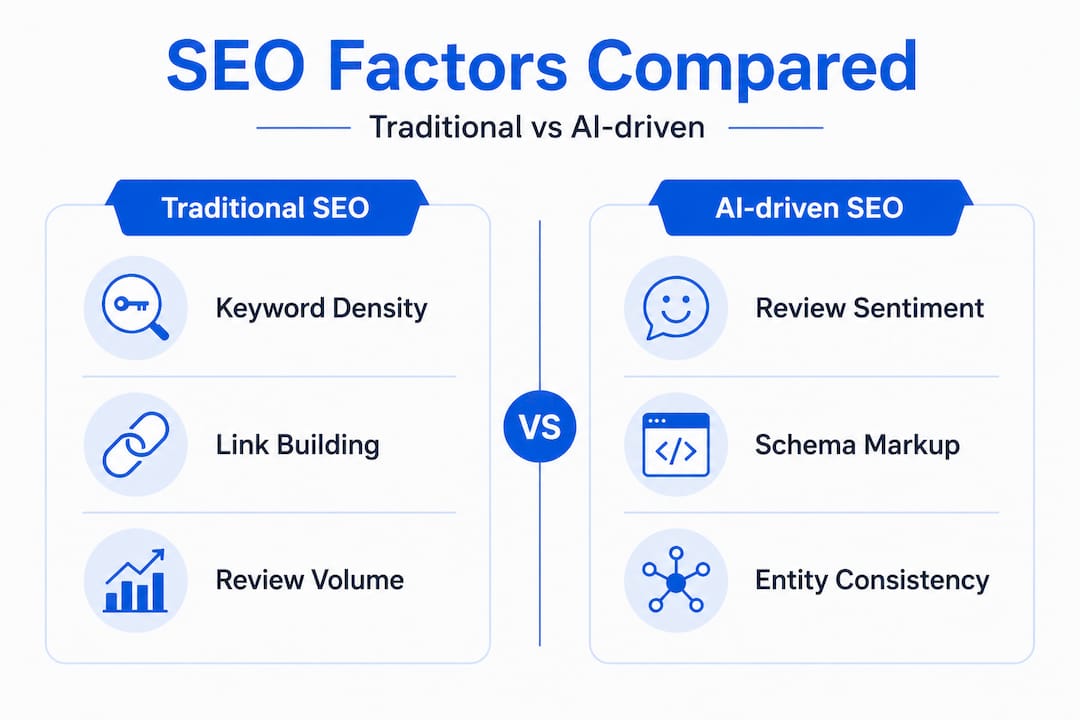
Pro Tip: Run a quick NAP audit right now. Google your business name and check the top 10 results. If your address, phone number, or business name appears differently across listings, that inconsistency is actively hurting your AI visibility score.
How to align your content for AI and generative engines
With your core pillars in place, the next step is making sure your content meets the specific criteria AI tools use when deciding which businesses to recommend. This goes beyond writing blog posts. It’s about creating content that AI systems can easily parse, trust, and cite.
AI generative engines don’t search for keywords the way Google’s traditional algorithm did. They look for semantic relevance, meaning your content needs to answer real questions in natural language, not just repeat a phrase 15 times. For local service businesses, this means writing content that addresses the specific problems your customers face in your service area, using the language they actually use.
Practical steps to make your content AI-friendly:
- Use clear H2 and H3 headings that mirror real questions your customers ask
- Write concise paragraphs (3 to 4 sentences max) so AI tools can extract answers cleanly
- Include location-specific details, neighborhood names, local landmarks, and regional context
- Add FAQ sections to every service page, structured with schema markup
- Create content that answers “who, what, where, when, why, and how” for your core services
Platform diversity is also critical. Entity consistency across platforms including your NAP data and schema signals is one of the strongest predictors of AI recommendation. But beyond consistency, you need to be present where AI tools retrieve information. YouTube videos, Reddit threads, and industry forums are increasingly used as retrieval sources by generative AI systems.
| Content type | AI retrieval potential | Effort level |
|---|---|---|
| Service page with FAQ schema | Very high | Medium |
| YouTube how-to video | High | Medium |
| Reddit community answer | High | Low |
| Blog post with local context | Medium-high | Medium |
| Social media post (no schema) | Low | Low |
| Generic keyword article | Very low | Medium |
The data is clear: AI favors businesses with 4.3 or higher star sentiment, hyperlocal proof points, and content that demonstrates genuine expertise. Pure AI-generated content without human editing and local context consistently underperforms.
Pro Tip: Add a “Neighborhoods we serve” section to your homepage and each service page. List specific areas, zip codes, and nearby landmarks. This hyperlocal content is exactly what AI tools scan for when matching a user’s location-based query to a business recommendation.
Pitfalls, limitations, and edge cases to watch in 2026
The opportunities in AI-driven local SEO are significant, but the pitfalls are just as real. Several businesses have made costly mistakes by misunderstanding how AI systems actually work, and 2026 has brought some sharp updates that make these mistakes more expensive than ever.
The most dangerous assumption is that ranking well in Google automatically means you’ll be recommended by AI assistants. It doesn’t. Local overlap between Google and AI results is only 0 to 20 percent. That means a business sitting comfortably in the Google 3-pack could be almost invisible to users asking ChatGPT, Perplexity, or Google’s AI Overviews for a local service recommendation. These are two separate visibility battles.
Common pitfalls to avoid:
- Scaled AI content: Publishing large volumes of AI-generated articles without human editing or local context. Scaled AI content is now penalized in 2026 algorithm updates, and the penalties can be severe
- Ignoring earned media: AI systems heavily favor third-party mentions, press coverage, and community citations over content you publish on your own site
- Treating GEO like traditional SEO: Generative Engine Optimization (GEO) requires a focus on scannability and earned authority, not just on-page signals
- Over-relying on one platform: Businesses that only optimize for Google are missing the growing share of queries handled by AI assistants that pull from entirely different data sources
- Neglecting review responses: AI tools analyze your responses to reviews as a signal of engagement and authenticity
“High Google rankings help, but they’re no longer sufficient. GEO requires earned authority and scannability that traditional SEO never demanded.”
The GEO approach (Generative Engine Optimization) is the framework that addresses these gaps. It focuses on making your content easy for AI systems to scan and extract, building authority through third-party sources, and ensuring your business entity is recognized consistently across the web. For niche local businesses, this earned authority approach often outperforms broad keyword strategies. You can explore AI-enabled SEO case studies to see how businesses in competitive local markets have applied these principles with measurable results.
Why hybrid human-AI strategy wins for local SEO
Here’s the contrarian view most AI SEO content won’t give you: pure automation loses. Every tool, every platform, and every vendor in this space will tell you that AI can handle your SEO. Some of it is true. AI can research keywords faster, generate content outlines, and identify citation gaps at scale. But the businesses seeing the biggest visibility gains in 2026 aren’t the ones that handed everything to an AI tool. They’re the ones that use AI for efficiency and humans for judgment.
Local service businesses have a natural advantage that pure AI content can never replicate: genuine local stories, real customer relationships, and specific knowledge of their community. A plumber in Austin who writes about the unique water quality issues in their neighborhood, references local building codes, and shares a story about a tricky job in a specific zip code is creating content that no AI tool can fabricate convincingly. And AI recommendation engines are getting better at detecting that authenticity gap.
The hybrid human-AI model consistently outperforms pure AI execution because it combines the speed and structure of AI with the context and credibility that only humans can provide. Customers who find you through an AI recommendation still need to trust you before they call. That trust comes from the human elements: real photos, specific local references, genuine review responses, and content that sounds like a real expert wrote it.
The businesses winning in local AI SEO right now are doing something deceptively simple. They’re using AI tools to handle the repetitive, structural work, and then layering in human expertise to make the content genuinely useful and locally relevant. The success stories of local AI SEO all share this pattern. It’s not about choosing between human and AI. It’s about knowing which jobs belong to which.
Elevate your local SEO with the right AI partner
Implementing everything covered in this article takes time, expertise, and a consistent system. Most local service business owners are already stretched thin running their actual business. That’s exactly where a done-for-you approach changes the equation.
MySearchHero is built for local businesses that want the full benefit of AI-driven SEO without spending hours managing it themselves. Each month, your local AI SEO expertise is put to work through a fully automated pipeline that delivers published articles, backlinks, Reddit mentions, and AI-optimized social media posts. Everything is structured for AI scannability, entity consistency, and multi-platform credibility. You get the visibility gains without the manual grind. Your marketing runs on autopilot while you focus on serving your customers.
Frequently asked questions
How is AI changing local SEO strategy in 2026?
AI prioritizes factors like review sentiment, entity consistency, and earned media well beyond just website rankings. Local businesses must optimize their GBP completely, manage citations across 50 or more directories, and focus on review sentiment analysis to be recommended by AI tools.
Does having a high Google ranking mean my business will be AI-recommended?
No, traditional Google rankings and AI recommendations are largely separate. Local overlap between Google and AI results is only 0 to 20 percent, meaning additional optimization steps are required to appear in AI-driven recommendations.
What type of reviews matter most to AI search engines?
Sentiment and authenticity matter far more than total review count. AI favors businesses with 4.3 or higher star sentiment and hyperlocal proof points embedded in the review language itself.
Can AI-generated content hurt my SEO?
Yes. Publishing large volumes of unedited AI-generated content can trigger penalties. Scaled AI content is penalized in 2026 updates, particularly when it lacks semantic value, local context, and genuine expertise signals.
What’s GEO in the context of local SEO?
GEO stands for Generative Engine Optimization. It focuses on making your content easily scannable and authoritative for AI discovery. GEO prioritizes scannability and earned authority over traditional keyword tactics, especially for niche local businesses competing for AI-driven recommendations.