
TL;DR:
- Over 70% of consumers trust brand mentions more than traditional ads, making organic references a vital growth tool.
- Proactively generating and managing mentions, especially positive reviews, can strengthen reputation and improve local SEO significantly.
Most small service-based businesses pour their budgets into paid ads and wonder why growth feels slow. Here’s the counterintuitive reality: over 70% of consumers trust brand mentions more than traditional ads. A brand mention is any time your business name, service, or location gets referenced online, whether in a Google review, a Reddit thread, a local blog, or a news feature. These organic references carry more weight than a polished ad because they come from real people. This article shows you exactly how to find, manage, and grow those mentions so they work for your business around the clock.
Table of Contents
- What are brand mentions and why do they matter?
- How brand mentions impact reputation and risk
- Brand mentions vs. traditional advertising: what works best?
- Practical strategies: using brand mentions to grow your business
- A new way to think about brand mentions
- Get started with better brand mention strategies
- Frequently asked questions
Key Takeaways
| Point | Details |
|---|---|
| Brand mentions build trust | Consumers trust brand mentions more than traditional ads, helping strengthen reputation and customer relationships. |
| Quick responses matter | Responding to negative mentions within a day can reduce customer churn and improve perception. |
| Mentions outperform ads | Brand mentions often deliver greater ROI and long-term value compared to repeat ad spending. |
| Monitor and act strategically | Active tracking and integration with customer management tools lifts conversion rates and reduces risks. |
| Actionable strategies drive growth | Request reviews, monitor online chatter, and quickly respond to maximize the effect of every brand mention. |
What are brand mentions and why do they matter?
Brand mentions are any online references to your business. That includes your business name, your service category, your location, or even a description that points clearly to you. They show up across review platforms, social media, industry blogs, local news sites, and community forums. For a small service-based business, every mention is a signal to potential customers and to search engines.
There are two primary types of mentions worth knowing. Direct mentions use your actual business name, for example, “I hired [Your Business Name] for my roof repair and they were fantastic.” Indirect mentions reference your service or location without naming you specifically, for example, “the best plumber in Austin fixed my leak last week.” Both types influence how people discover and perceive your business. Indirect mentions are often overlooked, but they can still drive traffic and build local authority.
Mentions also break down by sentiment. Positive mentions build credibility and attract new customers. Negative mentions, if left unaddressed, erode trust fast. Neutral mentions, like a simple listing in a local directory, still contribute to your online footprint and local SEO (search engine optimization, which is how Google decides where to rank your business).
“Over 70% of consumers trust brand mentions more than traditional ads, enhancing reputation and sentiment analysis for early risk detection.” — Search Engine Land
The channels where mentions happen matter too. Here are the key places your business gets talked about:
- Google Business Profile reviews (the highest-impact channel for local service businesses)
- Yelp and industry-specific review sites like Houzz, Angi, or Healthgrades
- Facebook and Instagram comments and community group posts
- Reddit threads and local subreddits
- Industry blogs and news features
- YouTube video comments and podcast shoutouts
- Local news websites and neighborhood apps like Nextdoor
Research on branded products and brand recall shows that repeated exposure to your brand name, across any medium, strengthens recognition and trust. The same principle applies online. Every mention is a small deposit into your credibility account. Using brand mention tracking tools helps you stay on top of where those deposits are landing.
How brand mentions impact reputation and risk
A single negative review left unanswered can cost you more than the customer who wrote it. Potential clients read reviews before making decisions, and silence signals that you either don’t care or aren’t paying attention. On the flip side, a well-handled negative mention can actually increase trust. Customers understand that problems happen. What they want to see is that you respond professionally and fix things.

The data here is striking. Responding to negative mentions within 24 hours can reduce customer churn by 15%, while integrating mention monitoring with your CRM (customer relationship management software) can boost lead conversion rates by 10 to 15%. That’s not a marginal improvement. For a service business generating $200,000 a year, a 10% lift in conversions is $20,000 in additional revenue.
Here’s a quick look at how response time affects your business outcomes:
| Response scenario | Customer churn impact | Trust perception | Lead conversion effect |
|---|---|---|---|
| Response within 24 hours | Reduced by up to 15% | Significantly higher | Increased by 10 to 15% |
| Response within 48 to 72 hours | Minimal reduction | Moderate | Slight improvement |
| No response at all | Increased by up to 25% | Damaged | Negative impact |
| Response with solution offered | Reduced by up to 20% | Highest | Maximized |
Beyond individual reviews, tracking the overall trend of your mentions gives you early warning signals. If you suddenly see a spike in negative comments about your response times, that’s a pattern you can address before it becomes a public relations problem. Sentiment monitoring (tracking whether mentions are positive, negative, or neutral over time) is one of the most underused tools in small business marketing.
Pro Tip: Set up a free Google Alert for your business name today. It takes two minutes and sends you an email every time your business gets mentioned online. Pair it with brand mention tracking solutions for a more complete picture across social media and review platforms.
Brand mentions vs. traditional advertising: what works best?
Paid advertising has its place. It delivers fast visibility and can target specific audiences with precision. But for small service-based businesses with limited budgets, the long-term math often favors organic brand mentions. Here’s a direct comparison:

| Factor | Brand mentions | Traditional paid ads |
|---|---|---|
| Consumer trust level | Over 70% trust mentions more | Lower trust, seen as self-promotional |
| Cost over time | Low to zero ongoing cost | Continuous spend required |
| Lifespan of impact | Permanent (reviews stay live) | Ends when budget stops |
| Conversion rate | Higher due to peer validation | Lower without strong social proof |
| SEO benefit | Directly boosts local rankings | Minimal direct SEO impact |
| Scalability | Grows organically with effort | Scales only with more budget |
The brand recall ROI study reinforces this point: repeated organic exposure to your brand name builds deeper recall than paid placements, often at a fraction of the cost. Ads create awareness. Mentions create belief.
That said, the smartest approach isn’t either-or. Here’s how to combine both for maximum effect:
- Run targeted ads to generate initial visibility. Use paid search or social ads to get your business in front of new audiences who haven’t heard of you yet.
- Deliver exceptional service to earn organic mentions. Every satisfied customer is a potential mention. Make it easy for them to leave a review by sending a follow-up message with a direct link.
- Amplify positive mentions in your ad creative. Screenshot a glowing review and turn it into a Facebook ad. Real words from real customers outperform generic ad copy every time.
- Monitor mentions to refine your ad targeting. If mentions show that customers love your speed, lead with that in your ads. Let organic feedback shape your paid messaging.
- Reduce ad spend gradually as mention volume grows. As your review count and online mentions build, organic discovery increases. You can scale back paid spend without losing visibility.
This cycle creates a compounding effect. Ads bring in customers. Happy customers leave mentions. Mentions attract more customers. Over time, your reliance on paid advertising decreases while your organic reach grows.
Practical strategies: using brand mentions to grow your business
Knowing the theory is one thing. Putting it into practice as a busy business owner is another. Here’s how to build a mention strategy that doesn’t require hours of your week.
Start by making it easy to get mentioned. After completing a job, send a short follow-up text or email. Something like: “Thanks for trusting us with your project. If you’re happy with the work, a quick Google review would mean a lot to us.” Include a direct link to your review page. Remove every possible barrier between a satisfied customer and a published review.
Use monitoring tools that do the heavy lifting. Free tools like Google Alerts cover basic web mentions. Platforms like Mention, Brand24, or the automated tracking built into brand mention tracking tools go further by scanning social media, forums, and news sites in real time. For a busy owner, automation here is not optional. It’s essential.
Respond to every mention, positive and negative. Thank customers who leave positive reviews. It takes 30 seconds and shows that you’re engaged. For negative mentions, respond calmly, acknowledge the issue, and offer a resolution. Never argue publicly. Your response is as much for future readers as it is for the person who wrote the review.
Connect your mention data to your CRM. When you know which mentions are driving inquiries, you can follow up faster and more effectively. Integrating mentions with CRM boosts lead conversion by 10 to 15%, which is a measurable return on a relatively small operational investment.
Here’s a simple starter checklist for busy owners:
- Set up Google Alerts for your business name and top services
- Add a review request to your post-service follow-up process
- Check your Google Business Profile reviews every Monday morning
- Respond to any new review within 24 hours
- Save positive mentions to use in your social media content
- Log recurring complaints as operational improvement opportunities
Pro Tip: Ask your best customers to mention a specific service or location in their review. Instead of “great company,” a review that says “best HVAC repair in downtown Denver” does double duty: it builds trust and boosts your local SEO for that specific search term.
A new way to think about brand mentions
Most business owners treat brand mentions as a side effect of doing good work. Something that happens to you, not something you build. That mindset leaves enormous growth potential sitting on the table.
Here’s the contrarian view we’ve developed working with service-based businesses: brand mentions are not a reputational bonus. They are a foundational growth asset, and they deserve the same strategic attention you give to your pricing, your hiring, or your advertising budget.
Think about what a single five-star review on Google actually does. It stays live indefinitely. It influences every potential customer who searches for your service in your area. It contributes to your local search ranking. It costs you nothing after the initial service delivery. No ad you can buy does all four of those things simultaneously.
We’ve seen local owners make a simple shift: instead of waiting for mentions to appear, they started treating every completed job as a mention opportunity. One cleaning service owner in Phoenix began texting a review link to every client within an hour of finishing a job. Within three months, her Google review count went from 12 to 94. Her organic search traffic doubled. She reduced her Facebook ad spend by 40% and maintained the same lead volume.
The challenge for most owners is the passive mindset. They assume that if their work is good, the mentions will come. Sometimes they do. But a proactive approach, one that treats each customer interaction as a chance to generate a lasting public endorsement, accelerates results dramatically.
Brand mentions are also future-proof in a way that paid ads are not. Ad costs on Google and Meta have risen significantly over the past five years, and algorithm changes can wipe out your visibility overnight. A library of authentic reviews and organic mentions is an asset that no platform update can take from you. It compounds over time and gets more valuable the longer you build it.
The mindset shift is simple but powerful: stop seeing mentions as something that happens after the work is done, and start seeing them as part of the work itself.
Get started with better brand mention strategies
Building a strong base of brand mentions takes consistency, but it doesn’t have to take hours of your time each week. The strategies in this article, from setting up monitoring alerts to connecting mentions with your CRM, are all manageable steps that deliver real, measurable results.
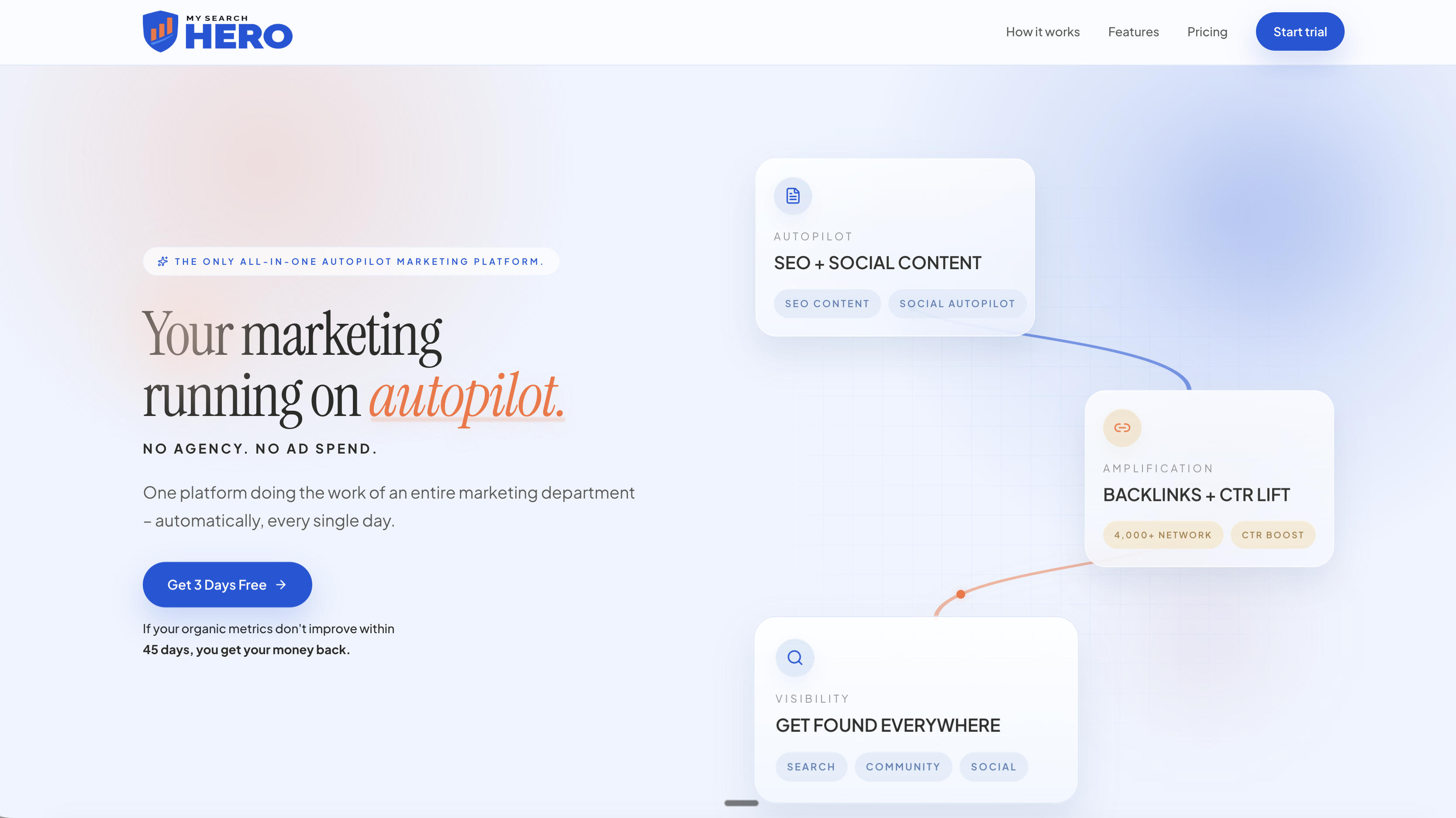
At MySearchHero, we handle the heavy lifting for you. Our done-for-you marketing service pushes out published articles, backlinks, Reddit mentions, and social media posts every month through a fully automated pipeline. Your mentions grow on autopilot while you focus on running your business. If you’re ready to stop relying solely on paid ads and start building an online presence that compounds over time, explore what My Search Hero tools can do for your business today.
Frequently asked questions
How do I measure the impact of brand mentions on my business?
Track website traffic spikes, new review activity, and inbound leads in the week following a major mention to see direct results. A simple weekly log of these metrics will reveal clear patterns over time.
Should I respond to every brand mention?
Yes, respond to both positive and negative mentions, ideally within 24 hours. Responding within 24 hours can reduce customer churn by 15% and signals to potential clients that you’re attentive and professional.
How do brand mentions affect my Google ranking?
Consistent positive mentions build local SEO authority and relevance, which directly influences where you appear in Google search results. Over 70% of consumers trust these organic signals, and Google’s algorithm reflects that same preference.
What if I get a negative brand mention?
Respond quickly, acknowledge the concern, and offer a clear solution without arguing publicly. A timely response to negative feedback can reduce churn by up to 15% and often turns a dissatisfied customer into a loyal one.
Is investing in brand mentions better than paid ads?
For service-based businesses, brand mentions deliver higher trust, longer-lasting impact, and lower ongoing cost compared to paid ads, making them a smarter long-term investment for most budgets.