
TL;DR:
- Personalization prioritizes hero headlines, primary calls-to-action, and top product blocks for maximum impact. It combines segmentation, behavioral, AI-driven, and dynamic techniques to tailor content efficiently. Start small with three to five segments, and focus on fast, high-impact changes before expanding.
Content personalization is defined as the practice of tailoring digital content to individual users based on their behavior, demographics, or intent signals. The three highest-impact ways to personalize content focus on hero headlines, primary calls-to-action, and top product or service blocks, since these elements drive the majority of first-impression conversions. Marketers who prioritize these three elements first see faster returns than those who try to personalize everything at once. The industry term for this discipline is “dynamic content personalization,” and it spans techniques from simple rule-based segmentation to AI-driven predictive models.

1. What are the top ways to personalize content?
Segmentation-based personalization is the foundation of every effective content strategy. You divide your audience into groups by traffic source, device type, geography, or CRM data, then serve each group a tailored version of your key page elements. First-party signals like CRM properties, geolocation, and referral source give you the accuracy you need without privacy risk. This approach works at any maturity level and requires no machine learning to start.
2. Behavioral personalization using real-time session signals
Behavioral personalization reads what a visitor does during a session and adjusts content on the fly. Scroll depth, click patterns, and time on page all signal intent. A visitor who reads three product comparison articles in a row is signaling purchase readiness. Serving that visitor a demo CTA instead of a generic newsletter signup converts at a measurably higher rate.
Pro Tip: Set a minimum session threshold before triggering behavioral changes. Reacting to a single page view creates noise, not signal.
3. Modular content structuring for scalable personalization
Structured content models that break pages into modular components allow you to personalize individual elements programmatically without maintaining dozens of separate page copies. Think of your page as a set of interchangeable blocks: headline, subheadline, hero image, CTA button, and product card. Each block can be swapped independently based on the visitor’s segment. This approach cuts maintenance overhead dramatically and makes A/B testing far cleaner.
Modular content is the architecture choice that separates teams who scale personalization from teams who get buried in it. Without it, every new segment requires a new page build. With it, one content model serves hundreds of variations through logic alone.
4. AI-driven predictive personalization
AI-driven hybrid recommendation models that integrate collaborative and content-based signals predict user intent more accurately than rule-based logic alone. Transformer architectures encode user behavior sequences into latent representations, which the model uses to surface the most relevant headline, product, or CTA for each visitor. That means the system learns which content combinations convert for which behavioral profiles, and it improves over time without manual rule updates.
Predictive personalization is not just for enterprise platforms. API-first content platforms now expose these capabilities to mid-market teams through pre-built connectors. The barrier is data quality, not budget. A clean first-party data set produces better predictions than a large but messy third-party data set.
5. Dynamic content updating during active sessions
Static personalization sets content at page load and leaves it unchanged. Dynamic personalization adapts content as the session progresses. A visitor who adds a product to their cart mid-session should see a checkout-focused CTA replace the awareness-stage headline they landed on. This shift from static to session-aware content is what separates basic personalization from genuinely responsive experiences.
The technical requirement here is a high-performance API layer that can push updates without causing a visible content reload. Speed matters. A delay of even 200 milliseconds between the original content and the personalized version creates a jarring experience that erodes trust.
6. A/B testing and experimentation for validation
No personalization strategy is complete without a testing framework. Start with a single high-impact segment and run a controlled A/B test before scaling to additional segments. This phased approach reduces the risk of over-segmentation, where you create so many audience slices that no single variant gets enough traffic to reach statistical significance.
The test structure matters as much as the hypothesis. Isolate one variable per test: headline copy, CTA color, or offer framing. Testing multiple variables simultaneously makes it impossible to know which change drove the result. Clean tests produce learnings you can apply across segments.
Pro Tip: Run each test for at least two full business cycles before calling a winner. Weekly traffic patterns skew results when tests end mid-cycle.
7. Layered personalization combining batch and real-time processing
Mature marketing systems use layered personalization that combines batch processing with real-time session adaptation. Batch processing handles scheduled updates: weekly email segments, monthly content refreshes, and campaign-specific landing page variants. Real-time processing handles in-session signals: behavioral triggers, cart activity, and referral source detection. Together, they cover the full personalization spectrum without requiring a single monolithic system to do everything.
This layered model also distributes computational load. Batch jobs run overnight when server demand is low. Real-time calls are lightweight because the heavy lifting already happened in the batch layer. Teams at Valiz describe this architecture as the standard for production-grade personalization at scale.
How to implement personalized content in high-impact areas
The three page elements that produce the fastest conversion gains when personalized are hero headlines, primary CTAs, and top product or service blocks. Each one sits above the fold and shapes the visitor’s first impression within seconds.
Effective personalization of these elements follows a clear pattern:
- Hero headlines should reflect the visitor’s traffic source. A visitor from a paid search ad for “email marketing software” should land on a headline that mirrors that intent, not a generic brand statement.
- Primary CTAs should match the visitor’s stage in the buying cycle. New visitors convert better on low-commitment offers like free trials or guides. Return visitors respond to direct purchase prompts.
- Top product or service blocks should surface the category most relevant to the visitor’s browsing history or referral keyword. Showing a B2B visitor an enterprise plan before a consumer plan removes friction immediately.
Avoid over-segmentation by capping your active segments at a number your team can actually monitor. More segments mean more variants to maintain, more tests to run, and more ways for errors to slip through. Start with three to five segments and expand only after each one shows a measurable lift.
Pro Tip: Use structured content components for every high-impact element. When a component is self-contained, you can update it across all variants in one edit instead of hunting through multiple page templates.
Rule-based vs. AI-driven personalization: which approach fits your team?
Content personalization techniques fall into two broad categories: rule-based and AI-driven. Each has a distinct use case, and the right choice depends on your data maturity and team capacity.
| Approach | How it works | Best for | Key limitation |
|---|---|---|---|
| Rule-based segmentation | Predefined logic routes visitors to content variants based on fixed criteria | Teams new to personalization with clean segment definitions | Requires manual updates as audience behavior shifts |
| Batch processing | Scheduled jobs update content variants on a set cadence | Email campaigns, weekly landing page refreshes | Not responsive to in-session behavior |
| Real-time dynamic | API calls adapt content during active sessions based on live signals | High-traffic pages where session behavior drives conversion | Requires fast infrastructure to avoid visual flicker |
| AI-driven predictive | Machine learning models predict the best content for each visitor | Teams with sufficient behavioral data and technical resources | Data quality and model maintenance add complexity |
| Hybrid layered | Combines batch baseline with real-time session adaptation | Mature teams seeking full-spectrum personalization | Highest implementation complexity |
Rule-based approaches work well for teams just starting out. They are transparent, easy to audit, and require no data science resources. AI-driven approaches pay off when your data volume makes manual rule management impractical. The hybrid model is the end state most mature teams reach after iterating through both.
Best practices and common pitfalls in personalizing digital content
Effective personalization requires as much discipline in what you avoid as in what you implement.
- Start small. Pick one high-impact segment, personalize one element, and measure the result before expanding. This is the single most reliable way to build a personalization program that scales.
- Avoid visual flicker. High-performance APIs and caching prevent the jarring flash of default content before the personalized version loads. If your system cannot serve personalized content fast enough, default to the standard version rather than showing a visible swap.
- Respect privacy boundaries. First-party data is the foundation of compliant personalization. Third-party cookie deprecation has made CRM data, on-site behavior, and declared preferences the primary inputs for any personalization strategy built to last.
- Do not over-segment. Every additional segment multiplies the number of variants you must create, test, and maintain. Segments with too little traffic never reach statistical significance in tests, which means you make decisions on noise.
- Use API-first platforms. Dynamic content personalization works best when your content infrastructure exposes content as data through APIs. This lets your personalization logic sit outside the CMS and apply across channels without rebuilding the same rules in multiple systems.
- Treat experimentation as ongoing. Personalization is not a one-time setup. Audience behavior shifts, campaigns change, and what worked in Q1 may underperform in Q3. Build a continuous testing cadence into your workflow from the start.
Key takeaways
Personalization works fastest when you focus on the three highest-impact page elements first: hero headlines, primary CTAs, and top product blocks, then layer in behavioral and AI-driven methods as your data matures.
| Point | Details |
|---|---|
| Start with three core elements | Hero headlines, primary CTAs, and top product blocks drive the fastest conversion gains when personalized first. |
| Use modular content architecture | Breaking pages into independent components lets you personalize at scale without building separate page versions. |
| Layer batch and real-time processing | Combining scheduled updates with in-session adaptation covers the full personalization spectrum efficiently. |
| Test before scaling | Run controlled A/B tests on one segment before expanding to avoid over-segmentation and inconclusive data. |
| Avoid visual flicker | Use fast APIs and caching to serve personalized content instantly, or default to standard content if speed is insufficient. |
What I’ve learned after watching personalization programs succeed and fail
The teams that get personalization right share one habit: they resist the urge to personalize everything at once. Every program I have seen collapse under its own weight started with a sprawling segment map and a dozen simultaneous tests. The teams that compound gains start with one segment, one element, and one clear hypothesis.
The shift toward AI-driven content adaptation is real, and it is accelerating. But AI does not replace the need for a sound content structure. A machine learning model fed into a brittle, monolithic page template produces personalized content that is still slow to update and painful to maintain. The architecture has to come first.
The other thing most articles skip: personalization is a creative discipline as much as a technical one. The best-performing headline variants are not the ones the algorithm predicted. They are the ones a writer crafted with a specific person in mind, then validated with data. Automation handles the delivery. Human judgment still drives the message.
My honest advice is to read the AI in content guide before you invest in any personalization platform. Understanding what AI can and cannot do for your content workflow will save you from buying tools that solve problems you do not have yet.
— Mike
Content personalization on autopilot
Executing personalization across articles, landing pages, and social content takes consistent output. Most marketing teams do not have the bandwidth to produce that volume while also running tests and managing segments.
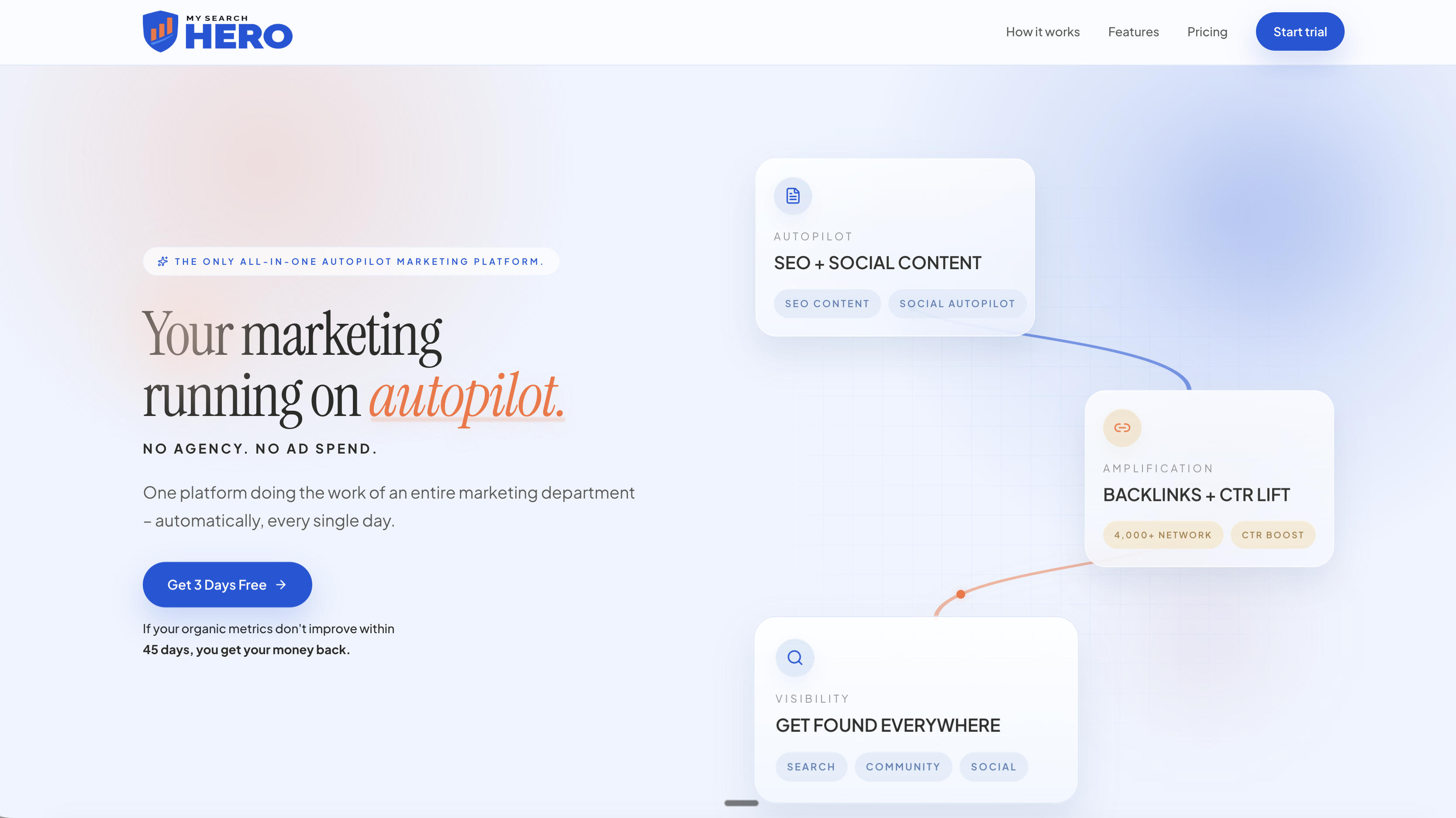
Mysearchhero is a done-for-you content and SEO service that publishes articles, builds backlinks, and distributes content across channels every month through a fully automated pipeline. If you are ready to build the content foundation that makes personalization possible, see how it works and get your marketing running on autopilot.
FAQ
What is content personalization?
Content personalization is the practice of adapting digital content to individual users based on their behavior, demographics, or intent signals. The goal is to serve each visitor the most relevant message at the right moment.
Which page elements should I personalize first?
Hero headlines, primary CTAs, and top product or service blocks deliver the highest conversion gains when personalized first. These three elements shape the visitor’s first impression and sit above the fold on most pages.
What is the difference between rule-based and AI-driven personalization?
Rule-based personalization uses fixed logic to route visitors to content variants, while AI-driven personalization uses machine learning models to predict the best content for each visitor based on behavioral data. Rule-based approaches are easier to implement; AI-driven approaches scale better as data volume grows.
How do I avoid visual flicker in dynamic personalization?
Use high-performance APIs and server-side caching to serve personalized content before the page renders. If your system cannot deliver the personalized version fast enough, default to standard content rather than showing a visible content swap.
How many audience segments should I start with?
Start with three to five clearly defined segments and expand only after each one shows a measurable lift in A/B testing. Too many segments too early creates variants with insufficient traffic to produce statistically significant results.