
TL;DR:
- Google does not penalize content created with AI but focuses on penalizing low-quality, thin, and manipulative content regardless of its origin. AI significantly boosts content creation efficiency, but human oversight, expertise, and authenticity are essential to maintain trust and meet quality standards. The key to successful AI-assisted content is integrating human judgment at every stage to preserve unique voice and value, preventing homogenization and brand erosion.
Most small business owners and content marketers assume Google punishes AI-generated content. That fear keeps a lot of people either avoiding AI tools entirely or treating every AI-written sentence like contraband. The reality is almost the opposite. The role of AI in content creation has grown so central that over 50% of B2B marketers now rely on it, and Google’s actual concern has never been the tool you used. It’s always been about quality. This guide shows you what that means for your business.
Table of Contents
- Understanding the role of AI in content creation
- Google’s stance on AI content: fact vs. fiction
- Shifting roles: from writer to AI content editor and quality controller
- Building trust: addressing consumer perception of AI-assisted content
- Best practices for integrating AI into your content creation process
- The uncomfortable truth about AI and content quality
- Let MySearchHero handle the AI content equation for you
- Frequently asked questions
Understanding the role of AI in content creation
AI in content is not just autocomplete on steroids. Today, it spans drafting full articles, generating topic ideas, rewriting for clarity, optimizing for keywords, and even adapting tone for different audiences. For a small business owner wearing six hats, that range of capabilities is genuinely useful.
The adoption numbers reflect that. B2B content marketers using AI report 3 to 5 times productivity improvements and 40 to 60% cost reductions. Those are not marginal gains. A solo marketer who used to publish two blog posts a month can realistically publish eight with the same hours invested.
Here is what AI content generation actually covers in practice:
- Drafting: AI produces a working first draft from a prompt, saving the hardest part of writing (starting from nothing)
- Idea generation: Tools can surface trending angles, related questions, and content gaps based on your niche
- SEO optimization: AI can suggest keyword placement, meta descriptions, and heading structures
- Repurposing: A blog post becomes a newsletter, a social caption, or a script with minimal extra effort
- Editing support: AI flags passive voice, inconsistencies, and structural issues faster than manual review
“AI tools are not replacing creative work. They are removing the mechanical parts of it so humans can focus on the thinking.”
The critical framing here is that AI works best as a complement to human expertise, not a substitute. Your voice, your client stories, your industry knowledge, and your judgment about what your audience actually needs — none of that lives inside a language model. That’s what you bring. Exploring the full range of marketing content strategies helps you see where AI fits naturally and where it falls short.
Google’s stance on AI content: fact vs. fiction
Here is the misconception worth killing outright. Google does not penalize content because it was written with AI. Full stop. What it actually penalizes is content created primarily to manipulate rankings, content that lacks human expertise, and content so thin it offers no real value to the reader.
The framework Google uses is called E-E-A-T, which stands for Experience, Expertise, Authoritativeness, and Trustworthiness. These are the signals Google’s quality raters look for when evaluating pages:
- Experience: Does the author show first-hand knowledge of the topic?
- Expertise: Is the information accurate and specific to the subject matter?
- Authoritativeness: Is the site and author recognized as credible in their field?
- Trustworthiness: Is the content honest, transparent, and backed by verifiable sources?
An AI draft fails E-E-A-T not because it was AI-generated, but because it typically lacks the first signal: lived experience. A plumber writing about pipe installation after 15 years on the job brings something no AI prompt can replicate. The fix is not to avoid AI. The fix is to add that layer of human accountability before the content goes live.
What actually triggers Google penalties is mass production of thin content. Think 500-word articles with no original data, no specific examples, and no genuine insight, published in bulk. That pattern is the problem, regardless of whether a human or an AI wrote it.
Pro Tip: Before you publish any AI-assisted content, ask yourself one question. “Does this page answer something better than anything else ranking for this topic?” If the answer is no, it is not ready.
Improving your AI and SEO visibility requires pairing the efficiency of AI tools with honest, human-reviewed content that earns its ranking.
Shifting roles: from writer to AI content editor and quality controller
The impact of AI on writing is not job elimination. It is job transformation. The role of AI content editing is becoming one of the most valuable skills a content team can have, and it is fundamentally different from traditional editing.

Writers at AI-forward publications have shifted from producing 3 posts a week to overseeing 30, with their focus moving to editing, fact-checking, and creative input rather than first-draft production. That is a real change in how content work gets done.
Here is what an effective AI content editor actually does:
- Sets the brief upstream. A good prompt produces a better draft. Writing tight, specific briefs is now more valuable than typing fast.
- Fact-checks every claim. AI hallucinates. It will cite studies that don’t exist and quote statistics with wrong numbers. Verify everything before publishing.
- Adds personal and brand voice. AI defaults to neutral. Your job is to inject the specific phrases, perspectives, and personality that make content recognizably yours.
- Corrects root problems, not surface ones. If an AI draft is structured poorly, fix the outline, not each individual sentence. Editing symptoms wastes time.
- Manages the content pipeline. One skilled editor can now manage a much higher volume of content by coordinating AI tools, writers, and publishing workflows together.
Pro Tip: Treat AI like a very fast junior writer who needs clear instructions and always needs a senior editor’s review. The quality ceiling is set by the editor, not the tool.
The healthiest AI content workflows are ones where human judgment sits at both ends of the process: setting direction at the start and ensuring quality at the finish.
Building trust: addressing consumer perception of AI-assisted content
There is a real gap between AI content that works and AI content that feels robotic. The role of AI in storytelling is growing, but audiences are getting sharper at detecting when content lacks a human point of view.
Research on consumer perception consistently shows that AI-assisted content reads as hollow when it skips unique human value. Generic tone, absence of real examples, and vague conclusions are the tells. Here is what loses reader trust fast:
- Summaries that could describe any company in your industry
- Advice that does not account for the reader’s actual context
- Statistics cited without commentary on what they mean for the reader
- No author identity, credentials, or point of view anywhere on the page
“Transparency without substance is still a trust problem. Saying ‘written with AI’ on a low-effort page does not make it credible.”
The fix is not to avoid disclosing AI use. The fix is to earn the trust that disclosure risks losing. That means adding original data, sharing personal experience, taking a position on a topic, and writing with enough specificity that the reader knows a real person thought carefully about their situation.
For sensitive content areas like health, finance, or legal topics, human review is not optional. Readers in those niches have a much lower tolerance for errors and a much higher baseline expectation for authority.
Connecting your content to a broader social media content planning approach helps you maintain a consistent voice across channels, which also reinforces trust over time.
Best practices for integrating AI into your content creation process
The future of AI in content belongs to teams and owners who treat it like a system, not a shortcut. Here is a practical approach you can put to work immediately.
- Write better prompts, not repetitive edits. If you keep fixing the same problem across multiple AI drafts, the issue is in your prompt. Spend time refining your brief instead of fixing outputs.
- Run a multi-pass editing workflow. First pass: fact-check every claim. Second pass: voice and tone alignment. Third pass: structure and flow. Fourth pass: SEO, headings, and meta. Final pass: read it out loud.
- Add first-hand data or experience in every piece. Even one original statistic, client story, or personal observation transforms generic AI content into something worth reading.
- Build E-E-A-T signals into your publishing process. Author bios, credentials, published dates, and transparent sourcing all signal accountability to Google and readers alike.
- Use AI tools for content creation in the right parts of the workflow. Research, outlines, first drafts, meta descriptions, and social captions are all strong use cases. Final editorial judgment is not.
For context on how the industry actually handles this, only 2.5% of published pages are fully AI-generated with no human editing at all. The vast majority of successful AI-assisted content involves meaningful human review.
| Task | AI handles well | Human judgment needed |
|---|---|---|
| First draft | Yes | No |
| Fact verification | No | Yes |
| Keyword placement | Yes | Light review |
| Brand voice | Partially | Yes |
| Original insights | No | Yes |
| Structural editing | Partially | Yes |
| Publishing decisions | No | Yes |

Pro Tip: Audit your existing content before publishing new AI-assisted pages. If older posts are thin or outdated, updating them with AI plus human review often produces faster SEO results than creating new content from scratch.
Studying content marketing examples from businesses that have done this well shows one consistent pattern: AI handles volume, humans handle judgment.
The uncomfortable truth about AI and content quality
Here is what most articles on this topic skip. The biggest risk of AI in content is not Google penalties. It is a gradual erosion of your brand’s distinctiveness.
When every business in your niche uses the same AI tools with similar prompts, the output converges. Content starts sounding the same. The angle is predictable. The examples are interchangeable. And readers, even if they cannot name what bothers them, feel it.
The brands winning with AI right now are not producing more content than their competitors. They are producing content that carries a genuine perspective that their competitors cannot easily replicate, because it comes from actual client relationships, real operational experience, and opinions formed over years in a specific industry.
We have seen this firsthand managing content for dozens of small businesses. The ones who treat AI as a “set it and forget it” publishing machine see modest early gains, then traffic plateaus as their content pool starts to look like everyone else’s. The ones who stay engaged with their content, injecting real knowledge at key points in each piece, keep compounding.
AI amplifies what you already bring to your content. If you bring nothing, it amplifies nothing. If you bring deep expertise, authentic stories, and a clear point of view, AI multiplies that advantage at a scale you could never achieve writing manually.
That is the actual opportunity here. Not saving time. Building a content asset that genuinely represents your authority in your market.
Let MySearchHero handle the AI content equation for you
Running a business leaves little time to stay on top of AI writing tools, Google’s evolving quality standards, and the editing workflows that separate ranked content from ignored content.
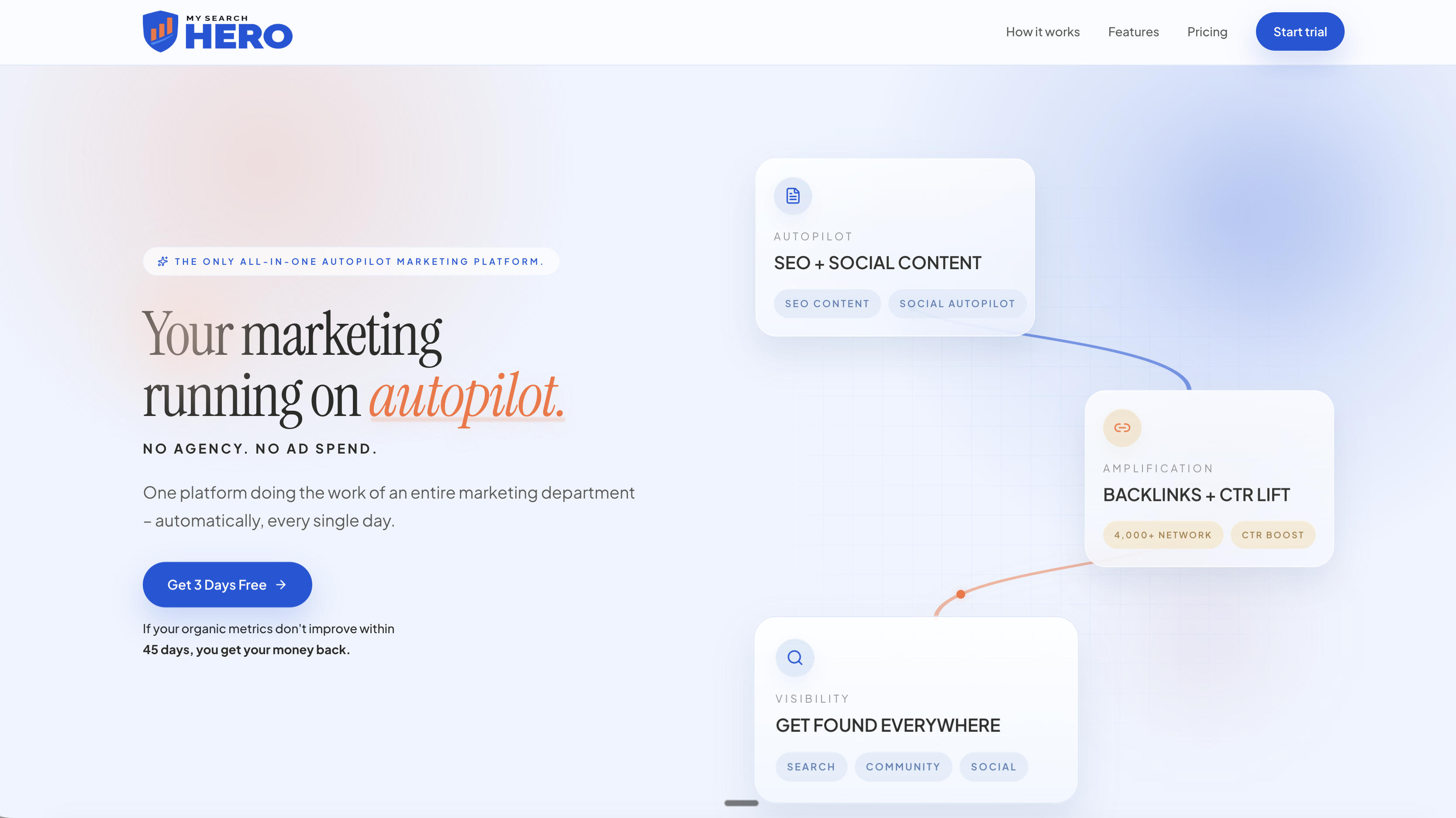
MySearchHero takes the entire process off your plate. Every month, subscribers receive published articles built with AI and reviewed by experienced editors, backlinks, Reddit mentions, and social media posts, all pushed live through a fully automated pipeline. You get the productivity benefits of AI content generation without the risk of publishing something that hurts your rankings or your brand. See how MySearchHero handles content marketing on autopilot for growing businesses.
Frequently asked questions
Does Google penalize AI-generated content?
No. Google targets manipulative content that lacks genuine human expertise, not content that was drafted using AI tools.
How can I ensure AI-generated content ranks well?
Add first-hand experience, verify all facts, include unique insights, and maintain E-E-A-T compliance through transparent authorship and credible sourcing.
Should I disclose when using AI to draft content?
Disclosure can build trust, particularly on sensitive topics, but only when the content includes human review and transparency that gives readers real value beyond the AI draft.
What is the best role for human writers with AI tools?
Human writers perform best as editors, fact-checkers, and creative directors who ensure quality and creative direction that AI tools cannot replicate on their own.