
Most local service business owners know they should be doing “content marketing,” but when you actually sit down to plan it, the choices feel overwhelming. Blog posts? Videos? Social media? Case studies? All of the above? The confusion leads to guessing, inconsistent effort, and content that never quite moves the needle. The good news is that there’s a simple, criteria-based approach to cut through the noise. By matching content types to your specific business goals and customer journey, you stop spinning your wheels and start building something that actually grows your business.
Table of Contents
- Use the right criteria to choose content types
- The top 8 content marketing types for local services
- How these content types compare
- Which content types to use for your business goals
- Why most local content strategies fall short—and how to fix it
- Get expert help building your content strategy
- Frequently asked questions
Key Takeaways
| Point | Details |
|---|---|
| Goal-driven selection | Align content types with specific business goals for best results. |
| Diverse content mix | Combine awareness and conversion assets to drive both engagement and leads. |
| Strategic comparison | Use side-by-side comparisons to choose the right formats for your needs. |
| Prove and persuade | Leverage reviews, FAQs, and case studies to earn trust and convert customers. |
| Regular strategy resets | Review and adapt your content approach as your business and market evolve. |
Use the right criteria to choose content types
Before you start creating anything, you need a clear filter for deciding what content is worth your time. Too many business owners pick formats based on what they see competitors doing, or what feels easiest to produce that week. That approach wastes effort and rarely builds momentum.
The smarter move is to start with three foundational questions. The Content Strategy Pillars framework from the Content Marketing Institute (CMI) breaks it down clearly:
“Why are you creating content? Who are you creating it for? And how will you deliver it in a way that’s different from everyone else?”
These three questions, Why, Who, and How, work as a strategic filter before you invest a single hour in content production. Here’s how to apply them as a local service business:
- Why: Define your primary goal. Are you trying to build brand awareness in your area? Generate leads from people who are ready to book? Build trust with clients who are on the fence? Your goal directly dictates which content types belong in your plan.
- Who: Understand your audience’s journey. A homeowner in the early “I wonder if I need a plumber” phase needs completely different content than someone actively comparing quotes. Map out where your customers typically are when they find you.
- How: Find your unique angle. What do you know, do, or offer that nobody else in your market does? Your expertise, your local knowledge, your specific process, these are the seeds of content that stands out.
Goal alignment is the most overlooked piece. A roofing company focused on generating estimates should prioritize conversion-focused assets like landing pages and FAQs over Instagram reels. Not because Instagram is bad, but because it’s not the right match for that specific goal. When you use these three questions consistently, content selection stops feeling like guesswork and starts feeling like strategy.
The top 8 content marketing types for local services
Now that you have a selection framework, here’s a breakdown of the eight most impactful content types for local service businesses. Each one serves a different purpose, and understanding those differences is what lets you build a mix that actually works.
1. Blog posts
Blog posts are the backbone of organic search visibility. They educate, answer questions, and help new customers discover your business through Google. A well-optimized blog post on “how to know when your HVAC needs replacing” can bring in steady traffic for years.
2. Social media posts
Social content builds local recognition and keeps your business visible to people who aren’t ready to buy yet. Regular posts on Facebook or Nextdoor, especially ones showing your team at work in the community, build familiarity and trust over time.
3. Landing pages
These are the workhorses of lead generation. A focused landing page for a specific service (like “gutter cleaning in Austin”) matches what someone is actively searching for and makes it easy for them to contact you. No distractions, just a clear offer and a call to action.
4. FAQ content
FAQ pages and FAQ sections within other pages serve a dual purpose. They answer the questions your customers are already asking, which builds trust, and they often appear in Google’s featured snippets, which dramatically increases visibility. Think: “How much does a tile installation cost?” or “Do I need a permit to add a deck?”
5. Reviews and testimonials
Social proof is one of the most powerful forces in local marketing. A collection of genuine, specific reviews on Google or your website does more to convert skeptical shoppers than any ad you could run. These aren’t something you write, but they are something you actively cultivate.
6. Case studies
Case studies take your results and make them tangible. A before-and-after story about a bathroom remodel, including the client’s problem, your process, and the outcome, shows potential customers exactly what working with you looks like. They’re particularly effective for higher-ticket services.

7. Video content
Video dramatically increases engagement across nearly every platform. Short behind-the-scenes clips, process walkthroughs, or even simple explainer videos on YouTube can reach local customers in ways that text alone can’t. Video also builds a personal connection faster than written content.
8. Downloadable guides or checklists
These are lead capture tools. A checklist like “10 questions to ask before hiring a contractor” attracts people who are in research mode, and in exchange for the download, you collect their contact info for follow-up.
One important warning here: as the Content Strategy Pillars framework emphasizes, ignoring conversion assets limits lead generation even if your awareness content performs well. Stacking your plan with blog posts and social media while skipping the evaluation of non-blog content assets like landing pages and case studies is one of the most common reasons local content strategies plateau. You build an audience but have no clear path to convert them.
Pro Tip: Pick one content type for each stage of your customer’s journey: one for awareness, one for consideration, and one for conversion. This simple structure gives your content plan direction without overwhelming your schedule.
How these content types compare
With all eight types on the table, a side-by-side comparison helps you see at a glance where each one fits in your strategy.
| Content type | Customer journey stage | Primary goal | Relative effort | ROI potential |
|---|---|---|---|---|
| Blog posts | Awareness | Search traffic, education | Medium | High (long-term) |
| Social media posts | Awareness, retention | Visibility, engagement | Low to medium | Medium |
| Landing pages | Decision | Lead generation | Medium | Very high |
| FAQ content | Consideration, decision | Trust, search snippets | Low | High |
| Reviews and testimonials | Consideration | Social proof | Low (management) | Very high |
| Case studies | Consideration | Trust, proof | High | High |
| Video content | Awareness, consideration | Engagement, connection | High | High |
| Downloadable guides | Consideration | Lead capture | Medium | Medium to high |
A few patterns stand out immediately. Blog posts and social media are excellent for top-of-funnel work (reaching people who don’t know you yet), but they rarely close deals on their own. Landing pages and reviews, on the other hand, are closer to where decisions actually happen.
Statistic to note: According to CMI’s content operations research, having a documented content strategy is a clear differentiator for businesses that see measurable performance improvements. The businesses that outperform their competition aren’t just creating more content. They’re being deliberate about what they create and why.
Being systematic about your content mix matters more than raw volume. A plumbing company that publishes two blog posts a month, maintains a strong Google review profile, and has one well-crafted landing page for each service will almost always outperform a competitor pumping out daily social posts with no strategy behind them.
Which content types to use for your business goals
Here’s where it all comes together. Different business goals call for different content mixes. Below are the most common scenarios local service businesses face, along with the content types that best fit each one.
Goal 1: Build awareness in a new area or for a new service
When you’re introducing yourself to a market, you need content that reaches people before they’re ready to buy. This means blog posts targeting local search terms, consistent social media posts that show your team and your work, and maybe a video or two introducing your company story.
Goal 2: Generate more leads right now
If the pipeline is slow, you need content that converts. Prioritize building or improving landing pages for your core services, adding FAQ sections to your site that address pricing and process questions, and actively requesting reviews from recent clients. These three types directly influence whether someone contacts you or keeps scrolling.
Goal 3: Win trust from clients comparing multiple providers
When customers are actively weighing their options, proof matters most. Case studies that walk through real projects, testimonials that speak to specific concerns (like reliability, pricing transparency, or cleanup), and detailed FAQ content that addresses objections will move more people from “maybe” to “yes.”
Situational example: Launching a new service
Say you’re a landscaping company adding irrigation system installation to your offerings. Start with a landing page optimized for “irrigation installation in [your city].” Add a blog post explaining how homeowners know they need a new system. Post photos of your first few installations on social media. Then ask those first clients for detailed reviews. That sequence touches every stage of the journey and builds momentum systematically.
Situational example: Responding to a slow period
Rather than running ads, review your existing content. Are your landing pages clear? Are you ranking for the questions your customers actually type into Google? CMI’s Reset Your Content Marketing Program recommends a proactive, systematic approach to content library organization and channel selection when you need to get results from what you already have before adding more.
- Audit what content you already have and whether it’s working.
- Identify gaps in the customer journey where someone might drop off.
- Prioritize the one or two content types most likely to fill those gaps.
- Set a 90-day measurement window to see what’s actually moving your numbers.
Pro Tip: If your content strategy for service businesses feels scattered, try mapping each piece of existing content to a single stage of the buyer journey. You’ll quickly see which stages are crowded and which are starving for support.
Why most local content strategies fall short—and how to fix it
After working with service businesses across dozens of industries, one pattern shows up again and again. Business owners aren’t failing because they chose the wrong content type. They’re failing because they’re treating content types in isolation instead of building a connected system.
Most people start with a blog because it feels productive and professional. Then they add social media because everyone says they should be on social. And then they wonder why, after six months of consistent effort, the phone still isn’t ringing more than it was before.
Here’s the uncomfortable truth: awareness content without conversion content is just charity. You’re educating and entertaining the internet with no mechanism to capture or convert that attention. Blog posts and social posts do their job well, but their job is to start a relationship, not close one. That’s why proof assets like reviews, case studies, FAQs, and landing pages are so often the missing piece.
The smart content mix doesn’t have to be complex. Even a simple three-layer system (one awareness format, one consideration format, one conversion format) outperforms a strategy that goes deep on volume in one area while ignoring the others.
The other thing most local businesses underinvest in is the “proof layer.” Reviews, testimonials, and case studies are often treated as nice-to-haves rather than strategic assets. But in competitive local markets, they’re often what separates the businesses that grow from the ones that stay flat. Someone who finds your blog post through Google still needs to be convinced you’re the right choice. Your proof content is what does that convincing.
Volume has its place, but compounding value comes from connecting types that build on each other. A blog post that ranks well drives awareness. A landing page captures intent. A strong review profile closes the deal. When those three work together, every piece of content you publish has a clearer path to actual business results.
Get expert help building your content strategy
Building a content strategy that works across all eight formats sounds great in theory, but actually executing it consistently while running a business is a different story.
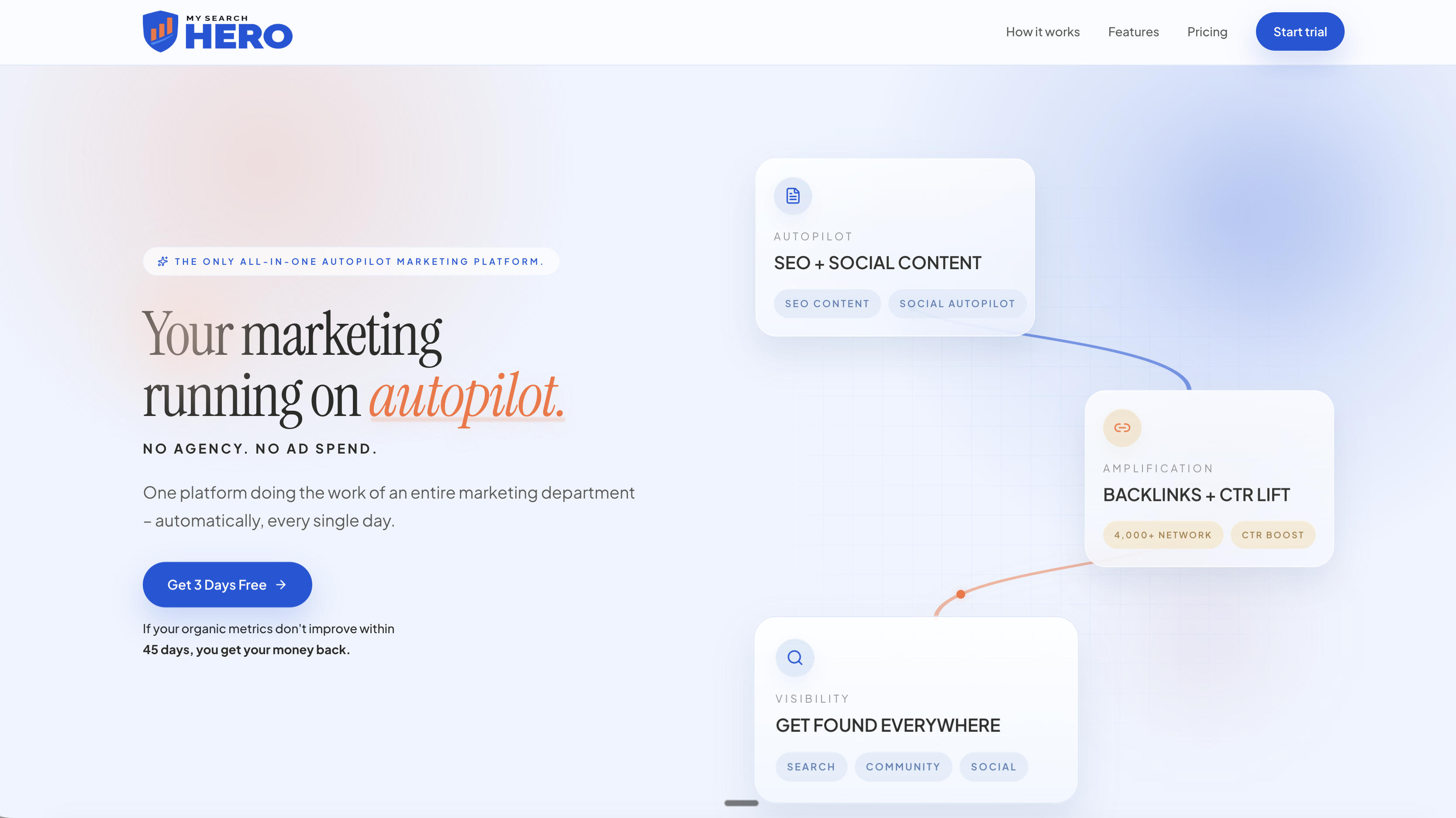
That’s exactly where MySearchHero comes in. We handle the entire done-for-you pipeline, from published blog articles and landing page content to social media posts and backlinks, all delivered monthly on autopilot. You get a custom content plan built around your specific services, goals, and local market, without the hours of research, writing, and scheduling that typically come with it. If you’ve been doing content marketing halfway because there just isn’t enough time to do it right, it’s worth seeing what a fully managed approach can do for your growth.
Frequently asked questions
What is the most effective content type for attracting local customers?
Blog posts and social media engagement are most effective for reaching and attracting local customers in the awareness stage, especially when targeted at location-specific topics your audience is actively searching.
Do I need multiple content types or just one?
A mix is ideal because awareness content alone can build traffic without generating leads. Pairing blog posts with landing pages, FAQs, and reviews creates a full path from discovery to conversion.
How do I know if my content mix is working?
Track leads, phone calls, and bookings alongside search rankings and social engagement. Systematic measurement across these indicators shows which content types are actually driving business outcomes versus just generating clicks.
How often should I update or reset my content marketing strategy?
Review your strategy annually or whenever your goals, audience, or results shift significantly. CMI recommends a formal reset when content demand grows or your business objectives change, rather than simply adding more content on top of a broken foundation.