
TL;DR:
- Most local business owners focus solely on acquiring new customers, overlooking the importance of building a marketing funnel that nurtures loyalty. A well-designed funnel guides potential customers through awareness, consideration, conversion, and retention stages, increasing long-term revenue. Automation tools simplify this process, enabling small businesses to compete effectively without extensive marketing teams.
Most local business owners pour energy into getting new customers and then consider the job done. But the businesses that grow consistently year after year know something different: the sale is just the beginning. A well-built marketing funnel keeps working long after that first transaction, turning one-time buyers into loyal advocates who send referrals your way. If you’ve ever felt like your marketing efforts aren’t producing predictable results, understanding the funnel framework is the shift that changes everything.
Table of Contents
- Understanding the marketing funnel: The customer journey explained
- Key stages of a marketing funnel for local businesses
- How automation powers the modern marketing funnel
- Steps to build and optimize your first marketing funnel
- What most local business owners miss about marketing funnels
- Transform your marketing funnel with expert help
- Frequently asked questions
Key Takeaways
| Point | Details |
|---|---|
| Funnel stages matter | Each marketing funnel stage plays a vital role in moving prospects toward becoming loyal customers. |
| Automation is accessible | Powerful automated tools make funnel management practical for local businesses of any size. |
| Retention unlocks growth | Ongoing engagement after the sale is crucial for maximizing lifetime customer value. |
| Start simple, iterate | Building an effective funnel doesn’t require perfection at launch; make improvements as you learn. |
Understanding the marketing funnel: The customer journey explained
A marketing funnel is a model that maps out the steps a potential customer takes from the moment they first hear about your business to the moment they become a loyal repeat client. Think of it like a physical funnel: wide at the top, narrow at the bottom. Lots of people enter at the top, and a smaller, more committed group exits at the bottom as paying customers.
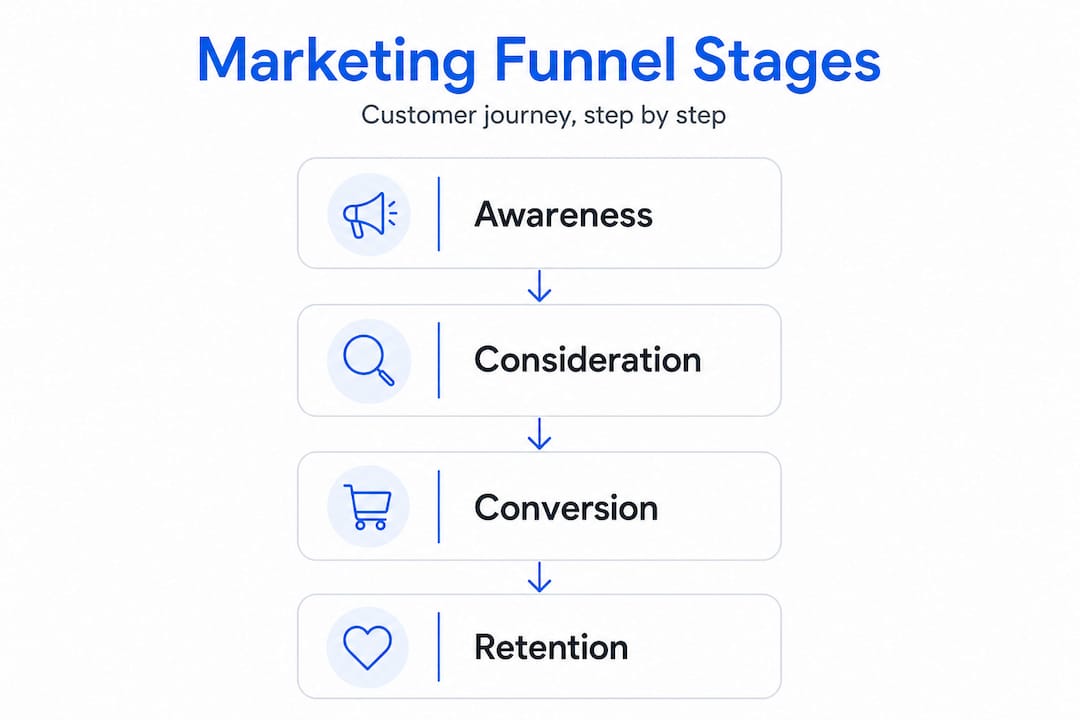
Marketing funnels visualize the process potential customers go through before purchasing. For local businesses, this framework is especially powerful because it helps you stop guessing and start making deliberate decisions about where to invest your time and money.
The four core stages of a marketing funnel are:
- Awareness: The prospect discovers your business for the first time, often through a Google search, social media post, or word of mouth.
- Consideration: They start evaluating whether your business is the right fit, reading reviews, visiting your website, or comparing your prices.
- Conversion: They take action, booking an appointment, placing an order, or walking through your door.
- Retention: You keep them coming back through follow-ups, loyalty programs, and consistent communication.
Here’s a quick look at what each stage involves for a typical local business:
| Funnel stage | Goal | Common tactics |
|---|---|---|
| Awareness | Get noticed | Local SEO, Google Business Profile, social ads |
| Consideration | Build trust | Reviews, blog content, email nurture sequences |
| Conversion | Close the sale | Special offers, easy booking, clear calls to action |
| Retention | Encourage repeat business | Loyalty rewards, follow-up emails, referral programs |
“A funnel isn’t a sales trick. It’s a map of your customer’s thinking. When you understand where they are in that journey, you can meet them with exactly the right message.”
The beauty of this framework is that it gives you a shared language to talk about your marketing. Instead of saying “our ads aren’t working,” you can say “we’re generating awareness but losing people at the consideration stage.” That precision makes fixing problems much faster and less expensive.
Key stages of a marketing funnel for local businesses
Now that the funnel’s purpose is clear, let’s break down each phase and what it means for local owners.
Top of the funnel: Awareness
At this stage, your only job is to get in front of the right people. For a local plumber, that might mean ranking on Google when someone searches “emergency plumber near me.” For a yoga studio, it could be a targeted Facebook ad aimed at people within a five-mile radius. The key metric here is reach: how many relevant people are seeing your business for the first time?

Middle of the funnel: Consideration
This is where most local businesses lose potential customers. Someone finds you, visits your website, and then… nothing. They leave without booking. The consideration stage is about staying in their mind and building enough trust that they choose you over a competitor. Automated marketing strategies like email sequences, review request campaigns, and retargeting ads are incredibly effective here.
Bottom of the funnel: Conversion
Conversion is the moment of action. For a local dentist, it’s a new patient booking their first appointment. For a restaurant, it’s a reservation or an online order. The friction at this stage matters enormously. A confusing booking process or a website that loads slowly can cost you customers who were already ready to buy.
Post-purchase: Retention and advocacy
This is the most underused stage in local marketing. Each funnel stage requires tailored messages and automation tools, and retention is no exception. A simple follow-up email after a service appointment, a birthday discount, or a referral incentive can dramatically increase the lifetime value of every customer you’ve already won.
Here’s a numbered breakdown of specific actions to take at each stage:
- Awareness: Claim and optimize your Google Business Profile. Post consistently on one or two social platforms. Run geo-targeted ads to reach people in your service area.
- Consideration: Set up an automated email sequence that goes out when someone fills in a contact form. Ask satisfied customers to leave reviews on Google.
- Conversion: Simplify your booking or purchase process. Add a clear, single call to action on every page of your website. Offer a limited-time incentive for first-time customers.
- Retention: Send a thank-you message within 24 hours of a purchase. Create a loyalty program. Ask for referrals with a small reward attached.
Pro Tip: Don’t try to fix every stage at once. Pick the stage where you’re losing the most people and fix that first. Even small improvements at a leaky stage can produce significant revenue gains.
How automation powers the modern marketing funnel
With funnel stages mapped, automation is the next step in making the process both effective and manageable.
Here’s the honest truth: most local business owners don’t have a marketing team. You’re wearing a dozen hats. Automation is what makes a sophisticated funnel possible without adding more hours to your already packed day.
Automation streamlines repetitive tasks in the funnel, allowing local businesses to compete efficiently with larger brands that have full marketing departments. The playing field has leveled dramatically in recent years, and the tools available today are both affordable and genuinely powerful.
Common automation tools and what they do:
- Email drip campaigns: A series of pre-written emails that go out automatically after someone signs up, books an appointment, or makes a purchase. You write them once, and they work around the clock.
- SMS reminders: Automated text messages that reduce no-shows for appointments and remind customers about upcoming promotions. Studies show SMS messages have an open rate above 90%, far higher than email.
- Appointment scheduling software: Tools that let customers book directly into your calendar without phone calls or back-and-forth emails.
- Review request automation: After a service is complete, an automated message goes out asking the customer to leave a Google review, dramatically increasing the volume of social proof you collect.
- Retargeting ads: Automated ads that follow website visitors around the internet, reminding them to come back and book.
Let’s look at a real-world example. A local gym wants to convert free trial sign-ups into paying members. Without automation, a staff member would need to personally follow up with every trial member, which rarely happens consistently. With marketing funnel tools in place, the gym can automatically send a welcome text on day one, a motivational email on day three, a “how’s it going?” check-in on day five, and a limited-time membership offer on day seven. The whole sequence runs without anyone lifting a finger, and the conversion rate from trial to paid member increases significantly.
Statistic callout: Businesses that use marketing automation see an average of 451% more qualified leads than those that don’t, according to research from the Annuitas Group. For local businesses, even a fraction of that improvement can mean the difference between slow growth and a waitlist.
Pro Tip: Start with one automation before building a complex system. A simple follow-up email sequence after a first purchase is a great place to begin. Once you see results, layer in more touchpoints.
Steps to build and optimize your first marketing funnel
Automation makes execution easier, but building and optimizing your funnel is an ongoing process. Here’s how to start.
Building a funnel from scratch feels overwhelming until you break it into clear steps. The goal isn’t perfection on day one. The goal is to get something working and then improve it over time based on real data.
-
Define your target audience. Who is your ideal customer? What problem are they trying to solve? What objections do they have? The more specific you are here, the more effective every other step becomes. A pet grooming salon, for example, might target dog owners within a ten-mile radius who have medium to large breeds and value convenience.
-
Map your funnel stages to your business. Take the four stages and write down exactly what your customer does at each one. Where do they find you? What questions do they ask? What makes them hesitate? What makes them come back? This exercise reveals gaps you didn’t know existed.
-
Choose your tools based on your size and budget. You don’t need an enterprise-level platform to run an effective funnel. Many email marketing platforms offer free tiers for small lists. A basic CRM (customer relationship management system) helps you track where each lead is in the funnel. Start simple and upgrade as you grow.
-
Create your content and messages for each stage. Write the emails, design the offers, and set up the automated sequences. Each message should speak directly to where the customer is in their journey. A first-time visitor needs different information than someone who has already purchased from you twice.
-
Set your key metrics and track them. Optimizing each funnel stage increases leads and retention, but only if you know what to measure. Track website traffic at the awareness stage, email open rates at the consideration stage, booking conversions at the bottom, and repeat purchase rates for retention.
-
Review and improve regularly. Look at your numbers monthly. If your email open rates are low, test a different subject line. If people are visiting your booking page but not completing the booking, simplify the form. Small, consistent improvements compound over time.
Common pitfalls to avoid:
- Skipping the retention stage entirely. Acquiring a new customer costs five to seven times more than keeping an existing one. Ignoring post-sale nurturing is one of the most expensive mistakes local businesses make.
- Building a funnel and never reviewing it. A funnel built in January may not reflect your customers’ needs in September. Review it quarterly.
- Trying to automate everything at once. Automation without strategy just speeds up the wrong things. Map your funnel manually first, then automate the parts that are working.
Pro Tip: Use a simple spreadsheet to track your funnel metrics before investing in complex dashboards. Clarity on your numbers matters more than the tool you use to track them.
What most local business owners miss about marketing funnels
Here’s a perspective that could genuinely change how you approach your marketing from this point forward.
After working with local businesses across many industries, a clear pattern emerges. The owners who struggle with marketing funnels aren’t failing because they lack tools or budget. They’re failing because they’re chasing perfection instead of progress. They spend months planning the ideal funnel and never launch it, while their competitors run imperfect funnels that actually generate revenue.
The most effective funnels we’ve seen weren’t built in a day. They started as a single follow-up email and a basic contact form. Over months, they grew into multi-stage automated systems. The secret was starting small and staying consistent.
The second thing most owners miss is the post-sale relationship. They celebrate the conversion and immediately shift focus to finding the next new customer. But the data tells a different story. Repeat customers spend, on average, 67% more than new ones. The retention stage of your funnel isn’t a nice-to-have. It’s where the real profit lives.
Long-term funnel strategies also require you to update your approach as your customers’ needs change. A funnel that worked beautifully two years ago may be missing the mark today because your audience’s expectations have shifted. Treat your funnel like a living system, not a one-time project.
Consistency beats cleverness every time. A simple funnel that runs reliably, sends follow-ups on schedule, and asks for reviews after every job will outperform a sophisticated funnel that gets abandoned after three weeks because it felt too complicated to maintain.
Transform your marketing funnel with expert help
Ready to put these marketing funnel lessons to work? Here’s how you can get started today.
Building and running a marketing funnel while also managing a local business is a real challenge. The strategy makes sense, but the execution takes time, tools, and consistent effort that most owners simply don’t have to spare.
That’s exactly where MySearchHero comes in. As a done-for-you SEO and content marketing service, MySearchHero handles the content, backlinks, and online visibility that feed the top of your funnel every single month, all on autopilot. From published articles to social media posts, the expert marketing funnel support is already built and ready to work for your business. You focus on serving your customers. We handle the marketing that keeps new ones coming.
Frequently asked questions
What are the main stages of a marketing funnel?
The main stages are awareness, consideration, conversion, and retention, which guide potential customers from first discovery all the way to long-term loyalty. Marketing funnels visualize the customer journey in stages so businesses can address each phase with the right message.
How can automation improve my marketing funnel?
Automation handles repetitive tasks like follow-up emails, review requests, and appointment reminders, making your funnel run efficiently without constant manual effort. Automation streamlines funnel tasks for efficiency, freeing up your time to focus on delivering great service.
Is a marketing funnel suitable for small local businesses?
Yes, even a simple two-step funnel with a contact form and a follow-up email can meaningfully improve how you attract and retain customers. Marketing funnels are accessible for local businesses of any size and budget.
What tools do I need to start a marketing funnel?
You need a basic email marketing platform, a way to capture leads (like a contact form or landing page), and a simple method for tracking results like a spreadsheet or basic CRM. Automation and simple tools make it possible to launch your first funnel without a large investment.