

Posting randomly on social media and hoping something sticks is one of the most common traps local business owners fall into. You spend 20 minutes writing a caption, throw up a photo, and then wonder why your engagement is flat. The problem is not your content. It is the absence of a system. A structured social media content plan gives your posting purpose, saves you hours each month, and creates the kind of consistent presence that builds real trust with your audience. This guide walks you through every step, from setting your goals to measuring results, so you can stop guessing and start growing.
Table of Contents
- What you need to start your social media content plan
- Structure your content: Building effective content pillars
- Step-by-step: Planning your content calendar and workflow
- Set benchmarks and measure for improvement
- What most guides miss about staying consistent on social media
- Elevate your visibility with expert support
- Frequently asked questions
Key Takeaways
| Point | Details |
|---|---|
| Start with clear objectives | Knowing your business and marketing goals is essential for building a focused social media plan. |
| Use content pillars | Defining a few core themes simplifies planning, improves consistency, and helps avoid burnout. |
| Build a workflow | A repeatable idea-to-publish process, with approvals and a shared calendar, saves time and boosts quality. |
| Benchmark and adapt | Tracking results against realistic benchmarks reveals what works, so you can refine your approach over time. |
What you need to start your social media content plan
Before you write a single post, you need clarity on three things: what you want to achieve, where your audience lives online, and what tools will keep you organized. Skipping this setup phase is exactly why most small business social media efforts fizzle out within a few weeks.
Start with your business objectives. Are you trying to drive foot traffic to a local storefront? Generate leads for a service? Build brand awareness in a specific neighborhood? Your objective shapes everything, from which platforms you prioritize to how often you post. A plumber trying to generate emergency service calls needs a different approach than a yoga studio building a loyal community.
Choose your platforms strategically. You do not need to be everywhere. Most local businesses see the best return by focusing on two or three platforms where their customers actually spend time. Facebook and Instagram work well for consumer-facing businesses. LinkedIn makes sense for B2B service providers. Google Business Profile is often overlooked but critical for local search visibility. Pick your platforms based on where your target customers are, not where you personally like to scroll.
Once you know your goals and platforms, you need three core tools:
- A content plan: Your high-level strategy document. It defines your goals, audience, tone, and content themes.
- A content calendar: The operational layer. It maps out what gets posted, on which platform, and when.
- A workflow: The process that moves a content idea from concept to published post, including who creates it, who approves it, and who hits publish.
According to monday.com’s social media planning guide, the right approach is to use a social media plan as the blueprint, then operationalize it with a content calendar and a workflow that covers the full idea-to-publishing cycle. Many business owners skip the blueprint entirely and jump straight to scheduling, which is like building a house without blueprints.
| Tool | Purpose | Example |
|---|---|---|
| Content plan | Strategy and direction | Goals, audience, tone, pillars |
| Content calendar | Scheduling and timing | Post topics, dates, platforms |
| Workflow | Process and accountability | Draft, review, approve, publish |
Pro Tip: Before you build anything, write down your top two business goals for social media in one sentence each. Every decision you make in your plan should connect back to those goals. If it does not, cut it.
Understanding content pillars explained will make the next phase of your planning much easier and more effective.
Structure your content: Building effective content pillars
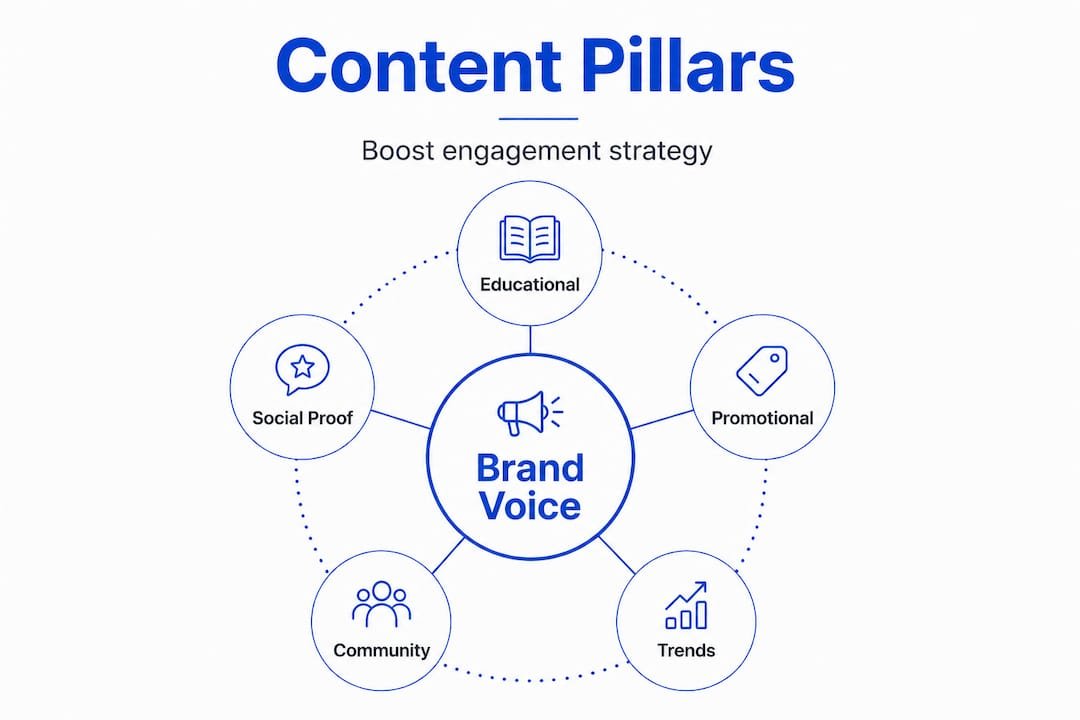
With your prerequisites in hand, you are ready to organize ideas for long-term consistency. Content pillars are the repeating themes or categories that anchor your social media presence. Think of them as the main chapters of your brand’s story online.

Without pillars, every post becomes a fresh creative decision. That is exhausting. With pillars, you already know the category. You just fill in the specific topic. This is the difference between staring at a blank screen every Monday morning and sitting down with a clear framework that practically generates ideas for you.
What are content pillars? A content pillar is a broad theme that aligns with your brand and resonates with your audience. Most local businesses work best with three to five pillars. Too few and your content feels repetitive. Too many and you lose focus.
Here are five common pillar types with examples for a local landscaping company:
- Educational: “How to prepare your lawn for winter in 5 steps”
- Promotional: “This week only: 15% off spring cleanups”
- Community-building: “Shoutout to our neighbors at Riverside Elementary for letting us beautify their entrance”
- Behind-the-scenes: “A day in the life of our crew on a big commercial project”
- Social proof: “Before and after: Check out this backyard transformation in Oak Park”
As HubSpot notes on content pillars, content pillars help keep your plan consistent and significantly reduce decision fatigue, which is one of the biggest hidden costs of social media management for small teams.
| Pillar type | Goal | Best platform |
|---|---|---|
| Educational | Build authority and trust | Instagram, Facebook, LinkedIn |
| Promotional | Drive sales and leads | Facebook, Instagram |
| Community | Build loyalty and local connection | Facebook, Nextdoor |
| Behind-the-scenes | Humanize the brand | Instagram Stories, TikTok |
| Social proof | Build credibility | Google, Facebook, Instagram |
How to pick the right pillars for your business. Look at your most engaged past posts and identify the patterns. What topics got the most comments or shares? What questions do customers ask you repeatedly in person or via email? Those are your natural pillars. Also be honest about your time and resources. A behind-the-scenes pillar requires someone to actually capture footage on the job. If that is not realistic, swap it for something you can execute consistently.
Pro Tip: Assign a percentage split to your pillars. For example, 40% educational, 30% social proof, 20% promotional, and 10% community. This keeps your feed balanced and prevents it from feeling like a constant sales pitch.
Using themes for consistency across your content makes your brand more recognizable and your planning far less stressful.
Step-by-step: Planning your content calendar and workflow
After defining clear pillars, it is time to bring structure to your idea pipeline and posting process. This is where your strategy becomes action.
Here is a practical, repeatable process for building and running your content calendar:
- Set your posting frequency. Decide how many times per week you will post on each platform. Start conservative. Three posts per week on Instagram is far better than seven posts one week and zero the next. Consistency signals reliability to both your audience and the platform’s algorithm.
- Brainstorm in batches. Set aside one hour per month to generate post ideas for all your pillars. Write down 20 to 30 rough ideas without judging them. You will not use all of them, but having a bank of ideas means you never start from zero.
- Assign ideas to your calendar. Plug your best ideas into your calendar, matching them to the right pillar, platform, and date. Tools like a shared Google Sheet, Trello, or a free plan on Buffer or Later work well for this. The monday.com social media plan template framework recommends treating the calendar as the operational layer that translates strategy into daily action.
- Draft your content. Write captions, gather images, and create graphics in batches. Doing this all at once is far more efficient than switching between creative and strategic thinking every day.
- Build in an approval step. Even if you are a solo operator, build in a 24-hour buffer between drafting and publishing. This gives you fresh eyes to catch errors. If you have a team, define who reviews what and set a clear turnaround time.
- Publish and document. Use a scheduling tool to automate publishing where possible. After posting, note the date and any relevant context in your calendar so you can compare performance later.
“A workflow is only as good as the habit behind it. The businesses that win on social media are not the most creative ones. They are the most consistent ones.”
Who should be involved? For most small businesses, one person handles content creation and a second person (a business partner, manager, or even a trusted employee) does a quick review. Avoid approval chains with more than two people. They slow everything down and kill momentum.
Following content calendar best practices helps you stay on schedule without turning social media into a second full-time job.
Pro Tip: Block 30 minutes every Friday to review the following week’s scheduled posts. This quick check catches outdated info, seasonal mismatches, or anything that might feel tone-deaf given current events.
Set benchmarks and measure for improvement
Once your system is live, setting benchmarks ensures you grow without burning out. A benchmark is simply a baseline number that tells you what normal looks like for your account, so you can tell when something is working better or worse than usual.
What to measure. Not all metrics are equally useful. Focus on the ones that connect to your actual business goals:
- Reach and impressions: How many people are seeing your content?
- Engagement rate: Likes, comments, shares, and saves divided by reach. This tells you how relevant your content is.
- Saves and shares: These are high-value signals. When someone saves a post, they found it genuinely useful. When they share it, they are endorsing you to their network.
- Link clicks: If you are driving traffic to a website or booking page, track how many clicks your posts generate.
- Follower growth rate: A slow, steady increase is healthy. A sudden spike followed by a drop often signals a one-time viral moment rather than sustainable growth.
Why quality and timing beat volume. Posting every day does not guarantee better results. In fact, social media benchmarks from Hootsuite make it clear that you should use benchmarks to set realistic goals and avoid the trap of treating posting more as automatically better. A well-timed post on a Wednesday afternoon when your audience is most active will consistently outperform three rushed posts scattered throughout the week.
How to find your benchmarks. Start by reviewing your last 30 to 60 days of posts on each platform. Calculate your average engagement rate for each post type. Then compare your numbers to published industry averages. Hootsuite, Sprout Social, and RivalIQ all publish annual benchmark reports by industry. These give you a realistic target instead of comparing yourself to national brands with full marketing teams.
Avoid the burnout trap. Many business owners start strong, post daily for two weeks, exhaust their ideas, and then go silent for a month. That silence hurts more than a slower, consistent schedule would have. Build a plan you can maintain at 70% energy, not one that requires 100% every single week.
What most guides miss about staying consistent on social media
Most social media guides focus on the technical setup. Pick your platforms, build your calendar, track your metrics. That advice is solid, but it leaves out the part that actually determines whether you stick with it: the human side of consistency.
Here is the uncomfortable truth. Motivation is not a system. You will have weeks where the business is slammed, a key employee calls out, and the last thing you want to do is write a caption about your services. If your social media plan depends on you feeling inspired, it will fail. The businesses that maintain a strong social presence over years are not the ones with the most creative teams. They are the ones with the most reliable processes.
The “more is better” myth is genuinely harmful. We have seen business owners burn out completely after trying to match the posting frequency of large brands with dedicated content teams. They post daily for three weeks, run out of steam, and then feel so guilty about the gap that they avoid the whole thing for months. A plan built around content themes for business owners with realistic posting frequency is worth ten times more than an aggressive schedule you cannot maintain.
Adaptability is what separates good plans from great ones. Your pillars give you stability, but your calendar needs to flex. A local restaurant that had a fixed content schedule in early 2020 had to throw it out overnight. Businesses that survived were the ones with strong enough foundations to pivot quickly while staying true to their brand voice. Build your plan with the assumption that something will change, because it always does.
Shared systems beat individual discipline every time. If your social media plan lives only in your head, it will not survive a busy season. Put it in a shared document. Assign clear ownership. Make the workflow so simple that someone else could run it for a week without asking you a single question. That is the real test of a good system.
Elevate your visibility with expert support
Building a social media content plan from scratch takes real time and strategic thinking, and many local business owners are already stretched thin managing everything else that comes with running a business.
At MySearchHero, we help local businesses and service providers grow their online presence without adding hours to their workload. Our done-for-you content marketing service delivers published articles, social media posts, backlinks, and more every month through a fully automated pipeline. You get a consistent, professional content presence without having to manage it yourself. If you are ready to stop guessing and start building a system that actually works, explore how we can help you grow your local business online on autopilot.
Frequently asked questions
What is the difference between a social media plan and a content calendar?
A social media plan defines your goals and strategy, while a content calendar schedules the specific posts, platforms, and timings. As monday.com explains, the plan is the blueprint and the calendar is how you operationalize it day to day.
How many content pillars should I have?
Most small businesses succeed with three to five content pillars, which is enough to maintain variety without overwhelming a small team. HubSpot’s research on content pillars confirms that repeating themes reduce decision fatigue and keep your content strategy consistent over time.
Should I post on social media every day?
No. Quality, timing, and consistency drive better results than daily posting, which often leads to lower engagement and burnout. Hootsuite’s benchmark data shows that posting more is not automatically better, and that a few well-timed posts often outperform a high-volume approach.
How do I find industry benchmarks for social media engagement?
Tools like Hootsuite Analytics provide up-to-date industry benchmark reports that help you set realistic engagement and growth goals based on your specific industry and platform, rather than comparing yourself to brands with much larger audiences.