
TL;DR:
- Most marketers understand they should post consistently, but few implement effective content schedules. Well-built schedules align publishing with business goals, improve efficiency, and reduce reactive chaos. Starting simple and gradually layering planning horizons fosters sustainable, proactive content operations.
Most marketers know they should post consistently. Few actually do. The role of content schedules goes far beyond putting dates on a calendar — a well-built schedule is the operational backbone of your entire content strategy, connecting daily publishing decisions to real business objectives. Without one, even talented teams fall into reactive mode: scrambling for ideas, missing deadlines, and publishing content that feels disconnected from any larger goal. This article breaks down exactly what content schedules do, why the data behind them is more compelling than most people realize, and how to build one that actually holds up.
Table of Contents
- Key Takeaways
- The role of content schedules as strategic roadmaps
- What the data says about planning vs. guessing
- Scheduling nuances across channels
- How to create content schedules that hold up
- My honest take on why most teams skip this
- Put your content schedule on autopilot
- FAQ
Key Takeaways
| Point | Details |
|---|---|
| Schedules are strategic tools | Content schedules do more than track dates — they align publishing decisions with business goals and audience needs. |
| Consistency gains are measurable | Documented schedules improve posting consistency by 60-80% compared to unplanned content efforts. |
| Channel types need different approaches | Social media calendars and SEO content schedules serve different functions and require separate planning layers. |
| Layered planning reduces chaos | Building schedules across annual, quarterly, monthly, and weekly horizons protects workflow stability and team morale. |
| Start simple, then scale | The most effective content schedules begin with a minimal structure and grow in complexity as your team builds the habit. |
The role of content schedules as strategic roadmaps
A content schedule is not just a spreadsheet with publish dates. Think of it as a centralized planning roadmap that coordinates content creation, approval, and distribution across every channel your brand operates on. It answers three questions at once: what gets published, when it goes out, and who owns each piece.
There is an important distinction worth making early. A content calendar typically operates at a broader strategic level, covering campaign themes, content pillars, and quarterly priorities. A social media schedule is more granular, capturing post-level details like copy, image assets, links, and approval status. Separating these two layers makes sure nothing slips through the cracks when a post is ready to publish but copy approval is still pending.
Most effective schedules include the following components:
- Content themes and pillars aligned to marketing campaigns or business priorities
- Formats and channels specifying whether each piece is a blog post, short-form video, newsletter, or social update
- Deadlines and owners with clearly assigned responsibility for drafting, editing, and publishing
- Distribution plans detailing where content gets syndicated or repurposed after initial publish
Pro Tip: When you build your schedule, add a “status” column with labels like Draft, In Review, Scheduled, and Published. This one change gives your whole team visibility into where every piece stands without a single status meeting.
The strategic foundation a schedule provides is what separates brands that grow their content presence from those that publish sporadically and wonder why nothing sticks.
What the data says about planning vs. guessing
Here is where the conversation gets concrete. Marketers who document and follow a content schedule see dramatic efficiency gains compared to those who operate without one.
| Metric | With a content schedule | Without a content schedule |
|---|---|---|
| Posting consistency | 60-80% higher | Irregular, reactive |
| Time spent on planning | 40-50% less per week | High weekly overhead |
| Content quality rating | 35-45% increase | Inconsistent quality |
| Performance tracking | 3x better insights | Limited visibility |
| Team collaboration | Aligned and transparent | Frequent miscommunication |
Those numbers are not theoretical. The time savings alone — 40-50% less time spent planning each week — represent hours that get redirected toward creating better content, analyzing results, or developing new campaigns.
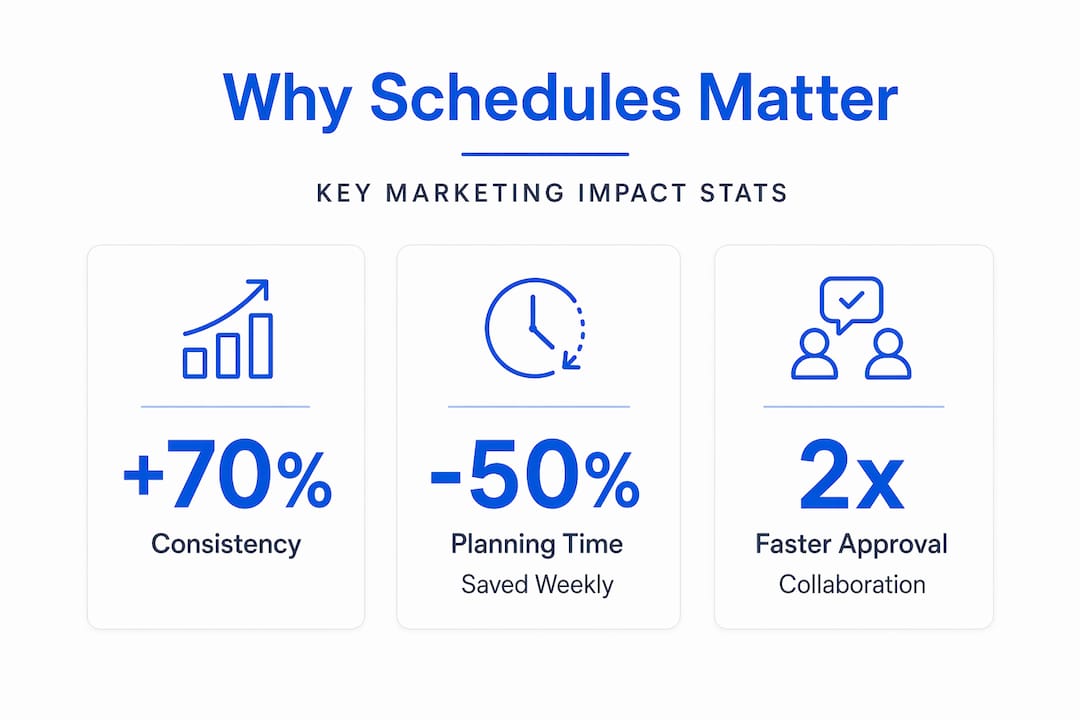
The collaboration benefit is equally underrated. When a centralized calendar is in place, sign-offs happen faster, brand voice stays consistent, and designers know what is coming far enough in advance to produce quality assets. Without that visibility, everyone is responding to last-minute requests and nothing feels coordinated.

The transformation from reactive to proactive creation is what organizations report most often when they adopt a documented schedule. Productivity increases, stress decreases, and audience engagement metrics follow.
Scheduling nuances across channels
Not every channel plays by the same rules. Understanding where those differences live helps you build a schedule that actually matches how each platform operates.
Social media scheduling
A social media calendar works at the execution level. Every post needs copy, visual assets, hashtags, links, and approval before it can go live. Social media calendars are designed to capture all of these elements in one place, so your team can move from creation to publishing without hunting through multiple documents or Slack threads.
Fast-moving platforms like X (formerly Twitter) benefit from rolling topic grids with shorter planning horizons. You might lock your themes two weeks out but leave room to swap specific posts if a trending conversation aligns with your brand. That flexibility is a feature, not a compromise.
SEO content scheduling
SEO scheduling operates on an entirely different logic. Publishing topic clusters — a pillar page supported by several related posts — in a coordinated sequence can reduce time-to-index by 57%. Google’s crawlers recognize topical authority faster when related content appears in bursts rather than scattered across months.
This means your SEO schedule should account for:
- Publishing pillar content first, then cluster articles within a defined window
- Spacing out content to avoid cannibalizing related keywords too quickly
- Aligning publish dates with your site’s historical crawl frequency when possible
- Planning internal links in advance so each new post connects to existing content immediately upon publication
Layered planning horizons
The most stable content operations use a layered lock approach:
- 90 days out: Lock broad themes and campaign priorities
- 30 days out: Finalize content formats, titles, and assigned owners
- 7 to 14 days out: Content enters a stable, near-final state with assets ready
This planning stability model reduces last-minute churn and protects your team from the whiplash of constant reprioritization. It also allows budget for reactive content without throwing the whole schedule off.
Pro Tip: Try a 30-minute single-session workflow each week to plan the following week’s social posts in one sitting. This approach saves 5-10 hours weekly by eliminating the daily decision overhead of figuring out what to post.
How to create content schedules that hold up
Building a content schedule that your team will actually use requires more than a good template. It requires a set of practices that keep the schedule alive and useful over time.
-
Start with one channel. Do not try to schedule every platform at once. Pick your most important channel, get a 4-week rhythm working, then expand. Complexity added too early leads to abandoned schedules.
-
Audit before you plan. Look at your top-performing content from the past 90 days. Patterns in format, topic, or publish time will shape what belongs in your new schedule. You can learn how to build a content calendar that factors in those performance signals.
-
Block buffer slots deliberately. Leave 15 to 20% of your publishing slots open for reactive content, trending topics, or time-sensitive news. Planning these buffer zones intentionally prevents your team from either ignoring relevant moments or blowing up the entire schedule to chase them.
-
Build in weekly and monthly reviews. A schedule that never gets updated becomes a burden. Spend 15 minutes every Friday reviewing next week’s queue and 30 minutes at month-end assessing what shifted and why. These rituals keep your schedule accurate and your team aligned.
-
Automate logistics, not strategy. Scheduling tools can handle publish queues, reminders, and approval workflows automatically. But decisions about topic clusters, publishing sequences, and content priorities need a human-led strategy. Do not hand that off to a tool.
-
Incorporate topic clusters for SEO. Rather than publishing standalone posts, group related articles into clusters and schedule them within the same two to four week window. This builds topical authority faster and gives your content marketing workflow a logical structure. The importance of content planning becomes obvious once you see how cluster-based scheduling accelerates organic rankings.
The most common mistake teams make is building an overly detailed schedule on day one and burning out on maintaining it by week three. Keep the format minimal. A shared spreadsheet with six columns beats a complex tool nobody logs into.
My honest take on why most teams skip this
I have seen hundreds of content operations up close, and the pattern is almost always the same. Teams skip scheduling not because they think it is unnecessary, but because they underestimate the cost of not having one. The cost is invisible. It shows up as a blog post published without a clear goal, a social media account that posts three times in one week and then goes silent for two, and a team that is always busy but cannot explain what the content actually accomplished.
What I have learned is that the shift from reactive to proactive publishing is the most underrated improvement a content team can make. It is not glamorous. Nobody gets excited about a spreadsheet. But once a team starts connecting daily publishing decisions to quarterly goals, the quality of every single piece improves because the context for why it matters becomes clear.
The layered lock approach changed how I think about scheduling entirely. Locking themes 90 days out but leaving execution details until 7 to 14 days before publish gives teams creative flexibility without chaos. It means the strategy is set but the execution can still respond to what is actually happening in the market.
My advice is always the same: do not wait until you have the perfect system. Start with a simple four-week plan on one channel. Review it, adjust it, and build from there. The habit is worth more than the tool.
— Mike
Put your content schedule on autopilot
If building and maintaining a content schedule feels like one more task on an already full plate, that is exactly the problem Mysearchhero was designed to solve.
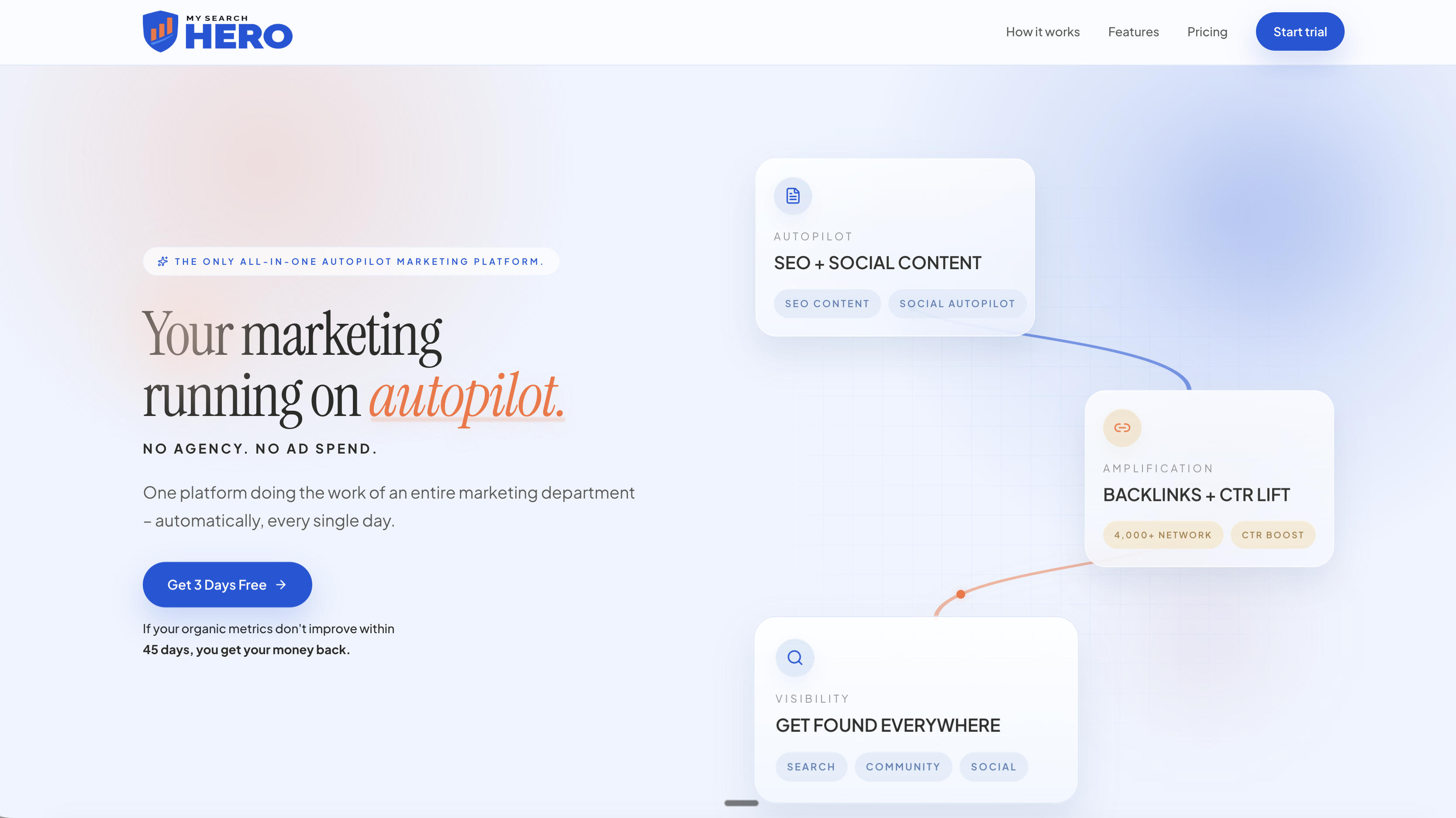
Mysearchhero is a done-for-you SEO and content marketing service that handles the entire publishing pipeline for you. Each month, subscribers receive published articles, backlinks, Reddit mentions, and social media posts pushed out through a fully automated system — all planned and executed with the same content schedule best practices covered in this article. No scrambling for ideas. No missed publish dates. No reactive chaos.
If you want your content to compound over time rather than stay stuck in a cycle of inconsistent posting, visit Mysearchhero to see how it works. You can also explore the social media content plan guide to start applying these principles to your own channels today.
FAQ
What is the role of content schedules in marketing?
Content schedules coordinate what gets published, when, and by whom across all marketing channels. They align daily publishing decisions with broader business objectives, improving consistency and team efficiency.
How much time do content calendars actually save?
Marketers using documented content schedules report saving 40-50% of weekly planning time compared to unplanned approaches. Single-session batch planning can save an additional 5-10 hours per week.
What is the difference between a content calendar and a social media schedule?
A content calendar covers broad themes, campaigns, and multi-channel priorities at a strategic level. A social media schedule operates at post level, tracking copy, assets, approvals, and exact publish times for each platform.
How do I start a content schedule without getting overwhelmed?
Begin with one channel and plan four weeks at a time. Use a simple shared spreadsheet with columns for date, channel, topic, format, owner, and status. Add complexity only after the basic rhythm is working.
Does scheduling content hurt authenticity or spontaneity?
No. The most effective schedules leave 15 to 20% of slots open for reactive and timely content. Strategic planning and creative agility are not opposites. They work better together than either does alone.