
TL;DR:
- Online advertising includes demand-driven search ads, brand-focused display and social ads, and nurturing email campaigns. Successful local businesses strategically stack and actively manage these formats across the customer journey for optimal results. Automation tools support, but manual oversight remains essential to prevent waste and maximize ROI.
Online advertising is defined as any paid promotional activity delivered through digital channels, including search engines, social platforms, websites, and streaming services. The major types of online advertising include search ads, display ads, social media ads, video ads, email marketing, and programmatic advertising. Each format serves a distinct role in the customer journey, and Google Ads, Meta, YouTube, and LinkedIn dominate the platforms where these formats run. Choosing the right mix determines whether your budget captures ready-to-buy customers or builds the brand awareness that feeds future demand.
1. Types of online advertising every local business should know
Before spending a dollar, recognize that digital advertising types are not interchangeable. Search ads, display ads, and social ads each occupy a different position in the buying funnel, and the businesses that win are the ones that stack them deliberately rather than picking one and hoping for the best. The sections below break down each format, explain what it does well, and tell you exactly when to use it.
2. Search engine advertising
Search advertising places your text ad in front of people who are actively typing a query into Google or Bing. That intent signal is the most valuable real estate in digital marketing. A user searching “emergency plumber near me” is not browsing. They are ready to call.
Google Ads runs on a pay-per-click model, meaning you pay only when someone clicks your ad. PPC pricing suits lead generation because your budget goes toward engaged users rather than passive viewers. The main formats are standard text ads and responsive search ads, where Google automatically tests headline and description combinations to find the best performers.
- Responsive search ads adapt to match the user’s query more closely, improving click-through rates.
- Keyword match types (broad, phrase, exact) control how tightly your ad aligns with search terms.
- Negative keywords block irrelevant searches and protect your budget from wasted clicks.
Pro Tip: Review your search terms report weekly and add irrelevant queries as negative keywords. Most accounts waste 20 to 30 percent of their budget on searches that will never convert, and manual review catches what automated filters miss.
3. Display advertising
Display advertising places image, animation, or video banners across websites, apps, and news outlets through networks like the Google Display Network. Where search ads capture demand, display ads create it. A user who has never heard of your business can encounter your brand dozens of times before they ever search for you.

Digital display advertising grew 17% year over year and became the second-largest investment channel for marketers, surpassing social media in total spend. That growth reflects a broader recognition that brand awareness is not a luxury. It is the engine that makes every other ad type perform better.
Display ads run on a CPM model in most cases, charging per thousand impressions. CPM suits brand awareness because you are paying for exposure, not clicks. The strategic mistake most local businesses make is ignoring display entirely because the click-through rates look low. Low clicks do not mean low impact. Repeated visual exposure builds the familiarity that drives conversions later.
Display ads complement search ads by extending reach with visual content at scale, which is why the two formats work best when run together rather than in isolation.
4. Social media advertising
Social media advertising runs paid content directly inside the feeds of Facebook, Instagram, LinkedIn, and TikTok. The defining advantage is targeting depth. You can reach users by age, location, job title, purchase behavior, relationship status, and hundreds of other signals that no other channel matches.
The native feel of social ads is a structural advantage. A sponsored post in an Instagram feed looks nearly identical to organic content, which reduces the friction that banner blindness creates on other channels. LinkedIn ads reach B2B decision-makers with a precision that Google cannot replicate. TikTok ads reach younger demographics with short-form video at a cost per click that is still lower than Facebook in most categories.
- Lookalike audiences let you find new customers who share characteristics with your best existing ones.
- Remarketing lists re-engage users who visited your website but did not convert.
- Lead generation forms collect contact details without requiring users to leave the platform.
Pro Tip: Use the Audience Insights tool inside Meta Business Suite before launching any campaign. The data on your existing page followers often reveals demographic patterns that change your targeting strategy entirely.
For a practical breakdown of social media ad formats that work for small businesses, the Mysearchhero blog covers platform-specific tactics in detail.
5. Video advertising
Video advertising runs pre-roll, mid-roll, and post-roll placements on YouTube, connected TV (CTV) platforms like Hulu and Roku, and over-the-top (OTT) streaming services. Video is the format with the highest emotional engagement because it combines motion, sound, and storytelling in a way that static images cannot.
YouTube’s skippable TrueView ads charge you only when a viewer watches at least 30 seconds or interacts with the ad. That pricing structure means you pay for genuine attention, not accidental impressions. CTV and OTT placements reach cord-cutters who have abandoned traditional cable, a demographic that is growing faster than any other TV audience segment.
The production barrier is lower than most local business owners assume. A 15-second ad shot on a smartphone with clear audio and a direct call to action outperforms an overproduced 60-second spot that buries the offer. Keep the message specific, lead with the problem you solve, and show your location or service area in the first five seconds.
6. Audio advertising
Audio advertising covers digital radio platforms like Spotify and Pandora, as well as podcast sponsorships and host-read ads. The format reaches audiences during commutes, workouts, and household tasks when screens are not in use, which means zero competition from other visual content.
Host-read podcast ads carry a trust premium that no other format replicates. When a podcast host personally endorses a product to an audience that has listened to them for years, the conversion rates reflect that relationship. For local businesses, geotargeted Spotify ads can reach listeners within a specific zip code at a cost that fits modest budgets.
Audio and video work best when integrated. Run a video ad on YouTube to introduce your brand, then reinforce the message with a Spotify audio ad targeting the same demographic. The repetition across formats accelerates brand recognition faster than either channel alone.
7. Email marketing
Email marketing is the only fully owned digital channel in the advertising mix. Email anchors the ad mix by providing direct customer relationships that are immune to auction prices, algorithm changes, and platform policy shifts. Your email list is an asset you control entirely.
Email marketing supports lead nurturing at every stage of the funnel. A new subscriber gets a welcome sequence. A past customer gets a re-engagement offer. A prospect who downloaded a guide gets a follow-up series that moves them toward a purchase. No paid channel can replicate that level of personalization at zero marginal cost per send.
Platforms like Mailchimp, Klaviyo, and ActiveCampaign automate these sequences so that the nurturing happens without manual effort. The list-building itself requires a lead magnet or opt-in incentive, which is where paid search and social ads feed directly into the email funnel. Paid ads attract the lead. Email closes the sale.
8. Programmatic advertising
Programmatic advertising is infrastructure, not a channel. Programmatic manages bids across platforms in real time using data signals to serve the right ad to the right user at the right moment, across display, video, audio, and social simultaneously. Demand-side platforms (DSPs) like The Trade Desk and Google’s Display and Video 360 are the tools that power these automated buys.
For local businesses, programmatic is most useful when you have enough conversion data to train the algorithm. Without sufficient data, automated bidding systems optimize toward the wrong signals and waste budget on low-quality traffic. Beginners often fail by relying solely on automated bidding without active campaign management, which is why manual oversight remains critical even when using programmatic tools.
The practical approach for small businesses is to start with manual campaigns on Google Ads and Meta, build a conversion history, and then layer in programmatic tools once the data is strong enough to guide the algorithm accurately.
9. Native advertising
Native advertising places sponsored content inside editorial environments so that it matches the look and feel of the surrounding content. Platforms like Taboola and Outbrain distribute native ads across major news sites and content networks. The format works because it does not interrupt the reading experience the way a banner ad does.
For local businesses, native ads work best for content-driven offers: a guide, a case study, or a how-to article that provides genuine value before making a pitch. The click-through rates are lower than search ads, but the audience arrives with higher content engagement, which makes them more receptive to a nurturing sequence.
10. Retargeting ads
Retargeting, also called remarketing, serves ads specifically to users who have already visited your website or interacted with your content. Google Ads and Meta both offer retargeting through pixel-based tracking. The conversion rates on retargeting campaigns consistently outperform cold audience campaigns because the user already knows who you are.
A user who visited your pricing page and left without converting is a far warmer prospect than someone seeing your brand for the first time. Retargeting keeps your offer in front of that user across Google Display Network, Facebook, Instagram, and YouTube simultaneously. For digital marketing examples that show how retargeting fits into a full-funnel strategy, the Mysearchhero blog covers real SMB applications.
Key takeaways
The most effective online advertising strategy for local businesses combines search ads for demand capture, display and social for awareness, email for nurturing, and retargeting to close the gap between interest and conversion.
| Point | Details |
|---|---|
| Stack ad types strategically | Use search, display, social, and email together to cover every funnel stage. |
| Search ads capture ready buyers | PPC on Google Ads targets high-intent users actively searching for your service. |
| Display builds brand recognition | A 17% growth rate confirms display advertising is a major investment channel, not an afterthought. |
| Email is your only owned channel | Email lists are immune to algorithm changes and auction price increases. |
| Manual oversight beats full automation | Active campaign management prevents budget waste that automated bidding alone cannot catch. |
Why I stopped treating ad types as separate decisions
I’ve watched local business owners make the same mistake for years. They pick one ad type, run it in isolation, and then blame the channel when results disappoint. A plumber runs Google search ads, gets decent leads for three months, then watches costs climb as competitors enter the auction. They cut the budget and declare that Google Ads “stopped working.” What actually stopped working was the strategy of relying on a single channel.
Local business success comes from stacking search, social, and display strategically rather than treating them as separate menu items. Search captures the demand that display and social created upstream. Email converts the leads that paid ads generated. Retargeting closes the users who almost converted. Remove any one layer and the whole system underperforms.
The other pattern I see constantly is over-trust in automation. Google’s Smart campaigns and Meta’s Advantage+ are genuinely useful tools, but they optimize for the metrics they can measure, not the outcomes you actually want. Manual monitoring of search terms and bids consistently outperforms fully automated systems in reducing junk leads and wasted spend. You do not need to micromanage every bid, but you do need to review performance weekly and make deliberate adjustments.
The businesses I see winning in 2026 are not the ones with the biggest budgets. They are the ones who understand what each ad type does, build a stack that covers the full funnel, and stay actively involved in managing it.
— Mike
How Mysearchhero helps you run every ad type smarter
Running search, display, social, video, and email campaigns simultaneously is a full-time job. Most local business owners do not have the bandwidth to manage each channel at the level it requires, which is where Mysearchhero delivers real value.
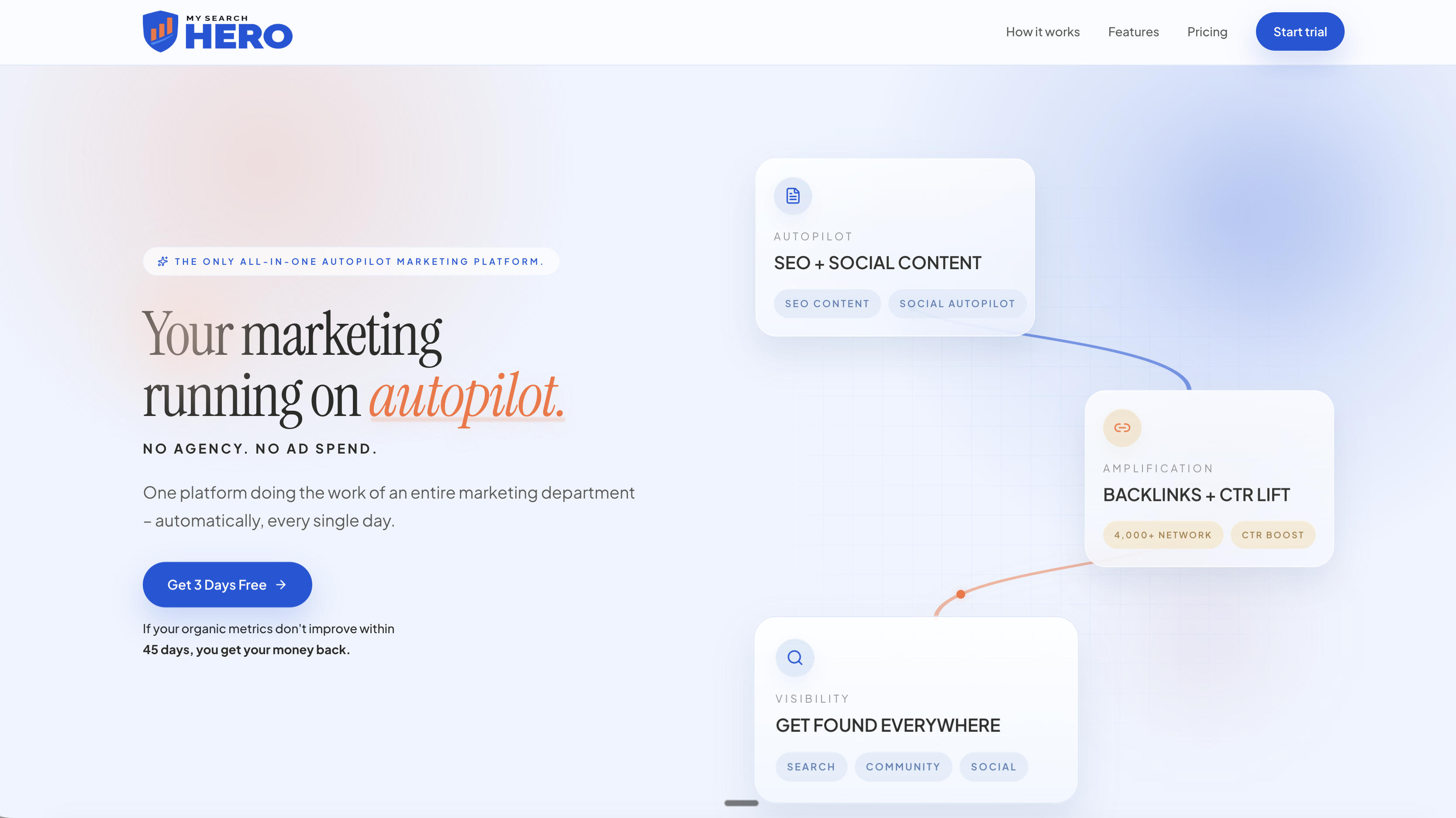
Mysearchhero is a done-for-you digital marketing service that handles content, backlinks, and online presence growth on autopilot. Every month, your marketing pipeline runs without you having to manage it manually. If you are ready to stop guessing which ad types to run and start building a strategy that covers the full funnel, visit Mysearchhero to see how the service works. Your marketing should work while you focus on running your business.
FAQ
What are the main types of online advertising?
The main types of online advertising are search ads, display ads, social media ads, video ads, audio ads, email marketing, programmatic advertising, native advertising, and retargeting. Each format serves a different stage of the customer journey.
Which online ad type works best for local businesses?
Search advertising on Google Ads delivers the highest immediate ROI for local businesses because it targets users with active purchase intent. Combining search with retargeting and email marketing produces the strongest full-funnel results.
What is the difference between PPC and CPM pricing?
PPC charges you each time a user clicks your ad, making it ideal for lead generation. CPM charges per thousand impressions and suits brand awareness campaigns where exposure matters more than direct clicks.
How does programmatic advertising differ from regular display ads?
Programmatic advertising automates the buying and placement of display, video, and audio ads across multiple platforms in real time using audience data. Standard display ad buys are negotiated manually with specific publishers or networks.
Is email marketing still an effective online advertising method?
Email marketing remains one of the most cost-effective online advertising methods because it operates on an owned channel that is not subject to platform algorithm changes or rising auction costs. Platforms like Mailchimp and Klaviyo automate the nurturing sequences that convert leads into customers.