
TL;DR:
- Most small business owners lack clarity, not ambition, when choosing from endless digital marketing options.
- Effective strategies focus on personalization, continuous optimization, and building first-party data for better ROI.
Most small business owners don’t lack ambition. They lack clarity. The options for digital marketing examples are endless: SEO, paid ads, email sequences, short-form video, creator partnerships, and more. Each one promises results, and each one requires time and money you may not have to waste. This article cuts through that noise. You’ll get a curated set of real-world digital marketing examples, a framework for evaluating what fits your business, and a comparison table to make faster, smarter decisions without second-guessing every move.
Table of Contents
- Key takeaways
- Real digital marketing examples that show what good looks like
- 1. Email marketing with behavioral triggers
- 2. SEO-driven content clusters
- 3. Short-form video with search intent
- 4. Creator partnerships as trust infrastructure
- 5. First-party email list campaigns
- 6. Personalized ecommerce email sequences
- 7. Nostalgic brand campaign remix
- 8. Google Business Profile optimization
- 9. Loyalty milestones and journey celebration
- 10. Answer Engine Optimization (AEO) content
- Side-by-side comparison of featured tactics
- How to choose the right tactic for your SMB
- My honest take on picking digital marketing examples
- Let Mysearchhero handle the execution for you
- FAQ
Key takeaways
| Point | Details |
|---|---|
| Personalization drives revenue | Brands that personalize well generate significantly more revenue, making it a non-negotiable strategy for SMBs. |
| Continuous optimization beats one-offs | Treating digital marketing as an ongoing workflow rather than isolated campaigns produces far better ROI over time. |
| First-party data outperforms third-party | Building and activating your own audience list consistently delivers better conversions at lower acquisition costs. |
| Match examples to your business stage | The best tactic depends on your budget, audience, and funnel maturity, not what works for a Fortune 500 company. |
| Creators are full-funnel assets | Creator content now functions as education, social proof, and ad creative all at once, giving SMBs outsized leverage. |
Real digital marketing examples that show what good looks like
Before you pick a tactic, you need to know what “working” actually looks like. The digital marketing examples below cover a range of strategies, budgets, and business types. None of them are theoretical. Each one reflects a pattern proven by real campaign performance or current market research.
Here is what to look for in any digital marketing example worth your attention:
- Budget-friendliness. Can an SMB realistically execute this without a six-figure media spend?
- Measurable ROI. Are there clear signals, such as conversion rates, cost per lead, or revenue attribution, to track performance?
- Scalability. Can you start small and grow the tactic as results prove out?
- Audience precision. Does the strategy let you reach the specific people most likely to buy from you?
- Personalization depth. The most effective personalization strategies now account for intent, behavior, timing, CRM stage, and predicted readiness, not just age or location.
- Trust signals. Especially for SMBs, campaigns that build credibility outperform campaigns that only push for conversion.
- Continuous optimization. Optimization as a workflow connecting all touchpoints, rather than disjointed one-off efforts, is what separates brands that grow from brands that plateau.
Pro Tip: Build a structured testing program from day one. Testing with statistically significant results consistently outperforms ad hoc experiments and gives you reliable data to improve conversion rates over time.
1. Email marketing with behavioral triggers
A local fitness studio sends a “we miss you” email to members who haven’t booked a class in 14 days, with a one-click rebook button. Open rates hit 42%, and re-engagement conversions outperform their generic newsletters by three to one.
This is one of the most accessible examples of online marketing for any SMB with a basic CRM. The power isn’t in the email itself. It’s in the trigger. Behavioral emails respond to what your customer does, making them feel noticed rather than marketed to.
2. SEO-driven content clusters
A boutique accounting firm writes one pillar page on “small business tax planning” and publishes eight supporting articles around related subtopics. Within six months, they rank on page one for 14 low-competition keywords and generate 60% of their new client inquiries through organic search.
This strategy scales without ongoing ad spend. Once the content ranks, it works around the clock. It’s one of the best digital marketing strategies for service-based businesses with defined client questions.
3. Short-form video with search intent
Searchable short-form video is an emerging force in 2026. A home renovation company films 60-second “before and after” clips, optimizes the captions with location and service keywords, and repurposes each video across TikTok, Instagram Reels, and YouTube Shorts.
The result is discovery-driven content that answers real questions and drives traffic from people already considering a purchase. Short-form video that balances entertainment with commercial clarity performs best.
4. Creator partnerships as trust infrastructure
An outdoor gear retailer works with five micro-influencers, each with under 20,000 followers but hyper-engaged audiences. Instead of sponsored posts, the brand treats them as full-funnel content partners, using creator videos for paid ads, product pages, and email campaigns simultaneously.

Creator content has evolved beyond sponsored posts. It now functions as trust infrastructure across paid and earned media, which is particularly valuable for SMBs that can’t afford traditional advertising at scale.
5. First-party email list campaigns
A specialty coffee subscription brand builds its email list through a free brewing guide gated behind a simple sign-up form. When they run promotions to that list, they see significantly better conversion rates than when they target cold audiences through paid social.
Activating first-party audiences consistently outperforms third-party targeting with better conversions and lower cost per acquisition. For SMBs, this means list-building is one of the highest-ROI investments you can make today.
6. Personalized ecommerce email sequences
Companies that excel at personalization generate 40% more revenue than average players. A direct-to-consumer skincare brand proves this by segmenting customers by skin type, purchase history, and browsing behavior, then sending product recommendations that feel handpicked.
Their abandoned cart sequence alone recovers 18% of abandoned orders. The key is that each email references something specific the customer did, not a generic offer.
7. Nostalgic brand campaign remix
A regional bakery chain runs a social media campaign featuring photos and recipes from their founding decade, asking customers to share their oldest memories with the brand. Engagement spikes, and brand sentiment surveys show notable improvement.
Nostalgic campaigns can increase brand likability by up to 20% by connecting emotionally across generations. For SMBs with a community history, this is an underused and low-cost tactic worth serious attention.
8. Google Business Profile optimization
A plumbing company in a mid-size city goes from three reviews to 200 over 12 months by adding a post-service follow-up text with a direct review link. They also post weekly updates to their Google Business Profile with photos and seasonal service reminders.
This is a free channel most SMBs ignore. Local SEO through Google Business Profile is one of the most effective digital advertising strategies for service-area businesses because it captures people actively searching for help right now.
9. Loyalty milestones and journey celebration
Top brands celebrate intermediate steps in the customer journey rather than only rewarding final purchases. A pet supply store sends a personalized “one year with us” email with a loyalty discount and a highlight of what the customer’s pet has benefited from.
This approach creates what researchers describe as visible progress and small moments of joy. It builds longer-lasting loyalty than any flash sale or acquisition offer. You can replicate it with basic CRM tagging and an email automation tool.
10. Answer Engine Optimization (AEO) content
A financial planning firm writes FAQ-style content specifically structured to appear in AI-generated search summaries and featured snippets. Questions like “how much should I save before age 40” are answered concisely, then expanded in the article below.
This reflects how digital marketing strategy is evolving in 2026. Search behavior is shifting to AI-assisted answers, and businesses that format content to match these outputs gain visibility without paying for ads.
Side-by-side comparison of featured tactics
Use this table to quickly identify which tactic fits your business based on cost, complexity, and potential return.
| Tactic | Budget range | Complexity | ROI potential | Best for |
|---|---|---|---|---|
| Behavioral email marketing | Low | Medium | High | Service or subscription businesses |
| SEO content clusters | Low to medium | Medium to high | High (long term) | Expertise-based or service businesses |
| Short-form video | Low to medium | Low to medium | Medium to high | Visually-driven products and services |
| Creator partnerships | Medium | Medium | High | Product businesses with defined audiences |
| First-party list campaigns | Low | Low | High | Any business with an existing customer base |
| Personalized ecommerce email | Low to medium | Medium | High | Ecommerce and subscription brands |
| Nostalgic social campaigns | Low | Low | Medium | Established local or regional brands |
| Google Business Profile | Free | Low | High | Local service businesses |
| Loyalty milestone emails | Low | Low to medium | High | Brands with repeat customer cycles |
| AEO content | Low to medium | Medium to high | High (emerging) | Knowledge-based businesses |
Pro Tip: Start with the tactic that matches your existing assets. If you have a customer email list, work that first. If you have a Google Business Profile with weak reviews, fix that before spending on paid ads.
How to choose the right tactic for your SMB
This is where most business owners get stuck. The comparison table shows what’s possible, but the decision still requires knowing your specific situation. Here is a practical way to narrow it down.
- Start with where your customers already are. If your buyers use Instagram daily and make purchase decisions based on visual content, short-form video and creator partnerships belong at the top of your list.
- Match the tactic to your funnel stage. If you have zero awareness, SEO and video help people discover you. If you have traffic but low conversions, behavioral email and personalization close the gap. You can go deeper on this in a marketing funnels guide written specifically for local businesses.
- Respect your actual budget. A tactic that requires consistent ad spend is not budget-friendly if you can only sustain it for three months. Organic plays take longer but compound in value over time.
- Build your brand alongside your campaigns. The branding fundamentals behind your campaigns matter. Without visual consistency, a clear voice, and trust signals, even a well-targeted ad will underperform.
Multi-touch attribution connects touchpoints to revenue, but must be supplemented by incrementality testing to measure what is truly driving results. As you integrate tactics, track which combination of channels produces the most conversions, not just which single channel gets the last click.
Pro Tip: Centralize your first-party customer data before scaling any personalization effort. A unified view of your customer across channels is what makes personalization work at scale rather than feeling scattered and generic.
My honest take on picking digital marketing examples
I’ve spent years watching small business owners get burned by chasing the latest tactic. One quarter it’s TikTok, the next it’s podcast ads, then it’s AI-generated content blasted at every channel. I understand the pressure. You see a competitor succeeding somewhere, and you want a piece of it.
What I’ve learned is that the businesses with the most durable growth treat digital marketing as a continuous workflow, not a series of launches. They run a test, learn from it, adjust, and repeat. They do not blow the budget on one campaign and hope for a viral moment.
I’ve also seen too many SMB owners underestimate trust. Brands that create joy and visible progress for customers at intermediate stages of the relationship outperform brands that only push for conversion. In 2026, clarity and consistent trust signals are genuinely what differentiate the brands that win. The tactics that work longest are the ones that serve the customer’s journey, not just your quarterly targets.
My advice: pick two tactics from this list, run them seriously for 90 days, and measure with intent. Stop trying to do everything. Do less, but do it with real conviction.
— Mike
Let Mysearchhero handle the execution for you
Running digital marketing campaigns while managing a business is genuinely hard to sustain. Mysearchhero is a done-for-you content and SEO service built specifically for SMBs that need results without the overhead of a full marketing team.
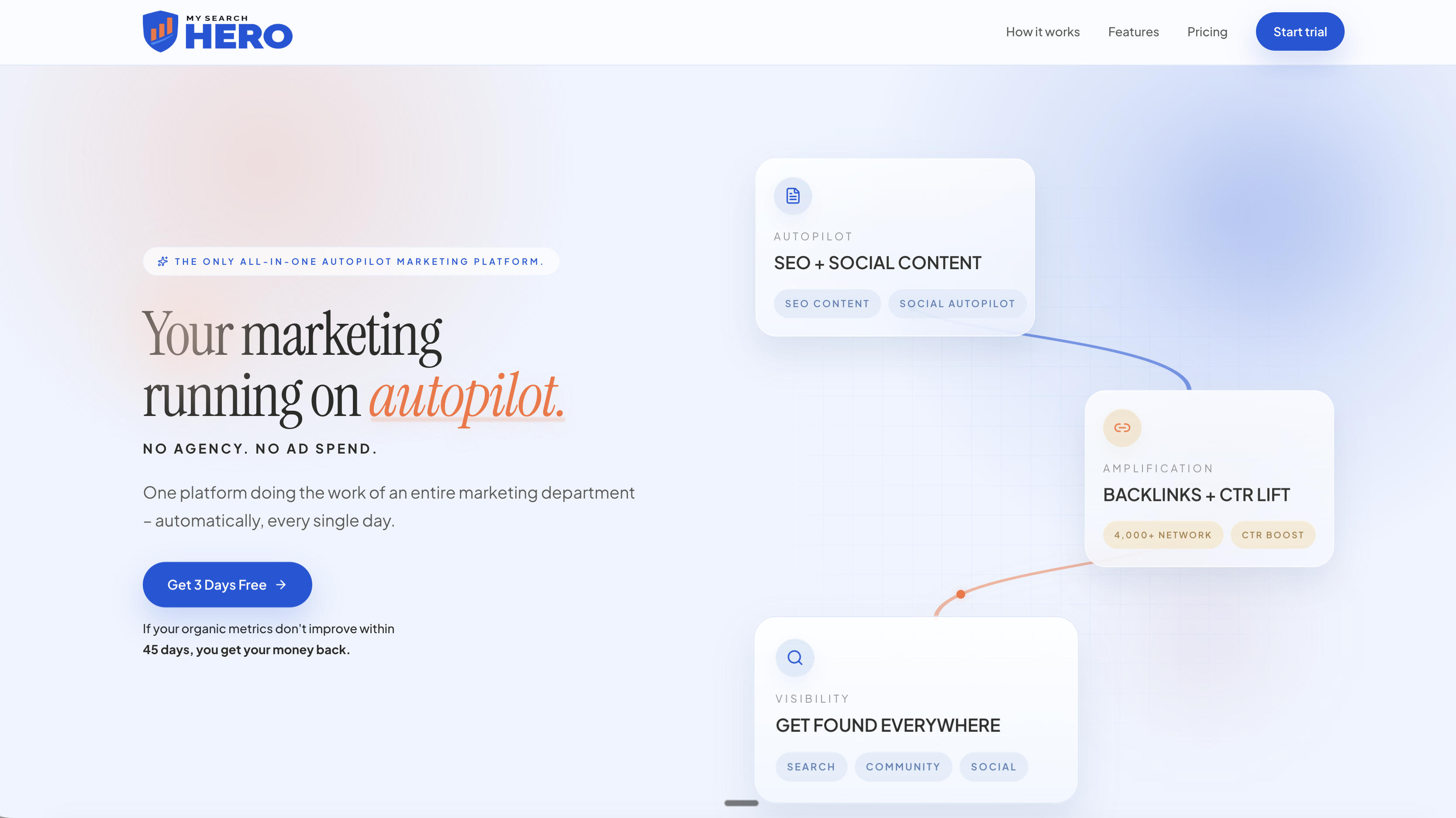
Every month, subscribers get published articles, backlinks, Reddit mentions, and social media posts pushed out through a fully automated pipeline. The service is designed around the same best practices covered in this article: first-party data thinking, multi-channel distribution, and content built for both search engines and real readers. If you want to put the digital marketing strategies from this article on autopilot, Mysearchhero gives you a done-for-you system that runs while you focus on your business.
FAQ
What are the best digital marketing examples for small businesses?
The most effective examples for SMBs include behavioral email marketing, Google Business Profile optimization, SEO content clusters, and first-party list campaigns. These tactics require lower budgets and deliver measurable returns without the complexity of large-scale paid advertising.
How do I measure the success of a digital marketing campaign?
Track conversion rates, cost per acquisition, and revenue by channel. Multi-touch attribution helps connect multiple touchpoints to revenue, but pair it with incrementality testing to understand what’s genuinely driving growth versus what’s just along for the ride.
What digital marketing strategies work best in 2026?
Personalization, first-party data activation, short-form searchable video, creator partnerships, and AEO content are leading strategies in 2026. Brands that combine trust-building with consistent optimization across channels see the strongest long-term results.
How much should a small business spend on digital marketing?
Most SMBs see solid results starting with 5 to 10 percent of revenue allocated to marketing. The split between paid and organic channels should reflect your timeline. Organic strategies take longer but compound in value, while paid campaigns generate faster feedback.
Why do most digital marketing campaigns fail for SMBs?
Many SMBs treat optimization as a one-time project rather than an ongoing workflow. Campaigns fail when they are launched without testing, run without measurement, or abandoned before enough data is collected to draw meaningful conclusions.