
TL;DR:
- Building a successful online community starts with a clear purpose and understanding of member needs to foster meaningful engagement. Choosing the right platform, designing participation flow, and implementing consistent rituals are essential for long-term vitality. Monitoring key metrics like retention and response times ensures ongoing improvement and sustained community health.
Building an online community means creating a shared space where members connect, interact, and grow together through purposeful engagement, not one-way broadcasting. The most effective ways to build community online center on shared purpose, smart platform selection, and participation structures that keep members coming back. Platforms like Mighty Networks, Discord, and Circle each serve different community types, and choosing the wrong one early is one of the most common mistakes organizations make. This guide gives you a practical, step-driven framework to launch and grow a thriving community from scratch.
1. What are the essential ways to build community online from scratch?
Building an online community starts with one question: why does this community need to exist? Before you pick a platform or write a single post, define your Big Purpose. That purpose is the reason members will show up, contribute, and stay. Shared purpose and connection are the foundation of every successful online community, not content volume or follower count.
The step-by-step framework looks like this:
- Define your Why. Write one sentence that explains what your community exists to do for its members.
- Identify your ideal member. Describe them in detail: their goals, frustrations, and what they want from a community like yours.
- Plan a community rhythm. Decide on weekly themes, monthly events, and recurring activities before launch.
- Choose a platform. Match the platform to your audience’s habits and your community’s goals.
- Seed the space. Prepare 10–15 starter posts and three easy prompts before inviting your first members.
- Promote and iterate. Track engagement metrics and gather member feedback to improve continuously.
Pro Tip: Write your community’s one-sentence promise before you do anything else. It becomes your filter for every decision, from platform choice to moderation policy.
2. Define your community’s purpose before choosing a platform

Purpose drives platform selection, not the other way around. Researching members’ habits before launch prevents mismatched tools and low post-launch participation. A community built for real-time collaboration needs Discord. A professional B2B network fits better on Slack. A course-led membership community belongs on Circle or Skool.
The mistake most organizations make is choosing a platform based on what they already use personally. Your members’ habits matter more than your preferences. Survey your existing audience or look at where similar communities already gather. That data tells you more than any platform comparison article.
3. How do participation dynamics affect community health?
Community participation follows a 90-9-1 pattern: 90% of members are lurkers, 9% contribute occasionally, and 1% create most of the content. This is not a failure. It is a natural product constraint that every community manager needs to accept and design around.
The practical implication is clear. Your top 1% of contributors carry the community. Protect them. Give them moderator roles, early access to new features, or public recognition. For the 9%, reduce friction. Make it easy to reply, react, or share a quick thought without writing a full post. Never punish lurkers. Many of them are your most loyal readers and will eventually convert to contributors when the right topic appears.
“Effective communities empower the 1% and reduce friction for the 9% to contribute, without punishing lurkers.” — The Complete Guide to Community Building in 2026
Tracking 5-minute retention is one of the sharpest ways to measure onboarding quality. If fewer than 20% of new members get a response within five minutes of joining, your welcome experience is broken. Fix that before you spend a dollar on growth.
Pro Tip: Assign a “welcome team” of two or three active members whose only job is to greet new joiners within the first hour. This single habit dramatically improves early retention.
4. What role does moderation play in a sustainable community?
Moderation is not a reactive task. It is a workflow. Moderation works best when it includes clear rules, stepwise enforcement, defined roles, and a regular update schedule. Treating it as a workflow means your community stays safe and consistent even as it scales.
A solid moderation policy covers four areas:
- Purpose statement. Why the community exists and what behavior supports that purpose.
- Welcome rules. What members can expect and what is not allowed, written in plain language.
- Enforcement steps. A clear progression from warning to timeout to ban, applied consistently.
- Moderator roles. Separate responsibilities for community managers (culture and engagement) and safety moderators (rule enforcement).
Community guidelines are most useful when written for clarity and usability, not legal protection. Members need to understand the rules at a glance. Moderators need to apply them without ambiguity. Measure moderation effectiveness by tracking report resolution time and repeat offender rates, not just ban counts.
“Moderation policy should be a living document with enforcement steps, clear moderator roles, and update cadence to match evolving needs.” — Community Moderation, Hivebrite
5. How to choose the best online community platform
Platform choice shapes everything from member behavior to content discoverability. The four most commonly used platforms each serve a distinct community type.
| Platform | Best for | Key strength | Limitation |
|---|---|---|---|
| Discord | Real-time chat communities | Fast, channel-based messaging | Can feel chaotic at scale |
| Slack | B2B and professional networks | Integrations and workspace feel | Free tier limits history |
| Circle | Course-led or membership communities | Async discussions and events | Less suited for casual chat |
| Skool | Education and cohort communities | Gamification and course bundling | Smaller ecosystem |
Starting niche with a simple chat group before investing in a heavier platform is the right move for most new communities. Build identity and manageable engagement first. Migrate to a more structured platform once you understand how your members actually communicate.
Pro Tip: Before committing to any platform, spend two weeks in an active community that uses it. You will learn more from that experience than from any feature comparison page.
6. How to seed early engagement and avoid a ghost town
An empty community is worse than no community. New members who arrive to silence leave and never return. Pre-launch planning should include a written community promise, prepared starter posts, and easy prompts that invite low-effort participation.
Practical seeding tactics that work:
- Post an introduction thread on day one and reply personally to every response.
- Ask a single, specific question in the first week rather than opening with broad discussion topics.
- Share a “behind the scenes” post about why you built the community. Members connect with founders who are transparent about their motivation.
- Limit the number of channels or categories at launch. Too many empty spaces signal low activity. Start with three channels and expand as the community grows.
The goal in the first 30 days is not growth. It is creating the feeling that something real is happening here. That feeling is what drives word-of-mouth referrals from your earliest members.
7. What ongoing practices keep a community vibrant?
Community growth is not a launch event. It is a maintenance practice. Engagement depth metrics matter more than raw member counts because a community of 500 active members outperforms one of 5,000 inactive ones every time.
Recurring practices that build long-term momentum include:
- Weekly wins threads. Members share one progress update. Simple, low-effort, and builds habit.
- Monthly town halls or AMAs. Live events create emotional connection and signal that leadership is present.
- Member spotlights. Publicly recognize top contributors each month. This rewards the 1% and motivates the 9%.
- Feedback loops. Run a short survey every quarter. Ask members what they want more of and what they would cut.
Community rituals and consistent rhythms create what experienced community builders call a “heartbeat.” Members know when to show up because something predictable and valuable happens on a regular schedule. That predictability is what separates communities that last from ones that fade after six months.
8. Community building through social media vs. owned platforms
Social media platforms like Instagram, LinkedIn, and Facebook Groups are useful for discovery and early audience building. They are not reliable foundations for a long-term community. Algorithm changes, reach limitations, and platform policy shifts can wipe out years of relationship-building overnight.
Owned platforms give you control. You own the member data, the content, and the communication channels. The best digital marketing strategies for SMBs treat social media as a funnel into an owned community, not as the community itself. Use Instagram or LinkedIn to attract members, then move them to Discord, Circle, or your own platform where you control the experience.
This does not mean abandoning social media. It means using it strategically. Post content that creates curiosity, then invite your audience into a space where the real conversation happens.
9. How to grow your online community with content and SEO
Content is the primary discovery mechanism for most online communities. Members find you through search, social sharing, or referrals from existing members. A consistent content strategy that targets the questions your ideal members are already asking brings in qualified people who are more likely to stay.
Content marketing workflows built around community topics serve two purposes. They attract new members through search, and they give existing members shareable resources that reinforce the community’s value. A well-written article about a topic your community cares about can drive new member sign-ups for months after publication.
SEO and community building are not separate strategies. They reinforce each other when executed together. Mysearchhero specializes in exactly this kind of integrated approach, where content drives discovery and community drives retention.
10. How to measure community health and iterate effectively
Measurement is what separates communities that improve from ones that plateau. The metrics that matter most are not follower counts or post volume. They are retention rates, response times, and engagement depth.
Track these numbers monthly:
- 5-minute retention rate. Are new members getting responses quickly after joining?
- 7-day retention rate. Are members returning within the first week?
- Monthly active members. What percentage of your total members posted or commented this month?
- Report resolution time. How quickly does your moderation team address flagged content?
When a metric drops, treat it as a signal, not a verdict. A falling 7-day retention rate usually means your onboarding experience needs work. A rising report resolution time means your moderation team is understaffed. Each metric points to a specific fix. Retention metrics prevent you from treating your community like a leaky bucket where members churn faster than you can recruit them.
Key takeaways
Building a thriving online community requires shared purpose, smart platform selection, consistent moderation, and data-driven iteration to sustain long-term member engagement.
| Point | Details |
|---|---|
| Start with purpose | Define your community’s one-sentence promise before choosing any platform or tool. |
| Design for participation inequality | Empower the top 1% of contributors and reduce friction for the 9% who contribute occasionally. |
| Treat moderation as a workflow | Use stepwise enforcement, defined roles, and regular policy updates to keep the community safe. |
| Match platform to member habits | Research where your audience already spends time before committing to Discord, Circle, or Slack. |
| Measure retention, not just growth | Track 5-minute and 7-day retention rates to catch onboarding problems before they compound. |
Why most online communities fail before they find their rhythm
I have watched dozens of communities launch with real energy and collapse within six months. The pattern is almost always the same. The founder picks a platform, invites their audience, and then waits for conversation to happen. It does not. The space goes quiet. The founder posts more content to fill the silence. Members feel like they are watching a broadcast, not participating in something. The community dies.
The fix is not more content. It is better relationship structure. A community is a many-to-many ecosystem, not a one-to-many channel. The moment you start treating it like a newsletter with comments, you have already lost the plot.
What actually works is starting smaller and more specific than feels comfortable. A community of 50 people who share a precise problem will outperform a community of 500 people who share a vague interest. Niche is not a limitation. It is the thing that makes members feel like they finally found their people.
The other lesson I keep relearning is that your first plan will be wrong. Not slightly off. Wrong in ways you cannot predict until real members show up and behave in ways you did not expect. The communities that survive are the ones where the founder treats member feedback as the primary product input. Run a survey in month two. Change something based on what you hear. Tell the community you changed it. That loop builds more trust than any amount of polished content.
Patience is the unglamorous part of this work. Most communities do not find their voice until month four or five. The ones that make it to month six almost always make it to year two.
— Mike
How Mysearchhero helps you grow your community faster
Building a community is hard enough without also managing your SEO, content calendar, and social presence from scratch.
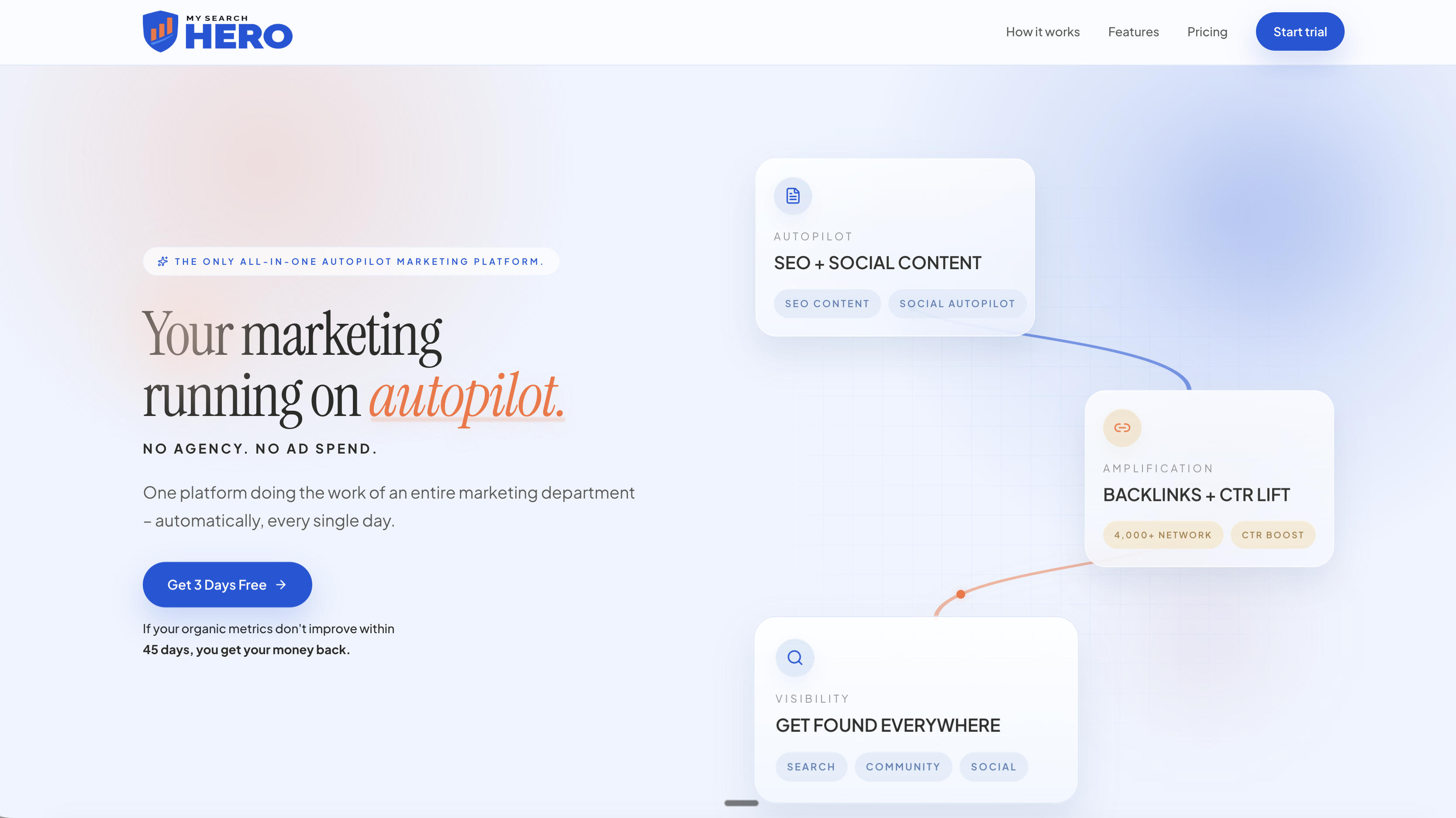
Mysearchhero is a done-for-you content and SEO service that publishes articles, builds backlinks, and generates social posts on autopilot every month. If you are serious about growing your online presence and driving qualified members into your community through search, Mysearchhero handles the content pipeline so you can focus on the relationships. Explore how the community growth tools at CallBack CRM pair with a strong content strategy to accelerate your results. Your marketing runs while you build.
FAQ
What is the fastest way to build an online community?
The fastest path is to start with a small, niche group around a specific shared problem, seed the space with starter posts and prompts, and respond personally to every early member. Speed comes from focus, not from broad outreach.
How many members do you need before a community feels active?
A community of 50 highly engaged members feels more active than one with 500 passive ones. Focus on engagement depth and response rates rather than total member count in the early stages.
What is the 90-9-1 rule in online communities?
The 90-9-1 rule states that 90% of members lurk, 9% contribute occasionally, and 1% create most of the content. Effective community design empowers the 1% and lowers barriers for the 9%.
Which platform is best for building an online community?
The best platform depends on your audience and goals. Discord suits real-time chat communities, Slack fits B2B professional networks, and Circle or Skool work well for course-led or membership communities.
How do you keep an online community active long-term?
Recurring rituals like weekly threads, monthly AMAs, and member spotlights create a predictable rhythm that keeps members returning. Tracking retention metrics monthly helps you catch and fix engagement problems before they compound.