
Three GA4 reports carry the weight of most SEO reporting: Traffic Acquisition filtered to Organic Search, Landing Pages filtered to organic and sorted by conversions, and the Google Organic Search reports unlocked once you link Search Console. Layer in one saved Exploration, built from landing page rows with sessions, engagement rate, key events, and revenue, and you have a weekly scoreboard worth checking every Monday. The rest of this guide walks through how to build each one, the KPIs worth watching, the admin settings that quietly wreck your historical data, and how to turn all of it into a repeatable workflow instead of a one-off dashboard nobody opens again.
TL;DR:
- GA4 traffic acquisition filtered to organic search provides a clear view of volume and engagement, especially when filtering by session source.
- Sorting landing pages by conversion rate rather than traffic highlights the pages most responsible for actual business results.
- Linking Search Console to GA4 offers visibility metrics that identify ranking issues and content gaps affecting search performance.
- Building a single saved exploration with key landing page data makes weekly SEO reporting efficient and actionable.
- Proper admin setup, including extending data retention and marking key events, ensures accurate, reliable SEO data over the long term.
Table of Contents
- GA4 SEO Reporting: Which Reports and KPIs Actually Matter
- How Do You Isolate Organic Traffic in GA4?
- Which Landing Pages Deserve Your Attention First?
- Linking Search Console to GA4: Setup and Payoff
- Building Your One Saved Exploration for Weekly Reporting
- GA4 Setup Checklist That Protects Your SEO Data
- How MySearchHero Turns These Reports Into a Weekly Habit
- MySearchHero: Skip the Dashboard-Building and Get the Reports Done For You
- Where to Learn More About GA4 for SEO
- Sources
- FAQ
GA4 SEO Reporting: Which Reports and KPIs Actually Matter
Most GA4 confusion for SEO comes from treating it like a firehose instead of a short checklist. You need four report types and five numbers. Nothing else earns a permanent spot on your dashboard.
The four reports:
- Traffic Acquisition, filtered to Organic Search, for a channel-level pulse check on volume and engagement.
- Landing Pages, filtered to organic and sorted by conversions, to find which content actually earns its keep.
- Google Organic Search Queries and Landing Pages, unlocked by linking Search Console, for the visibility layer GA4 can’t see on its own.
- A saved Exploration combining landing pages, organic traffic, and key events, for the weekly scan that replaces clicking through three separate menus.
The key KPIs worth tracking inside those reports include organic sessions, engagement rate, key events attributed to organic traffic, and landing-page performance (sessions against conversions, not sessions alone), along with revenue or lead value where applicable. Search Engine Journal frames Traffic Acquisition as the core report precisely because it pairs sessions and engagement with actual conversion events, not just raw traffic counts.
Here’s the part people miss: GA4 metrics and Search Console metrics answer different questions. Search Console tells you how visible you are in search results. GA4 tells you what happens after someone clicks. A page can rank on page one and still lose in GA4 if the content doesn’t match search intent. You need both numbers side by side to know whether a ranking problem is really a content problem, which is exactly what the Search Console integration later in this guide is built to solve.
How Do You Isolate Organic Traffic in GA4?
Open Reports > Acquisition > Traffic Acquisition, then filter the primary dimension to Session Default Channel Group equals Organic Search. That single filter turns a noisy, all-channel report into a clean organic scoreboard.
- Add a filter on the report (the funnel icon) for Session Default Channel Group = Organic Search.
- Add columns for sessions, engaged sessions, engagement rate, key events, and total revenue, removing any default columns you don’t use.
- Set the date range to a rolling 28 days with a comparison to the prior period, so growth or decline is visible without extra math.
- Sort by sessions first to check volume, then re-sort by key events to check whether that volume is converting.
Each metric earns its column for a reason: sessions show reach, engagement rate shows whether the content holds attention, key events show business impact, and revenue shows whether that impact is worth anything financially. Search Engine Journal points out that GA4 replaced Universal Analytics goals with events, which is why “key events” now does the job “goal completions” used to do.
Reading the row is where the actual work starts. A sessions dip with stable engagement usually points to a ranking or indexing issue, worth checking in Search Console before touching the site. A sessions increase with falling engagement rate often means new content is attracting the wrong query intent. High traffic with zero key events is a distribution win and a conversion failure at the same time. Each pattern points to a different fix, and none of them get solved by staring at a total sessions number in isolation.

Pro Tip: Save this filtered view as a custom report in the left navigation. Rebuilding the filter every Monday is the fastest way to stop checking it every Monday.
Which Landing Pages Deserve Your Attention First?
Go to Reports > Engagement > Landing Pages, filter to Organic Search using the same channel group filter, then sort the table by a key event column instead of sessions. That one sort order reorganizes your entire priority list from “what’s popular” to “what’s working,” and it’s the report Analytics Help treats as the most actionable view in GA4 for SEO.
Once sorted, pages tend to fall into three buckets:
- Protect: high sessions, high conversions. These pages carry real revenue weight, so any technical change, redesign, or content edit needs a monitoring plan before and after launch.
- Optimize: high sessions, low conversions. The traffic is there; the page isn’t closing the loop. This is a CTA, internal-linking, or page-layout problem, not a rankings problem.
- Promote: low sessions, high conversion rate. The content already works. It just isn’t getting seen enough, which points to backlinks, internal links from higher-traffic pages, or a fresh promotional push.
Sorting by conversions instead of sessions is what surfaces the “optimize” bucket, since sorting by traffic alone buries those pages under bigger, less efficient ones. It also surfaces the “promote” bucket, which is easy to miss entirely when you only look at your top ten pages by volume. A page ranking fifth for sessions but first for conversion rate deserves more attention than most SEO reports give it, and this is the report that makes that gap visible.
Linking Search Console to GA4: Setup and Payoff
Search Console handles visibility. GA4 handles behavior. Google’s own developer guidance is blunt about this: use both together, because neither tool alone tells the full story.
- In GA4, go to Admin > Product Links > Search Console Links, then click Link and choose the verified property.
- Select the data stream and confirm the association, then choose the web property you want connected.
- In the Reports library, find the unpublished Google Organic Search collection and publish it so it appears in the left navigation.
- Wait for data to populate. Search Console data appears in GA4 about 48 hours after collection, and Search Console itself only retains 16 months of history.
Once published, the Google Organic Search Queries and Google Organic Search Traffic reports add impressions, clicks, and click-through rate, metrics GA4 never tracks on its own. The catch is compatibility: these reports don’t mix cleanly with every GA4 dimension, so treat them as a separate lens rather than an extension of your standard exploration.
The highest-leverage move here is pairing the two datasets. Filter Search Console queries to positions 5 through 20 with high impressions and low click-through rate. Those are near-miss rankings where a better title tag or meta description could realistically move the needle. Then check whether the landing pages tied to those queries show strong engagement in GA4 but weak click volume in Search Console, a combination that points squarely at a title and snippet problem rather than a content problem.
Building Your One Saved Exploration for Weekly Reporting
The single most useful thing you can build in GA4 is one saved Exploration: landing page as the row dimension, filtered to Organic Search, with sessions, engagement rate, key events, and revenue as metrics, sliced by device if you want the extra layer. This is the view Voctos treats as the anchor of a repeatable weekly reporting cadence, and it’s the report worth bookmarking above every other GA4 screen.
Build it once under Explore > Blank, apply the filters and dimensions, then save it with a name specific enough that a teammate could open it cold and know what it’s for. From there:
- Export it weekly, or connect the underlying data to Looker Studio or BigQuery if you’re producing recurring client or stakeholder reports.
- Build a simple Looker Studio dashboard with four visuals: organic sessions trend, engagement rate by landing page, key events by landing page, and a query-level table pulled from the linked Search Console data.
- Reserve Path Exploration for deeper questions, like mapping what visitors do after landing on an organic page, useful when a page converts well on paper but you want to know the actual click path.
Pro Tip: Add a decay-detection view for your top ten organic pages, comparing this month’s sessions to the same month last year. Content decay shows up in trend lines months before it shows up in rankings.
GA4 Setup Checklist That Protects Your SEO Data
Most SEO reporting problems trace back to admin settings nobody touched after the property was created. Fix these once and every report above becomes more reliable.
- Extend data retention from the default two months to 14 months, the maximum GA4 allows in the interface. The default window quietly erases the year-over-year comparisons SEO reporting depends on, a gap Usercentrics flags as one of the most damaging default settings in the platform.
- Set the correct time zone and currency under Admin > Property Settings, since a mismatched time zone throws off day-level comparisons and a wrong currency corrupts every revenue figure downstream.
- Enable Enhanced Measurement so scroll depth, outbound clicks, and file downloads register automatically instead of requiring custom event code.
- Mark key events on your actual conversions, form submissions, calls, bookings, so they show up correctly across every report in this guide.
- Export to BigQuery if you need history beyond 14 months or want to join GA4 data with other business systems.
Pro Tip: After making these changes, submit a real test conversion (fill out your own form) and confirm it appears as a key event within a day. Confirm the Search Console link is publishing data within the 48-hour window before you trust any query report.
How MySearchHero Turns These Reports Into a Weekly Habit
The saved Exploration doesn’t help anyone if it just sits there. We check it every Monday morning: organic sessions, engagement rate, key events, and any AI referral traffic showing up in the newer AI Assistant channel row. Anything that dips gets triaged the same day, either a technical flag worth checking against Search Console or a content page that needs a second look.
Monthly, those weekly numbers roll into three workstreams: content refresh sprints for pages showing decay, internal-linking passes for high-converting pages stuck at low traffic, and outreach pushes for pages that already convert but need more visibility.
[brand_signal]
— Mike
MySearchHero: Skip the Dashboard-Building and Get the Reports Done For You
Building the reports in this guide takes real setup time, and most small business owners don’t have a spare afternoon for GA4 filters and saved Explorations. A done-for-you service can replace that entire workflow with monthly SEO articles, backlinks, Reddit mentions, and social posts delivered on autopilot, paired with reporting that tracks whether the content is actually moving organic traffic and conversions.
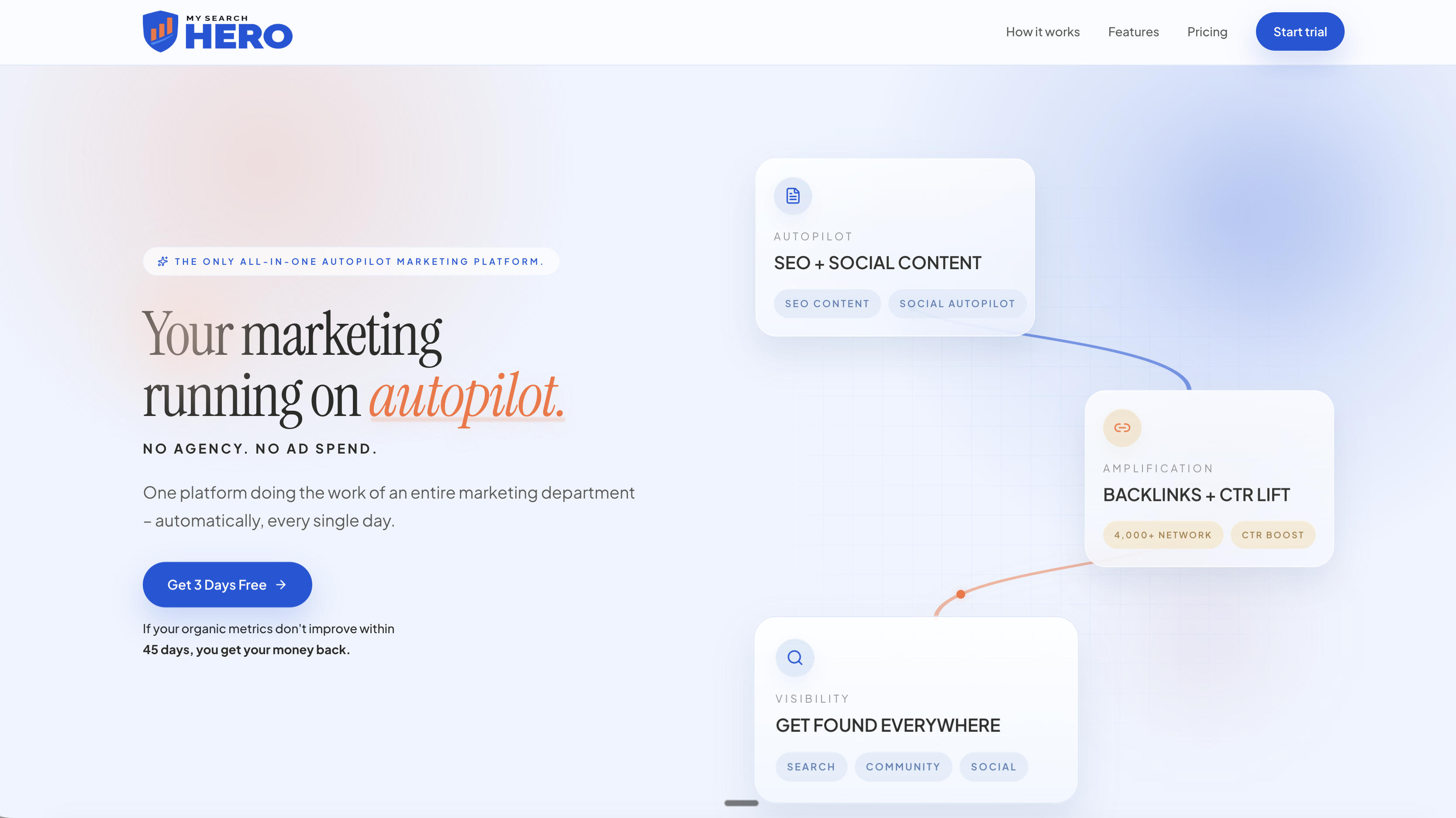
Instead of hiring separate vendors for content, links, and reporting, Mysearchhero bundles all of it into one subscription starting with the Hero plan at $397 per month, backed by a 45-day money-back guarantee if your organic metrics don’t move. If the GA4 setup above feels like more than you want to manage yourself, check current plans and start a trial to see what a done-for-you version of this reporting cadence looks like for your business.
Where to Learn More About GA4 for SEO
For the primary reference on organic reporting and Search Console linking, see Analytics Help and Google’s Search Console connection guide. For step-by-step report builds, Voctos and Search Engine Journal walk through the reasoning behind each metric choice, and Usercentrics covers the retention settings that protect your historical data.
Sources
- Analyze organic search results for your website in Analytics — Analytics Help
- Essential GA4 Reports You Need To Measure Your SEO Campaigns — Search Engine Journal
- GA4 Reports for SEO Priorities: A Practical Guide — Voctos
- GA4 data retention guidance — Usercentrics
FAQ
Is SEO Still Worth It in 2026?
Yes. Organic search remains one of the few channels that compounds over time instead of shutting off the moment you stop paying for it. The tools for measuring it have changed, GA4 replacing Universal Analytics being the biggest shift, but the underlying value of ranking well hasn’t gone anywhere.
What Is the Best Tool for SEO Reporting?
GA4 paired with Search Console covers most of what SEO reporting needs: GA4 for behavior and conversions, Search Console for visibility metrics like impressions and click-through rate. For businesses that want the reporting handled without building dashboards themselves, Mysearchhero bundles content, promotion, and reporting into one recurring service.
Which Two GA4 Reports Are the Most Useful for SEO?
Traffic Acquisition filtered to Organic Search and Landing Pages filtered to organic and sorted by conversions. The first shows whether organic volume and engagement are healthy at a channel level, and the second shows exactly which pages convert that traffic into business results, a combination Analytics Help treats as the most actionable pairing in GA4.
What Is the 80/20 Rule in SEO?
In practice, most SEO results come from a small share of pages and queries, meaning a handful of landing pages or search terms usually drive most of your organic conversions. That’s exactly why sorting the Landing Page report by conversions matters more than sorting by traffic. It surfaces that small, high-value group instead of burying it under high-traffic pages that don’t convert.