
An authority backlink is an editorial, contextual link from a trusted, topically relevant site that passes real trust to your page. It matters because higher link authority correlates with higher rankings, but the single best next step for most small businesses isn’t chasing metrics. It’s landing a handful of genuinely relevant editorial placements each month, on top of a clean local citation foundation.
TL;DR:
- Most effective backlinks result from editorial placements on relevant sites, with placement in the article body passing more authority than footer links.
- The total number of backlinks matters less than diversity, relevance, and the quality of referring domains, with top-ranking pages averaging nearly four times more backlinks.
- Evaluation of backlink opportunities should prioritize topical relevance, placement in the content, dofollow status, and real organic visibility over general domain metrics.
- Building authority backlinks involves contextual insertions, guest posting, broken link repairs, local sponsorships, and content that naturally attracts links, rather than mass link buying.
- Manipulative or bulk paid links can lead to penalties, so focusing on organic, editorial, and locally relevant links is safer and more sustainable.
Table of Contents
- What Are Authority Backlinks in SEO, Really?
- Do Backlinks Actually Correlate With Higher Rankings?
- How Do You Evaluate a Prospective Backlink?
- What Are the Best Tactics for Building Authority Backlinks?
- How Do You Measure Backlink Impact Month to Month?
- What Backlink Practices Put Your Site at Risk?
- How Are Authority Backlinks Different From Other Link Types?
- How Do You Recover From a Backlink Penalty or Algorithm Update?
- Why Does Content Quality Determine Whether You Earn Links?
- What Do Successful Authority Backlink Campaigns Look Like?
- MySearchHero’s Approach to Building Authority Backlinks
- Should You Handle Backlinks Yourself or Hire It Out?
- Sources
- FAQ
What Are Authority Backlinks in SEO, Really?
Forget the idea that one number tells you whether a link is good. A link’s authority comes from four things working together: editorial intent (someone chose to link because your content deserved it, not because you paid a fee), topical relevance (a plumbing site linking a plumbing page beats a random lifestyle blog doing the same), placement (a link buried in a footer counts for far less than one embedded in the body of an article), and whether it’s dofollow (which passes ranking signal) or nofollow (which mostly doesn’t).
That’s why Moz’s explanation of backlinks frames them as votes of confidence that feed into a page’s E-E-A-T, not as a raw counting exercise. A page with fifty low-relevance links can lose to a page with five that actually fit the topic.
A quick glossary helps here, since these terms get thrown around loosely:
- Referring domain: a unique website linking to you (10 links from one site count as one referring domain).
- Referring page: the specific page carrying the link.
- Anchor text: the clickable words in the link, which help search engines understand what the linked page is about.
Do Backlinks Actually Correlate With Higher Rankings?
Yes, and the gap is not subtle. Backlinko’s ranking factors analysis found the average number one result carries roughly 3.8 times more backlinks than pages sitting in positions two through ten. Sites with stronger overall link authority also tend to hold more first-page rankings across the board.
The number that matters: pages ranking first average nearly four times the backlinks of everything below them, according to Backlinko’s research.
Diversity matters as much as volume. Ten links from ten different referring domains typically carry more weight than ten links from the same site, because each new domain is a separate vote. None of this means links guarantee a ranking. A page with weak content and great backlinks still loses to a page with strong content and modest links. Backlinks are necessary fuel, not the whole engine.
How Do You Evaluate a Prospective Backlink?
Before you spend an hour on outreach or hand money to a link seller, run the opportunity through a short screening process. This keeps you from wasting effort on placements that look impressive but do nothing for rankings.
- Check topical relevance first. Does the site cover your industry, your region, or an adjacent topic a real customer would read about?
- Look at placement. Is the link inside the article body, or stuffed into a sidebar, footer, or a generic resource page nobody visits?
- Confirm dofollow status. View the page source or use a browser extension to see if the link carries a
rel="nofollow"tag. - Check for real organic visibility. A site with almost no organic traffic isn’t sending real authority, regardless of what its metrics claim.
- Look at domain trust metrics last, not first. Domain Rating and Domain Authority are useful tiebreakers, never the primary filter.
A relevant link from a smaller, niche site often outperforms an irrelevant link from a massive domain, according to BacklinkBot’s analysis of authority backlinks. A DR 50 plumbing blog linking to your plumbing page can outweigh a DR 90 celebrity gossip site that mentions you in passing.
Pro Tip: Save every prospective link in a spreadsheet with columns for relevance, placement, and dofollow status before you reach out. It takes five minutes and stops you from chasing the wrong sites later.
What Are the Best Tactics for Building Authority Backlinks?
Start with the tactics that use an editor’s existing audience and existing pages, rather than asking someone to build something new for you. That’s the fastest route to a real “yes.”
- Contextual link insertions. Find pages that already mention a topic close to yours and pitch a natural addition to the existing content. This works because you’re not asking for a favor, you’re improving something that already exists.
- Guest posting done right. Pitch a topic the target site’s audience actually wants, not a thin post built around your anchor text. Editorial guest posts on relevant sites remain one of the more dependable tactics for earning high-authority links.
- Broken-link building. Find dead links on resource pages in your niche, then offer your content as the replacement. Site owners appreciate the fix, and you get a contextual placement in return.
- Journalist outreach through HARO-style platforms. Reporters need quick expert quotes, and a well-timed pitch can land you a link from a publication you’d never get through cold outreach alone.
- Local relationship and sponsorship links. A chamber of commerce listing, a Little League sponsorship, or a mention in the local paper carries geographic relevance a national blog never will. This is often underrated by small business owners rushing to compete nationally.
- Content plays that pull links naturally. Original data, a local salary or pricing survey, or a genuinely useful evergreen guide gets linked without you asking, because writers need something to cite.
Contextual insertions and broken-link repairs deliver a strong return precisely because they leverage a page’s existing audience instead of starting from zero.
Pro Tip: When you pitch a guest post or insertion, ask specifically for an in-content, dofollow placement. Vague requests get you buried in a sidebar; specific requests get you read.
If you want distribution help beyond direct outreach, creator partnerships through a service like Chatterlinkk can extend your content’s reach into audiences that later cite or link it organically.
How Do You Measure Backlink Impact Month to Month?
Track a small set of numbers instead of drowning in a dashboard. The ones that actually tell you whether your effort is working:
- New referring domains per month, not total links (quality over quantity).
- Organic traffic to the specific pages you targeted with outreach.
- Keyword rankings for the terms those pages were built to rank for.
- Referral traffic clicking through from the new links themselves.
- Branded search volume, which often rises quietly after a wave of press or guest post coverage.
A realistic monthly cadence for a small business: a handful of outreach emails sent weekly, two to four pieces of genuinely linkable content published per month, and one audit of new referring domains at month’s end to catch anything unnatural. Pick two or three pages to target at a time rather than spreading effort across your whole site. A concentrated push toward your top service pages or local landing pages produces visible movement faster than a scattershot campaign touching everything at once.
What Backlink Practices Put Your Site at Risk?
Manufactured links leave fingerprints: identical anchor text repeated across dozens of low-relevance directories, a sudden burst of links appearing in a single week, or placements on sites that exist purely to sell links. Google’s algorithms are built to catch exactly this pattern, and paid or unnatural link schemes can trigger a manual action or an algorithmic devaluation that quietly erases your rankings.
If you suspect your profile is compromised:
- Stop the risky practice immediately, including any active link-buying subscriptions.
- Document where the suspicious links came from before you do anything else.
- Redirect effort toward editorial outreach and local relationship links to rebuild organically.
- Use Google’s disavow tool only for direct, clearly manipulative links, and treat it as a last resort rather than routine maintenance.
How Are Authority Backlinks Different From Other Link Types?
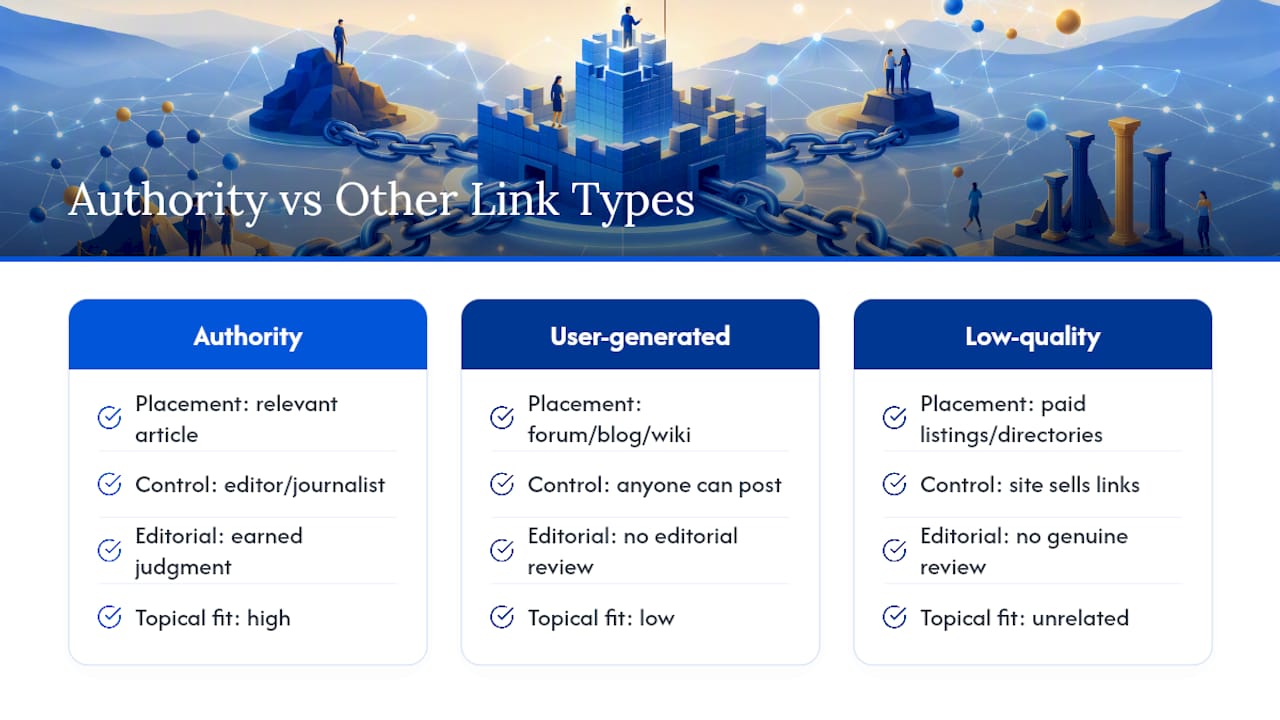
Not every link on the internet carries the same weight, and lumping them together is where a lot of business owners get confused. An authority backlink is earned editorially: someone reads your content, decides it adds value, and links to it inside a relevant article. User-generated links work differently. Think forum comments, blog comment sections, or open wiki edits where anyone can drop a URL. These links exist because a system allows it, not because an editor judged the content worthy, and search engines have known this for years, which is why most comment and forum links carry a nofollow tag by default.
Low-quality links share a different problem: they might be dofollow and technically placed in content, but the site hosting them has no real audience, no topical connection to your business, and often exists solely to sell placements. A directory listing on a defunct “SEO resource” site with a Domain Rating of 3 and zero organic traffic is a low-quality link even if it’s dofollow and sits in the body text.
The practical test isn’t the link type’s category; it’s whether a real editor with a real audience decided your content deserved a mention. A single guest post on a relevant regional business journal will typically outperform fifty user-generated forum links combined, because the journal link carries editorial judgment and topical fit that forum spam never will. When you’re evaluating a link opportunity, ask who controls the placement and why it exists. If the answer is “anyone can post here” or “this site sells links to whoever pays,” you’re not looking at an authority backlink no matter what the metrics say.
How Do You Recover From a Backlink Penalty or Algorithm Update?
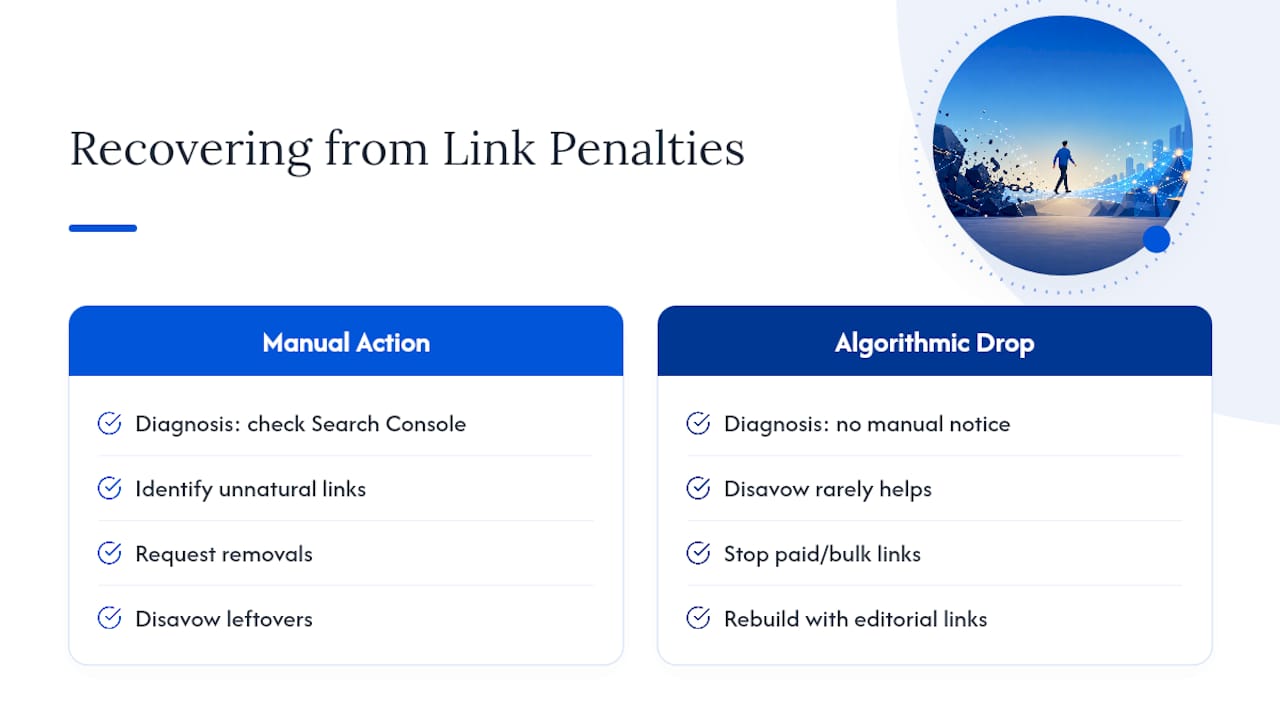
Recovery starts with diagnosis, not action. Check Google Search Console for a manual action notice under the Security & Manual Actions section. If nothing appears there, but your rankings dropped sharply after a known core update, you’re likely dealing with an algorithmic reassessment of your link profile rather than a manual penalty, and the fix looks different.
For a manual action tied to unnatural links, the process is specific: identify every link you know to be paid, exchanged, or otherwise manipulative, request removal directly from webmasters where possible, and disavow what you can’t get removed. Submit a reconsideration request through Search Console once cleanup is documented, explaining what happened and what changed.
For an algorithmic drop with no manual action, disavowing rarely helps on its own. Google’s systems are reassessing your entire link profile’s quality and relevance, not penalizing a specific set of links. The better move is rebuilding: shift spending away from any bulk or paid link tactics entirely, and invest in the editorial approaches covered earlier, guest posts, contextual insertions, local relationship links, until your ratio of genuine editorial links to manufactured ones improves naturally.
Either path takes patience. Link-related recoveries often play out over several algorithm cycles, not one refresh. Businesses that stop the harmful practice immediately and focus on steady, relevant coverage tend to recover faster than those that panic and mass-disavow everything, which can strip out links that were actually helping.
Why Does Content Quality Determine Whether You Earn Links?
Nobody links to thin content, no matter how good your outreach email sounds. Editorial links are decisions, and editors only make that decision when your page genuinely helps their reader or adds something their own content lacks: original data, a clearer explanation, a local angle their audience needs.
This is why content quality and backlink acquisition aren’t two separate workstreams, they’re the same effort viewed from different angles. A page built around a genuinely useful local pricing guide or an original survey gives outreach something to sell. A page that just restates common knowledge gives outreach nothing to pitch, no matter how many emails you send.
Relevance compounds this. A page that precisely matches a target site’s audience and topic gets linked far more easily than a page that’s merely “related.” If you sell HVAC services and pitch a local news outlet, an article breaking down regional energy costs will land better than a generic “why AC maintenance matters” post, because it gives the journalist a locally specific hook.
The practical implication for small business owners: before you spend hours on outreach, ask whether the page you’re pitching is actually worth linking to. If it isn’t, fix the content first. Building an editorial link to a mediocre page is possible but rare, and it usually takes far more outreach volume to succeed than building the same link to a page that earns it on its own merit.
What Do Successful Authority Backlink Campaigns Look Like?
The pattern across effective campaigns is consistency over intensity. A regional service business that publishes one genuinely useful local resource, say, a cost breakdown for a common home repair specific to its city, and pitches it to local news and community sites tends to accumulate a handful of durable, relevant links over several months rather than one viral spike.
Broken-link repairs follow a similarly quiet pattern: a business identifies outdated resource pages in its niche, offers an updated replacement, and picks up a steady trickle of placements from site owners who were already looking to fix a dead link anyway. This tactic rarely produces a dramatic before-and-after story, but it compounds. Ten small, relevant placements over a year often outperform one aggressive burst of fifty low-relevance links, both in ranking impact and in how safely the profile ages.
Local relationship links show the same slow-build pattern. A sponsorship of a community event or a chamber of commerce membership rarely moves rankings by itself, but stacked alongside a few editorial placements and a clean citation base, it contributes to the kind of steady local link profile that pushes a business into the local map pack over time. The common thread across all of these examples isn’t a clever trick. It’s repetition of a defensible tactic long enough for the compounding to show up in rankings.
MySearchHero’s Approach to Building Authority Backlinks
Mysearchhero runs backlink acquisition as a steady monthly pipeline rather than a one-off sprint: published articles, editorial backlinks through a publisher network, Reddit mentions in relevant conversations, and automated social posts, all moving on a consistent schedule. That cadence matters because rapid, one-off link campaigns are exactly the pattern Google’s systems flag as unnatural. A slow, editorial drip looks like normal business growth instead. For readers who want the mechanics behind this, the monthly editorial backlinks workflow breaks down how the placements actually happen.
— Mike
Should You Handle Backlinks Yourself or Hire It Out?
Doing this yourself is entirely possible, but it eats hours every week that most small business owners don’t have. Mysearchhero exists for the owner who wants the editorial backlink strategy covered above running in the background without personally cold-emailing bloggers every Tuesday.
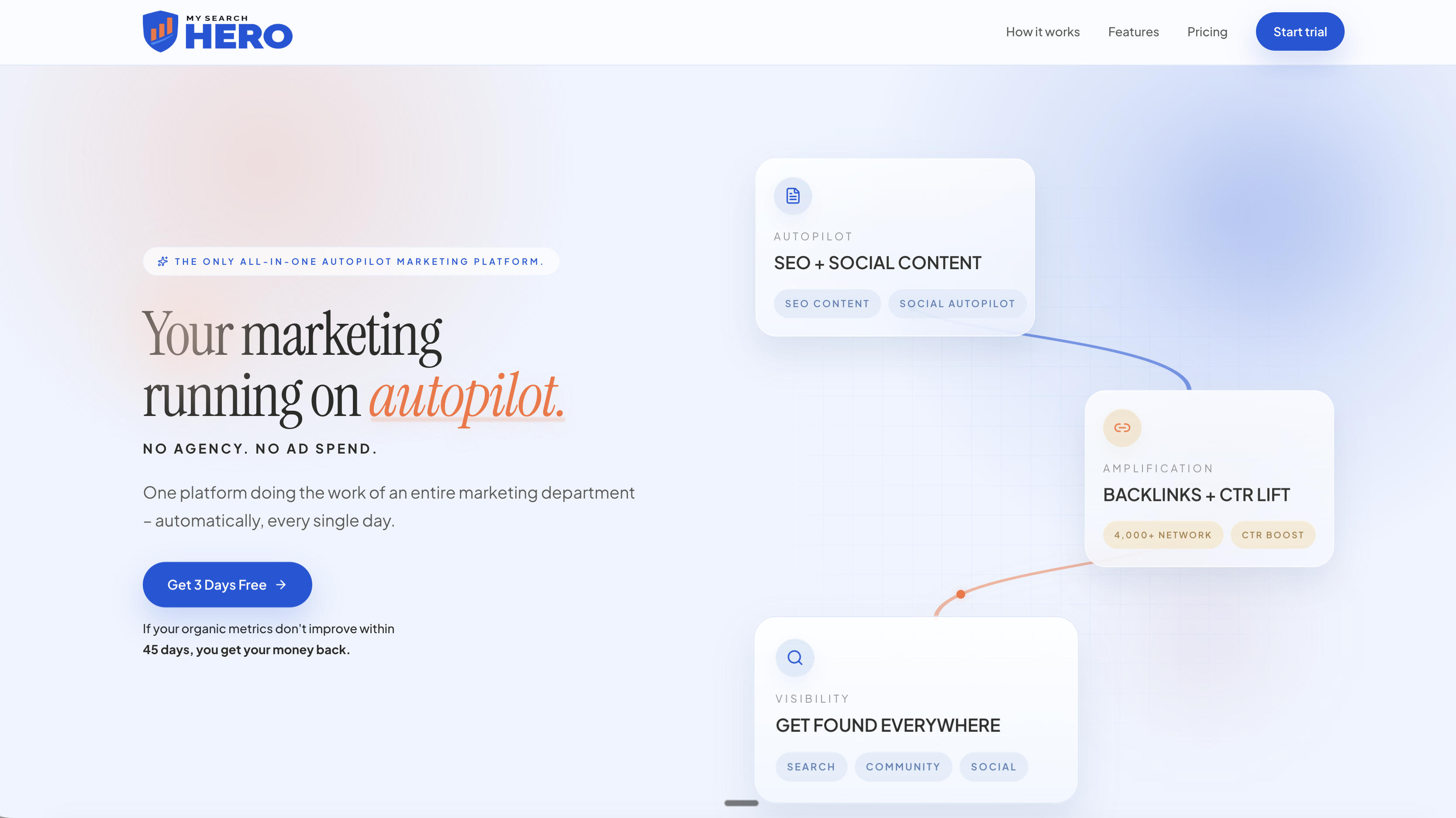
A subscriber receives a bundle of deliverables each month, including published SEO articles, authority backlinks, Reddit mentions in relevant conversations, and AI-generated social posts across platforms, all pushed out automatically. This fits a specific profile best: a local or service-based business that knows it needs consistent editorial coverage but has no in-house marketing team to chase it down manually. The plans run from an entry-level tier up through a higher tier that bundles SEO articles, backlinks, CTR signal boosting, Reddit presence, and social automation into one subscription, backed by a money-back guarantee if organic metrics don’t move. If you’d rather review the tiers yourself, Mysearchhero’s plans lay out exactly what each one includes.
Sources
External: Moz on backlinks, Backlinko ranking factors, Local Link Building Journal. Internal: How to Get Backlinks, Link Building Explained.
- What Are Backlinks In SEO and Why Are They Important? – Moz
- Search Engine Ranking Factors – Backlinko
- Local Link Building: How to Dominate Your Local Market (2026 Guide) – Link Building Journal
FAQ
What Is a High-Quality Authority Backlink?
It’s an editorial link, placed inside relevant content, on a topically related site that carries real dofollow value. Placement and relevance matter more than a raw metric score, according to BacklinkBot’s breakdown of authority backlinks.
How Many Backlinks Does a Small Business Need?
There’s no fixed number. What matters more is the diversity of referring domains and how relevant each one is to your industry, since Backlinko’s data shows top-ranking pages average nearly four times the backlinks of pages ranking below them.
Are Local Citations the Same as Local Backlinks?
No. Citations are structured NAP (name, address, phone) listings, while local backlinks are editorial links from local media, chambers, or sponsorships. Citations build the trust foundation that local backlinks then multiply.
How Much Does Mysearchhero Cost?
Mysearchhero’s plans start at $197 per month for the Spark tier and go up to $397 per month for the Hero tier, which includes the full backlink, content, and social bundle. Full pricing and plan details are available on the Mysearchhero site.
Can Buying Backlinks Get My Site Penalized?
Yes, paid links that look manufactured, especially with identical anchor text or sudden unnatural bursts, can trigger a manual action or algorithmic devaluation from Google. The safer route is editorial outreach and contextual placements built over time rather than bulk purchases.