
TL;DR:
- Effective small business branding starts with clear foundational elements that guide all decisions and messaging. Consistent visuals, strategic digital presence, and ongoing customer feedback are essential for building trust and engagement with your audience. Prioritizing strategy over aesthetics and iterating with feedback ensures long-term growth without excessive costs.
Standing out online isn’t just about having a nice logo. For small businesses, branding is the difference between being forgotten and being chosen. Research confirms that brand orientation via digital channels measurably boosts business performance, yet most small business owners treat branding as an afterthought. This guide cuts through the noise and gives you practical, research-backed strategies you can start using today, whether you’re launching your first business or refreshing a brand that’s stopped getting results.
Table of Contents
- Start with your brand foundations
- Design consistent visuals and messaging
- Leverage digital channels for maximum reach
- Iterate your branding with customer feedback
- Side-by-side comparison: Top branding moves for small businesses
- The branding trap most small businesses miss
- Take your branding further with My Search Hero
- Frequently asked questions
Key Takeaways
| Point | Details |
|---|---|
| Build brand foundations | Clarify your brand purpose, values, and audience to guide every decision. |
| Stay visually consistent | Unified logos, colors, and tone make your small business memorable. |
| Activate digital channels | Leverage websites and social media to maximize your brand’s reach and impact. |
| Iterate with feedback | Use customer insights to continuously improve your brand strategy. |
| Quality beats shortcuts | Investing in real, intentional branding pays off more than ‘good enough’ fixes. |
Start with your brand foundations
Before you design a single graphic or write a single social post, you need to know what your brand actually stands for. This is where most small businesses skip ahead and pay for it later. Skipping your foundations is like building a house on sand. Everything looks fine until the first storm hits.
According to branding experts, the six core brand elements every small business needs to define are:
- Brand purpose: Why does your business exist beyond making money? What problem are you solving, and why does it matter?
- Core values: What principles guide every decision you make, from how you hire to how you respond to a negative review?
- Unique value proposition (UVP): What makes you the obvious choice over every competitor in your space? This is your clearest competitive edge.
- Target audience: Who exactly are you serving? Get specific. “Women aged 30 to 45 who run online businesses” is far more useful than “small business owners.”
- Positioning: Where do you sit in the market? Are you the premium option, the most accessible, the fastest, or the most specialized?
- Brand voice and personality: Do you sound like a trusted friend, a sharp expert, or an enthusiastic coach? Your tone should be consistent everywhere.
Defining these six elements gives you a decision-making filter for everything else. When you’re unsure whether a marketing idea fits your brand, you check it against these foundations. If it doesn’t align, you skip it. Simple.
For crafting your UVP, start by listing three things you do better than anyone else, then ask your best customers which one they value most. Their answer is usually your UVP.
Pro Tip: Interview three to five of your best customers and ask them why they chose you over competitors. Their exact words are often more powerful than anything your marketing team could write. Use their language directly in your messaging.
Design consistent visuals and messaging
With solid foundations in place, give your brand a visual identity that’s instantly recognizable wherever customers encounter you. Consistency is the engine of trust. When someone sees your brand on Instagram, then on your website, then in their email inbox, and it all looks and sounds the same, they start to feel like they know you. That familiarity is what drives purchases.
Here’s a practical checklist for building visual and messaging consistency:
- Logo: You need a primary logo and at least one simplified version for small formats like profile pictures and favicons. Avoid overly complex designs that blur at small sizes.
- Color palette: Pick two to three primary colors and one or two accent colors. Write down the exact hex codes and use them everywhere, no exceptions.
- Typography: Choose two fonts maximum. One for headlines, one for body text. Free options like Google Fonts give you professional results at zero cost.
- Tone of voice: Write a one-page guide that describes how your brand sounds. Include three words that describe your tone, two things you always say, and two things you never say.
- Templates: Create reusable templates for social posts, email headers, and presentations so every piece of content looks like it came from the same place.
- Image style: Decide whether your brand uses bright, airy photography or bold, high-contrast visuals. Stick to it.
One of the most expensive mistakes founders make is treating branding as a one-time task they can revisit later. Forbes warns that “good enough” branding leads to higher long-term costs because you end up rebuilding trust every time your brand looks inconsistent. Invest in getting the strategy right from the start, even if the execution is simple.
Pro Tip: Free tools like Canva, Looka, and Coolors let bootstrapped businesses build a polished visual identity without hiring a designer. Start there, then upgrade your assets as revenue grows.

Leverage digital channels for maximum reach
Once you’ve nailed the look and feel, it’s time to activate your brand across the digital landscape. Digital channels are where small businesses have the biggest opportunity to compete with larger players, because reach is no longer determined by budget alone. It’s determined by strategy and consistency.
Here’s a step-by-step approach to launching your brand digitally:
- Build a branded website first. Your website is your most credible digital asset. It needs to clearly communicate your UVP within five seconds of someone landing on it. Use your brand colors, fonts, and voice throughout.
- Claim your Google Business Profile. This is non-negotiable for any local or service-based business. A complete, optimized profile puts you in front of people searching for exactly what you offer.
- Choose two social media platforms strategically. Don’t spread yourself thin across every platform. Pick the two where your target audience spends the most time and show up there consistently.
- Create a content calendar. Plan your posts, articles, and emails at least two weeks in advance. Consistency signals credibility to both algorithms and potential customers.
- Set up local business listings. Beyond Google, make sure your business is listed accurately on Yelp, Bing Places, and any industry-specific directories. Consistent name, address, and phone number data across all listings boosts your local search visibility.
- Track your brand mentions. Use free tools like Google Alerts to monitor what people are saying about your business online. Responding to mentions, both positive and negative, shows that a real person is behind the brand.
“A systematic review of SME branding research confirms that brand orientation and digital marketing together produce significantly stronger business performance outcomes than either approach alone.”
The key insight here is that digital channels don’t just give you reach. They give you measurable reach. You can see exactly which content resonates, which platforms drive traffic, and which messages convert. Use that data to sharpen your brand over time.
Iterate your branding with customer feedback
Launching your brand is just the beginning. Real impact comes from learning and evolving with your customers. The brands that stay relevant over years and decades are the ones that treat customer feedback as a strategic asset, not an annoyance.
Here’s a simple three-step iteration process any small business can use:
- Collect feedback systematically. Don’t wait for reviews to appear randomly. Send short surveys after purchases, ask for feedback during customer service interactions, and monitor your online reviews weekly. Tools like Typeform and Google Forms make this easy and free.
- Identify patterns, not outliers. One customer complaint doesn’t mean you need to overhaul your brand. But if five different customers say your website is confusing, that’s a signal worth acting on. Look for themes across multiple feedback sources before making changes.
- Make small, intentional updates. Update your messaging, visuals, or positioning in small increments. Test a new tagline for 30 days. Try a different tone in your email subject lines. Measure the impact before rolling out bigger changes.
The research backs this up. Experts consistently advise businesses to iterate with feedback rather than chasing perfection from the start. A brand that’s 80% right and improving is always more effective than one that’s stuck waiting to be 100% perfect before launching.
Pro Tip: Never let customer feedback override your core brand identity. If feedback suggests you should sound “more casual,” test it. But if it suggests you should abandon your values or positioning, that’s a sign you may be attracting the wrong customers, not that your brand is wrong.
Side-by-side comparison: Top branding moves for small businesses
The best branding strategies depend on your specific business, so let’s compare them side by side. Use this table to decide where to start or where to double down based on your current situation.
| Strategy | Difficulty | Impact | Best for |
|---|---|---|---|
| Define brand foundations | Low | Very high | All businesses, especially new ones |
| Build visual consistency | Medium | High | Businesses with existing customers |
| Launch on digital channels | Medium | Very high | Businesses ready to scale reach |
| Optimize Google Business Profile | Low | High | Local and service-based businesses |
| Collect and act on feedback | Low | Medium to high | Established businesses refining their brand |
| Create a content calendar | Medium | High | Businesses wanting consistent visibility |
| Develop brand voice guidelines | Low | High | Teams with multiple people creating content |
Research into SME branding pillars consistently points to two areas that drive the most performance: getting your core brand elements right and activating those elements through digital channels. If you’re short on time, start there and build outward.
The table above also reveals something important. The highest-impact strategies tend to be the ones that require the least financial investment. Defining your brand foundations costs nothing but time. Claiming your Google Business Profile is free. Building a consistent visual identity with free tools is accessible to any business at any stage.
The branding trap most small businesses miss
Here’s the uncomfortable truth that most branding guides skip over. Most small businesses don’t have a branding problem. They have a thinking problem.
They spend money on logos, social media managers, and ad campaigns before they’ve ever answered the question: “Why should anyone care about this brand?” The result is a business that looks polished on the surface but has no real identity underneath. Customers can feel that emptiness, even if they can’t name it. It’s why some businesses with beautiful branding still struggle to build loyalty.
The real ROI of branding isn’t in the logo. It’s in the clarity. When you know exactly who you are, who you serve, and why you’re different, every marketing decision becomes faster and cheaper. You stop wasting money on campaigns that don’t fit. You stop second-guessing your messaging. You start attracting customers who actually align with what you offer.
We’ve seen this pattern repeatedly. Businesses that invest in building brand strategy before tactics consistently outperform those that lead with execution. The ones who skip strategy often end up rebuilding their brand from scratch within two years, which costs far more than getting it right the first time.
The Forbes insight that “good enough” branding leads to higher long-term costs isn’t just about aesthetics. It’s about the compounding cost of confusion. Every time a customer isn’t sure what your brand stands for, you lose a little more trust. And trust, once lost, is expensive to rebuild.
The fix isn’t perfection. It’s intention. Slow down, do the strategic thinking first, and your execution will be faster, cheaper, and far more effective.
Take your branding further with My Search Hero
Ready to put these branding strategies into action? Building a strong brand foundation is one thing. Consistently executing it across digital channels, week after week, is where most small businesses run out of time and energy.
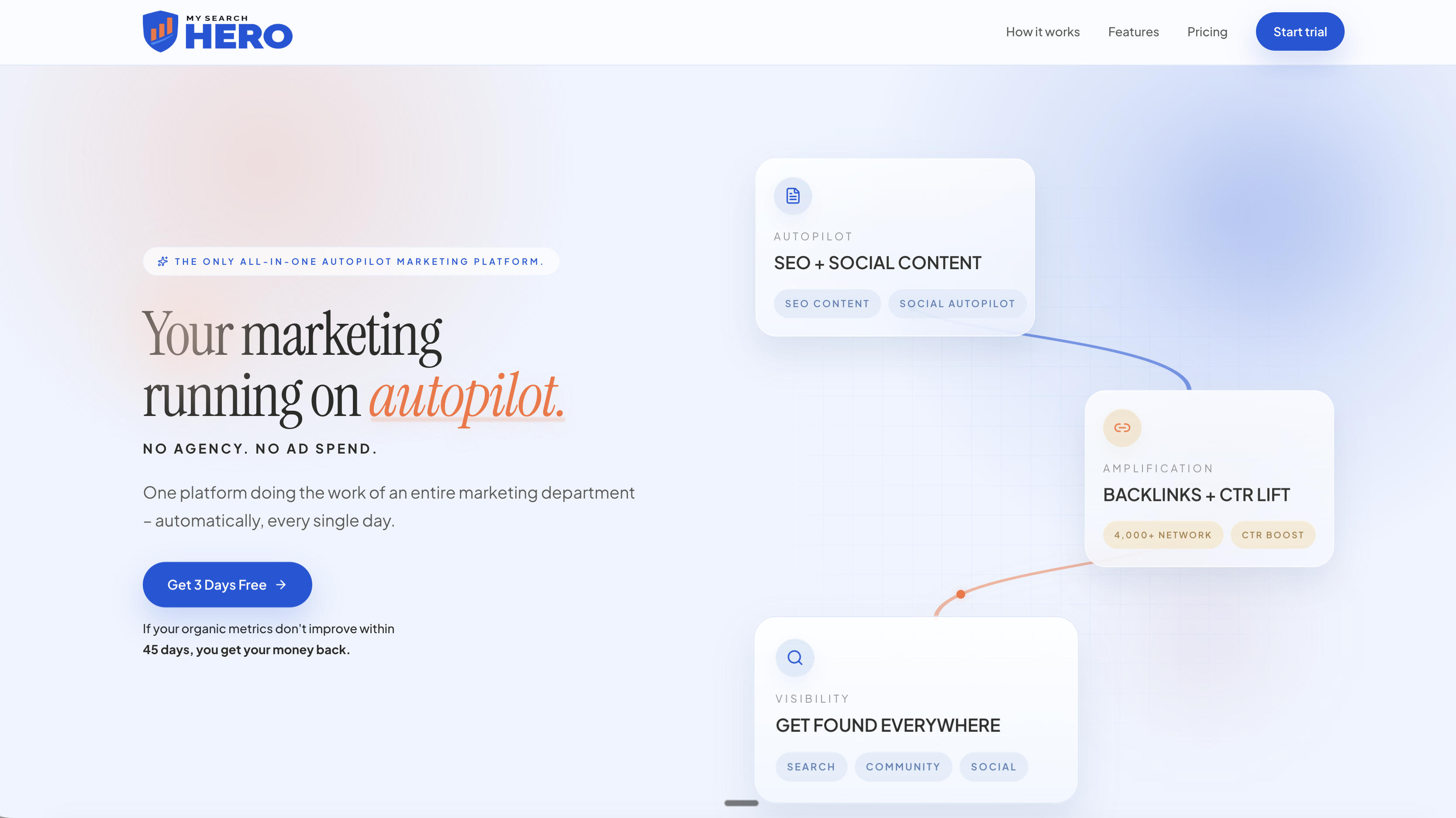
That’s exactly what branding solutions for small businesses at MySearchHero are built for. Every month, our done-for-you service pushes out published articles, backlinks, Reddit mentions, and AI-generated social media posts through a fully automated pipeline. You get consistent brand visibility across the channels that matter, without adding another item to your to-do list. If you’re serious about growing your online presence and attracting more of the right customers, MySearchHero puts your marketing on autopilot so you can focus on running your business.
Frequently asked questions
What are the first steps in creating a small business brand?
Define your brand’s purpose, values, UVP, and target audience before anything else. These core brand elements form the strategic foundation that every other branding decision should build on.
How do digital channels affect small business branding?
Digital channels like social media and websites amplify brand reach and customer engagement significantly. Research shows that brand orientation via digital marketing produces measurably stronger business performance for small and medium-sized businesses.
Is it necessary to update branding over time?
Yes, regular iteration with feedback keeps your brand relevant and effective as your market evolves. Experts recommend that businesses iterate with feedback rather than waiting for perfection before making improvements.
Can branding be effective on a small budget?
Yes, by focusing on strategy and consistency over perfection, even bootstrapped businesses can build powerful brands. Defining your core brand elements costs nothing but time and sets the stage for every other investment you make.