
Geo-targeted content delivers different messaging, offers, or pages to people based on where they physically are, and it earns its budget fastest for businesses with a physical location, multi-store inventory, or a live event to promote. If you run a single website with one homepage trying to rank everywhere, this is the fix. If you already have location pages that all read the same, this is why they aren’t working.
The tactic pays off in three scenarios: brick-and-mortar stores fighting for map-pack visibility, retailers whose inventory varies by location, and businesses running time-sensitive local promotions. The toolkit includes hyper-local landing pages, distance-aware calls to action, geofenced offers, and a measurement setup that proves lift instead of guessing at it.
- Store visits and footfall campaigns
- Multi-location inventory pages
- Event or campus-specific promotions
- Territory-based pricing or offers
Pro Tip: Before building a single page, pull your last twelve months of transaction data and map where your actual customers live. Most businesses guess their trade area. The data usually surprises them.
Key Takeaways
Geo-targeted content works when it pairs neighborhood-level specificity with a measurement plan that proves lift instead of assuming it.
| Point | Details |
|---|---|
| Definition matters | Geotargeting serves broader areas; geofencing triggers on entry/exit of a specific perimeter. |
| Best candidates | Businesses with a physical trade area, multi-location inventory, or time-sensitive local offers. |
| Content quality | Every local page needs at least three unique proof points to avoid clone-page penalties. |
| Measurement | Geo holdouts and matched markets prove lift; platform dashboards alone overstate it. |
| Pilot approach | Mysearchhero supports small pilot rollouts (3 to 5 pages) with schema, backlinks, and holdout reporting. |
Table of Contents
- What’s the Difference Between Geo Targeted Content and Geofencing?
- When Does Geo Targeted Content Actually Move the Needle?
- How Do You Build a Geo Targeted Content Playbook Step by Step?
- Which Channels Work Best for Geo Targeted Campaigns?
- How Do You Measure Whether Geo Targeting Is Working?
- What Mistakes Waste Geo Targeting Budget?
- How Mysearchhero Supports a Geo Targeting Pilot
- What Actually Matters in Geo Targeted Content Right Now
- Mysearchhero: Your Path to Geo Targeting Without Hiring an Agency
- Sources
- FAQ
What’s the Difference Between Geo Targeted Content and Geofencing?
Geotargeting, geofencing, and location-based marketing get used interchangeably, and that’s where most campaigns go sideways. They aren’t the same tool.
Geotargeting delivers content or ads to anyone inside a broader geographic boundary, a city, ZIP code, or state, based on signals like IP address, GPS, or account settings. It often layers in behavior and demographic data to sharpen who inside that area actually sees the message, according to Airship’s explainer on geo-targeted marketing.
Geofencing is narrower and more mechanical: it draws a virtual perimeter around a specific point, a store, a stadium, a competitor’s parking lot, and triggers an action the moment a device enters or exits that polygon. Martech360 frames the split simply. Geofencing is built for immediate, location-triggered actions. Geotargeting is built for broader awareness and market-level messaging.
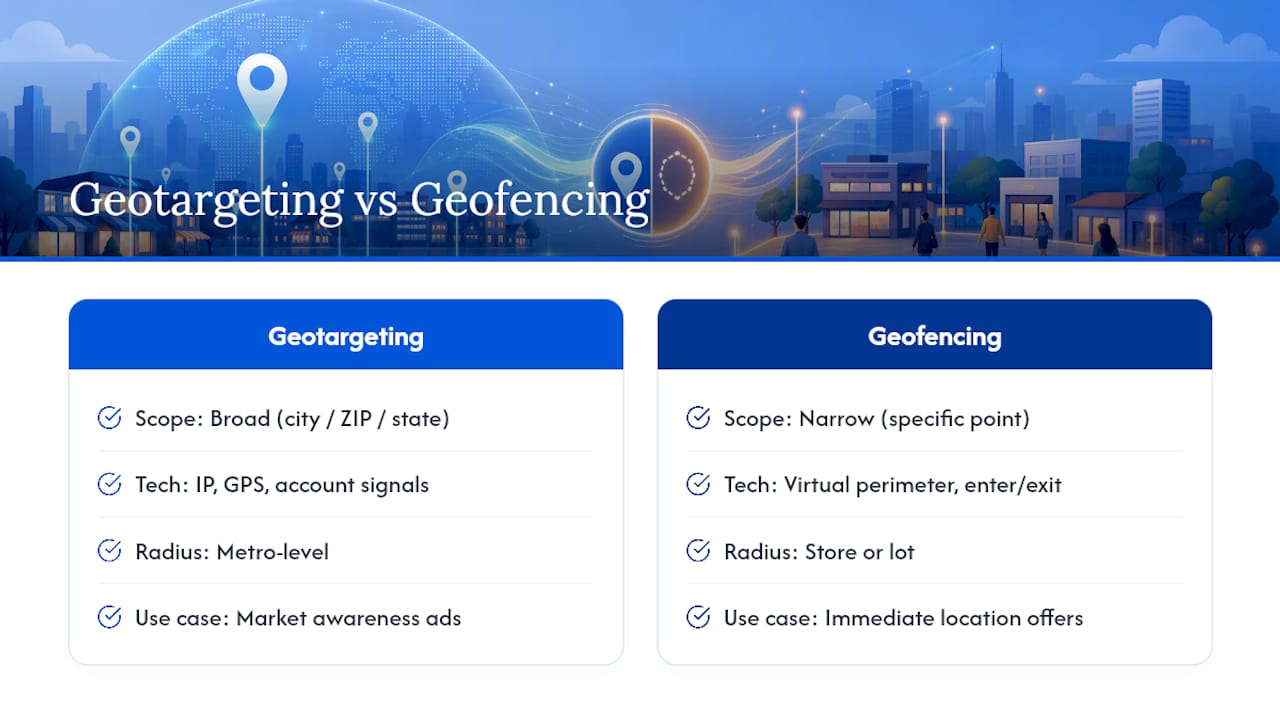
Location-based marketing is the umbrella term covering both, plus proximity beacons, Wi-Fi triangulation, and aggregated location graphs pulled from apps and carriers, per Wikipedia’s overview of geotargeting.
A quick example: a pizza chain uses geotargeting to show “Now Delivering in Denver” ads across the metro, and geofencing to push a “20% off, you’re 3 minutes away” notification the second someone’s phone crosses into the parking lot radius.
When Does Geo Targeted Content Actually Move the Needle?
Not every business needs neighborhood-level pages. Here’s where the investment consistently pays off:
- Store visits and footfall. Retailers with multiple locations use geofenced ads to drive walk-ins, and geofencing pilots have reported footfall lifts in short campaign windows, according to industry case-study summaries on geo content marketing.
- Inventory-aware store pages. Furniture and appliance retailers show different stock, pricing, and delivery windows per location instead of one generic catalog page.
- Event and campus promotions. Universities, concert venues, and conference organizers geotarget attendees within a mile radius for parking, food, and merchandise offers.
- Territory-specific offers. Franchises run different pricing or promotions by region based on local competition and demand.
- Local SEO visibility. Neighborhood-specific pages consistently outrank generic city pages when they carry real local detail, a point 12AM Agency’s research on geo content backs up directly.
Localized landing pages have also been shown to lift organic click-through rate and conversions shortly after publishing, per the same geo content marketing report. The best candidates share three traits: real local demand, a defined and predictable trade area, and the operational ability to actually fulfill a location-specific offer. If you can’t deliver on the promise locally, don’t make the promise locally.
How Do You Build a Geo Targeted Content Playbook Step by Step?
Building this right takes more than swapping a city name into a template. Here’s the sequence that actually holds up.
- Map your trade area. Pull transaction or CRM data and build rings, typically 1, 3, and 5 miles from each location, rather than guessing at boundaries. Web Tonic’s hyperlocal marketing guide recommends tiering budget by ring, spending more on the closest zones where conversion rates run highest.
- Build the content blueprint. Every local page needs at least three unique proof points, a named landmark, a street or intersection reference, and a zip-specific review or testimonial. Generic city pages with swapped headers get treated as thin content and hurt more than they help.
- Set the technical foundation. Add LocalBusiness schema markup, embed an actual map (not a static image), and watch canonicalization closely across near-duplicate location URLs, guidance echoed in reporting on 2026 geo content standards.
- Layer in dynamic creative. Swap hero images by region, adjust CTAs based on distance (“5 minutes away” vs. “delivers to your area”), and surface real-time inventory or open/closed status where possible.
- Run the operational process. Keep a content calendar, QA every new page against a clone checklist before publishing, and refresh photos and local details on a set cadence, quarterly at minimum.
Pro Tip: Set a hard rule: no location page goes live without at least three local specifics a competitor’s template couldn’t fake. That single guardrail catches most clone-page mistakes before Google does.
- Unique local proof point (landmark, review, or event)
- LocalBusiness schema implemented
- Map embed functional and mobile-friendly
- Canonical tags checked against near-duplicate pages
Which Channels Work Best for Geo Targeted Campaigns?
Your channel choice depends on the objective, not just the budget.
- Google Search and Maps. Local pages compete for map-pack placement; this is where hyper-local content and a strong local SEO checklist matter most.
- Google Ads. Radius and ZIP-level targeting let you bid tighter than platform defaults, often down to a few blocks around a store.
- Meta and TikTok. Both offer radius targeting and store-visit campaign objectives, but audience minimums can force you to widen the radius more than you’d like.
- DSPs, CTV, and DOOH. Programmatic and connected TV buys support geofenced delivery for regional brand campaigns, though minimum spend thresholds are usually higher.
- Push and in-app. Best for existing customers already in your app, triggered by geofence entry rather than broad targeting.
One setting trips up more campaigns than any other: presence versus interest targeting. Presence means the person is physically in the area right now. Interest means the platform thinks they care about that area, even from three states away. Confirm which one you’re actually buying before you launch. Prefer geofencing when the goal is an immediate action like a visit or a redemption; prefer market-level geotargeting when the goal is awareness or reach across a broader region.
How Do You Measure Whether Geo Targeting Is Working?
Measurement is where most geo campaigns fall apart, mostly because teams read platform dashboards at face value instead of testing for real lift.
Track CTR, conversion rate, direction requests, calls, and footfall or visit lift by ring, then compare cost per acquisition across distance bands. A campaign that looks strong citywide often hides a 1-mile ring that’s carrying the entire result.
- Geo holdouts. Withhold the campaign from a comparable region and measure the performance gap.
- Matched market tests. Pair similar markets, run the campaign in one, and compare outcomes.
- Difference-in-differences analysis. Track the change in each market before and after launch, then compare the deltas.
- UTM segmentation. Tag creative by location variant to isolate which local pages or ads actually drive results.
Platform-reported geographic breakdowns tend to overstate impact because they don’t account for what would have happened anyway, which is exactly why a genuine holdout test matters more than a dashboard number.
What Mistakes Waste Geo Targeting Budget?
Cloned location pages are the single most common failure. Swapping a city name into an identical template creates duplicate-feeling content, and neighborhood-level specificity, street names, landmarks, localized FAQs, is the only reliable way to prove real local presence.
- Publish only pages with three or more unique local proof points, never a copy-paste template.
- Double-check presence versus interest settings before every launch to stop budget leaking to the wrong audience.
- Review audience size and frequency caps weekly; geofenced audiences shrink fast and can burn out quickly.
- Confirm your map embed loads properly on mobile, a broken embed kills trust instantly.
Pro Tip: Get consent right before you get clever. If you’re using device-level location signals for retargeting or geofencing, your privacy policy and consent flow need to say so explicitly, not bury it in boilerplate.
How Mysearchhero Supports a Geo Targeting Pilot
Running this playbook manually across five, ten, or fifty locations is where most internal teams stall out. A done-for-you monthly bundle, published hyper-local pages, authority backlinks, Reddit mentions, and social content, maps directly onto a geo pilot without the operational drag.
A reasonable pilot: publish a few location pages, run one geofenced or radius ad campaign, and measure results against a geo holdout before scaling to a full template rollout. Small pilots protect budget and prove indexation before you commit to dozens of pages.
- Hyper-local page publishing with schema and map embeds
- Backlinks routed through a publisher network for authority
- Reddit mentions in relevant local conversations
- Reporting built around the pilot’s holdout comparison
What Actually Matters in Geo Targeted Content Right Now
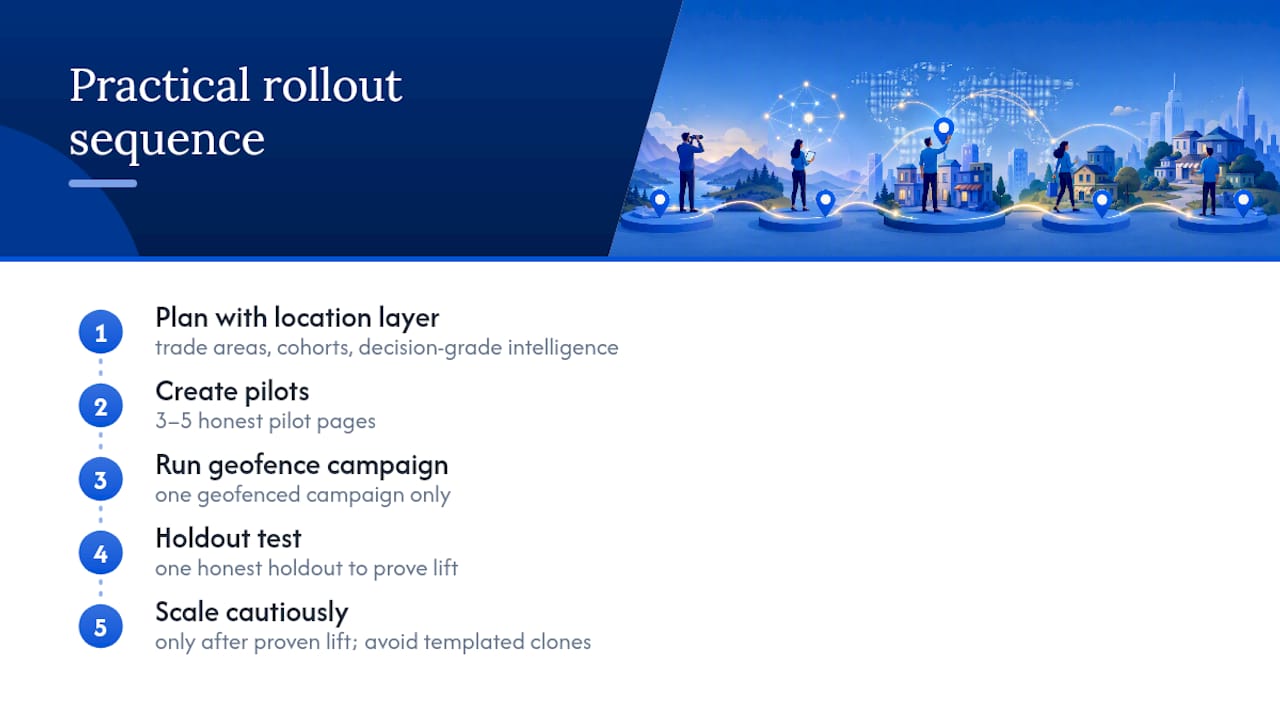
The conventional advice on this topic hasn’t caught up with what search engines now reward. Most guides still treat geo targeting as a coordinates problem, get the pin accurate, target the right radius, done. That’s backwards. The teams getting real results treat location as a planning layer: trade areas, audience cohorts, and decision-grade intelligence, not raw GPS points, an approach AI Digital’s research on location marketing supports directly.
The overrated tactic is templated scale. Businesses rush to publish fifty location pages from one template, thinking coverage beats quality. Search engines increasingly treat that as thin content, and a handful of genuinely local pages will outperform fifty clones every time.
Start smaller than feels comfortable. Three to five pilot pages, one geofenced campaign, one honest holdout test. Prove the lift before you scale the template. That sequence, backed by real audience segmentation, as this guide on audience segmentation lays out well, protects budget and builds a foundation that actually holds up under scrutiny.
— Mike
Mysearchhero: Your Path to Geo Targeting Without Hiring an Agency
Building even a single well-researched local page, with real schema, map embeds, and genuine neighborhood detail, takes hours most business owners don’t have. Multiply that across five or ten locations, and it’s a part-time job you didn’t sign up for. Mysearchhero is the alternative to hiring an agency for a geo targeting pilot: monthly deliverables, published articles, authority backlinks, Reddit mentions, and social posts, arrive automatically instead of requiring a retainer conversation every quarter.
That matters most for the exact pilot this article recommends. Instead of drafting local pages yourself and hoping they rank, Mysearchhero can put a hyper-local content pipeline into motion, backed by backlinks and social visibility, while you run the geofenced ad test and watch the holdout numbers. If you’re ready to move past the planning stage, start a trial and get your first pilot pages moving this month.
Sources
- What Content Works Best for Geo Targeting in 2026? – 12AM Agency
- Hyperlocal Marketing: 10 Tactics That Work | Web Tonic™
- Geotargeted Marketing
FAQ
What does “geo targeted” mean?
Geo targeted means content, ads, or offers are delivered specifically to people in a defined geographic area, a city, ZIP code, or radius, rather than shown broadly to everyone.
Is GeoTarget a legit company?
There are several companies and platforms using “GeoTarget” or similar names in the geo-marketing space; verify any specific vendor’s reviews, case studies, and business registration directly before signing a contract, since the term itself is generic and used industry-wide.
What’s the difference between geofencing and geotargeting?
Geofencing triggers an action when a device enters or exits a specific virtual boundary, ideal for immediate actions like a store visit alert, while geotargeting delivers content across a broader area like a city or region for awareness and reach.
Can you give me an example of geotargeting in the context of marketing?
A retail chain showing “Now Open in Austin” ads only to users whose IP address or device location falls within the Austin metro area is a straightforward geotargeting example, distinct from a geofenced push notification triggered by walking past the store.