
TL;DR:
- Local marketing promotes small businesses directly to nearby customers through digital and offline channels. Combining Google Business Profile, local SEO, and community engagement creates a strong local presence and long-term loyalty. Most successful local businesses focus on a few channels, measure results, and stay consistent over years.
Local marketing is the practice of promoting your business directly to nearby customers through tailored digital and offline methods that increase visibility, trust, and sales within your community. This local marketing guide covers every channel and tactic you need, from Google Business Profile basics to community marketing strategies that cut acquisition costs and build lasting loyalty. Local business owners who combine search visibility, paid ads, and genuine community engagement consistently outperform those who rely on a single channel. The strategies here reflect 2026 best practices and are built for businesses that want real growth, not just more impressions.
What are the essential local marketing channels every business needs?
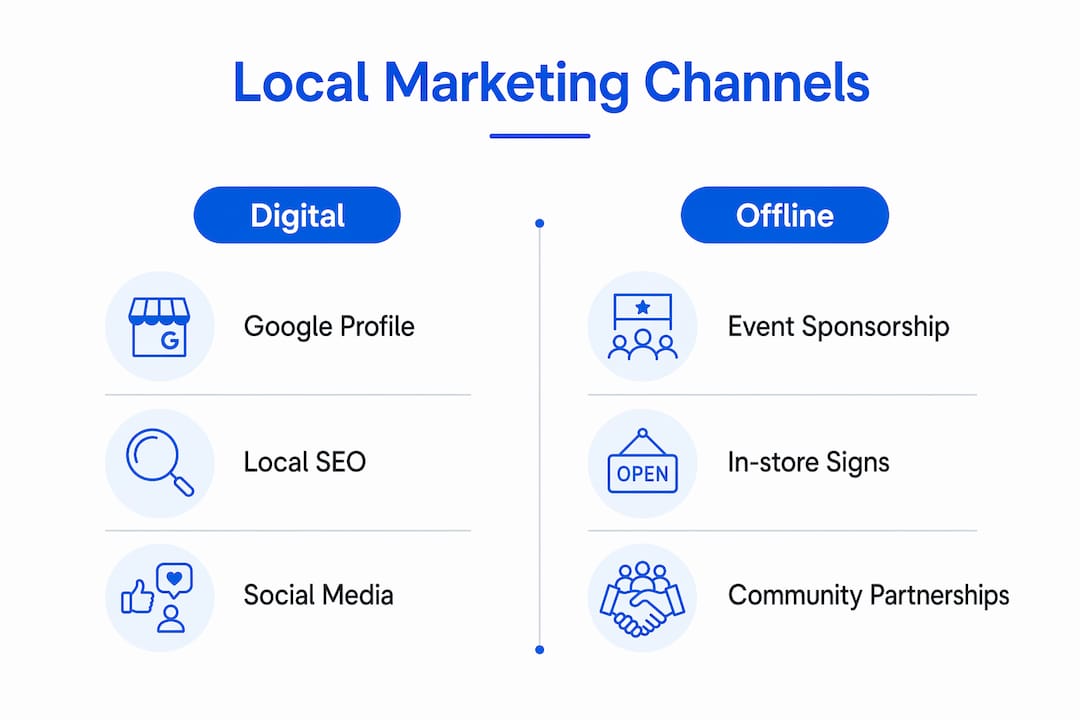
Every effective local marketing approach starts with three digital foundations: Google Business Profile, local SEO, and Google Local Services Ads. These three channels cover the moment a nearby customer searches for what you sell, and they work together rather than independently.

Google Business Profile is the single most important free tool for local search visibility. An accurate, complete listing improves how often your business appears in Google Maps and the local pack. Missing hours, outdated phone numbers, or no photos all reduce your ranking and credibility.
Local SEO techniques build on your Google Business Profile by targeting location-specific keywords on your website. A plumber in Austin should have pages optimized for “Austin emergency plumber” rather than just “plumber.” That specificity is what connects your site to searches happening in your zip code.
Google Local Services Ads operate on a pay-per-lead model designed to connect businesses directly with customers who need immediate service. Unlike traditional pay-per-click ads, Local Services Ads charge only when a customer calls, messages, or books. That distinction matters enormously for service businesses like HVAC companies, electricians, and locksmiths.
Social media platforms round out the digital side. Facebook Groups and Nextdoor work especially well for neighborhood marketing because they are built around geographic communities. Instagram suits businesses with strong visual products, like restaurants or boutiques.
Offline channels still carry weight. Local event sponsorships, in-store signage, and community partnerships build name recognition that digital ads cannot replicate on their own.
| Channel | Primary purpose | Expected outcome |
|---|---|---|
| Google Business Profile | Local search visibility | More map and pack appearances |
| Local SEO | Organic website traffic | Higher rankings for location searches |
| Local Services Ads | Direct lead generation | Phone calls and bookings from nearby buyers |
| Social media (Nextdoor, Facebook) | Community engagement | Repeat visits and word-of-mouth referrals |
| Offline events and sponsorships | Brand recognition | Foot traffic and community trust |
Pro Tip: If you run an urgent-service business like a locksmith or plumber, prioritize Local Services Ads before any other paid channel. The pay-per-lead model means you only pay when someone actually contacts you, not just when they see your ad.
How can local businesses use community marketing to boost retention?
Community marketing is the practice of building an engaged group of customers around a shared identity, interest, or local need. 66% of companies report that community engagement programs positively impact long-term customer retention. That number reflects a simple truth: people buy from businesses they feel connected to.
The most effective communities are tightly focused. Effective local communities are anchored around a specific identity or shared local pain point. Trying to appeal to every segment of your town at once produces weak engagement and a community that fades quickly. A running store in Denver builds a stronger community by focusing on trail runners than by targeting all fitness enthusiasts.
Here is a practical sequence for building a local community from scratch:
- Define your community’s shared identity. Pick one specific local interest, problem, or value your business addresses. The narrower the focus, the faster trust builds.
- Choose an asynchronous platform. Facebook Groups, Reddit community pages, or a forum on your own website all work. Asynchronous engagement generates higher participation and lasting content compared to live events or calls. Forum threads stay searchable for years; a live Zoom call disappears the moment it ends.
- Seed the community with useful content. Answer common questions, share local tips, and post behind-the-scenes content. Give before you ask.
- Invite your best customers first. Early members set the tone. Choose people who are genuinely enthusiastic about your business and your neighborhood.
- Respond to every post for the first 90 days. Consistent responses signal that the community is alive and worth participating in.
- Introduce peer-to-peer conversations. Ask members to share their own experiences. Peer advocacy reduces your customer acquisition costs more than any ad campaign.
Community programs require multi-year investment and dedicated management for measurable returns. Expect to spend at least two years building before the community generates significant referral volume on its own. That timeline is not a warning. It is a competitive advantage, because most businesses quit before they get there.
Pro Tip: Turn your community’s most common questions into blog posts or FAQ pages on your website. Community conversations converted to content create a compounding loop where new organic search visitors find your content, join your community, and become customers.
How to optimize paid advertising and geotargeting for local growth?
Paid local business advertising works best when your targeting matches the geography of your actual customers. Geotargeting strategies enable businesses to deliver ad messages to hyperlocal audiences for better conversion rates. Combining geotargeting with strong ad creative increases both relevance and return on ad spend.
Google Local Services Ads and traditional Google Search ads serve different purposes. Local Services Ads use algorithmic keyword matching and charge per lead, making them ideal for service businesses that need direct bookings. Traditional pay-per-click ads give you more control over keywords and landing pages, which suits businesses selling products or running promotions with specific messaging.
| Ad model | Cost structure | Best for | Key limitation |
|---|---|---|---|
| Local Services Ads | Pay per lead | Urgent service businesses | Limited creative control |
| Google Search (PPC) | Pay per click | Product sales, promotions | Requires active keyword management |
| Social media ads | Pay per click or impression | Brand awareness, events | Lower purchase intent |
| Nextdoor ads | Pay per impression | Hyperlocal neighborhoods | Smaller audience scale |
Budget allocation for local advertising should follow a simple rule: put the majority of your spend on the channel with the shortest path from ad to sale. For a dentist, that is Local Services Ads. For a boutique clothing store, that is Instagram or Facebook with a radius targeting set to 10 miles.
Common mistakes to avoid in local ad campaigns:
- Setting your geographic radius too wide and paying for clicks from customers who will never drive to your location
- Using generic ad copy that does not mention your city or neighborhood
- Sending paid traffic to your homepage instead of a location-specific landing page
- Ignoring negative keywords, which causes your ads to appear for irrelevant searches
- Running ads without tracking phone calls, since most local conversions happen by phone
Neighborhood-targeted campaigns work best when the ad copy reflects the local context. A restaurant in Chicago’s Wicker Park neighborhood gets better results mentioning “Wicker Park” in the ad than using a generic “Chicago restaurant” message. Specificity signals relevance to both the algorithm and the reader.
What offline tactics strengthen your digital local presence?
Offline marketing tactics like local events, sponsorships, and in-store experiences reinforce digital efforts and deepen brand trust. Strong offline visibility and online visibility work together. Each one amplifies the other.
Sponsoring a local youth sports team, hosting a neighborhood workshop, or partnering with a nearby business for a joint event all generate the kind of word-of-mouth that no ad budget can buy. These activities also produce digital byproducts: social media mentions, local news coverage, and Google reviews from attendees.
Small business PR tactics that earn local media coverage directly improve your search visibility. A mention in a local newspaper or community blog often includes a backlink to your website. Backlinks from locally relevant sources are a strong signal in local SEO ranking algorithms.
Quick-win neighborhood marketing tips that combine offline and online:
- Ask customers to leave a Google review immediately after a positive in-store experience, while the moment is fresh
- Display your social media handles prominently in your store so foot traffic converts to followers
- Collect email addresses at events and follow up with a local-specific offer within 48 hours
- Partner with a complementary local business for a co-branded social post after a joint event
- Use QR codes on physical signage to drive offline visitors to your Google Business Profile or website
Pro Tip: Track the digital impact of every offline campaign. After a sponsorship or event, watch your Google Business Profile for spikes in searches, calls, and direction requests. That data tells you which offline activities actually move the needle.
Key Takeaways
Local businesses that combine Google Business Profile, community marketing, geotargeted paid ads, and offline tactics build the strongest and most durable local presence.
| Point | Details |
|---|---|
| Start with Google Business Profile | A complete, accurate listing is the fastest way to improve local search visibility. |
| Build community around one identity | Focused communities generate more trust and referrals than broad, unfocused groups. |
| Use Local Services Ads for urgent services | The pay-per-lead model means you only pay when a real customer contacts you. |
| Convert community content to SEO | Turning forum questions into blog posts creates a compounding growth loop. |
| Measure offline campaigns digitally | Track Google Business Profile activity after events to identify what drives real results. |
Why most local businesses are leaving growth on the table
Most local business owners I work with are not failing at marketing because they lack effort. They are failing because they are spreading that effort across too many channels without a clear priority order. A Facebook page, a Google ad, a flyer, a Yelp profile, and a monthly email newsletter all running at 20% effort produce worse results than two channels running at full commitment.
The second mistake I see constantly is treating community engagement as a short-term tactic. Business owners run a Facebook Group for three months, get frustrated by slow growth, and abandon it. The data is clear: community programs need at least two years of consistent activity before they generate meaningful referral volume. The businesses that stick with it own their local market. The ones that quit hand that advantage to a competitor.
The third issue is the offline-online disconnect. Owners run great in-store events but never ask attendees for a Google review or a social media follow. That event generates zero digital equity. Every offline touchpoint should have a digital follow-up built in before the event even happens.
The businesses I see winning in 2026 are not using more tools. They are using fewer tools with more consistency, measuring what works, and doubling down on the channels that produce actual customers.
— Mike
How Mysearchhero supports your local marketing efforts
Growing your local presence takes consistent content, backlinks, and search visibility. Mysearchhero delivers all of that on autopilot.
Each month, Mysearchhero publishes articles built for local SEO, earns backlinks from relevant sources, and distributes content across social and community channels. You get a complete local SEO content system without hiring a full marketing team. Business owners who want to compete on search, build community authority, and stay visible in their neighborhoods use Mysearchhero to keep their pipeline full while they focus on running their business. Visit Mysearchhero to see the monthly plans.
FAQ
What is local marketing?
Local marketing is the practice of promoting a business to customers within a specific geographic area using digital and offline channels. The goal is to increase visibility, foot traffic, and sales from nearby buyers.
How does local SEO differ from general SEO?
Local SEO targets location-specific keywords and signals like Google Business Profile, local citations, and proximity to the searcher. General SEO focuses on ranking nationally or globally without geographic targeting.
What are Google Local Services Ads?
Google Local Services Ads are a pay-per-lead ad format that connects service businesses directly with customers who call, message, or book. Businesses only pay when a lead is generated, not for clicks.
How long does community marketing take to show results?
Community marketing programs typically require at least two years of consistent activity before generating significant referral volume. The investment pays off through lower customer acquisition costs and stronger long-term retention.
What is the fastest way to improve local visibility?
Completing and optimizing your Google Business Profile is the fastest free action you can take. Accurate hours, photos, and a keyword-rich business description improve your ranking in local search results almost immediately.