
TL;DR:
- Social listening turns online conversations into strategic insights about brand perception and market trends. It analyzes why discussions happen and guides actions, unlike basic monitoring which only reports what is happening.
Social listening is defined as the practice of tracking, analyzing, and interpreting online conversations to generate strategic insight about your brand, competitors, and market. Unlike basic social media monitoring, which tells you what is happening, social listening tells you why it is happening and what you should do about it. Tools like Sprout Social, Hootsuite, and Pulsar Platform have built entire product lines around this distinction. For marketing professionals and business owners, mastering social listening means turning the noise of millions of daily posts into decisions that improve campaigns, products, and customer relationships.
What is social listening and how does it differ from monitoring?
Social listening is the interpretive layer built on top of raw data collection. It tracks conversations across social media, forums, blogs, and review sites, then analyzes sentiment, context, and patterns to produce strategic guidance. The social listening definition goes beyond counting mentions. It answers three questions: What are people saying? Why are they saying it? What should we do about it?

Social media monitoring, by contrast, is the real-time collection of brand mentions and keyword alerts. It tells you that 500 people mentioned your product this morning. Social listening tells you that 400 of those mentions express frustration with your checkout process, and that the same frustration appeared in competitor conversations three weeks ago. That is the difference between a notification and an insight.
Monitoring and listening are complementary but serve different purposes. Monitoring is reactive and operational. Listening is proactive and strategic. A brand that only monitors is always catching up. A brand that listens is making decisions before problems escalate.
Pro Tip: Set up monitoring alerts for your brand name and top product terms first. Once that data flows, layer in listening queries around competitor names, category keywords, and unbranded pain points your customers describe. That second layer is where the real insight lives.
How does social listening work?
Social listening follows a four-stage loop: monitoring, analysis, insights, and action. Each stage feeds the next, and the loop repeats continuously.
- Monitoring. Platforms like Pulsar Platform, Sprout Social, and Hootsuite collect data from Twitter/X, Instagram, Reddit, TikTok, news sites, forums, and review platforms. They pull posts, comments, and articles that match your defined keywords and topics.
- Analysis. AI and natural language processing (NLP) classify the collected content by sentiment (positive, negative, neutral), topic, and emotion. Machine learning models detect emerging themes and flag anomalies in volume or tone.
- Insights. The analyzed data reveals trends, unmet needs, and early warning signals. This is where a spike in negative sentiment around a product feature becomes a product roadmap input, not just a customer service ticket.
- Action. Insights get routed to the right teams. Marketing adjusts messaging. Product updates its backlog. Customer care responds to at-risk customers. The output of each action feeds back into the next monitoring cycle.
The technology behind this process matters. NLP allows platforms to understand sarcasm, slang, and context. Without it, a post saying “Oh great, another update that breaks everything” would register as positive. Machine learning improves accuracy over time by learning from corrections and new data patterns.
Pro Tip: Define your listening parameters before you turn on any tool. Decide which keywords, hashtags, competitor names, and product categories belong in your query set. A poorly scoped query returns either too much noise or too little signal.
Social listening vs. social monitoring: a side-by-side comparison
The table below captures the practical difference between the two practices.
| Dimension | Social monitoring | Social listening |
|---|---|---|
| Primary question | What is happening? | Why is it happening? |
| Time horizon | Real-time alerts | Trends over time |
| Output | Notifications and reports | Strategic recommendations |
| Use case | Crisis alerts, response queues | Campaign planning, product insight |
| Scope | Direct brand mentions | Category, competitor, and unbranded conversations |
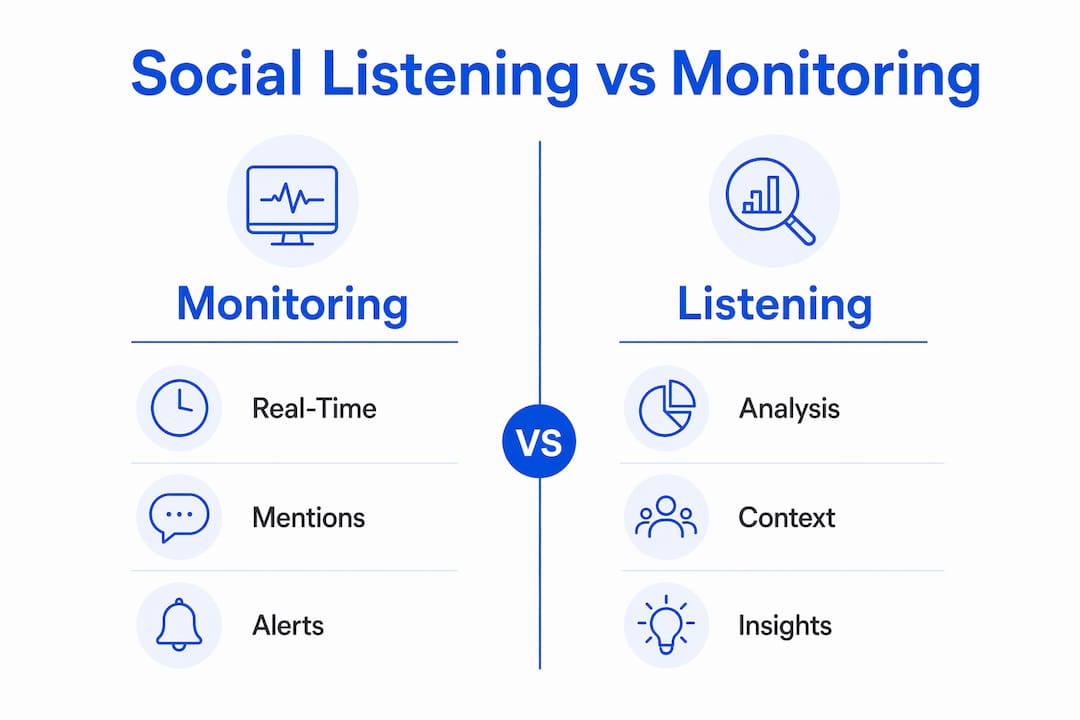
Keyword and mention alerts miss a large share of relevant conversations because most people do not tag brands when they complain or recommend. A customer posting “I switched from my old project tool to Notion and never looked back” does not mention the old tool by name. Social listening captures that signal. Social monitoring does not.
The most common mistake brands make is treating monitoring as listening. They buy an alert tool, assign it to one social media manager, and call it a listening program. The result is a faster inbox, not a smarter strategy.
Why is social listening important for brand engagement?
Social listening gives brands access to unfiltered consumer sentiment that surveys and focus groups cannot replicate. People say things online they would never say in a research setting. That candor is the data advantage.
The importance of social listening shows up across four business functions:
- Brand health. Listening tracks how sentiment shifts over time, across regions, and across audience segments. A brand can detect a reputation problem in one city before it spreads nationally.
- Campaign evaluation. Post-launch sentiment shifts and volume changes within 24–48 hours tell campaign teams whether a message is landing or backfiring. That speed allows real-time adjustments before budget is wasted.
- Product development. Conversations about competitor products reveal feature gaps and unmet needs. Listening to what customers wish a product did is cheaper than commissioning a research study.
- Competitive intelligence. Tracking competitor mentions reveals their weaknesses, their customers’ frustrations, and the positioning gaps your brand can fill.
Companies like Netflix, Spotify, and McDonald’s gain measurable advantage by acting fast on early signals detected through social listening. Netflix uses audience conversation data to inform content decisions. Spotify tracks listening behavior commentary to shape playlist and feature development. The brands that win are the ones that treat social conversation as a continuous data source, not a PR monitoring task.
“Social listening transforms raw conversation data into the kind of customer intelligence that used to require months of research and thousands of dollars in focus groups.” — Sprout Social
The benefits of social listening extend to brand growth through social mentions, where every tracked conversation becomes an opportunity to engage, respond, or redirect.
How to implement a social listening program
Building an effective social listening program requires more than selecting a tool. Effective programs define what signals matter, who receives the output, and what decisions each signal triggers.
- Define your signals. Start with brand name variations, product names, key executives, and top competitors. Add category keywords that describe the problem your product solves. Include common misspellings and abbreviations.
- Select your channels. Match channel selection to where your audience actually talks. B2B brands often find more signal on LinkedIn and Reddit. Consumer brands typically find it on Instagram, TikTok, and Twitter/X.
- Assign ownership. Each insight type needs a designated owner. Sentiment spikes go to the PR team. Product complaints go to the product manager. Campaign feedback goes to the marketing lead. Without clear routing, insights die in a dashboard.
- Set measurement baselines. Track sentiment score, share of voice, and conversation volume before any campaign launches. Post-launch changes only mean something when you have a baseline to compare against.
- Review and iterate. Social listening programs that run on autopilot decay. Quarterly reviews of query performance, signal relevance, and team workflows keep the program sharp.
Many organizations buy alert systems without workflows to translate insights into action. The tool is not the program. The workflow is the program.
Pro Tip: Start small. Pick one business question you want social listening to answer, such as “What do customers say about our onboarding experience?” Build your query set around that question, run it for 30 days, and present findings to one stakeholder. A focused proof of concept builds internal buy-in faster than a broad rollout.
Pairing your listening program with marketing automation lets you route insights directly into campaign workflows without manual handoffs.
What are the future trends shaping social listening?
Social listening is moving from trend tracking to structural conversation analysis. The next generation of capabilities includes:
- Narrative intelligence. Advanced listening platforms now detect the story frames and belief structures driving public perception, not just sentiment scores. A brand can see not only that people are angry but why the narrative framing makes them angry and what story would shift that perception.
- AI-powered forecasting. Machine learning models now predict conversation volume spikes and sentiment shifts before they peak. Brands can prepare responses and content before a trend goes mainstream.
- Expanded scope. The most effective programs now listen beyond brand mentions to capture full category conversations and competitor discussions. This gives brands a market-level view, not just a brand-level view.
- CRM and automation integration. Listening data is being piped directly into CRM systems like Salesforce and marketing automation platforms. A negative sentiment spike can trigger a customer retention workflow automatically.
- Multilingual and multi-channel listening. Global brands now run listening programs across languages and platforms simultaneously, using AI translation and cross-platform aggregation to maintain a unified view of global sentiment.
The role of AI in marketing is central to these advances. NLP accuracy, real-time processing, and predictive modeling are all AI-dependent capabilities that separate basic monitoring tools from true listening platforms.
Key Takeaways
Social listening is the practice of analyzing online conversations to understand why audiences feel and act the way they do, and it requires defined signals, clear workflows, and continuous iteration to deliver real business value.
| Point | Details |
|---|---|
| Listening vs. monitoring | Monitoring tracks what is said; listening explains why and guides what to do next. |
| Four-stage process | Every effective program follows: monitoring, analysis, insights, and action. |
| Brand and campaign value | Sentiment shifts within 24–48 hours post-launch reveal whether a campaign is working. |
| Program setup | Define signals, assign owners, and set baselines before selecting any tool. |
| Future direction | Narrative intelligence and AI forecasting are moving listening from reactive to predictive. |
Social listening as a business operating system, not a report
Most marketing teams treat social listening as a reporting function. They pull a monthly summary, share it in a slide deck, and move on. That approach wastes most of the value.
I have seen brands with access to Sprout Social or Pulsar Platform generate almost no strategic output because no one defined what a “signal” meant or who was supposed to act on it. The tool ran. The data accumulated. Nothing changed.
The brands that get real value treat social listening as a continuous operating loop. Insights from one campaign directly shape the brief for the next one. A product complaint cluster in week two becomes a fix in week six. A competitor weakness spotted in listening data becomes a positioning angle in the next quarter’s messaging.
The other mistake I see constantly is over-reliance on technology. AI and NLP are powerful, but they miss nuance. A human analyst reading 50 posts understands irony, community context, and cultural subtext in ways that sentiment scores do not capture. The best programs combine automated scale with human interpretation on the signals that matter most.
For small businesses with limited resources, start with one free or low-cost tool like Google Alerts or the native listening features in Hootsuite’s free tier. Pick one question. Run it for 30 days. The goal is not a perfect program. The goal is a habit of listening that grows into a system.
— Mike
How Mysearchhero helps you turn listening into growth
Social listening only creates value when insights reach the right people at the right time. Most marketing teams lack the bandwidth to run a continuous listening program alongside everything else they manage.
Mysearchhero is a done-for-you content and SEO service that keeps your brand visible and your marketing running without adding to your team’s workload. Each month, subscribers receive published articles, backlinks, Reddit mentions, and social media posts, all pushed through an automated pipeline. If you want your brand to show up in the conversations your customers are already having, see how it works and get your marketing running on autopilot.
FAQ
What is the social listening definition in simple terms?
Social listening is the practice of tracking online conversations about your brand, competitors, and industry, then analyzing them to understand sentiment, trends, and what actions to take.
How is social listening different from social media monitoring?
Social monitoring collects real-time mentions and alerts. Social listening interprets those conversations over time to reveal patterns, causes, and strategic opportunities.
What tools are used for social listening?
Sprout Social, Hootsuite, and Pulsar Platform are widely used social listening platforms. Each collects data across multiple channels and applies AI-powered sentiment and trend analysis.
How do you measure the effectiveness of a social listening program?
Track sentiment shifts, conversation volume, and share of voice before and after campaigns. Campaign teams typically evaluate these metrics within 24–48 hours of a campaign launch to confirm message resonance.
Can small businesses benefit from social listening?
Small businesses benefit most from focused listening programs built around one or two key questions. Free tools like Google Alerts and entry-level tiers of Hootsuite provide enough data to start building a listening habit without significant investment.