
TL;DR:
- Social mentions are online references to your brand, which serve as crucial trust signals for search engines and consumer perception. Monitoring and analyzing both tagged and untagged mentions across multiple platforms enables proactive reputation management and strategic marketing actions. Responding swiftly to negative mentions and leveraging positive ones can significantly boost brand loyalty, visibility, and financial performance.
Social mentions are every instance where your brand is referenced online, whether tagged with an @ symbol or cited as plain text across platforms like Instagram, Reddit, YouTube, or niche forums. The role of social mentions extends far beyond vanity metrics. They serve as trust signals for search engines, shape consumer perception in real time, and directly correlate with measurable financial outcomes. Research shows YouTube likes and Instagram comments correlate positively with firm Return on Equity, which means what people say about you online has a direct line to your bottom line. Tools like Hootsuite, SocialSonar, and Pulsar have made tracking these signals more accessible than ever, but most brands still underuse them.
What is the role of social mentions in SEO and visibility?
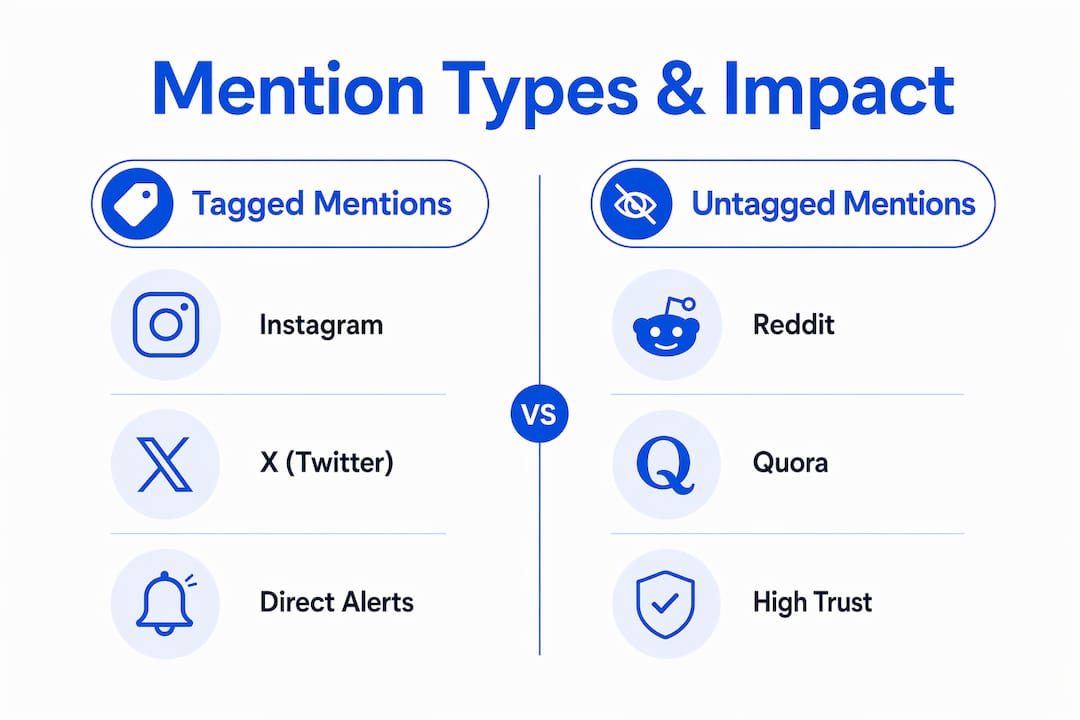
Social mentions function as off-page trust signals that search engines and AI algorithms use to assess brand authority. According to research from Semrush, mentions act as trust signals for AI and search algorithms, improving ranking potential even without direct backlinks. That finding matters because most brands obsess over link building while ignoring the hundreds of unlinked references accumulating across the web.
There are two primary types of mentions worth tracking. Tagged mentions use the @ symbol and notify the brand directly. Untagged mentions are plain-text references that appear in blog posts, forum threads, news articles, and social comments without any direct notification. Both types carry weight with algorithms, but untagged mentions are far more common and far more overlooked.
The platform where a mention appears also shapes its impact. A reference on a high-authority site like Forbes carries more algorithmic weight than a comment on a small blog. But volume and diversity across platforms also matter. A brand mentioned consistently across Reddit, LinkedIn, Instagram, and YouTube signals broader relevance to search engines than one mentioned heavily on a single channel. This is where AI-driven SEO signals are changing the game for local and mid-size brands.
| Mention Type | Platform Example | Algorithmic Trust Impact |
|---|---|---|
| Tagged (@) mention | Instagram, X (Twitter) | Moderate. Direct engagement signal |
| Untagged plain-text | Reddit, Quora, blogs | High. Organic trust signal |
| Linked brand mention | News sites, Forbes | Very high. Combines trust and authority |
| Visual platform engagement | YouTube likes, Instagram comments | Measurable ROE correlation |
| Forum thread reference | Reddit, niche communities | High. Peer recommendation signal |
Pro Tip: Set up Google Alerts for your brand name, common misspellings, and your CEO’s name. You will catch untagged mentions that never show up in your social inbox.
How do you monitor and interpret social mentions effectively?
Effective monitoring goes well beyond checking your notifications tab. Multi-layered social mention tracking requires measuring volume, sentiment, share of voice, reach, and engagement rate together. Each metric tells a different part of the story, and relying on just one gives you a distorted picture.

The most underrated monitoring practice is tracking brand variations. Your brand name gets misspelled, abbreviated, and referenced in unexpected ways constantly. If you only track the exact brand name, you miss a significant portion of the conversation. The same applies to tracking executive names, product names, and campaign hashtags. Hootsuite’s research confirms that monitoring these variations detects negative sentiment days before traditional news media picks it up.
Social monitoring and social listening are not the same thing, and confusing them is a costly mistake. Social monitoring tracks volume and sentiment reactively. Social listening analyzes narrative trends proactively to forecast where the conversation is heading. Monitoring tells you what is happening. Listening tells you why it is happening and what it means for your brand strategy.
Here are the core best practices for setting up a mention monitoring system that actually works:
- Track your brand name, common misspellings, product names, and key executive names across all major platforms
- Set sentiment alerts so you receive immediate notification when negative mention volume spikes above your baseline
- Use AI-powered platforms like SocialSonar or Pulsar for narrative trend analysis, not just keyword alerts
- Review your share of voice monthly against direct competitors to measure relative brand presence
- Log all mentions in a centralized dashboard so your marketing and PR teams work from the same data
Pro Tip: Never treat mention volume alone as a success metric. Tie every monitoring report to a specific business objective, such as customer acquisition, reputation recovery, or campaign reach, and compare results against a defined baseline period.
How can businesses turn social mentions into marketing wins?
The real value of social mentions is not in counting them. It is in responding to them strategically. Brands using personalized responses to social mentions see 20–30% higher customer retention rates through community engagement. That retention lift comes from a simple principle: people who feel heard become loyal customers and vocal advocates.
Here is a sequential process for turning mentions into measurable marketing outcomes:
- Categorize mentions by sentiment. Separate positive, neutral, and negative mentions before deciding how to respond. Each category requires a different approach.
- Respond to negative mentions within 24 hours. Speed signals that you take customer experience seriously. Delayed responses allow negative narratives to spread.
- Amplify positive mentions publicly. Repost user-generated content, thank customers by name, and share their stories. This turns one person’s praise into social proof for thousands.
- Identify high-reach advocates. Find customers or creators who mention you repeatedly and have engaged audiences. These are your natural influencer partners.
- Convert mentions into content. Customer stories, testimonials, and organic reviews sourced from mentions are among the most credible content assets you can publish.
- Feed mention data back into your product and messaging teams. The language customers use when praising or criticizing your brand is the most accurate copy research you will ever get.
The comparison below shows how engagement tactics should shift based on mention sentiment and platform context.
| Mention Sentiment | Platform | Recommended Response Tactic |
|---|---|---|
| Positive | Instagram, TikTok | Repost, comment with gratitude, request permission to feature |
| Negative | Twitter/X, Reddit | Acknowledge publicly, resolve privately, follow up publicly |
| Neutral or question | LinkedIn, forums | Provide value, answer directly, avoid hard selling |
| Crisis-level negative | Any platform | Immediate public statement, escalate to PR team |
Early detection of negative mentions is where monitoring pays for itself most clearly. Sentiment monitoring catches volume spikes with negative tone days before traditional news coverage picks up the story. A brand that responds within hours of a complaint thread going viral on Reddit has a fundamentally different outcome than one that discovers the story three days later through a news alert. The benefits of social mentions for reputation management are most visible in these crisis prevention moments.
What mistakes kill the value of social mention tracking?
The most common mistake is conflating paid mentions with earned mentions in your reporting. Paid mentions are contract-based and should be tracked separately from organic, earned references. Mixing them inflates your perceived brand presence and produces ROI figures that do not reflect actual consumer sentiment or organic reach.
Relying on raw mention volume without context is equally misleading. A spike in mentions after a product launch looks very different from a spike triggered by a customer service failure. Without baseline comparisons and sentiment context, both spikes look the same in a volume report.
Here are the pitfalls that consistently undermine social mention strategy:
- Ignoring unlinked mentions on Reddit, Quora, and niche industry forums where peer recommendations carry the most trust
- Failing to analyze the narrative behind mentions, which means missing the strategic insight that explains why sentiment is shifting
- Treating every mention as equally valuable regardless of the source’s authority or audience size
- Reacting to individual mentions without identifying the broader pattern driving them
Unlinked brand mentions on niche platforms are high-trust recommendations that most marketers undervalue. A Reddit thread recommending your software to 50,000 subscribers in a specific subreddit is worth more than 200 generic Instagram tags. Ignoring those threads means missing both the reputation signal and the opportunity to earn organic backlinks by engaging authentically.
Pro Tip: Use social listening tools to identify the narrative framing around your brand before it reaches mainstream media. Narrative framing in communities often preempts traditional media coverage by days, giving you a window to shape the story rather than react to it.
Key takeaways
Social mentions are measurable trust signals that directly affect brand visibility, consumer loyalty, and financial performance when tracked and acted on with clear business objectives.
| Point | Details |
|---|---|
| Mentions affect rankings | Untagged and tagged mentions both signal brand authority to search engines and AI algorithms. |
| Monitor beyond notifications | Track brand variations, misspellings, and executive names to catch early negative sentiment. |
| Listening beats monitoring | Social listening reveals why sentiment shifts, not just that it shifted. |
| Respond fast to negatives | Brands that respond within 24 hours prevent isolated complaints from becoming PR crises. |
| Separate paid from earned | Mixing paid and organic mentions in KPIs distorts ROI and hides true brand performance. |
Why most brands are still playing defense with mentions
I have watched brands spend serious money on social media advertising while completely ignoring the organic conversation already happening about them. That is backwards. The mentions you did not pay for are the ones consumers trust most, and they are often the richest source of strategic intelligence you have access to.
What has changed most in the past two years is the quality of AI-driven mention analytics. Platforms like Pulsar now surface narrative clusters, not just keyword counts. You can see that a segment of your audience consistently frames your brand as “expensive but worth it” while another frames it as “overpriced.” Those are two different strategic problems requiring two different responses, and raw mention volume tells you nothing about either.
The brands winning in 2026 are not the ones with the most mentions. They are the ones treating mention data as a narrative intelligence feed. They use it to inform product messaging, identify emerging customer segments, and get ahead of reputation risks before those risks reach the news cycle. That shift from reactive to proactive is the single biggest unlock in modern brand management.
My honest recommendation: stop reviewing mention reports monthly. Review them weekly, tie every insight to a business objective, and assign ownership to a specific person on your team. Mentions are perishable intelligence. A week-old crisis signal is not a signal anymore. It is a headline.
— Mike
How Mysearchhero helps you master brand mentions
Understanding the importance of online mentions is one thing. Acting on them consistently is another challenge entirely.
Mysearchhero is a done-for-you SEO and content marketing service that puts your brand monitoring and content growth on autopilot. Each month, subscribers receive published articles, backlinks, Reddit mentions, and AI-generated social media posts pushed through a fully automated pipeline. You get the visibility benefits of consistent social mentions without building the infrastructure yourself. If you are ready to stop guessing and start growing, explore Mysearchhero and see how automated brand presence works in practice.
FAQ
What are social mentions exactly?
Social mentions are any online references to your brand, product, or key personnel, whether tagged with an @ symbol or cited as plain text across social platforms, forums, blogs, and news sites.
How do social mentions affect search rankings?
Social mentions serve as trust signals for search engines and AI algorithms, improving brand authority and ranking potential even when the mention contains no direct backlink.
What is the difference between social monitoring and social listening?
Social monitoring tracks mention volume and sentiment reactively. Social listening analyzes narrative trends proactively to understand why sentiment is shifting and where the conversation is heading.
Why do untagged mentions matter for brands?
Untagged mentions on platforms like Reddit and Quora are high-trust peer recommendations. They influence consumer decisions and can generate organic backlinks when brands engage with them directly.
How often should businesses review their social mentions?
Weekly reviews tied to specific business objectives produce the most value. Monthly reporting is too slow to catch early crisis signals or capitalize on emerging positive narratives.