
TL;DR:
- Effective small business PR requires building foundational assets like press kits and a clear story before targeted outreach. Consistent, specific tactics such as media pitching, community events, and awards generate credible media attention and local engagement. Ongoing measurement, relationship maintenance, and disciplined scheduling are essential for sustained brand visibility and growth.
Small business PR tactics are defined as the deliberate, low-cost strategies owners use to earn media coverage, build community trust, and grow brand awareness without a dedicated agency budget. Public relations, the recognized industry term, covers everything from press kit creation to local media outreach and influencer partnerships. The businesses that win at PR are not the ones with the biggest budgets. They are the ones with the clearest story, the most consistent outreach, and the right foundational assets in place before they ever send a pitch.
What small business pr tactics actually require before you pitch anyone
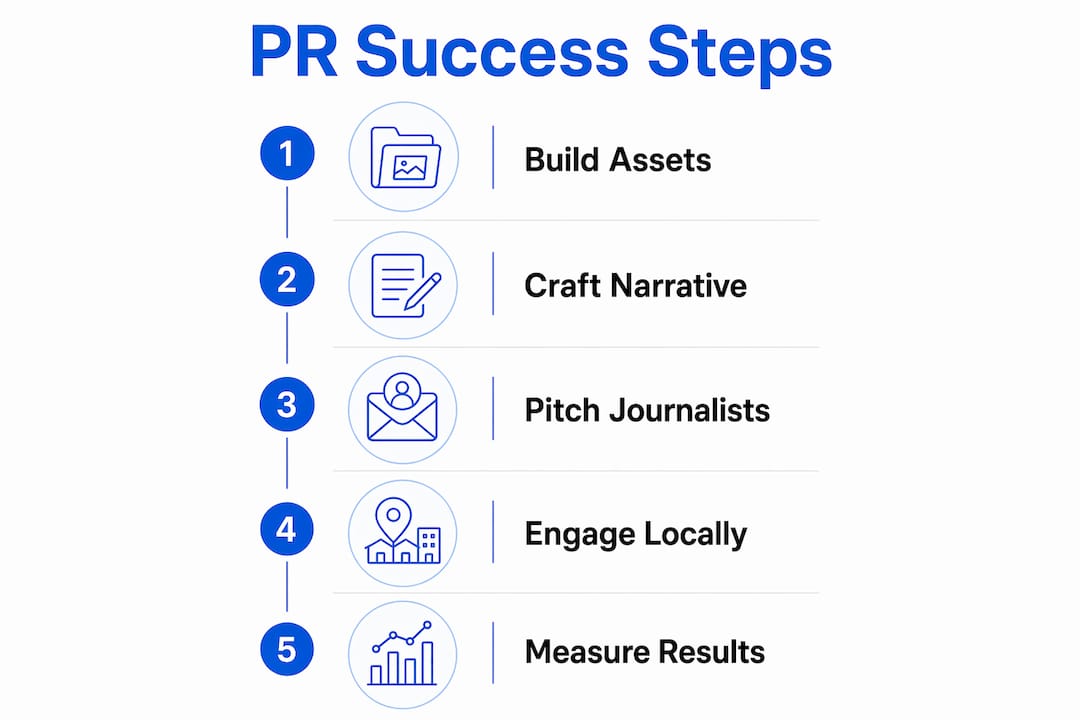
Most small business owners skip straight to pitching and wonder why nothing lands. The real work starts with your foundational PR assets, the materials that make a journalist’s job easier the moment they consider covering you.

A press kit is the single most important asset you can build. Media kits remove friction for reporters by organizing your current milestones, quotes, and ready-to-use images in one fast-loading, accessible location. Shopify recommends hosting high-resolution images and downloadable files through services like Dropbox so journalists never have to ask for assets twice. That small detail alone separates businesses that get covered from those that get ignored.
Your press kit should include five core components:
- Company boilerplate: A 100-word description of what you do, who you serve, and why it matters
- Founder or team bios: Short, human, and quotable
- High-resolution images: Product photos, headshots, and your logo in multiple formats
- Recent press mentions or milestones: Revenue growth, awards, community impact
- Contact information: A named person, not a generic inbox
Beyond the kit, your brand narrative is what makes a journalist want to tell your story. Authentic storytelling, grounded in your real origin, values, or community role, outperforms generic “we’re the best” messaging every time. A bakery that opened after a layoff, a hardware store run by three generations of the same family, or a gym that trains first responders for free: these are stories that get picked up. Generic product announcements do not.
For managing media contacts, tools like HubSpot CRM or even a well-maintained Google Sheet work fine at the small business level. The goal is to track who you have contacted, when, and what the outcome was.
Pro Tip: Update your press kit every quarter. Stale stats and old photos signal to journalists that your business is not actively growing, and that perception kills coverage opportunities before they start.
| Asset | Why it matters |
|---|---|
| Digital press kit | Reduces journalist friction and speeds up coverage decisions |
| Brand narrative | Creates emotional connection and makes your story pitchable |
| Media contact list | Keeps outreach organized and follow-ups timely |
| High-res image library | Eliminates back-and-forth requests that kill momentum |
Which PR tactics actually generate coverage and local engagement?
Once your assets are ready, the tactics that consistently deliver results for small businesses share one trait: they are specific, not broad. Effective PR strategies for small businesses include shaping a brand narrative, hosting events, applying for awards, working with micro-influencers, issuing press releases, and sponsoring community events. Each of these builds emotional connection and media credibility simultaneously.
Here is how to execute the highest-impact tactics in order of effort-to-return:
-
Targeted media outreach. Build a contact list of 15 to 30 journalists, bloggers, and local editors who cover your industry or geography. Pitch them with a specific, timely angle tied to a news hook. A curated list of 20 well-matched contacts outperforms a spray-and-pray list of 200 every time.
-
Local event hosting or sponsorship. Community PR tactics like supporting local events, charities, and neighborhood businesses build reputation and local visibility in ways that paid ads cannot replicate. Even online-only businesses benefit from showing up in their geographic community.
-
Award applications. Industry awards and “best of” lists generate third-party credibility at zero cost. Local business journals, chambers of commerce, and trade publications run these programs annually. Winning one gives you a press release, a social post, and a website badge all at once.
-
Thought leadership content. A weekly blog post, a guest column in a local publication, or a short podcast appearance positions you as the expert in your category. This content also feeds your SEO and gives journalists a reason to quote you as a source.
-
Micro-influencer partnerships. Creators with 5,000 to 50,000 followers in your niche or city typically deliver higher engagement rates than larger accounts and cost far less. A local food blogger reviewing your restaurant or a fitness creator wearing your gear reaches exactly the audience you want.
-
HARO and journalist query platforms. Services like Help a Reporter Out (HARO) send daily journalist queries to your inbox. Responding promptly to relevant queries is one of the fastest ways to earn media placements without cold pitching.
Pro Tip: Check journalist query platforms like HARO every morning and respond within two hours. Journalists work on tight deadlines, and the first credible response usually wins the quote.
How to execute and measure a PR campaign that actually moves the needle
Execution without measurement is just activity. A practical PR plan in 2026 combines foundational assets, newsworthy pitch angles, and SMART measurable outcomes, such as targeting a 15% increase in website traffic from media referrals or securing three interviews within a quarter. Those specific targets transform PR from a vague “awareness” exercise into a business function with accountable results.
Pitching is where most small businesses lose momentum. Journalists prefer pitches that lead with a clear, quotable insight, stay within 150 to 250 words, and connect directly to the journalist’s beat. A pitch that opens with “I wanted to reach out about our exciting new product” gets deleted. A pitch that opens with “Local bakery sales jumped 40% after switching to zero-waste packaging. Here’s what changed” gets read.
Your outreach workflow should follow a structured cadence:
- Day 1: Send personalized pitch to your curated contact list
- Day 5: Send one follow-up to non-responders with a fresh angle or added data point
- Day 10: Close the loop, note outcomes, and update your tracking sheet
- Weekly: Monitor brand mentions using Google Alerts or a tool like Mention
Treat earned media outreach like a managed funnel with a capped contact list, tracking ownership, and ongoing performance analysis. Repeated cycles with the same journalists build familiarity, and familiarity converts to placements over time.
When you earn coverage, do not let it sit. Posting PR wins on Google Business Profile drives branded searches and reinforces local SEO signals. A single media mention repurposed across your GBP, email newsletter, and social channels multiplies its impact several times over.
The two most common mistakes to avoid: treating PR as a one-time stunt around a product launch, and sending untargeted mass pitches to hundreds of journalists who have no reason to care about your story. Both waste time and damage your sender reputation with the media contacts you actually need.
What ongoing PR activities keep your brand visible month after month?
PR momentum dies when it is treated as a campaign rather than a discipline. Assigning a dedicated internal point person and scheduling regular interviews, content contributions, and social sharing is what separates businesses with consistent media presence from those that spike once and disappear. A few focused hours per month produce far better results than a frantic week of activity every six months.
The ongoing activities that matter most are straightforward:
- Monthly press kit refresh: Update stats, add new milestones, and swap in recent press mentions
- Weekly media monitoring: Use Google Alerts for your brand name, competitors, and key industry terms
- Quarterly award and opportunity audit: Identify new award programs, speaking slots, and editorial calendars relevant to your business
- Ongoing relationship maintenance: Reply to journalist social posts, share their work, and send brief check-in notes to contacts who have covered you before
Integrating PR with your content marketing workflow creates a compounding effect. Every blog post is a potential pitch angle. Every press mention feeds your social calendar. Every award win updates your Google Business Profile and strengthens local SEO.
For small businesses exploring marketing automation for SMBs, tools that schedule social posts, monitor mentions, and distribute press releases on a recurring basis reduce the manual load significantly. The goal is a system that keeps running even when you are focused on operations.
Pro Tip: Block two hours every Monday morning for PR tasks only. Treat it like a standing client meeting. Businesses that schedule PR time consistently outperform those that fit it in whenever they have a spare moment.
Key takeaways
Effective small business PR requires consistent foundational assets, targeted outreach, and ongoing measurement to convert media attention into real business growth.
| Point | Details |
|---|---|
| Build assets first | A press kit, brand narrative, and media contact list must exist before any pitching begins. |
| Target over volume | A curated list of 15 to 30 relevant contacts outperforms mass pitching every time. |
| Measure with SMART goals | Set specific targets like traffic increases or interview counts to hold PR accountable. |
| Repurpose every win | Post media coverage on Google Business Profile, email, and social to multiply its impact. |
| Treat PR as ongoing | Assign a point person and schedule monthly PR tasks to maintain momentum year-round. |
Why most small businesses get PR backwards
I have reviewed hundreds of small business PR attempts, and the pattern is almost always the same. The owner spends two weeks crafting a press release, sends it to 300 journalists at once, gets two responses, and concludes that PR does not work for small businesses. That conclusion is wrong. The approach was wrong.
The businesses I have seen build genuine media presence share one habit: they show up consistently with a real story, not just a product update. A plumbing company that documented its apprenticeship program for local high school students earned more local press in six months than competitors who had been issuing product announcements for years. The story was human, specific, and tied to something the community actually cared about.
The other thing I have noticed is that small business owners underestimate how much journalists want local sources. National publications are flooded with pitches from PR agencies. Local editors and trade journalists are often starved for credible, quotable experts in specific niches. If you are the most knowledgeable person in your city on a particular topic, you have a genuine competitive advantage in earned media. Most owners never claim it.
Digital tools have made this easier than ever. Google Alerts costs nothing. HARO is free at the basic tier. A Google Business Profile update takes three minutes. The barrier to consistent PR is not money. It is discipline and a clear story. Get those two things right, and the tactics follow naturally.
— Mike
How Mysearchhero helps you put these tactics on autopilot
Building a PR presence takes time, and most small business owners are already stretched thin. Mysearchhero is a done-for-you content and SEO service that handles the publishing, backlink building, and social distribution that PR momentum depends on. Each month, subscribers receive published articles, backlinks, Reddit mentions, and AI-generated social posts pushed through a fully automated pipeline. You get the visibility benefits of consistent content and local business marketing without adding hours to your week. If you are ready to stop doing PR in bursts and start building presence on autopilot, explore Mysearchhero to see what fits your business.
FAQ
What are the most effective low-cost PR tactics for small businesses?
The highest-return low-cost PR tactics are targeted media pitching, HARO query responses, local event sponsorship, and award applications. Each generates third-party credibility without paid media spend.
How long does it take for small business PR to show results?
Consistent PR effort typically produces measurable results, such as increased media mentions or referral traffic, within 60 to 90 days. One-off campaigns rarely move the needle; sustained monthly activity does.
What should a small business press kit include?
A press kit should include a company boilerplate, founder bio, high-resolution images, recent milestones or press mentions, and a direct media contact. Hosting assets via Dropbox or a dedicated press page reduces journalist friction.
How do you measure PR success for a small business?
SMART PR goals tied to specific outcomes, such as a 15% increase in referral traffic or three secured interviews per quarter, give you a clear way to evaluate whether your efforts are working.
How often should a small business pitch journalists?
Pitch on a monthly cadence with a fresh angle each time. Journalists favor pitches that are brief, specific, and tied to their beat. Building familiarity through consistent, respectful outreach converts to placements over time.