
TL;DR:
- Effective content promotion for local businesses combines paid advertising, email marketing, and earned media to build trust and visibility across the marketing funnel. Developing linkable assets and engaging niche online communities enhances long-term authority and traffic. Consistently measuring and sequencing tactics ensures sustainable growth and maximizes return on investment.
Content promotion strategies are the mix of tactics businesses use to increase online visibility, engage prospects, and drive sales across multiple digital channels. For local business owners, the difference between a blog post that generates leads and one that disappears into the void is almost always promotion, not the content itself. The most effective approach combines paid, owned, and earned tactics that move customers from awareness through to a purchase decision. This article breaks down 10 proven strategies tailored to local budgets and goals, so you can stop guessing and start getting results.
1. The top content promotion strategies for local businesses
Before diving into individual tactics, recognize that promotion’s core job is to raise awareness and convince potential customers to buy by progressing them through the marketing funnel. No single channel does this alone. The strategies below work best when layered.

2. Paid social media and video ads
Paid social is the fastest way to put your content in front of people who have never heard of you. Platforms like Facebook, Instagram, and YouTube let you target by zip code, interest, and purchase behavior, which is a significant advantage for local businesses with limited reach. YouTube promotion, for example, uses In-Feed Video Ads, in-stream pre-roll ads, and Featured Search Ads to target high-intent viewers at different stages of their decision process. The key is matching the ad format to where the viewer is in the funnel.
Pro Tip: Start with a $5 to $10 daily budget on Facebook or Instagram to test which content resonates before scaling spend. A small test run reveals audience preferences faster than any amount of planning.
3. Email marketing to a permission-based list
Email marketing consistently outperforms social media for direct engagement because the audience has already opted in. Permission-based email distribution reaches subscribers who are already interested, which means higher open rates and more qualified traffic back to your content. A local HVAC company, for example, can send a seasonal maintenance checklist to its subscriber list and generate service calls within 48 hours. Build your list through website pop-ups, in-store sign-ups, and lead magnets like free guides or discount codes.
4. Creating linkable content assets
Linkable assets are pieces of content so useful or original that other websites naturally reference them. Annual research reports, local market data, original surveys, and detailed how-to guides all qualify. Outreach paired with quality assets achieves 8 to 18% conversion rates, while outreach without a strong asset yields under 1%. That gap is enormous and explains why most cold outreach campaigns fail. A local real estate agency publishing an annual neighborhood price report, for instance, will attract links from local news sites and community blogs without any additional effort.
Pro Tip: Annual or quarterly original research reports compound inbound links and brand authority over time. One well-researched report can generate links for two to three years after publication.
5. Engaging niche online communities and forums
Reddit, Facebook Groups, Nextdoor, and industry-specific forums are where your potential customers already spend time asking questions. Participating genuinely in these spaces, by answering questions and sharing relevant content without spamming, builds credibility and drives targeted traffic. A local restaurant owner active in a city-specific Facebook Group can share a blog post about sourcing local ingredients and generate more foot traffic than a paid ad. The rule is to contribute value first and promote second.
6. Influencer and employee advocacy
Local micro-influencers with 1,000 to 10,000 followers often deliver better engagement rates than national accounts because their audiences are geographically concentrated and trust their recommendations. Employee advocacy works similarly. When your team shares company content on their personal LinkedIn or Instagram profiles, it reaches networks that your brand page never could. A dental practice whose hygienists share patient education posts on LinkedIn will consistently outperform a practice that only posts from its own account. Authenticity is the mechanism that makes both tactics work.
7. Content repurposing across channels
A single blog post contains enough material for a YouTube video, three Instagram carousels, a LinkedIn article, and a podcast episode. Repurposing is not laziness. It is a distribution multiplier that extends the life and reach of every piece of content you create. A social media content plan that maps each content format to the right platform will help you execute this without burning out. The goal is to meet your audience where they already are, in the format they prefer.
8. Internal linking and on-site SEO
Internal linking connects your content logically and drives traffic to your most important pages, yet most local businesses ignore it entirely. Every blog post you publish should link to at least two or three related pages on your site. This keeps visitors on your site longer, reduces bounce rates, and signals to Google which pages carry the most authority. A plumbing company that links every service-area blog post back to its main booking page will see measurable improvements in both rankings and conversion rates over time.
9. Referral and loyalty programs
Referral programs turn satisfied customers into active promoters of your content and services. Coupons, deals, and referral marketing assist purchase decisions at the bottom of the funnel by creating urgency and delivering tangible value. A local gym offering a free month to members who refer a friend generates both new memberships and social proof. Pair referral programs with content by asking referrers to share a specific blog post or video as part of the referral process.
10. Hosting or sponsoring local events
Events create earned media opportunities that no paid campaign can replicate. When a local business sponsors a community 5K or hosts a free workshop, local news outlets, bloggers, and attendees generate coverage and social posts organically. Earned media acts as credibility transfer from trusted outsiders to your brand, reinforcing your owned content claims and increasing visibility. A hardware store hosting a free tile-laying workshop will generate more trust-building content in one afternoon than months of social posts.
11. Using analytics to optimize promotion efforts
Promotion without measurement is guessing with extra steps. Google Analytics 4, Meta Business Suite, and Mailchimp all provide data on which content drives traffic, conversions, and engagement. Review your top-performing posts monthly and double down on the formats and channels that produce results. A local boutique that tracks which email subject lines generate the most clicks will consistently improve its open rates over time. Analytics turn promotion from an expense into an investment with a measurable return.
How different promotion channels compare for ROI
Choosing where to focus your promotion budget requires understanding the trade-offs between channels. The table below compares the most common options across the dimensions that matter most to local businesses.
| Channel | Reach | Cost | Time to results | Credibility |
|---|---|---|---|---|
| Paid social ads | High | Medium to high | Fast (days) | Low to medium |
| Email marketing | Medium | Low | Fast (days) | High |
| Earned media / PR | Medium | Low | Slow (weeks to months) | Very high |
| SEO / internal linking | High | Low | Slow (months) | High |
| Referral programs | Low to medium | Low | Medium (weeks) | Very high |
Paid ads deliver speed but require ongoing spend. Email and referral programs cost little and carry high trust. SEO and earned media take longer but build compounding authority. The most effective local businesses use all five in combination, with paid ads driving initial awareness and organic channels handling long-term retention.
How to sequence promotion through the buyer’s journey
The marketing funnel for local businesses maps directly onto promotion channel selection. Using the right tactic at the wrong stage wastes budget and confuses prospects.
- Awareness stage: Paid social ads, YouTube pre-roll, community forum participation, and event sponsorships introduce your brand to new audiences.
- Consideration stage: Email nurture sequences, detailed blog posts, influencer endorsements, and outreach-driven backlinks build trust and keep prospects engaged.
- Decision stage: Referral programs, limited-time coupons, customer testimonials, and event-based offers push prospects to act.
A local landscaping company, for example, might run Facebook video ads in spring to generate awareness, follow up with an email series on lawn care tips for new subscribers, and close with a referral discount for customers ready to book. Each stage uses a different tactic, but they all point toward the same outcome.
Pro Tip: Effective social posts need a clear call to action at every stage of the funnel. A post that says “Read our spring lawn care guide” outperforms one that simply drops a link with no context.
Key takeaways
The most effective content promotion for local businesses combines paid speed, email trust, and earned credibility across all three funnel stages rather than relying on any single channel.
| Point | Details |
|---|---|
| Layer your channels | Combine paid, email, SEO, and earned media for full-funnel coverage. |
| Assets drive outreach success | Build linkable content before launching any outreach campaign. |
| Sequence tactics by funnel stage | Match each promotion method to awareness, consideration, or decision. |
| Measure and reallocate | Use analytics monthly to shift budget toward what actually converts. |
| Referrals close deals | Pair referral programs with specific content to amplify word-of-mouth at the bottom of the funnel. |
Why most local businesses get promotion backwards
I have worked with dozens of local business owners who spend 90% of their time creating content and 10% promoting it. The ratio should be closer to 50/50, and for newer sites, even 30/70 in favor of promotion. The content does not matter if no one sees it.
The other mistake I see constantly is treating promotion as a one-time event. You publish a post, share it once on Facebook, and move on. That is not a strategy. The businesses that win are the ones that build a repeatable promotion system: email goes out every Tuesday, social posts are scheduled two weeks in advance, and outreach happens on a rolling monthly basis.
Start with two channels you can execute consistently before adding more. Email and one social platform is enough to build real momentum. Add paid ads when you have content that is already converting organically. Add earned media and events when you have the bandwidth to follow through. Sophistication comes from consistency, not from doing everything at once.
— Mike
How Mysearchhero puts your content promotion on autopilot
Running a consistent promotion system takes time most local business owners simply do not have. Mysearchhero is a done-for-you SEO and content marketing service that handles the entire pipeline for you.
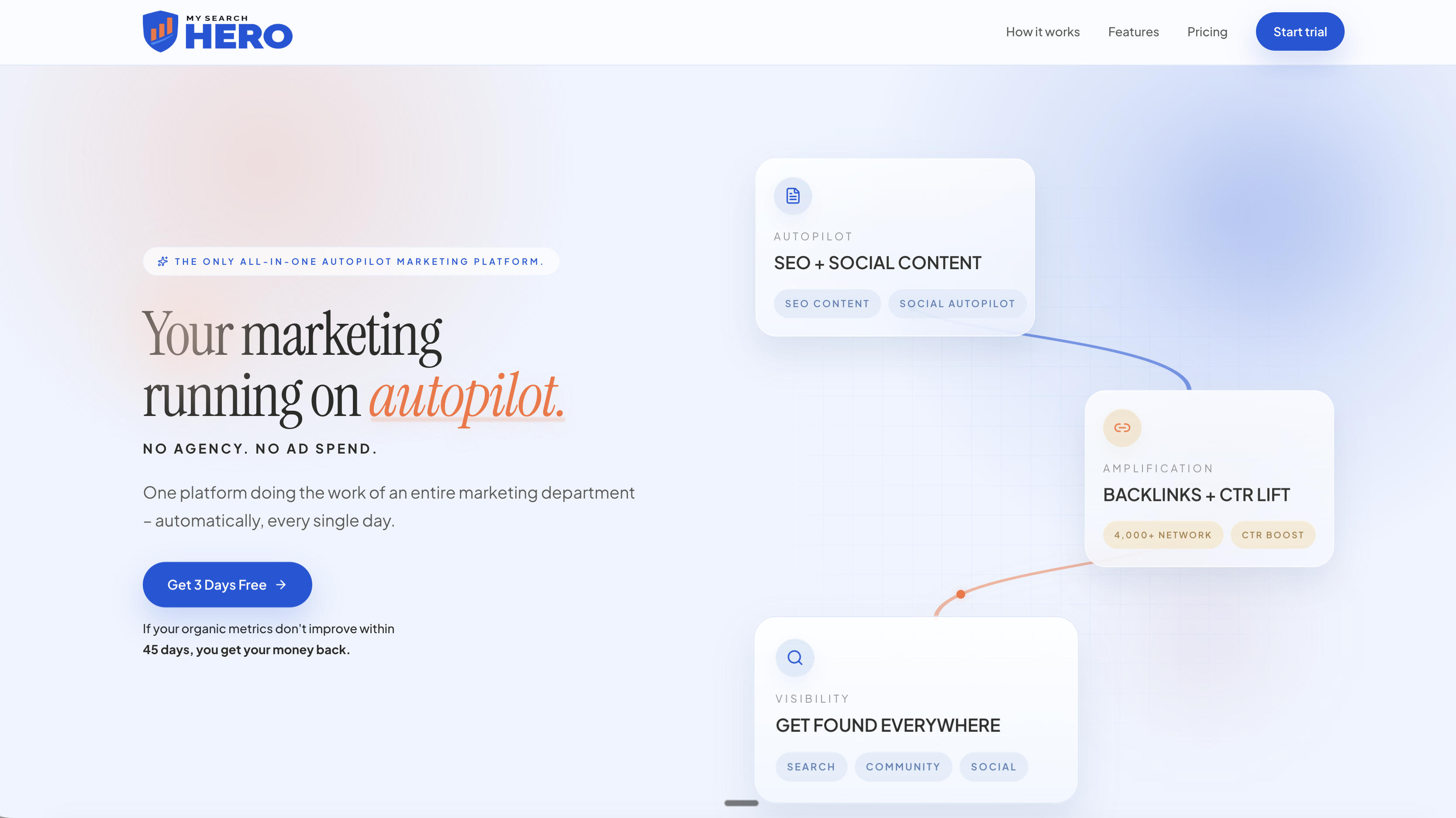
Each month, Mysearchhero subscribers receive published articles, backlinks, Reddit mentions, and AI-generated social media posts, all pushed out through a fully automated system. You get the content marketing workflow without the manual effort. If you are ready to grow your online presence without adding more to your plate, visit Mysearchhero to see how it works.
FAQ
What are content promotion strategies?
Content promotion strategies are the methods businesses use to distribute and amplify their content across paid, owned, and earned channels to increase visibility and drive customer action. They include tactics like email marketing, paid social ads, SEO, influencer outreach, and referral programs.
Which content promotion channel has the best ROI for local businesses?
Email marketing to a permission-based list consistently delivers the highest ROI for local businesses because it reaches an already-engaged audience at low cost. Referral programs rank closely behind due to their high trust factor and low acquisition cost.
How often should I promote my content?
Promotion should be ongoing, not a one-time event after publishing. A repeatable system, such as weekly emails, scheduled social posts, and monthly outreach, produces compounding results that a single share never will.
What is a linkable content asset?
A linkable content asset is a piece of content, such as an original research report, local market data, or a detailed guide, that other websites naturally want to reference and link to. Outreach with strong assets converts at 8 to 18%, compared to under 1% without one.
How do I measure the success of my content promotion?
Track traffic sources, conversion rates, and engagement metrics in Google Analytics 4 or your email platform’s dashboard. Review results monthly and reallocate effort toward the channels and content formats that generate the most qualified leads.