
TL;DR:
- AI-powered outreach automates and personalizes communication with prospects using data-driven techniques, significantly increasing response rates and reducing sales cycles. It integrates machine learning, human review, and multichannel sequencing to improve efficiency, quality, and engagement. Successful implementation relies on strategic signal targeting, human oversight, and continuous measurement to prevent robotic messaging and maintain trust.
AI-powered outreach is the practice of using artificial intelligence to automate, personalize, and optimize communication with prospects at scale, replacing manual guesswork with data-driven precision. The industry term for this practice is AI-driven sales engagement, and it covers everything from automated email sequences to real-time lead scoring and reply handling. Tools like Apollo, Outreach, and CustomGPT.ai have made this approach accessible to marketing teams of every size. Email response rates jump to over 30% with AI personalization, compared to just 2 to 5% for generic outreach. That gap alone explains why marketing professionals and business owners are rethinking how they engage leads in 2026.
What is AI-powered outreach and why does it matter?
AI-powered outreach uses machine learning, natural language processing, and behavioral data to craft and deliver messages that feel personal, arrive at the right time, and adapt based on prospect responses. It is not simply scheduling emails in advance. The system researches accounts, generates tailored copy, scores leads by conversion likelihood, and triggers follow-ups without human intervention at each step.
The business case is direct. Lead-to-opportunity conversion improves 30 to 70% when AI personalization replaces generic templates. For a marketing team running hundreds of outreach sequences simultaneously, that improvement compounds fast. It means fewer wasted touches, shorter pipelines, and more revenue from the same headcount.
What separates AI-driven sales engagement from older marketing automation is intelligence. Legacy tools like basic email drip platforms execute fixed sequences. AI systems read signals, adjust messaging, and prioritize prospects based on live data. The difference is the same as a GPS that recalculates versus a printed map that cannot.
How does AI-powered outreach improve marketing and sales results?
The measurable impact of AI on outreach performance comes from four specific mechanisms: speed, personalization, availability, and effort reduction.
Speed and cycle compression. AI compresses sales cycles by 20 to 40% because it operates 168 hours per week versus the 40 hours a human sales development rep can manage. Follow-ups go out within minutes of a prospect opening an email or visiting a pricing page. That immediacy matters because buyer intent is highest in the first hour after an engagement signal.

Personalization at scale. Generic outreach fails because prospects recognize it immediately. AI systems trained on verified account intelligence, such as recent funding rounds, new product launches, or leadership changes, generate messages that reference one or two specific details per prospect. Signal-based targeting referencing recent prospect actions dramatically outperforms template-driven campaigns.
Effort reduction. Manual effort drops by up to 80% when AI handles lead research, data enrichment, and initial outreach drafts. Sales reps spend their time on conversations that are already warm, not on building lists or writing the same email for the fortieth time. Team retention also improves by 15 to 30% because repetitive work disappears from the job description.
24/7 follow-up automation. A prospect in Tokyo who downloads a white paper at 2 a.m. Eastern time gets a relevant follow-up within minutes, not the next business day. That responsiveness is structurally impossible with a human-only team.
- Response rates: 2 to 5% (generic) versus 30%+ (AI-personalized)
- Sales cycle reduction: 20 to 40% faster
- Manual effort saved: up to 80%
- Team retention improvement: 15 to 30%
Pro Tip: Do not measure AI outreach success by volume alone. Track reply rate, meeting booked rate, and pipeline velocity. Volume without quality is the fastest way to burn your sender reputation.
What are the key components of an AI outreach system?
Understanding how AI-powered outreach works mechanically helps you deploy it without creating the robotic messaging that kills campaigns. The system has five distinct layers.
-
Account research. AI tools scan public data sources, news feeds, LinkedIn activity, and CRM records to build a verified intelligence profile on each target account. CustomGPT.ai and similar knowledge-based tools go further by grounding research in proprietary company data, which produces more accurate context than general AI models.
-
Content generation. The AI drafts outreach messages, subject lines, and follow-up sequences using the account intelligence gathered. The best systems generate multiple variants and select the highest-performing version based on historical engagement data.
-
Human-in-the-loop review. Human review is the critical differentiator between high-conversion AI outreach and generic automated copy that prospects reject. A human editor checks tone, accuracy, and brand voice before messages go live. This step takes minutes, not hours, but it prevents the errors that destroy trust.
-
Automated sequencing and follow-ups. Once approved, the system manages timing, channel selection (email, LinkedIn, SMS), and follow-up triggers automatically. Apollo and Outreach both handle multi-channel sequencing with built-in A/B testing.
-
Lead scoring and reply handling. AI scores inbound replies by intent, flags hot leads for immediate human follow-up, and routes cold or unsubscribe responses to the appropriate workflow.
Pro Tip: The human-in-the-loop step is where most teams cut corners and where most campaigns fail. Budget 15 to 20 minutes per day for a senior marketer to review AI drafts before they send.
The distinction between AI-assisted outreach (human-reviewed) and fully AI-automated outreach (no review) is significant. Fully automated systems produce higher volume but lower quality. AI sales assistants trained on proprietary knowledge consistently outperform generic AI models because the messages are grounded in verified facts rather than plausible-sounding guesses.
How does AI outreach compare to traditional outreach methods?
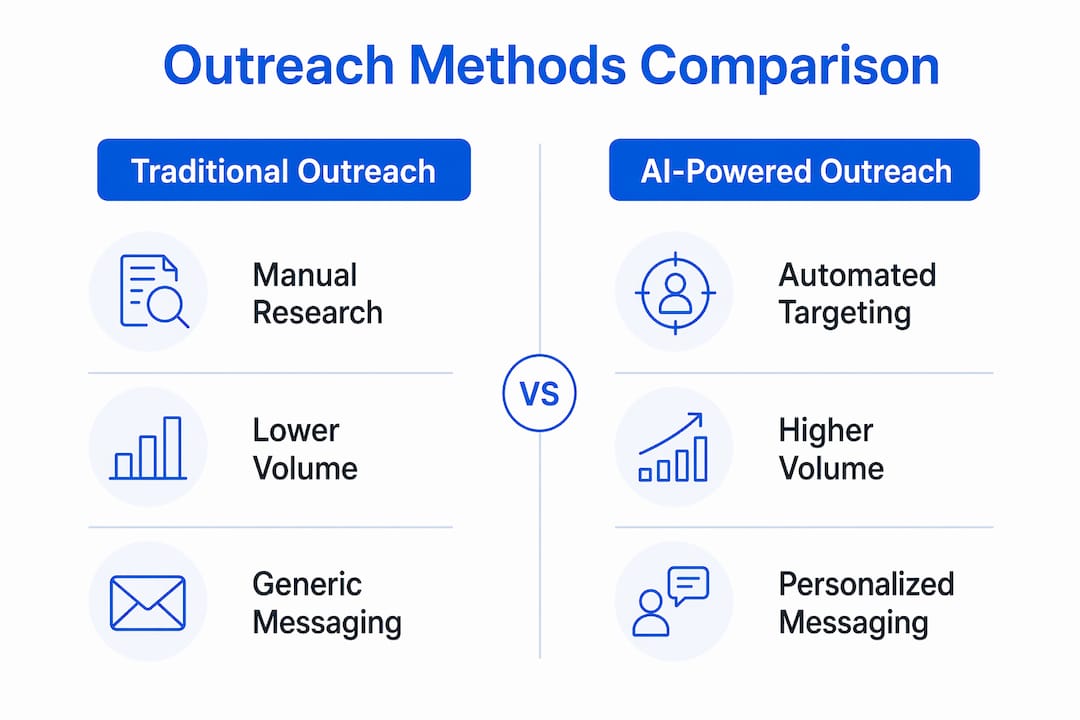
Traditional outreach relies on a sales rep manually researching a prospect, writing a personalized email, sending it, and following up days later. That process produces quality but does not scale. AI outreach flips the constraint: it scales instantly but requires deliberate design to maintain quality.
| Factor | Traditional outreach | AI-powered outreach |
|---|---|---|
| Volume per rep per day | 20 to 50 touches | 500 to 2,000 touches |
| Personalization depth | High (manual research) | High (automated research + human review) |
| Response time to signals | Hours to days | Minutes |
| Cost per qualified lead | High | Significantly lower |
| Risk of sounding robotic | Low | Medium to high without human oversight |
The risk column in that table deserves attention. Over-automation without human oversight leads to short-term volume gains but long-term erosion of your total addressable market. Prospects who receive three robotic emails from your domain mark you as spam, unsubscribe, and remember the experience. Rebuilding that trust costs more than the time you saved.
The teams winning with AI outreach in 2026 are not the ones sending the most messages. 74.8% of companies now measure AI outreach success by customer satisfaction rather than message volume. That shift reflects a mature understanding of what AI is actually for: better decisions, not just faster execution.
Traditional outreach still wins in one scenario: high-value, complex enterprise deals where a single relationship is worth millions of dollars. In that context, AI supports the human rather than replacing them, handling research and scheduling while the rep focuses entirely on relationship depth.
What practical strategies make AI outreach work?
Deploying AI outreach effectively requires more than buying a tool. The hybrid model where AI handles heavy lifting and humans control strategy and editorial tone consistently outperforms fully automated approaches. Here is how to build that model.
Start with signal-based targeting. Before writing a single message, identify what recent actions your ideal prospects are taking. A company that just raised a Series B, hired a new VP of Marketing, or published a case study about a problem you solve is a warm target. Referencing one or two recent signals per message is the single highest-impact personalization tactic available.
Build a knowledge base for your AI. Generic AI models write generic messages. Feed your AI tool your case studies, customer testimonials, product differentiators, and objection-handling scripts. CustomGPT.ai and similar platforms let you create a proprietary knowledge layer that makes every generated message sound like it came from your best sales rep.
Maintain brand voice standards. Create a short style guide (two pages maximum) covering tone, vocabulary, banned phrases, and preferred sentence structure. Give this to your AI tool as a system prompt and to your human reviewer as a checklist. Consistency across hundreds of messages is what makes AI outreach feel like a real person, not a bot.
Measure the right metrics. Track reply rate, positive reply rate, meeting booked rate, and pipeline contribution per sequence. Do not optimize for open rate alone. Open rates measure curiosity; pipeline contribution measures revenue. You can learn more about AI in marketing to see how these metrics fit into a broader growth strategy.
Iterate weekly. AI outreach campaigns that go untouched for 30 days decay. Buyer language changes, competitor messaging shifts, and what felt fresh in January feels stale by March. Build a weekly review cadence where you update templates, refresh signal criteria, and retire sequences that have dropped below your reply rate threshold.
Pro Tip: Use a B2B pipeline with AI approach on LinkedIn to layer social touches between email sequences. Prospects who see your name on multiple channels convert at higher rates than those who only receive email.
Key takeaways
AI-powered outreach works because it combines machine-speed research and personalization with human editorial judgment, producing results that neither approach achieves alone.
| Point | Details |
|---|---|
| Response rate advantage | AI personalization drives 30%+ reply rates versus 2 to 5% for generic outreach. |
| Sales cycle compression | AI availability and instant follow-ups reduce sales cycles by 20 to 40%. |
| Human review is non-negotiable | Human-in-the-loop editing prevents robotic copy and protects sender reputation. |
| Signal-based targeting wins | Messages referencing one or two recent prospect actions outperform all generic templates. |
| Measure quality, not volume | 74.8% of companies now prioritize customer satisfaction over message volume as the primary success metric. |
Why the automation trap is the real threat to your outreach program
I have reviewed hundreds of AI outreach campaigns over the past few years, and the pattern that kills programs is always the same. A team gets access to a tool like Apollo or Outreach, sets up a 10-step automated sequence, and lets it run without touching it for two months. Reply rates start strong, then crater. By month three, they are worse than before AI was introduced.
The problem is not the tool. The problem is treating AI as a replacement for thinking rather than an accelerant for it. Buyers in 2026 are more sophisticated than they were three years ago. They have received enough AI-generated emails to recognize the patterns immediately. The moment a message feels templated, it is deleted.
What actually works is counterintuitive. The teams with the best results are sending fewer messages than before, not more. They use AI to identify the 50 highest-probability accounts each week instead of blasting 5,000. They use AI to research those 50 accounts deeply and draft messages that reference specific, verifiable details. Then a human reads every draft before it sends.
The AI-native era is defined by tightly integrated tools across research, scoring, sequencing, and analytics. But integration without judgment is just sophisticated spam. The marketers who win are the ones who use AI to make better decisions, not just faster ones. If you are building an AI outreach program in 2026, start by asking what you want to be true about every message you send. Then build the AI workflow backward from that standard.
— Mike
How Mysearchhero helps you grow on autopilot
Mysearchhero is a done-for-you SEO and content marketing service built for marketing professionals and business owners who want consistent growth without managing every moving part. Each month, subscribers receive published articles, backlinks, Reddit mentions, and AI-generated social media posts, all pushed through a fully automated pipeline. The same principles that make AI outreach effective, verified research, human editorial review, and signal-based targeting, are built into every deliverable Mysearchhero produces. If you want your content working as hard as your outreach, explore Mysearchhero and see how the autopilot model works for your business.
FAQ
What is AI-powered outreach in simple terms?
AI-powered outreach is the use of artificial intelligence to research prospects, generate personalized messages, and automate follow-ups at scale. It replaces manual sales development work with data-driven systems that operate around the clock.
How much does AI outreach improve response rates?
AI personalization increases email response rates to over 30%, compared to 2 to 5% for generic outreach campaigns. Lead-to-opportunity conversion also improves by 30 to 70% with properly implemented AI systems.
What tools are used for AI-powered outreach?
Apollo, Outreach, and CustomGPT.ai are among the most widely used platforms for AI-driven sales engagement. Each handles different parts of the workflow, from lead research and scoring to message generation and sequence automation.
Is human oversight still needed with AI outreach tools?
Human review remains critical even with advanced AI tools. Fully automated outreach without editorial oversight produces generic copy that prospects reject, and over time it erodes your total addressable market.
How does AI outreach differ from traditional marketing automation?
Traditional marketing automation executes fixed sequences based on preset rules. AI outreach reads live behavioral signals, adjusts messaging dynamically, and prioritizes leads based on real-time conversion probability rather than static criteria.