
TL;DR:
- Video content dominates business marketing in 2026 by increasing engagement, recall, and conversions across digital platforms. It enhances SEO, extends content longevity, and supports every stage of the customer journey through targeted formats like testimonials and explainer videos. Success relies on authentic presentation, strategic repurposing, and consistent, platform-specific distribution rather than production quality alone.
Video content is the dominant format for business marketing in 2026, outperforming every other media type in audience attention, brand recall, and conversion rates. 91% of businesses now use video marketing, and the average return is $4.20 for every dollar spent. That kind of adoption does not happen by accident. Video works because it compresses information, builds emotional connection, and fits how people actually consume content on platforms like YouTube, TikTok, and LinkedIn. Whether you are running short-form social reels, product tutorials, or customer testimonials, understanding the mechanics behind video’s effectiveness is what separates brands that grow from brands that stall.
How does video content improve engagement compared to other media?
The role of video content in driving engagement is measurable and significant. Video captures 90% more engagement than static content, and it produces 80% brand recall within 30 days versus less than 10% for text ads. That gap exists because the human brain processes visual and auditory information simultaneously, reducing the mental effort required to absorb a message.

One minute of video communicates the equivalent of 1.8 million words. This is not a metaphor. It reflects how much contextual information, tone, facial expression, and motion can be packed into a short clip that would take pages of text to replicate. For business owners, this means a 60-second product demo can do more work than a 1,000-word product description.
Dwell time is another concrete benefit. When a visitor watches a video on your website, they stay longer. Search engines interpret longer sessions as a signal of content quality, which feeds directly into rankings. Social platforms reward the same behavior: posts with video receive more shares, comments, and saves than image or text posts across Facebook, Instagram, and LinkedIn.
Specific formats drive specific outcomes:
- Explainer videos reduce confusion about complex products or services, cutting support ticket volume for software companies like Dropbox, which famously used a single explainer video to drive early growth.
- Testimonial videos build social proof at the consideration stage, where skepticism is highest.
- Behind-the-scenes clips humanize a brand and increase perceived authenticity, which matters more to younger buyers than polished production.
“Video serves distinct psychological roles at different customer journey stages, from entertainment in awareness to persuasion in consideration.” — Journal of Marketing and Sales Research
What impact does video content have on SEO and online visibility?
Websites with video are 53 times more likely to rank on Google’s first page than text-only pages. That statistic reflects a combination of factors: longer dwell time, lower bounce rates, and Google’s preference for pages that serve multiple content types. Understanding how video integrates with SEO for business growth is no longer optional for competitive brands.
Videos on landing pages increase conversions by 80 to 86%, with comparison videos performing best at 91%. The mechanism is straightforward. A visitor who watches a product comparison video has already done the mental work of evaluating options. By the time the video ends, their decision is largely made. Text requires the reader to do that work themselves, and most do not.
| SEO metric | Text-only pages | Pages with video |
|---|---|---|
| First-page Google ranking likelihood | Baseline | 53x higher |
| Average dwell time | Low | Significantly higher |
| Landing page conversion rate | Baseline | Up to 86% increase |
| Organic traffic growth | Baseline | Up to 250% increase |
| Email click-through rate | Baseline | 200 to 300% increase |
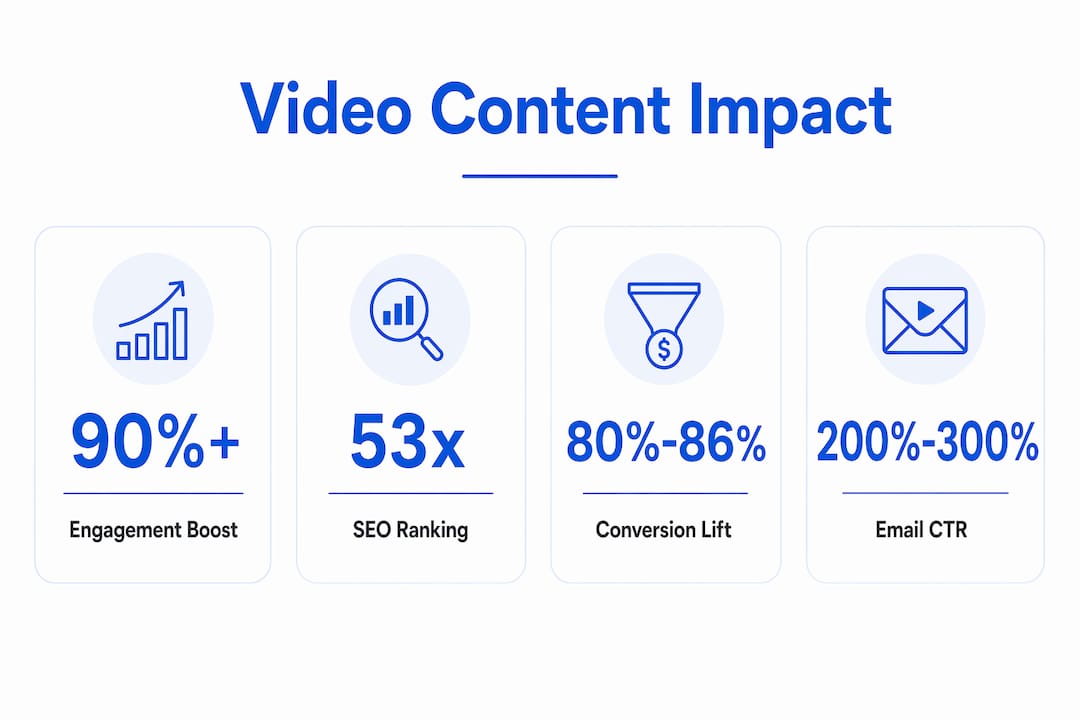
Including video in email campaigns increases click-through rates by 200 to 300%, making it the single highest-impact optimization available to email marketers. That is not a marginal improvement. It is a category-level shift in performance.
Pro Tip: Add the word “video” to your email subject line even when linking to a hosted video on your website. Open rates increase because subscribers know exactly what they are getting, and click-through rates follow.
Which video types best support different marketing goals?
Matching video format to marketing objective is where most brands leave performance on the table. A well-produced brand film posted at the wrong funnel stage generates views but not revenue. The psychological role of video shifts depending on where the viewer sits in their buying journey.
Here is how to align format with goal:
-
Awareness (top of funnel): Short-form clips on TikTok, Instagram Reels, and YouTube Shorts stop the scroll and introduce your brand to cold audiences. 55% of users make purchases after discovering brands through short-form video. This format works because it reduces perceived risk quickly and delivers a single memorable impression.
-
Consideration (middle of funnel): Tutorials, explainers, and product demos address the specific questions buyers ask before committing. A software company walking a prospect through a feature set in a five-minute walkthrough removes the friction that a spec sheet never could.
-
Conversion (bottom of funnel): Testimonial videos and case study videos close deals. Real customers describing real outcomes carry more weight than any copy you write about yourself. Testimonial videos generate 6.2x returns compared to other formats.
-
Retention and community: Live streams, Q&A sessions, and post-purchase onboarding videos keep customers engaged after the sale. Brands that invest here see higher lifetime value and lower churn.
The smartest content strategy treats a single long-form asset as source material. A 30-minute webinar becomes a YouTube upload, five short clips for social, three audiogram posts, and a blog post with embedded highlights. Repurposing long-form video into smaller formats extends content shelf life and multiplies ROI without multiplying production costs.
Pro Tip: Record your next client call or internal training session with permission. That raw footage is often more useful as source material than a scripted production, and it costs nothing extra to capture.
What production and distribution practices actually move the needle?
Production quality matters less than most marketers assume. Authentic human presence in a video increases trust and purchase intention more than high production values. A founder speaking directly to camera on a smartphone outperforms a polished corporate video with no human face in it. Buyers respond to people, not aesthetics.
That said, a few technical details consistently affect reach and engagement:
- Subtitles: 85% of Facebook videos are watched without sound. Subtitles are not optional. They are the difference between a watched video and a scrolled-past one.
- Thumbnails: A clear, high-contrast thumbnail with a human face and readable text outperforms abstract imagery every time on YouTube and LinkedIn.
- Mobile formatting: Vertical video (9:16 ratio) performs better on TikTok, Instagram Reels, and YouTube Shorts. Horizontal (16:9) still dominates YouTube long-form and LinkedIn.
- Posting windows: Content posted in mornings and afternoons consistently reaches more viewers than evening posts across most platforms.
Platform prioritization matters too. Video-first platforms like YouTube and TikTok algorithmically favor video content because it drives longer sessions. Publishing the same video natively on each platform, rather than sharing a YouTube link on LinkedIn, signals to each algorithm that you are a native creator. Native uploads consistently outperform shared links in reach. A solid social media content plan that accounts for platform-specific behavior is what separates brands that get traction from those that post and hope.
Key takeaways
Video content drives superior marketing outcomes because it combines information density, emotional connection, and algorithmic preference in a single format that no other media type can match.
| Point | Details |
|---|---|
| Engagement advantage | Video captures 90% more engagement than static content and delivers 80% brand recall at 30 days. |
| SEO multiplier | Pages with video are 53x more likely to rank on Google’s first page and see up to 250% more organic traffic. |
| Format-to-funnel alignment | Short-form drives awareness, tutorials support consideration, and testimonials close conversions. |
| Authenticity over polish | Real human presence on camera increases trust and purchase intent more than high production budgets. |
| Repurposing maximizes ROI | One long-form video can generate dozens of assets across formats, multiplying returns without multiplying costs. |
Why most brands are still using video wrong
I have reviewed hundreds of video marketing strategies over the years, and the same mistake shows up repeatedly. Brands treat video as a production project instead of a communication strategy. They spend weeks on a brand film, post it once, and wonder why it did not move the needle. The video was fine. The strategy was not.
The brands that win with video are not necessarily the ones with the best cameras. They are the ones who post consistently, match format to funnel stage, and measure the right outcomes. Views are a vanity metric. Watch time, click-through rate, and conversion rate are what tell you whether video is actually working.
The emerging shift I am watching closely is AI-driven video personalization. Automated customized messaging tailored to audience segments is already increasing relevance and conversion for brands using tools like Adobe and Synthesia. This is not a future trend. It is happening now, and the brands building personalization into their video workflows today will have a significant advantage in 12 months.
The other thing most marketers overlook is the impact of video content on content longevity. A well-optimized YouTube video can generate leads for years. A social post disappears in 48 hours. Investing in video that lives on owned and search-indexed platforms is a compounding asset, not a one-time expense.
— Mike
How Mysearchhero helps you build a video-driven content strategy
Building a video content strategy that actually produces rankings, traffic, and leads requires more than a camera and a posting schedule. It requires SEO-aligned content planning, consistent distribution, and the kind of systematic execution that most in-house teams cannot sustain alone.
Mysearchhero delivers done-for-you content marketing that integrates video strategy with SEO, backlink building, and social distribution through a fully automated pipeline. Each month, clients receive published articles, Reddit mentions, AI-generated social posts, and backlinks, all coordinated to grow organic visibility without adding to your workload. If you are ready to make video a compounding asset instead of a one-off effort, Mysearchhero is built for exactly that.
FAQ
What is the role of video content in digital marketing?
Video content serves as the primary format for capturing attention, building brand trust, and driving conversions across the full marketing funnel. It outperforms text and images in engagement, recall, and SEO impact at every stage.
How does video content improve SEO rankings?
Websites with video are 53 times more likely to appear on Google’s first page, primarily because video increases dwell time, reduces bounce rates, and earns more backlinks than text-only pages.
Which video format has the highest conversion rate?
Comparison videos perform best at 91% conversion lift, followed closely by testimonial videos, which generate 6.2x returns compared to other video formats.
How often should businesses post video content?
Consistency matters more than frequency. Posting mornings and afternoons on platform-native uploads, rather than shared links, produces better algorithmic reach regardless of how many videos you publish per week.
Does video content work for small businesses with limited budgets?
Authentic human presence on camera outperforms high-budget productions in trust and purchase intent, meaning a smartphone and a clear message are sufficient to compete effectively with larger brands.