
TL;DR:
- Backlink diversity involves acquiring links from a broad range of domains, platforms, and anchor texts to create a natural SEO profile. It significantly influences search rankings by signaling organic discovery and brand trust, with quality links having more impact than sheer quantity. Building a varied and steady backlink profile reduces risks and insulates sites from algorithm penalties, making diversity essential for long-term ranking stability.
Backlink diversity is defined as acquiring links from a wide variety of domains, platforms, anchor text types, and link attributes to build a natural, trustworthy SEO profile. SEO professionals who understand why diversify backlinks matters gain a structural advantage over competitors who chase raw link volume. Tools like Ahrefs and Semrush both confirm that the composition of your backlink profile predicts ranking stability far better than the total number of links. This guide breaks down the mechanics, the evidence, and the tactics you need to build a profile that holds up through algorithm updates.
Why diversify backlinks: how it shapes your rankings
Backlink diversity directly influences where your pages rank because search engines read your link profile as a signal of organic discovery. A site that earns links from news outlets, niche blogs, forums, and directories looks like a brand the internet genuinely endorses. A site with 500 links from five domains looks manufactured.

Ahrefs analyzed 920 million pages and found that unique referring domains correlate more strongly with rankings than total backlink count. That correlation (Spearman 0.293) is not enormous in isolation, but it is consistent across every niche studied. The implication is clear: spreading links across more domains compounds authority faster than stacking links on the same few sources.
Quality amplifies that effect. A Semrush 2024 ranking factor study found that link quality measured by editorial relevance and site authority carries a Pearson correlation of 0.65 with rankings, compared to 0.18 for referring domain count alone. Quality has 3.6 times more impact than quantity. That means a diverse profile of high-authority, editorially placed links outperforms a large profile of low-quality links from many domains.
Google’s co-founders built PageRank on this logic. PageRank values credibility conveyed by diverse, authoritative pages, not just link volume. A homogeneous link profile contradicts that model and triggers scrutiny.
“Diversified backlink profiles demonstrate authenticity and reduce risk from Google over-optimization filters and Penguin penalties.” Search engines interpret uniform link profiles as artificial. Diversity signals organic discovery and brand trust.
What types of backlinks actually create diversity?
A genuinely diverse backlink profile spans multiple dimensions simultaneously. Varying only one dimension, such as anchor text, while keeping all links from the same platform type, still creates a detectable footprint.
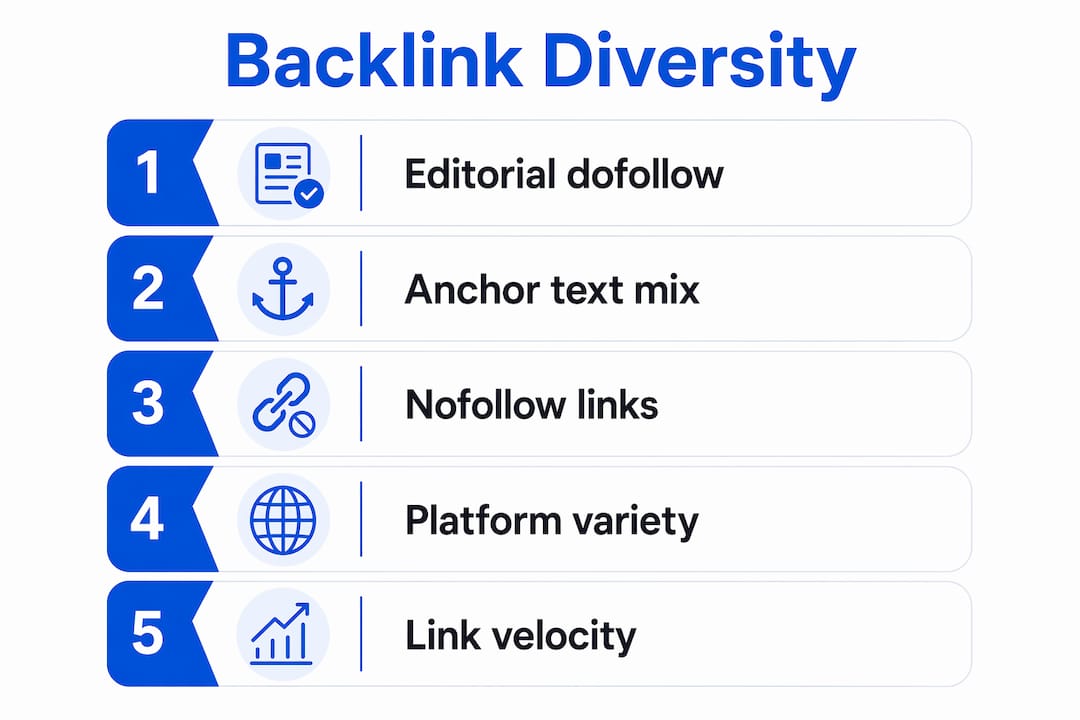
Backlink diversity includes five core dimensions: referring domains, platform types, anchor text distribution, link attributes, and link velocity. Each dimension contributes a separate signal to the overall picture search engines construct about your site.
Backlink source types to include:
- Editorial links from niche blogs and industry publications
- News and PR placements on high-authority media sites
- Business directories and local citation sources
- Forum and community links (Reddit, Quora, niche forums)
- Social media profile and content links
- Resource pages and curated link lists
Anchor text distribution matters as much as source variety. Over-optimizing for exact-match anchors is one of the fastest ways to trigger a Penguin-style filter. A natural profile mixes branded anchors (“Mysearchhero”), partial-match anchors, generic anchors (“click here,” “read more”), and naked URLs.
Link attributes add another layer. A 100% dofollow profile is statistically unusual for any organically growing site. Natural profiles include nofollow links from social platforms, Wikipedia citations, and press mentions. Ignoring nofollow links because they pass no direct PageRank misses their role in making your profile look real.
| Link type | Diversity value | Common sources |
|---|---|---|
| Editorial dofollow | High | Niche blogs, industry media |
| PR/news placement | High | Forbes, trade publications |
| Directory listing | Medium | Yelp, industry directories |
| Forum/community | Medium | Reddit, niche forums |
| Social profile | Low to medium | LinkedIn, Twitter/X |
| Nofollow editorial | Profile naturalness | Wikipedia, news sites |
Pro Tip: Use Ahrefs’ referring domains report filtered by platform type to spot gaps in your profile. If 80% of your links come from blogs, you have a footprint problem worth fixing before your next content push.
Why quantity alone fails without diversity
The most common backlink mistake SEO professionals make is treating link building as a volume game. More links from the same source type do not compound authority. They compound risk.
Consider two sites with 200 backlinks each. Site A has all 200 links from a single domain. Site B has one link each from 200 different domains. 200 links from 200 domains outperform 200 links from one domain for search rankings. The math is not close.
The risk compounds when you rely on a single tactic. Backlink profiles heavily reliant on one tactic or source are vulnerable to volatility and algorithm penalties. A site that built its authority entirely on guest posts faces a serious problem the moment Google updates its assessment of guest post networks. A site with links from 15 different source types absorbs that update without losing ground.
Search engines track behavioral footprints. Homogeneous link sources resemble manufactured ecosystems, and Google’s systems are trained to detect exactly that pattern. The penalty is not always a manual action. Algorithmic suppression is quieter and harder to diagnose.
- Single-source risk: All links from one platform type create a detectable pattern that flags manipulation.
- Anchor text over-optimization: Exact-match anchors above roughly 10–15% of your profile attract over-optimization filters.
- Velocity spikes: Acquiring 300 links in one month after months of inactivity looks unnatural regardless of source quality.
- Authority without relevance: High-DA links from irrelevant niches carry less weight than mid-authority links from topically aligned sites.
“Link diversity reduces exposure to over-optimization filters and Penguin-style algorithm suppression, creating a resilient SEO profile.” Resilience is the operational word. A diverse profile does not just rank better. It stays ranked.
How to diversify backlinks: proven strategies that work
Building a diverse backlink profile is not a one-time project. It is an ongoing acquisition process that requires deliberate variation across source types, anchor text, and link velocity. The benefits of backlinking compound when you treat diversity as a standing constraint on every campaign, not an afterthought.
Core diversification tactics:
- Guest posting on niche-relevant sites: Produces editorial dofollow links with natural anchor text. Vary the publications and avoid using the same anchor text across multiple placements.
- Digital PR and news placements: Earns high-authority links from media outlets. These links are often nofollow but carry strong trust signals and brand mentions.
- Resource page outreach: Targets curated lists in your niche. These links are editorially placed and topically relevant, which strengthens both authority and topical signals.
- Forum and community participation: Reddit, Quora, and niche forums generate nofollow links that contribute to profile naturalness. They also drive referral traffic, which reinforces engagement signals.
- Broken link building: Finds dead links on authoritative pages and offers your content as a replacement. This produces editorial links with contextual relevance.
Balancing link velocity across your target pages is as important as the source mix. Concentrate all new links on your homepage and you create a pattern that looks like manipulation. Spread acquisition across blog posts, service pages, and category pages to mirror how a real brand earns attention.
Contextual backlinks placed editorially within relevant content significantly improve backlink diversity and SEO trust signals. An editorial mention inside a paragraph about your topic carries more weight than a footer link or a sidebar widget. Prioritize placements where the link appears within body copy.
Sites that maintain consistent, varied link growth achieve 5–14% higher organic monthly growth over 6–12 months. That compounding effect is the strongest argument for treating diversity as a long-term system rather than a campaign tactic.
Pro Tip: Audit your backlink profile in Ahrefs or Semrush every 90 days. Sort by platform type and anchor text category. If any single category exceeds 40% of your profile, that is your next diversification target.
To learn how to get backlinks from a wider range of sources, the tactics above give you a starting framework. The execution requires consistent outreach, content worth linking to, and a tracking system that flags footprint risks before they become ranking problems.
Key Takeaways
Backlink diversity is the single most underrated factor separating sites that rank consistently from sites that spike and drop with every algorithm update.
| Point | Details |
|---|---|
| Unique domains beat volume | 200 links from 200 domains outperform 200 links from one domain for rankings. |
| Quality multiplies diversity | Editorial relevance and site authority have 3.6x more ranking impact than domain count alone. |
| Varied source types reduce risk | Profiles relying on one link tactic are vulnerable to algorithm penalties and ranking drops. |
| Anchor text must be mixed | Over-optimizing exact-match anchors above natural distribution levels triggers over-optimization filters. |
| Consistent growth compounds gains | Sites with varied, steady link growth achieve 5–14% higher organic monthly growth over 6–12 months. |
The footprint problem most SEO professionals ignore
The part of backlink diversity that gets the least attention is footprint detection. Most SEO professionals focus on domain authority and anchor text. They miss the platform-type dimension entirely.
I have audited profiles where every single link came from WordPress blogs. The domain authority varied. The anchor text varied. The niches varied. But every link was from a self-hosted WordPress blog with a specific comment or author bio structure. Google’s systems do not need a manual reviewer to spot that. The pattern is machine-readable.
The fix is not complicated, but it requires discipline. Every time you plan a link acquisition campaign, ask which platform types are underrepresented in your current profile. If you have strong blog coverage, your next push should target forums, directories, or PR placements. Rotate deliberately.
The other thing I see overlooked is the role of internal linking in amplifying backlink diversity. A diverse set of external links pointing to a well-structured internal link architecture distributes authority more efficiently than the same links pointing to a flat site structure. Backlink diversity and internal SEO structure are not separate strategies. They work as a system.
The SEO professionals who build the most durable rankings treat link diversity as trust architecture. It validates content depth across subtopics, signals organic discovery, and insulates the site from the next algorithm update. That is not a tactical advantage. It is a structural one.
— Mike
How Mysearchhero builds diverse backlinks for you
Building a genuinely diverse backlink profile requires consistent execution across multiple source types, every single month. Most SEO teams run out of bandwidth before they hit the diversity threshold that actually moves rankings.
Mysearchhero is a done-for-you SEO and content marketing service built for exactly this problem. Each month, subscribers receive a bundle of published articles, backlinks from varied sources, Reddit mentions, and AI-generated social media posts, all pushed through a fully automated pipeline. The service handles source variation, anchor text distribution, and link velocity so your profile grows naturally without manual oversight. If you want a backlink profile that compounds authority without the footprint risks, Mysearchhero is built to deliver that on autopilot.
FAQ
Why does backlink diversity matter more than total link count?
Unique referring domains correlate more strongly with rankings than total backlink count, according to Ahrefs analysis of 920 million pages. A diverse profile signals organic discovery, while a high-volume profile from few domains signals manipulation.
What makes a backlink profile look natural to Google?
A natural profile mixes dofollow and nofollow links, varied anchor text types, and multiple platform sources including blogs, directories, forums, and news sites. A 100% dofollow profile from a single platform type is statistically unusual and attracts algorithmic scrutiny.
How often should I audit my backlink profile for diversity gaps?
Audit every 90 days using tools like Ahrefs or Semrush. Sort links by platform type and anchor text category to identify any single source exceeding 40% of your profile, then target that gap in your next acquisition campaign.
Can nofollow links contribute to backlink diversity?
Nofollow links contribute to profile naturalness even without passing direct PageRank. Social media links, Wikipedia citations, and press mentions are typically nofollow, and their absence from a profile is itself a red flag.
What is the fastest way to diversify an existing backlink profile?
Digital PR placements and resource page outreach are the fastest ways to add high-authority links from source types most profiles underrepresent. Pair these with forum participation and directory listings to cover multiple platform dimensions simultaneously.