
TL;DR:
- External links signal content quality and credibility to search engines without directly boosting rankings.
- Linking to authoritative, relevant sources improves topical relevance and helps Google classify your content accurately.
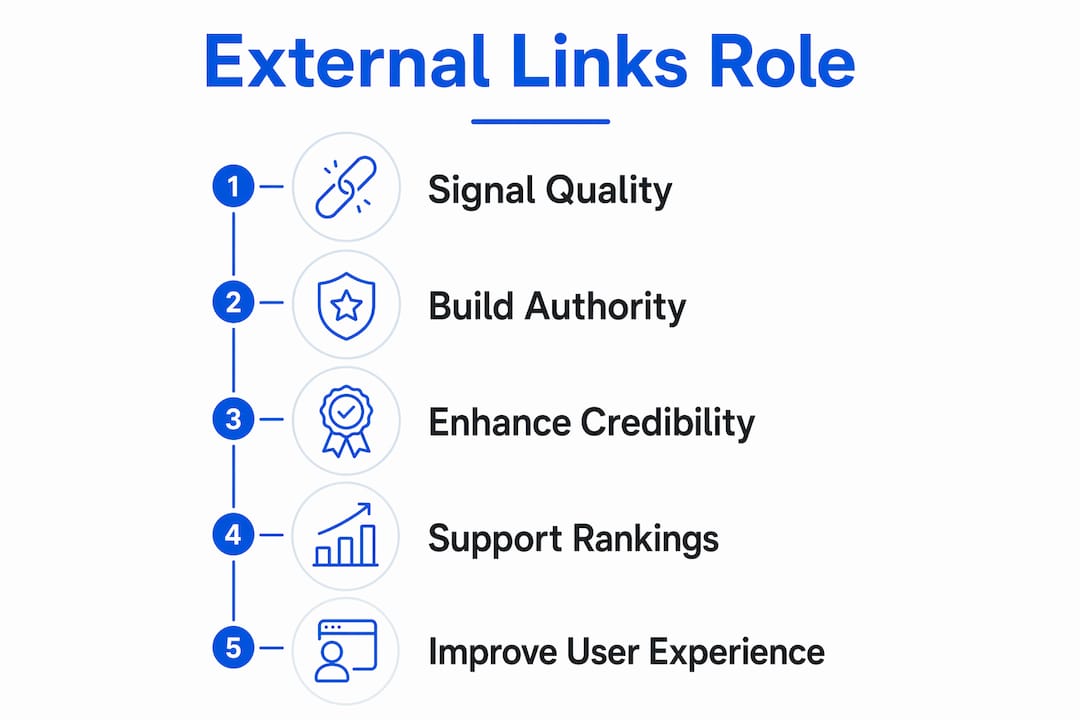
External links are hyperlinks pointing from your website to another domain, and they serve as one of the clearest signals of content quality and credibility available to search engines. The role of external links is not to directly boost rankings but to tell Google and other search engines that your content is grounded in real, verifiable sources. Google’s E-E-A-T framework (Experience, Expertise, Authoritativeness, and Trustworthiness) treats outbound links as evidence that your content connects to a broader ecosystem of trusted information. Webmasters and digital marketers who understand this distinction stop chasing link volume and start building editorial credibility instead.
How do external links influence SEO and site authority?
External links are not a direct ranking factor, but they shape how search engines classify and evaluate your content. Google reads your outbound links as topical signals. When you link to authoritative, relevant sources, you tell the algorithm what your page is about and that you have done the research to back it up.

Google’s 2024 algorithm updates confirmed that outbound link quality is a positive signal. Linking to low-quality or irrelevant sites, on the other hand, can suppress your search visibility through what practitioners call topic-toxicity suppression. That suppression does more damage than any minor loss of link equity ever would.
One myth worth killing: PageRank leakage. The idea that linking out “bleeds” your page authority to other sites has been overstated for years. The real risk from outbound links is topic-toxicity, not equity loss. A page linking to irrelevant or spammy sites gets classified as low-quality content. A page linking to the CDC, a peer-reviewed journal, or a government database gets classified as well-researched.
Search engines in 2026 also use outbound links as topical classifiers in AI-driven ranking systems. Authoritative outbound links help AI classifiers understand what your content covers and whether it belongs in a given topic cluster. This makes external linking a quiet but measurable part of your overall SEO strategy.
“Zero external sources leave an article appearing ‘unmoored’ from trusted context.” — SEO practitioners on the synthesis effect of authoritative citations.
The synthesis effect matters here. 8–12 high-authority citations per long-form article create a collective signal of expertise that no single link can produce alone. That number reflects real editorial depth, not link stuffing.
What best practices should webmasters follow for external links?
Getting external linking right comes down to three principles: quality, context, and intent. Follow these and you avoid the most common mistakes webmasters make.
- Link only to authoritative, relevant sources. Government sites, academic institutions, major industry publications, and recognized research bodies all qualify. A link to a thin affiliate blog does not.
- Embed links contextually in body text. Links buried in footers or sidebars carry almost no editorial weight. Contextual placement with descriptive anchor text signals editorial intent to both users and search engines.
- Use descriptive anchor text. “A 2024 CDC report on vaccine efficacy” is better anchor text than “click here.” Descriptive anchors tell Google what the linked page covers and why you cited it.
- Aim for 8–12 external citations per long-form article. Fewer than that and your content looks unmoored. More than that and you risk diluting your editorial focus.
- Balance outbound links with internal links. External links support credibility. Internal links keep readers on your site and distribute authority across your pages. Both matter.
- Never link for SEO manipulation. Reciprocal link schemes, paid links, and link farms all violate Google’s guidelines and carry real penalties. Every external link should exist because it genuinely helps the reader.
Pro Tip: Before publishing any article, audit every external link for domain authority and topical relevance. A single link to a spammy or off-topic site can undercut the credibility of every other citation on the page.
E-E-A-T specifically requires linking to primary research, government sources, or institutional data to satisfy Google’s trust demands. This is not optional for content competing in health, finance, legal, or any other YMYL (Your Money or Your Life) category.
How do external links affect user experience and site credibility?
External links serve your readers before they serve your rankings. When you cite a source, you give readers a path to verify your claims, explore the original data, and build their own understanding. That transparency builds trust faster than any design element or brand statement can.
The benefits of external links for users include:
- Claim verification. Readers can check your sources directly, which increases confidence in your content.
- Deeper exploration. A link to a full research paper or government report lets readers go further than your article alone can take them.
- Transparency signals. External links improve user experience by showing that your content is grounded in real evidence, not just opinion.
- Goodwill and backlink potential. Linking to reputable sites can generate reciprocal backlinks over time, as industry peers notice and reference your content in return.
The SEO value and the user value of external links are not separate things. They reinforce each other. A reader who trusts your content stays longer, shares it more, and returns. Those behavioral signals feed back into your search performance.
One distinction worth drawing: linking out for user value and linking out for SEO value should produce the same decision. If a link genuinely helps the reader understand your point better, it almost certainly helps your SEO too. If you are adding a link only because you think it will help rankings, it probably will not.
How do external links relate to backlinks and your overall link strategy?
External links and backlinks are two sides of the same coin. External links (outbound) are links you send to other sites. Backlinks (inbound) are links other sites send to you. Both matter, but they work differently.
| Link type | Direction | Primary SEO function |
|---|---|---|
| External (outbound) links | Your site to other domains | Signals content quality and topical relevance |
| Backlinks (inbound links) | Other domains to your site | Transfers authority and boosts ranking potential |
Backlinks remain one of the top 3 ranking factors in 2026. The number one search result typically has 3.8 times more backlinks than lower-ranking pages. That gap is not closed by outbound linking alone. But outbound linking contributes to the content quality that earns backlinks in the first place.
The relationship works like a flywheel. You publish well-researched content with authoritative outbound citations. That content ranks better because it signals expertise. Higher-ranking content attracts more inbound links from other sites. More inbound links push your rankings higher still. Understanding the importance of backlinks within this cycle is what separates reactive SEO from a real growth strategy.
Advanced SEO workflows integrate external linking with ongoing backlink acquisition and on-page content quality. Treating them as separate tactics misses the compounding effect they create together.
Pro Tip: When you link out to a high-authority site, consider reaching out to let them know. A brief, genuine note about why you cited their work occasionally leads to a mention or backlink in return. It is a low-effort tactic with a real upside.
For webmasters building a link strategy from scratch, the clearest starting point is understanding how to get backlinks that actually move rankings, then layering in a consistent outbound linking practice to support content quality.
Key takeaways
External links build content credibility and topical authority, and when combined with a strong backlink profile, they form the foundation of a durable SEO strategy.
| Point | Details |
|---|---|
| Not a direct ranking factor | External links signal content quality and topical relevance, not rankings directly. |
| Quality beats quantity | Aim for 8–12 authoritative citations per article; irrelevant links cause topic-toxicity suppression. |
| Context and placement matter | Embed links in body text with descriptive anchor text to signal editorial intent. |
| Backlinks amplify outbound efforts | Strong outbound linking supports the content quality that earns inbound backlinks over time. |
| E-E-A-T demands real sources | Linking to primary research and institutional sources satisfies Google’s trust requirements. |
What I have learned from years of watching external links work (and fail)
The biggest mistake I see webmasters make is treating external links as a risk. They worry about sending traffic away from their site or “losing” PageRank. That fear is outdated and it costs them credibility.
The sites I have watched rank consistently well all share one habit: they cite their sources without hesitation. They link to the CDC, to peer-reviewed studies, to government data. They do not hoard their outbound links. And because their content looks authoritative, it earns backlinks from other sites that want to reference something credible.
The second mistake is the opposite one: linking to anything and everything to appear well-researched. Quantity without quality is worse than no links at all. A page with 20 outbound links to thin affiliate sites or irrelevant blogs reads as low-effort to both users and algorithms.
My honest view is that external linking is an editorial discipline, not an SEO tactic. The moment you start asking “does this link help my rankings?” instead of “does this link help my reader?”, you make worse decisions on both fronts. The best external links are the ones you would include even if Google did not exist.
Search algorithms will keep evolving. AI-driven ranking systems will get better at detecting manufactured signals. What will not change is that well-sourced, contextually linked content serves readers better. And content that serves readers better will always find a way to rank.
— Mike
How Mysearchhero supports your link strategy
Building a credible external linking practice takes time, and pairing it with consistent backlink acquisition takes even more. Mysearchhero handles both sides of that equation for you.
Every month, Mysearchhero delivers published articles built with authoritative outbound citations, a growing backlink profile, and supporting content across Reddit and social media. The entire pipeline runs on autopilot so your site gains authority without pulling your team away from other work. If you want a done-for-you SEO service that treats link strategy as a complete system, visit Mysearchhero to see what a monthly plan includes.
FAQ
What is the role of external links in SEO?
External links signal content quality and topical relevance to search engines. They are not a direct ranking factor but contribute to E-E-A-T signals that influence how Google evaluates and classifies your content.
Do external links help rankings directly?
External links do not directly boost rankings, but pages that link to authoritative, relevant sources tend to rank better because search engines interpret those links as markers of well-researched content.
How many external links should an article have?
8–12 high-authority citations per long-form article create a synthesis effect that signals genuine expertise. Fewer looks unsubstantiated; more risks diluting editorial focus.
What is the difference between external links and backlinks?
External links point from your site to another domain. Backlinks point from another domain to your site. Both are part of a complete link strategy, but backlinks remain a top-3 ranking factor while external links primarily support content quality signals.
Can external links hurt your SEO?
Yes. Linking to low-quality, irrelevant, or spammy sites causes topic-toxicity suppression, which damages search visibility more than any minor loss of link equity from legitimate outbound links.