
TL;DR:
- Effective SEO relies on a balanced approach that combines technical, on-page, off-page, and local strategies. Businesses should prioritize fixing technical issues before pursuing content and link-building efforts for better results. The most successful strategies integrate all core types and tailored specialties based on their specific business needs.
SEO strategy is defined as a structured plan to improve a website’s visibility in search engines through distinct, coordinated approaches. The four core types of SEO strategies are on-page, off-page, technical, and local SEO, with specialized layers like e-commerce and international SEO addressing specific business needs. Understanding how each type works, and when to use it, is the difference between a site that ranks and one that stalls. Tools like Semrush and resources like Backlinko confirm that strategy development works best when built around 10–20 core queries reflecting real customer problems.
1. What are the four core types of SEO strategies?
The four core SEO pillars form the foundation of every effective search strategy. Each one targets a different part of how search engines find, evaluate, and rank your site. Skipping any one of them creates a gap that limits your results, no matter how strong the others are.

On-page SEO covers everything on your actual web pages: title tags, meta descriptions, header structure, keyword placement, and content quality. The goal is to make each page clearly relevant to a specific search query. A product page optimized with the right keywords, structured headers, and internal links will consistently outrank a page that ignores these signals.
Off-page SEO builds your site’s authority through external signals, primarily backlinks. Link-worthy content types include benchmarks, teardowns, tools, and proprietary data sets, which earn substantially more backlinks than basic blog posts. That matters because backlinks from authoritative sites signal trust to Google, which translates directly into higher rankings. Read more about off-page link building to understand how authority compounds over time.
Technical SEO is the minimum standard every site must meet before other efforts pay off. Without crawlability, site speed, and clean indexing, even high-quality content cannot rank well. Clean architecture, mobile-friendliness, and XML sitemaps are non-negotiable. Think of technical SEO as the plumbing. Nobody sees it, but everything breaks without it.
Local SEO targets geographically specific searches, including “near me” queries. Google Business Profile optimization and local citations are the two most critical elements. A restaurant, law firm, or home services company that ignores local SEO is invisible to the customers closest to them.
Pro Tip: Fix technical SEO issues first. Running content campaigns on a slow, poorly indexed site is like pouring water into a leaking bucket.
2. What specialized SEO strategy types should businesses consider?
Beyond the four core pillars, several specialized SEO types address specific business models and audience behaviors. These are not optional extras for large enterprises. Many small and mid-sized businesses need at least one of them to compete effectively.
E-commerce SEO handles the complexity of product catalogs, filters, and pagination. Proper internal linking and page categorization improve both rankings and user experience at scale. A site with 10,000 product pages faces duplicate content and crawl budget problems that a standard blog never encounters. E-commerce SEO solves those problems systematically.
International SEO targets multiple countries or languages using hreflang tags, country-specific domains or subdirectories, and localized content. A U.S. brand expanding into Germany or Brazil needs a different URL structure and content strategy, not just a translated homepage.
Mobile SEO is no longer a specialty. Google uses mobile-first indexing, meaning your mobile site is the version that gets ranked. Pages that load slowly on mobile or break on smaller screens lose rankings regardless of desktop performance.
Voice SEO optimizes for conversational queries typed or spoken into tools like Google Assistant or Siri. Voice searches tend to be longer and more question-based than typed queries. Structuring content around natural language questions, especially in FAQ formats, captures this traffic.
Content SEO treats content as its own strategic layer, focused on topical authority, content clusters, and search intent alignment. SEO built around actual customer pain points from sales calls, support tickets, and CRM data produces content that converts, not just content that ranks.
Video SEO optimizes YouTube and embedded video content for search. YouTube is the second-largest search engine in the world. Titles, descriptions, transcripts, and chapter markers all affect how video content ranks.
Pro Tip: Start with mobile SEO and content SEO before investing in voice or video. The foundational specialized types deliver faster returns for most businesses.
3. How do these SEO strategy types compare and complement each other?
No single SEO type works in isolation. The most effective SEO campaigns combine short-term tactics like schema markup with long-term efforts including link building and authority-based content campaigns. Short-term results appear in 1–3 months. Long-term results from link building and content authority take 6–12 months or more.
| SEO Type | Primary Focus | Best For | Time to Results |
|---|---|---|---|
| On-page SEO | Content, keywords, meta tags | All websites | 1–3 months |
| Off-page SEO | Backlinks, authority signals | Competitive niches | 3–12 months |
| Technical SEO | Crawlability, speed, indexing | All websites | 1–2 months |
| Local SEO | Geographic visibility | Brick-and-mortar, service areas | 1–3 months |
| E-commerce SEO | Product pages, filters, scale | Online stores | 2–6 months |
| International SEO | Multi-language, multi-country | Global brands | 3–9 months |
| Content SEO | Topical authority, intent | Content-driven businesses | 3–9 months |
Technical SEO and on-page SEO always come first. They create the conditions for every other strategy to work. Off-page SEO amplifies what is already there. Local SEO and specialized types layer on top based on your business model and audience.
The biggest mistake businesses make is running off-page campaigns before their technical foundation is solid. Backlinks pointing to a slow, poorly structured site produce far weaker results than the same links pointing to a clean, fast one. Sequence matters as much as selection.
4. What are some effective SEO strategy examples and best practices?
Real results clarify what works. Businesses that consolidated fragmented websites into a single unified architecture saw 661% year-over-year growth in organic traffic. That is not a content win or a link building win. It is a structural decision rooted in technical and on-page SEO working together.
Keyword research and content planning
Effective keyword research starts with customer problems, not search volume. Pull topics from sales call recordings, support tickets, and customer reviews. Then map those topics to specific pages using a cluster model: one pillar page covering a broad topic, supported by several detailed subtopic pages. This structure signals topical authority to Google and keeps users on your site longer.
Technical optimization priorities
Site speed, mobile performance, and crawl efficiency are the three technical areas that move rankings fastest. Use Google Search Console to identify crawl errors and index coverage issues. Use PageSpeed Insights to find load time problems. Fix broken internal links and remove duplicate content before scaling any content campaign.
Link building aligned with off-page SEO
Content that earns backlinks is data-rich, analytical, or benchmarking-focused. Generic “tips” posts rarely attract links without heavy outreach. Publishing original research, industry surveys, or detailed case studies generates links passively. That reduces outreach labor and builds authority faster than traditional guest posting alone.
Pro Tip: Use Semrush or Ahrefs to audit your backlink profile quarterly. Identify toxic links and disavow them before they drag down your domain authority.
Local SEO with Google Business Profile
A fully optimized Google Business Profile is the single highest-leverage action for local businesses. Add accurate hours, photos, service descriptions, and a consistent NAP (name, address, phone number) across all directories. Respond to reviews regularly. Google treats engagement signals as a ranking factor in local results. Understanding why SEO matters for service businesses makes the case for investing in local SEO early.
Monitoring and measurement
Google Analytics 4 tracks organic traffic, engagement rate, and conversion paths. Google Search Console shows which queries drive impressions and clicks. Semrush and Ahrefs track keyword rankings and backlink growth over time. Without measurement, you cannot tell which SEO type is producing results or where to adjust.
Key takeaways
A complete SEO strategy requires technical SEO as the foundation, on-page and content SEO for relevance, off-page SEO for authority, and specialized types matched to your specific business model.
| Point | Details |
|---|---|
| Technical SEO comes first | Fix crawlability, speed, and indexing before scaling content or links. |
| Core pillars work together | On-page, off-page, technical, and local SEO each fill a distinct role. |
| Specialized types add precision | E-commerce, international, and content SEO address specific business needs. |
| Sequence affects results | Running link campaigns before fixing technical issues weakens their impact. |
| Measurement is non-negotiable | Use Google Analytics 4 and Search Console to track what is actually working. |
What I have learned about picking the right SEO strategy
Most businesses I have worked with want to start with content. It feels productive. You can see the output. But the honest truth is that content without a solid technical foundation is wasted effort. I have seen sites publish 50 articles and gain almost no traction because their crawl budget was being eaten by duplicate filter pages or their Core Web Vitals were failing on mobile.
The other pattern I keep seeing is businesses treating SEO types as either/or choices. They pick “content SEO” or “local SEO” and ignore the rest. That is not how search engines work. Google evaluates your site across all these dimensions simultaneously. A local service business still needs clean technical SEO and solid on-page optimization. An e-commerce store still needs off-page authority to compete in crowded categories.
The role of SEO in business growth has shifted in 2026 because AI-generated content has flooded search results. The sites that win now are the ones with genuine authority signals: real backlinks, strong technical performance, and content built around actual customer intent rather than keyword volume. That combination is harder to fake and harder to compete against.
My advice is to audit your site across all four core pillars before deciding where to invest. You will almost always find a technical or on-page issue that is holding back results you are already close to achieving.
— Mike
How Mysearchhero helps you put this into practice
Understanding SEO strategy types is one thing. Executing them consistently is another.
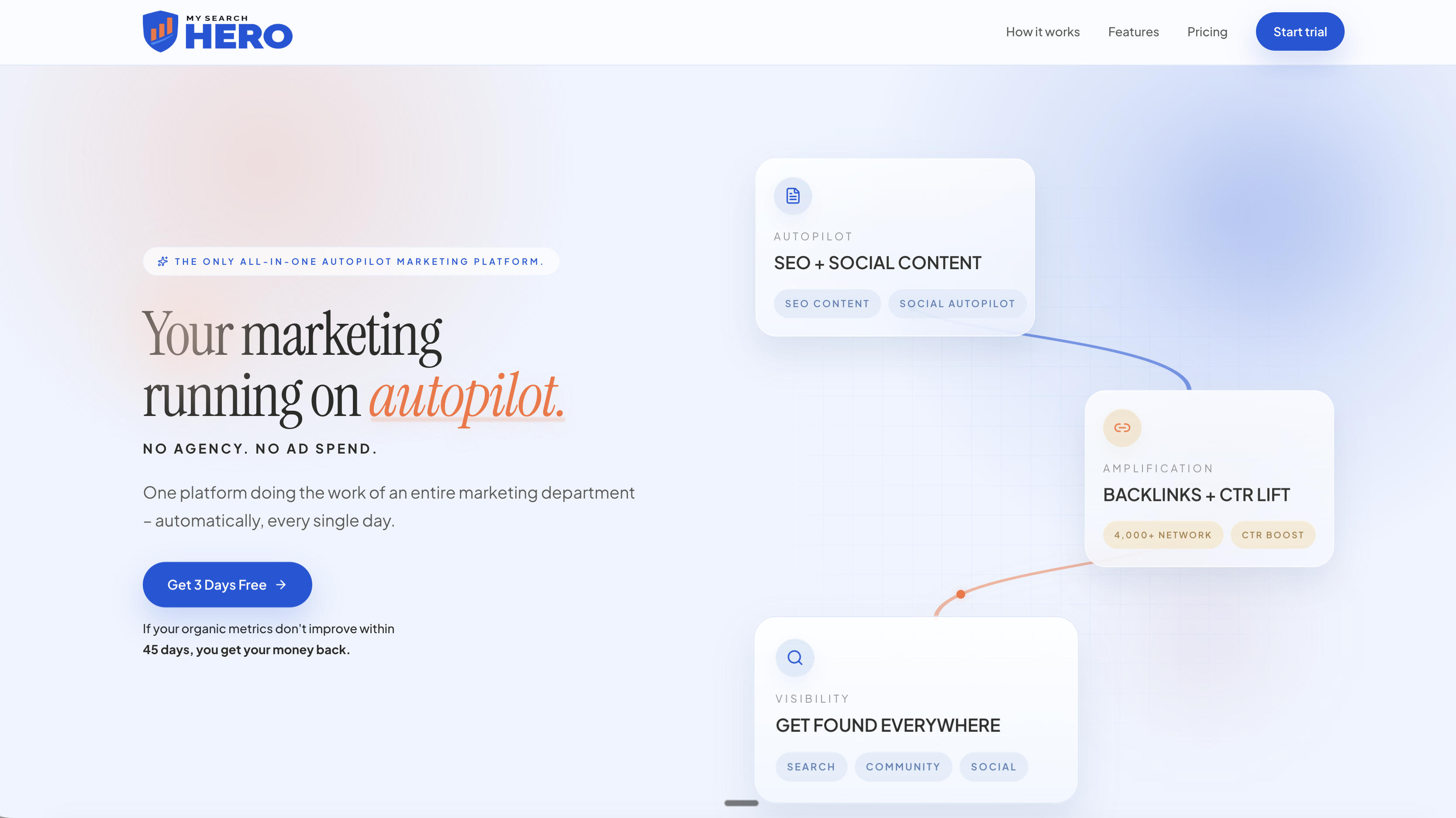
Mysearchhero is a done-for-you SEO and content marketing service built for business owners and marketers who want results without managing the process themselves. Each month, subscribers receive published articles, backlinks, Reddit mentions, and social media posts, all delivered through a fully automated pipeline. Whether you need to build topical authority through content SEO, strengthen your off-page profile with quality backlinks, or get consistent local visibility, Mysearchhero handles the execution. Your marketing runs on autopilot while you focus on your business.
FAQ
What are the main types of SEO strategies?
The four core types are on-page, off-page, technical, and local SEO. Specialized types include e-commerce, international, content, mobile, voice, and video SEO.
Which SEO strategy type should I start with?
Start with technical SEO. Without clean crawlability, site speed, and proper indexing, no other SEO effort produces its full potential.
How long does it take for SEO strategies to show results?
Technical and on-page SEO show results in 1–3 months. Off-page and content SEO typically take 6–12 months to produce significant ranking gains.
What is the difference between on-page and off-page SEO?
On-page SEO covers elements you control directly on your site, like content and meta tags. Off-page SEO refers to external signals, primarily backlinks from other websites.
Do small businesses need all types of SEO strategies?
Small businesses need technical SEO and on-page SEO as a baseline. Local SEO is critical for businesses serving a geographic area. Specialized types like e-commerce or international SEO apply only when the business model requires them.