
Multi-channel content is the practice of distributing tailored content across multiple independent platforms — email, blog, social media, paid ads, and more — so you reach audiences where they already spend time. Each channel runs its own strategy and format; there is no requirement for a unified backend or shared customer data. Use this approach when your primary goal is reach and repeated impressions, not a seamlessly integrated customer journey. HubSpot’s Multi-Channel Content Report shows that 94% of brands use three or more channels and 84% of marketers report increased ROI after adopting a multi-channel approach. Mysearchhero automates this kind of cross-channel publishing for small businesses, handling article distribution, backlinks, social posts, and Reddit mentions from a single subscription.
Table of Contents
- How multichannel differs from omnichannel
- What channels belong in a multi-channel content program
- Why multi-channel content is worth the effort — and where it gets hard
- How to build a multichannel content campaign, step by step
- How to repurpose one content asset across channels
- Setting up operations: calendars, roles, and scaling
- Measuring what actually matters
- How to prioritize channels when your budget is limited
- Key Takeaways
- The part most guides skip about multi-channel content
- Mysearchhero handles the distribution so you can focus on strategy
- FAQ
How multichannel differs from omnichannel
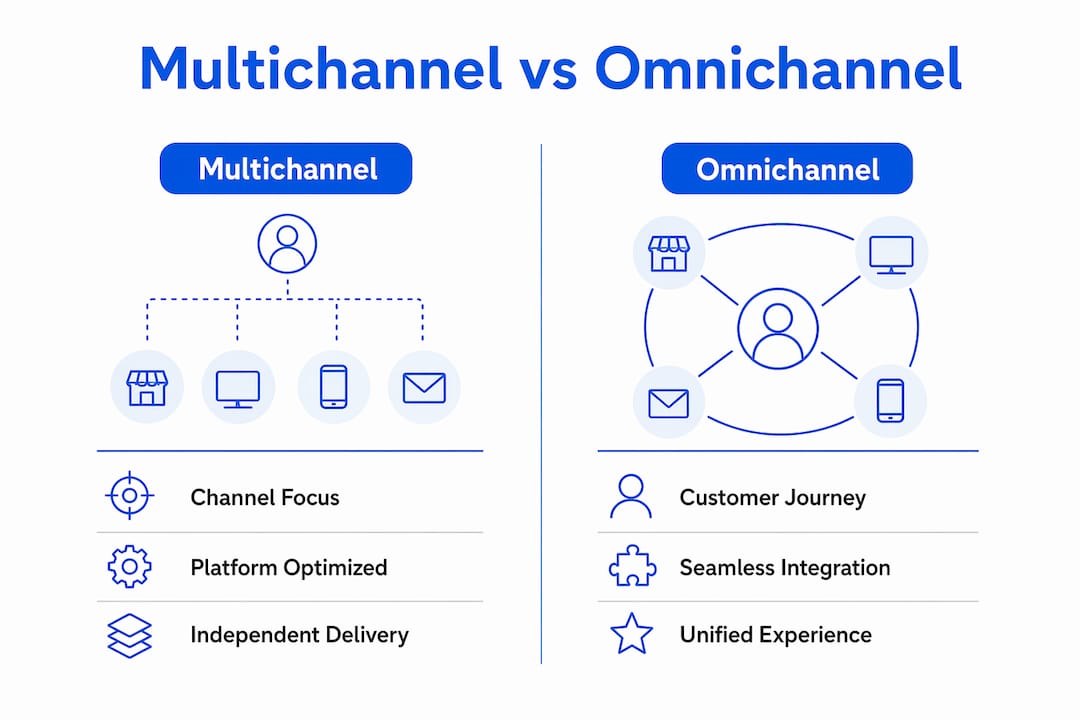
The short answer: multichannel is channel-centric; omnichannel is customer-centric. Each channel in a multichannel program operates independently with its own goals, creative, and metrics. Omnichannel, by contrast, depends on centralized customer data to deliver a seamless experience that follows a single buyer across every touchpoint.
Two quick examples:
- Multichannel campaign: A home services company runs a blog post on SEO, a separate Instagram Reel on seasonal tips, and an email promotion with a discount code. Each piece is optimized for its platform. None of them “know” about the others.
- Omnichannel experience: A retail brand shows a customer the exact product they browsed online when they walk into a physical store, then follows up with a personalized email based on what they picked up in-store.
Mailchimp frames the choice this way: multichannel optimizes for each platform; omnichannel optimizes for the customer. Pick multichannel when you have channel-level capability but not the data infrastructure for real-time personalization.
| Dimension | Multichannel | Omnichannel |
|---|---|---|
| Focus | Channel and product | Customer journey |
| Integration | Channels operate independently | Unified data and experience |
| Data | Fragmented per channel | Centralized, holistic view |
| Best for | Reach, experimentation | Retention, personalization |
| Complexity | Moderate | High |

The trade-off is real. Multichannel gives you reach and the freedom to experiment on each platform. The cost is potential fragmentation: if your Instagram voice contradicts your email tone, customers notice. Omnichannel solves that problem but requires a data stack most small teams cannot sustain.
What channels belong in a multi-channel content program
Top-performing brands treat owned channels as the foundation and social as the experimentation layer. Here is how the full channel inventory breaks down.
Owned channels (you control these permanently):
- Website/blog/SEO: Long-form articles, landing pages, and pillar content. Best for organic search traffic and building topical authority over time.
- Email: Newsletters, drip sequences, and promotional sends. Best for nurturing existing subscribers and driving repeat visits.
Paid channels (rented reach, immediate scale):
- Paid social (Meta, LinkedIn, TikTok Ads): Sponsored posts and video ads. Best for targeting new audiences by interest or demographic.
- Search ads (Google Ads): Text and shopping ads triggered by intent. Best for capturing buyers who are already searching for a solution.
Earned channels (third-party validation):
- PR and media mentions: Guest posts, press coverage, podcast appearances. Best for credibility and referral traffic.
- Community mentions (Reddit, forums, review sites): Organic brand references in relevant conversations. Best for trust-building and discovery.
Traditional channels:
- Events and webinars: Live or recorded sessions. Best for high-engagement prospects and repurposable content.
- Direct mail: Physical mailers or postcards. Best for local businesses targeting a defined geographic area.
The “Core Four” that most small teams should anchor to first: website/blog, organic social, email, and one paid channel. Owned channels matter most for long-term stability because you cannot be de-platformed from your own blog or email list the way you can from a social network.
Pro Tip: Before adding a fifth or sixth channel, ask whether you can publish consistently on your current four. Inconsistent presence on six channels does less than consistent presence on three.

Why multi-channel content is worth the effort — and where it gets hard
The benefits of multi-channel content distribution are real, but so are the costs. Here is an honest look at both.
Primary benefits:
- Increased visibility: Your content appears in more places, which raises the odds that a potential customer encounters it at the right moment.
- Repeated impressions: A buyer who sees your blog post, then your Instagram Reel, then your email is far more likely to convert than someone who saw only one touchpoint.
- Channel-specific experimentation: Because each channel runs independently, you can test different messages, formats, and CTAs without disrupting the whole program.
- Audience reach where they actually are: Different segments prefer different platforms. Email works for existing customers; paid social reaches cold audiences; SEO captures intent-driven searchers.
Primary drawbacks:
- Resource strain: More channels mean more creative, more scheduling, and more reporting. Small teams feel this fast.
- Inconsistent messaging: Without shared brand guidelines and templates, tone and visual identity drift across platforms.
- Attribution complexity: Data silos make it hard to know which channel actually drove a conversion.
| Challenge | Mitigation |
|---|---|
| Resource strain | Prioritize 3–4 channels; repurpose one asset across all |
| Inconsistent messaging | Shared brand voice doc and creative templates |
| Attribution complexity | Consistent UTM tagging and a single reporting dashboard |
| Channel fragmentation | Assign a channel owner for each platform |
The mitigation for most of these problems is the same: fewer channels, done well, with a shared governance model. Adding channels without measurement is one of the fastest ways to waste budget.
How to build a multichannel content campaign, step by step
A solid campaign does not start with picking platforms. It starts with a clear goal and works backward.
Step-by-step campaign checklist:
- Set a measurable goal. “More awareness” is not a goal. “Increase blog organic sessions by 30% in 90 days” is. Tie every channel to this goal before you pick creative.
- Define your audience segment. Who are you trying to reach, and what do they care about at this stage of the funnel? A cold audience on paid social needs different content than a warm subscriber on email.
- Map personas to channels. Example: a 35-year-old small business owner researches on Google (blog/SEO), scrolls LinkedIn during lunch (organic social), and checks email in the morning (email drip). That mapping tells you where to show up and in what format.
- Write a channel-specific brief for each asset. One core message, adapted per platform. The blog post goes deep; the LinkedIn post pulls the sharpest insight; the email leads with the benefit and links back.
- Build a repurposing plan before you create anything. Decide upfront how a single long-form asset will become three or four channel-ready pieces. This saves production time and keeps messaging consistent.
- Schedule with a content calendar. Assign publish dates, owners, and approval steps for every piece. Weekly cadence works for most small teams; biweekly is fine for channels with longer shelf lives like SEO.
- Distribute and monitor. Publish on schedule, then watch channel-specific metrics for the first 48–72 hours. Early signals (click-through rate, open rate, engagement) tell you whether the creative is landing.
- Optimize and amplify. Find your organic winners, then put paid budget behind them. Do not amplify before you have organic signal.
Pro Tip: Write the campaign brief in one document that every channel lead can see. When everyone works from the same core message, tone stays consistent even when formats diverge.
How to repurpose one content asset across channels
Repurposing is not recycling. It is adapting the same core idea into formats that work natively on each platform, without rebuilding from scratch every time.
Workflow 1: Long-form blog post → email series → social clips
- Publish a 1,500-word blog post on a topic your audience searches for.
- Pull three key insights from the post and turn each into a standalone email (one per week). Each email links back to the full post.
- Extract one surprising stat or tip per insight and write a short LinkedIn or Instagram caption. Add a graphic or short video clip if you have one.
Time estimate: 60–90 minutes to adapt a published post into three emails and six social captions.
Workflow 2: Webinar → blog post → short clips
- Record a 45-minute webinar or live Q&A session.
- Transcribe it (tools like Otter.ai or Rev work well) and edit the transcript into a structured blog post.
- Clip two or three 60-second highlights for short-form video on YouTube Shorts, Instagram Reels, or TikTok.
Time estimate: 2–3 hours to produce a blog post and three short clips from a recorded session.
Keeping messaging consistent across formats:
- Write a one-paragraph “core message” statement before you create anything. Every channel adaptation should be traceable back to it.
- Use the same headline or hook across platforms, then adapt the body for format length.
- Tailor the CTA per channel: “Read the full post” for social, “Book a call” for email, “Download the guide” for paid.
For video repurposing tactics specifically, the format decisions matter as much as the content itself.
Setting up operations: calendars, roles, and scaling
Klaviyo’s research makes a practical point: you do not need real-time data integration to run a strong multi-channel program. What you need is a consistent brand identity, a repeatable calendar, and automated deployment. That is achievable for a two-person team.
Minimum roles for a functional multichannel program:
- Content owner: Sets strategy, approves final copy, owns the editorial calendar.
- Editor/writer: Produces and adapts assets across formats.
- Channel lead(s): One person per platform who understands that platform’s native behavior (algorithm, format, audience).
- Paid specialist: Manages ad spend and amplification (can be part-time or outsourced).
Content calendar basics:
- Use a shared tool (Notion, Airtable, or a simple Google Sheet) with columns for: publish date, channel, asset type, owner, status, and link.
- Plan in four-week sprints. Lock the calendar two weeks out; leave one week of flex for reactive content.
- Cadence options: weekly for social and email; biweekly for blog; campaign bursts for product launches or seasonal pushes.
Tool categories you actually need:
- Scheduling: Buffer, Later, or Hootsuite for social; Mailchimp or Klaviyo for email.
- Analytics: Google Analytics 4 for web; native platform analytics for social; a UTM naming convention applied consistently across every link.
- Asset management: A shared Google Drive or Notion workspace with a folder per channel.
Pro Tip: Automate distribution, not strategy. Scheduling tools handle the “when and where.” A human still needs to decide the “what and why” for each campaign.
Measuring what actually matters
Attribution is the hardest part of running a multi-channel program, especially for small teams with siloed data. The professional fix is not an expensive customer data platform. It is consistent UTM tagging, a single reporting dashboard, and a lightweight attribution model you can actually maintain.
Priority KPIs by funnel stage:
- Awareness: Organic impressions, reach, new website sessions, branded search volume.
- Engagement: Time on page, email open rate, click-through rate, social shares and saves.
- Conversion: Form fills, demo requests, purchases, email list sign-ups.
- Retention: Email unsubscribe rate, repeat site visits, returning customer rate.
Attribution models — when to use which:
- Last-click: Simple, fast, and directionally useful for small teams. Overweights the final touchpoint but gives you a starting baseline.
- First-click: Useful when you want to understand which channel is best at generating awareness.
- Linear/multi-touch: Distributes credit across all touchpoints. More accurate but requires clean UTM data across every channel.
For most small teams, a rules-based last-click or linear model with consistent UTM parameters is the right starting point. Invest in a more advanced model only after your data is clean and your channel count justifies the complexity.
Reporting checklist:
- Weekly: channel-level engagement metrics (open rates, CTR, social engagement).
- Monthly: conversion metrics by channel, cost per lead or acquisition, top-performing assets.
- Quarterly: channel ROI review, audience growth, and a decision on whether to add, cut, or shift budget across channels.
Callout: Adding a channel without a measurement plan is one of the most common budget mistakes in multi-channel marketing. Sometimes the better investment is better analytics, not another platform.
How to prioritize channels when your budget is limited
Not every channel deserves equal attention, especially early. A prioritization framework helps you decide where to start and when to expand.
Prioritization matrix:
| Channel | Reach | Estimated ROI | Ownership | Experimentation value |
|---|---|---|---|---|
| Website/blog (SEO) | Medium (grows over time) | High (owned, compounds) | Owned | Low (slow feedback loop) |
| Medium (list-dependent) | High (direct, measurable) | Owned | Medium | |
| Organic social | High (algorithm-dependent) | Medium | Rented | High (fast feedback) |
| Paid social | High (budget-dependent) | Medium–High | Rented | High |
| PR/earned media | Variable | High (credibility) | Earned | Low |
Sample budget split for a small team (rationale: owned channels first):
- 40% on owned content production (blog posts, email sequences).
- 30% on paid amplification of top organic performers.
- 20% on organic social (time investment, not cash).
- 10% on earned/PR outreach.
HubSpot’s multi-channel data supports this logic: owned channels provide stability; social and paid are for experimentation and amplification. Start with what you control, validate with organic performance, then put money behind winners.
Quick validation tests before scaling spend:
- Publish three blog posts on a topic cluster and measure organic traffic after 60 days.
- Run a four-email drip sequence to a cold segment and track open and click rates.
- Post the same core message in three formats on one social platform and see which format earns the most saves or shares.
For a broader look at how content drives brand growth, owned channels consistently outperform rented ones over a 12-month horizon.
Key Takeaways
Multi-channel content works when you prioritize owned channels first, repurpose assets systematically, and measure with consistent UTM tagging from day one.
| Point | Details |
|---|---|
| Start with owned channels | Website, blog, and email provide stable reach you control — build here before renting social reach. |
| Higher ROI reported | HubSpot data shows 94% of brands use three or more channels and 84% of marketers report increased ROI after adopting a multi-channel approach. |
| Repurpose before you recreate | One long-form post can become three emails and six social captions in under 90 minutes. |
| Measure before you expand | Consistent UTM tagging and a single dashboard prevent attribution blind spots as channels multiply. |
| Mysearchhero automates distribution | Mysearchhero handles automated publishing, backlinks, social posts, and Reddit mentions so small teams can scale without adding headcount. |
The part most guides skip about multi-channel content
The conventional wisdom says: be everywhere your customer is. That sounds right until you watch a two-person marketing team burn out trying to maintain seven platforms at once, each with its own content calendar, ad account, and reporting login.
The real lesson from running multi-channel programs is that channel count is a vanity metric. What actually moves the needle is depth on a small number of channels, combined with a repurposing system that makes one good piece of content do the work of five. A single well-researched blog post, adapted into an email sequence and a handful of social clips, will consistently outperform seven mediocre posts spread thin across every platform you can name.
The other thing guides understate is the 60–90 day pilot. Before you ask leadership to fund a full multi-channel rollout, run a contained pilot: two or three channels, one content theme, one clear conversion goal. Track it weekly. At the end of 90 days, you have real data to present — not projections. That is how you get budget approved and keep it.
Common mistakes worth naming directly: starting with paid before organic is validated, assigning no single owner to the program, and treating “we posted on Instagram” as a measurement. None of those are strategies. The teams that succeed treat multi-channel content as a system with defined inputs, outputs, and owners — not a checklist of platforms to tick off.
Mysearchhero handles the distribution so you can focus on strategy
Running a multi-channel content program on a small team means the operational work — publishing articles, building backlinks, posting to social, monitoring Reddit conversations — can easily consume more time than the strategy itself.
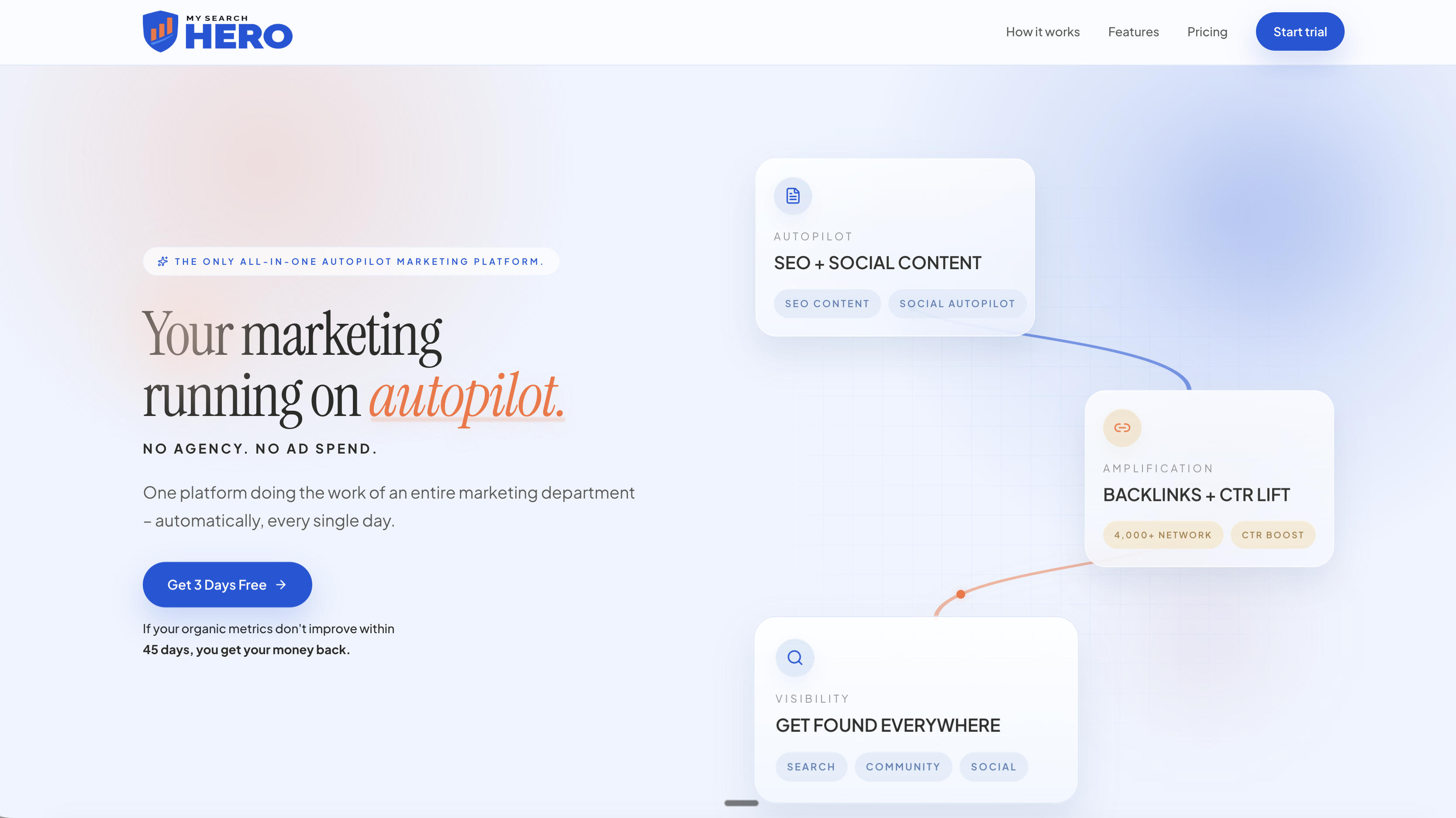
Mysearchhero is built for exactly that problem. Each month, subscribers get a bundle of published SEO articles pushed to their site, authority backlinks through a publisher network, Reddit brand mentions in relevant conversations, and AI-generated social media posts across multiple platforms — all through an automated pipeline. You keep control of strategy and approvals; Mysearchhero handles the distribution engine. For small and local service businesses that want consistent multi-channel presence without hiring a full content team, that is a meaningful difference. See what’s included in each plan and start your free trial to see the output before you commit.
Useful sources
- TechTarget — What Is Multichannel Marketing?: Authoritative definition of multichannel marketing and how channels operate independently.
- HubSpot — Multi-Channel Content Report: Survey data on channel usage, ROI outcomes, and amplification strategies from 300+ marketers.
- Mailchimp — Omnichannel vs. Multichannel: Practical guidance on choosing between approaches based on operational capacity.
- Salesforce — Omnichannel vs. Multichannel: Clear breakdown of integration levels and strategic implications.
- CallRail — Pros and Cons of Multichannel Marketing: Honest assessment of resource costs, attribution challenges, and analytics recommendations.
- Klaviyo — Omnichannel vs. Multichannel: Practical advice for small teams on achieving strong results without complex data infrastructure.
FAQ
What is multi-channel content marketing?
Multi-channel content marketing is the practice of distributing tailored content across multiple independent platforms — such as email, blog, social media, and paid ads — each with its own strategy, to reach audiences where they prefer to engage.
What is an example of a multi-channel campaign?
A home services company that publishes a blog post for SEO, sends a related email to subscribers, and runs a paid social ad targeting a cold audience is running a multi-channel campaign. Each channel operates independently with its own format and goal.
What are the main disadvantages of multichannel marketing?
The three most common drawbacks are resource strain (more channels require more creative and management), inconsistent messaging across platforms, and attribution complexity when data is siloed across channels.
What are the benefits of a multi-channel approach?
Greater visibility, repeated impressions across touchpoints, and the ability to experiment with channel-specific strategies are the primary benefits. HubSpot data shows 94% of brands use three or more channels and 84% of marketers report increased ROI after adopting a multi-channel approach.
How is multichannel different from omnichannel?
Multichannel uses independent channels each with their own strategy; omnichannel integrates all channels around a unified customer experience using centralized data. Multichannel is better for reach and experimentation; omnichannel is better for personalization and retention.