
TL;DR:
- Updating business profiles regularly boosts local search rankings, builds customer trust, and prevents data fragmentation. Consistent activity on profiles, especially fixing key information and engaging with reviews, outperforms one-time setup efforts and maintains visibility. Automating this process through services like Mysearchhero simplifies ongoing updates for busy small businesses.
Keeping your business profiles current is one of the highest-leverage, lowest-cost things you can do for local visibility. Updated profiles improve your ranking in local search, build customer trust before anyone calls you, and prevent the citation fragmentation that quietly bleeds leads. Three reasons stand out above everything else:
- Local ranking signals. Google’s algorithm weighs relevance, distance, and prominence — and profile completeness feeds all three.
- Customer trust and conversion. Stale hours, wrong phone numbers, and missing photos push buyers to the next listing before you ever get a chance.
- NAP consistency. Inconsistent name, address, and phone data across directories splits your authority and confuses search engines.
Table of Contents
- Why updating your profiles affects rankings and revenue
- Which profile fields you should keep current
- How often you should update each part of your profile
- How to measure whether your updates are working
- Common profile mistakes that hurt your visibility
- Doing it yourself vs. automating your profile updates
- Your 30-day plan to activate a dormant profile
- Key Takeaways
- The habit is the strategy
- Mysearchhero keeps your profile active without the manual work
- Useful sources
- FAQ
Why updating your profiles affects rankings and revenue
Profile updates affect both ranking and conversion because search engines and customers treat your profile data as a trust signal. Google’s local ranking factors are relevance, distance, and prominence. You can’t move your address, but you can control how complete and accurate your profile is — and that directly feeds relevance and prominence scores.
The platform has also shifted. Google Business Profile is now a live engagement surface, not a static directory listing. Businesses that treat it as set-and-forget are losing map-pack positions to competitors who post weekly, upload photos monthly, and respond to reviews within 48 hours. AI-driven features like Google’s local AI summaries pull directly from profile data, so a sparse or outdated profile gets deprioritized in those results too.
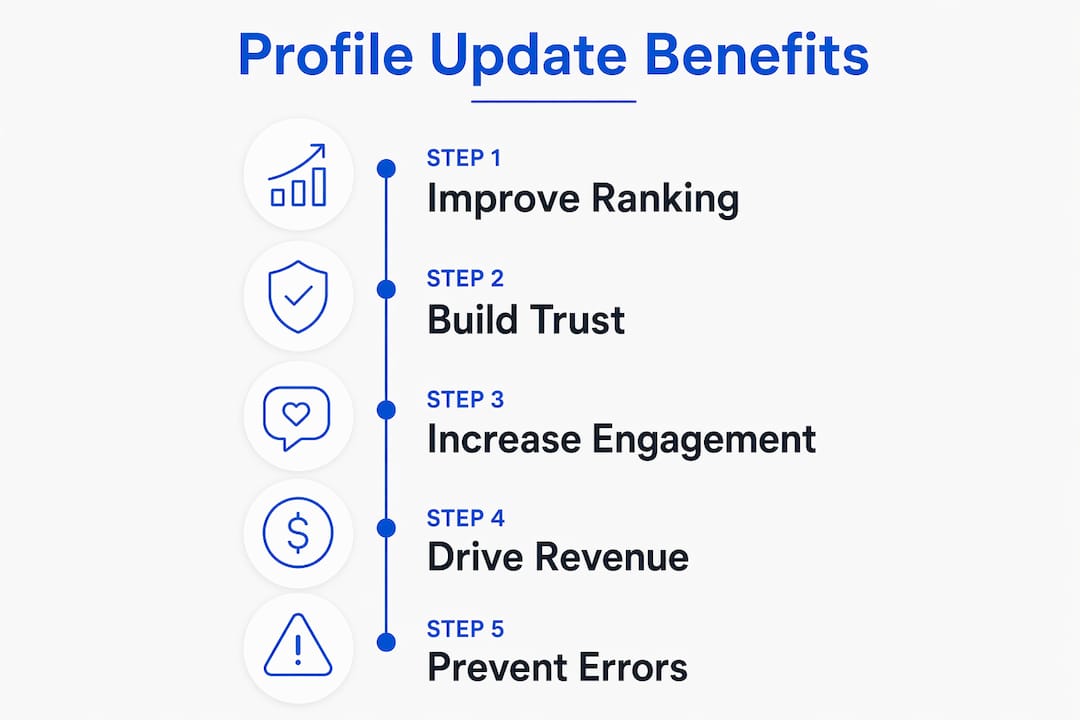
On the customer side, inaccurate listings damage trust and cost real business. A wrong phone number doesn’t just frustrate one caller — it compounds across every platform that scraped your old data.
Responding to reviews within 24–48 hours is both a conversion signal and a trust signal. Silence on a profile reads as neglect, to customers and to the algorithm.
Which profile fields you should keep current
Not all fields carry equal weight. Fix these in priority order across your Google Business Profile and Bing Places for Business listings:
Tier 1 — Fix immediately if wrong:
- Business name (exact legal format, no keyword stuffing)
- Address and phone number (match these character-for-character everywhere)
- Primary business category
- Hours, including holiday hours and temporary closures
Tier 2 — Update monthly:
- Photos: exterior, team, work samples, before/after
- Services list and service descriptions
- Booking or appointment links
- Business attributes (women-owned, wheelchair accessible, etc.)
Tier 3 — Review quarterly:
- Q&A section (seed it with your own FAQs)
- Products or menu items
- Secondary categories
Apply the same canonical NAP format to every directory, aggregator, and social profile. Citation splitting from inconsistent formatting fragments your authority across competing data clusters.
Pro Tip: Upload one to three new photos and publish a Google Post in the same week. That combination sends the strongest freshness signal for the least time investment.

How often you should update each part of your profile
Most small businesses update their profiles rarely, but Google’s guidance and practitioner best practices recommend weekly posts, monthly photo uploads (3–5), prompt review responses within 24–48 hours, and a quarterly audit. Establishing a consistent rhythm on these actions gives your business a significant edge.
How to measure whether your updates are working
Track these four metrics inside Google Business Profile Insights before you change anything, so you have a real baseline, and learn more about the benefits of fast-loading local websites for business that complement your profile updates.
- Profile views — how many people saw your listing in Search and Maps
- Direction requests — a strong proxy for purchase intent
- Calls from profile — direct revenue signal
- Website clicks — traffic driven from the listing
Run a simple experiment: commit to weekly posts and monthly photo uploads for six weeks, then compare those four metrics against the six weeks before. You don’t need a sophisticated tool for this. A spreadsheet with weekly snapshots is enough to see the trend.
For ranking position, free tools like Google Search Console show impression data for branded queries. Third-party listing management platforms can track map-pack position over time if you want more granularity. The local SEO checklist on the Mysearchhero blog pairs well with this measurement setup.
Common profile mistakes that hurt your visibility
These errors actively reduce visibility, not just aesthetics. Each one has a straightforward fix.
Duplicate listings. Two Google Business Profile listings for the same location split your reviews and confuse the algorithm. Request a merge through Google Business Profile support, keeping the listing with more reviews and activity as the primary.
Inconsistent NAP. Bad data propagates downstream from aggregators like Data Axle and Localeze to dozens of directories. Fix the aggregator record first, or the corrected data keeps getting overwritten.
Unverified listings. An unverified Google Business Profile has limited features and lower trust signals. Verify via postcard, phone, or video depending on what Google offers your category.
Outdated hours. If your profile says you’re open and a customer arrives to a locked door, that’s a one-star review waiting to happen.
Ignored Q&A. Anyone can answer questions on your Google Business Profile, including strangers. Seed the section yourself with accurate answers to your most common questions.
Pro Tip: Always fix Google Business Profile and Bing Places for Business first. These are the highest-authority sources, and correcting them stops bad data from re-propagating to downstream directories.
Doing it yourself vs. automating your profile updates
Automation reduces manual overhead and keeps freshness signals consistent when it’s set up correctly. The right approach depends on your situation.
| Approach | Best for | Trade-offs |
|---|---|---|
| Fully manual | Single-location, hands-on owner | Full control; time-intensive |
| Hybrid (tool + human review) | 2–3 locations | Faster; still needs oversight |
| Fully managed service | Multi-location or time-constrained owners | Lowest effort; monthly cost |
The main risk with automation is canonical data governance. If your NAP isn’t locked down before you push it through a distribution tool, you’ll automate the wrong data at scale. Fix the source record first.
For owners who’d rather focus on running their business, Mysearchhero handles the monthly content cadence — published SEO articles, authority backlinks, social media posts, and monitoring — as a single managed subscription. It’s built for local service businesses that need consistent output without hiring a marketing team.
Your 30-day plan to activate a dormant profile
A 30-day habit will move your profile into the active freshness window and lift engagement quickly. Here’s the week-by-week breakdown:
- Week 1: Audit and fix NAP across Google Business Profile and Bing Places for Business. Verify both listings if not already done. Upload five photos (exterior, interior, team).
- Week 2: Publish your first Google Post. Respond to every outstanding review. Add or update your services list and primary/secondary categories.
- Week 3: Upload three to five more photos. Pull your GBP Insights baseline (views, calls, clicks, direction requests). Search your business name and phone number to find any aggregator records with wrong data — correct the top three.
- Week 4: Publish your second Google Post. Ask your five most recent customers for a review. Block 30 minutes on your calendar for monthly and quarterly cadence going forward.
That’s it. Four weeks, roughly two to three hours total, and your profile goes from dormant to active.
Key Takeaways
Consistent profile updates improve local search visibility, build customer trust, and prevent the citation fragmentation that costs small businesses real revenue.
| Point | Details |
|---|---|
| Update cadence matters | Weekly posts, monthly photo uploads (3–5), review responses within 24–48 hours, and a quarterly audit keep freshness signals active and support local ranking. |
| NAP consistency is foundational | Inconsistent name, address, and phone data across directories splits authority and reduces local pack eligibility. |
| Measure before and after | Track profile views, calls, direction requests, and website clicks in GBP Insights to confirm impact. |
| Fix high-authority sources first | Correct Google Business Profile and Bing Places for Business before tackling smaller directories. |
| Mysearchhero automates the cadence | For owners short on time, Mysearchhero delivers monthly content, backlinks, and social signals as a managed subscription. |
The habit is the strategy
Most local SEO advice focuses on one-time fixes: claim your listing, fill in the fields, done. That framing misses the point entirely. Google’s local algorithm now rewards ongoing activity, not just completeness at setup. A profile that was perfect six months ago and hasn’t been touched since is already losing ground to a competitor who posts every Tuesday and uploads new job photos twice a month.
The businesses I see dominating local map packs aren’t doing anything exotic. They’re just consistent. Weekly posts, fast review responses, fresh photos. That rhythm is what separates a profile that generates calls from one that just exists.
For most single-location service businesses, the DIY cadence in this article is genuinely manageable. Where it breaks down is when you’re running multiple locations, or when “I’ll do it this week” keeps getting pushed to next week. That’s when automation stops being a luxury and starts being the only realistic path to consistency.
Mysearchhero keeps your profile active without the manual work
Staying on top of weekly posts, monthly photos, and quarterly audits is straightforward in theory. In practice, it’s the first thing that slips when you’re busy running a business.
Mysearchhero is built for exactly that gap. Each month, subscribers get a bundle of published SEO articles, authority backlinks, Reddit brand mentions, and social media posts pushed through a fully automated pipeline. The content feeds your profile’s freshness signals without you having to schedule anything.
For local service businesses that want consistent online visibility without hiring a marketing team, it’s a direct alternative to the manual cadence described in this article. You get the monthly deliverables, the reporting, and the SEO lift, on autopilot. Start your free trial and see what consistent output actually looks like for your business.
Useful sources
- Google Business Profile: How Google determines local search ranking — official guidance on relevance, distance, and prominence as ranking factors
- BrightLocal: Local citations trust report — consumer trust impact of inaccurate business listings
- Good Company AI: How often should you update your Google Business Profile? — cadence recommendations for posts, photos, and review responses
- Koira.ai: GBP update frequency — SMB behavior vs. Google recommendations — data on how infrequently most SMBs update profiles
- Koira.ai: NAP consistency and local search rankings — how citation inconsistency fragments authority
- Data Axle: Bad data costs you customers — consumer behavior and the revenue cost of inaccurate listings
- Search Engine Journal: The new Google Business Profile playbook for AI local search — how GBP has become a live engagement surface
- Searchnova360: Inconsistent business citations hurt local SEO — citation splitting, authority fragmentation, and remediation steps
FAQ
Why does updating a Google Business Profile improve local rankings?
Google’s algorithm rewards relevance, distance, and prominence. Regular updates — posts, photos, accurate hours — feed completeness and freshness signals that directly improve relevance and prominence scores.
How often should a small business update its profile?
Publish a Google Post weekly, upload three to five photos monthly, respond to reviews within 24–48 hours, and run a full audit quarterly. Urgent changes like hours or phone number should be fixed immediately.
What happens if your business profile has inconsistent NAP data?
Inconsistent name, address, and phone data across directories creates competing data clusters that split your authority and reduce your eligibility for the local map pack. Fix aggregator-level records first to stop bad data from re-propagating.
Does Mysearchhero help with business profile updates?
Mysearchhero automates the monthly content cadence — SEO articles, backlinks, social posts, and monitoring — that keeps freshness signals active for local service businesses without manual effort each week.
What’s the fastest way to improve a dormant profile?
Upload five real photos and publish a Google Post in the same week. For ongoing cadence, monthly photo uploads (3–5) and weekly posts are recommended, along with review responses within 24–48 hours and a quarterly audit.