
Yes, small businesses should automate repeatable SEO tasks, but strategy and content quality need to stay human-led. Google warns that mass-produced content created mainly to manipulate rankings violates its guidance, and local visibility now depends heavily on consistent Google Business Profile management. The safest path automates audits, local-profile upkeep, and reporting, while keeping editorial judgment in human hands.
TL;DR:
- Automation should focus on technical audits, local profile management, and reporting, as these are low-risk tasks that improve efficiency without sacrificing quality.
- Human oversight remains essential for strategy, content quality, brand voice, and decisions about rankings and claims, because AI cannot replace editorial judgment.
- Starting with a pilot of one to three automations helps measure impact and ensures technical issues are resolved without risking overall site performance.
- Selecting tools that integrate well, offer clear change logs, and have predictable pricing avoids unexpected costs and data silos.
- A managed, all-in-one SEO service can provide automation benefits with less effort, often for around $397 per month, backed by guarantees of measurable metric improvements.
Table of Contents
- What SEO automation actually covers for small businesses
- Checklist: SEO tasks small businesses should automate first
- Matching SEO tool categories to the problem you’re solving
- How to choose and assemble an automation stack
- Running a pilot without putting your rankings at risk
- How done-for-you automation handles scale and quality
- Balancing scale with quality in your own SEO program
- A turnkey option when you want automation without the setup
- FAQ
- Sources
What SEO automation actually covers for small businesses
SEO automation means using software, APIs, or AI to run repeatable optimization tasks: generating content briefs, scanning for technical errors, building schema markup, and monitoring rankings or traffic; for practical guidance on when AI helps content production and how to maintain quality, see Why use AI for content creation? Boost output fast. It is not a replacement for strategy. A tool can flag a broken redirect chain or draft an outline, but it cannot decide what your business should rank for or whether a piece of content actually serves your customers.

The distinction matters because Google has been explicit about where automation crosses a line. Its guidance on AI-generated content states that generating content at scale primarily to manipulate search rankings is a violation of its spam policies, regardless of whether a human or a machine produced it. The standard it applies is whether content is made for people first. Automation that speeds up research, formatting, or technical fixes supports that goal. Automation that floods a site with thin, interchangeable pages does not.
A practical way to sort tasks is by how much judgment they require:
- Low judgment, safe to automate: crawl scans, broken link detection, schema generation, rank tracking, reporting dashboards.
- Medium judgment, automate with review: content briefs, on-page optimization suggestions, internal linking recommendations.
- High judgment, keep human: topic strategy, final editorial review, brand voice, claims about pricing or expertise.
Industry guides on SEO automation echo this split: automate repetitive, verifiable work and leave strategy and editorial judgment to people who understand the business and its customers. Tools handle volume well. They do not replace the firsthand knowledge that makes content trustworthy.
Checklist: SEO tasks small businesses should automate first
Not every task deserves the same priority. Small teams get the most value by automating the work that is repetitive, time-consuming, and low-risk if something minor goes wrong, while leaving judgment calls for later.
- Technical audits and recurring scans. Set up automated crawls that catch indexing errors, Core Web Vitals regressions, and broken links before they affect rankings.
- Content lifecycle management. Use scheduled tools to flag pages due for a refresh, generate briefs from current search intent, and surface on-page issues like thin meta descriptions.
- Local profile upkeep. Automate Google Business Profile posting, NAP (name, address, phone) consistency checks across directories, and new review alerts.
- Reporting and anomaly detection. Connect Search Console to a dashboard that flags sudden traffic or ranking drops so you catch problems within days, not months.
- Schema and internal linking, with QA in place. Automate markup generation and link suggestions, but spot-check a sample before publishing at scale.
Pro Tip: Start with the task that currently eats the most staff hours for the least strategic payoff, usually technical audits or reporting, and automate that first.
This order is not arbitrary. Technical audits and reporting are mechanical: a tool either finds a 404 error or it does not, and there is little room for misjudgment. Local profile tasks follow close behind, because GBP accuracy has become one of the clearest ranking signals for service businesses, as covered in the next section. Content automation sits lower on the list because a poorly supervised content pipeline is where quality problems show up fastest. A missed schema tag rarely tanks a site. A batch of generic, unedited articles can.
Matching SEO tool categories to the problem you’re solving
Most small business owners shop for tools by brand name before they understand what category actually solves their problem. Matching the category to the task first saves money and prevents paying for breadth you will not use.
- All-in-one platforms bundle rank tracking, site audits, keyword research, and reporting into one dashboard. They make sense when you need several functions and want one login, but they often include modules a small team never touches, and the price reflects that breadth.
- Content-optimization tools generate briefs, score drafts against competitor content, and suggest keyword placement. They work best in a human-in-the-loop workflow where an editor still approves the final piece, since scoring tools optimize for pattern-matching, not accuracy or brand voice.
- Technical automation tools run scheduled crawls, flag Core Web Vitals issues, and sometimes suggest or auto-apply fixes like redirect cleanup. These are among the safest to automate heavily because the output is verifiable: a page either loads faster or it does not.
- Local management tools handle GBP post scheduling, review monitoring, and NAP consistency across listings. For a service business with one or several locations, this category often delivers the fastest visible return, since AI-driven local search increasingly weights verified entity data like consistent business names, addresses, and phone numbers.
- Orchestration platforms and APIs connect the other categories together, triggering a content brief when a ranking drops or opening a ticket when a crawl finds a critical error. Small teams usually do not need this layer until they are running several automations that would otherwise require manual handoffs.
The breadth-versus-focus tradeoff shows up most with all-in-one platforms. A five-person service business rarely needs enterprise-level competitive intelligence, and paying for it is a common source of wasted spend. A narrower content-optimization tool paired with a dedicated local-management tool often covers more real ground for less money. Orchestration layers matter only once you have outgrown manual handoffs between tools, which for most small businesses happens later rather than sooner.
How to choose and assemble an automation stack
Picking tools in isolation leads to a pile of subscriptions that do not talk to each other. A better approach treats the stack as a system with clear integration points and governance rules from the start.
Start with these selection criteria:
- Pricing model fit. Flat monthly fees are easier to budget than usage-based pricing tied to crawl credits or report volume, which can escalate fast as your site grows.
- Integration points. Confirm the tool connects to Search Console, your analytics platform, and your CMS, since disconnected tools create manual data entry that defeats the purpose of automating.
- QA and provenance features. Look for tools that log what was changed, when, and by what process, so you can trace a ranking change back to its cause.
- Verifiability. Favor tools whose output you can check against a primary source, like Search Console data, rather than a proprietary score you have to trust blindly.
Governance matters as much as tool selection. Set a human review gate before anything automated publishes to your live site, sample a percentage of automated technical fixes each month rather than reviewing all of them, and decide upfront whether you will disclose AI assistance in your content, a question our guide to AI in content for small businesses covers in more detail.
Watch billing closely. Many tools advertise a low floor price, then charge extra for crawl credits, additional seats, or per-report fees once you exceed a threshold. Ask vendors directly what triggers an overage charge before you commit.
Pro Tip: Ask any vendor what happens when you exceed your plan’s limits, in writing, before you sign up. Vague answers usually mean expensive surprises later.
A short vendor checklist helps keep evaluations consistent: does it integrate with your existing stack, does it log changes for review, does the pricing stay predictable as you scale, and can you export your data if you switch providers later.
Running a pilot without putting your rankings at risk
Jumping straight to full automation across your whole site is how small businesses get burned. A short, controlled pilot lets you measure impact before committing budget or risking traffic.
- Pick one to three automations to test, such as a weekly technical crawl, automated GBP posting, or content brief generation for one content category.
- Set test KPIs before you start, like time saved per week, percentage of flagged issues resolved, or change in impressions for a specific page set.
- Run the pilot for four to six weeks, long enough to see a trend in Search Console data without waiting so long that you cannot isolate the cause of any change.
- Review results against a human-only baseline where possible, comparing automated output to pages handled the old way.
- Decide to scale, adjust, or drop the automation based on whether it met the KPI you set, not on how convenient it felt to use.
Human checkpoints should sit inside the pilot, not after it. An editor should review every piece of automated content before publishing during the test phase, and someone should sample a portion of automated technical fixes weekly to confirm they did not introduce new errors.
Monitoring ties the pilot together. Keep an eye on:
- Search Console performance reports for shifts in clicks, impressions, and average position tied to the pages you automated.
- Core Web Vitals and index coverage reports to catch technical regressions early.
- GBP insights like calls, direction requests, and post engagement if you automated local profile tasks.
- Traffic and conversion trends at the page level, not just site-wide, since a site-wide average can hide a problem on the exact pages you changed.
Set alerts for sudden drops in any of these so you catch an issue within days rather than during a monthly review. If an automated change coincides with a traffic or ranking drop, roll it back immediately, document what changed, and only reintroduce it after identifying the cause.
A few recipes work well for small teams getting started: a weekly crawl that automatically opens a ticket for any critical issue, which a human then triages and fixes; a monthly content refresh flag that triggers an automated brief, which an editor reviews before any rewrite goes live; and a weekly GBP posting schedule paired with review monitoring, where a human still writes the responses.
How done-for-you automation handles scale and quality
Some small businesses decide the pilot-and-govern approach described above is more than they want to manage internally, and look for a provider that runs the automation on their behalf. MySearchHero is one example of how a done-for-you model applies the same principles at scale.
The service publishes a bundle of monthly deliverables through an automated pipeline: SEO articles published directly to the client’s site, backlinks built through a publisher network, Reddit mentions placed in relevant conversations, and AI-generated social media posts across platforms. The structure mirrors the checklist earlier in this article: recurring content output, link building, and distribution running on a schedule rather than depending on someone remembering to do it each week.
Responsible automation at this scale depends on a few practices:
- Transparency about AI use, stating clearly where automation and AI assistance play a role in content production rather than presenting it as entirely manual work.
- Editorial QA built into the pipeline, so published content meets a people-first standard rather than being pushed out unreviewed.
- Documented, trackable deliverables, like published articles and backlinks a client can verify, rather than vague promises of “visibility.”
This matches the practitioner guidance on SEO automation: automate repetitive production work, but keep a quality layer in place so the output still serves the reader.
Balancing scale with quality in your own SEO program
Automation earns its keep the moment it removes a task that was draining hours without requiring judgment, a weekly crawl, a GBP post schedule, a reporting dashboard. It becomes a liability the moment it starts making decisions that should belong to someone who understands your customers: what to say, what to promise, what your brand sounds like. The line between those two is not always obvious in advance, which is why a short pilot with a human review gate matters more than any tool’s feature list.
Success metrics deserve the same scrutiny. Rank position is the easiest number to watch and often the least useful one on its own. Pay closer attention to impressions and clicks in Search Console, GBP calls and direction requests, and whether traffic converts once it lands, since those reflect what a ranking is actually worth to the business.
For a small team weighing DIY tools against a managed service, the honest answer depends on time more than budget. If you have someone who can own governance, review output, and watch the dashboards weekly, a self-managed stack works. If that person does not exist on your team, a managed provider that builds QA into its process is often the more realistic path to consistent output.
— Mike
A turnkey option when you want automation without the setup
Building and governing your own automation stack takes time most small business owners do not have between running the actual business and checking a dashboard. We offer a direct alternative: one subscription that replaces the need to piece together separate tools for content, backlinks, and social posting.
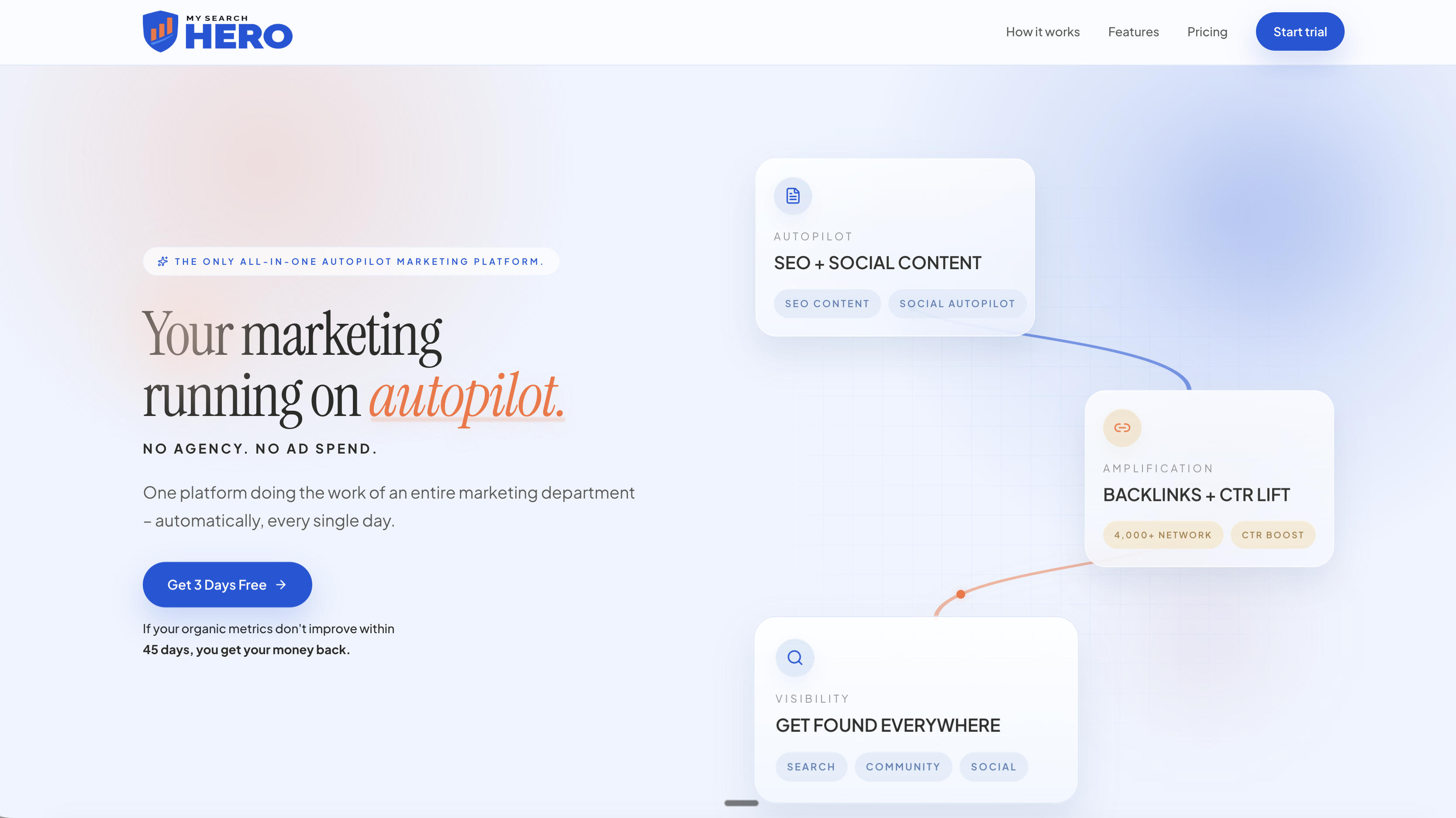
A subscription covers monthly SEO articles published to your site, backlinks through a publisher network, Reddit mentions in relevant discussions, and AI-generated social posts, combined into a single platform priced at $397 per month on the Hero plan. Lower-tier options are available with different monthly pricing, and an Enterprise plan is offered for larger needs at a higher monthly price. The tradeoff compared to assembling your own stack is straightforward: less control over individual tool choices, in exchange for one price, one dashboard, and no need to manage QA across five separate vendors yourself. We back this with a money-back guarantee if your organic metrics do not improve.
If the pilot-and-govern approach in this article sounds like more than your team can take on internally, you can compare plans and check current availability directly.
FAQ
Which AI tool is good for SEO?
The right tool depends on the task: content-optimization platforms help draft briefs and score on-page content, while technical automation tools handle crawls and Core Web Vitals monitoring. No single AI tool replaces the full process, which is why most small businesses pair a narrow tool with human review rather than expecting one platform to do everything.
How much does SEO cost for a small business?
Costs vary widely based on whether you buy individual tools, hire freelance help, or use a done-for-you service, and no single figure applies across providers or markets. Done-for-you platforms like MySearchHero publish fixed monthly pricing, for example $397 per month on its Hero plan, which makes budgeting more predictable than usage-based tool pricing that can escalate with crawl credits or report volume.
What is the 80/20 rule in SEO?
In SEO, the principle generally refers to focusing the bulk of your effort on the small number of pages, keywords, or fixes that drive most of your results, rather than spreading attention evenly across everything. In practice for a small business, that often means prioritizing technical fixes and local profile accuracy before investing heavily in lower-impact content expansion.
What are basic SEO tools?
Basic SEO tools typically include a site crawler for technical audits, a rank tracker, Search Console for performance and indexing data, and a keyword research tool. For local service businesses, a Google Business Profile management tool belongs on that basic list as well, given how much local visibility depends on accurate, active profiles.
Is it safe to automate content creation for SEO?
It is safe when the output still serves readers first and gets human review before publishing. Google’s own guidance on AI-generated content treats content made primarily to manipulate rankings as a violation regardless of whether it was written by a person or a machine, so the production method matters less than the editorial standard applied to it.
Sources
- How Google Search views AI-generated content
- How will AI Mode impact local SEO?
- What is SEO automation? Complete 2026 guide