
TL;DR:
- SEO automation employs AI-driven tools to perform routine SEO tasks quickly, enhancing efficiency. Agentic SEO advances this by enabling systems to detect, decide, and fix issues autonomously with user oversight. Human judgment remains essential for strategic decisions, content quality, and brand consistency.
SEO automation is the use of AI-powered software to execute repetitive, rules-based SEO tasks automatically, replacing hours of manual work with processes that run in minutes. Tools like Ahrefs, Yoast, and Optimatio have made it possible to automate up to 99% of routine SEO chores as of 2026. The real shift this year is the rise of agentic SEO, a more advanced form of automation where AI systems don’t just report problems but detect, decide, and fix them autonomously. For digital marketers and business owners, understanding this distinction is the difference between saving a few hours a week and transforming how your entire SEO operation runs.
What is SEO automation and what tasks does it cover?
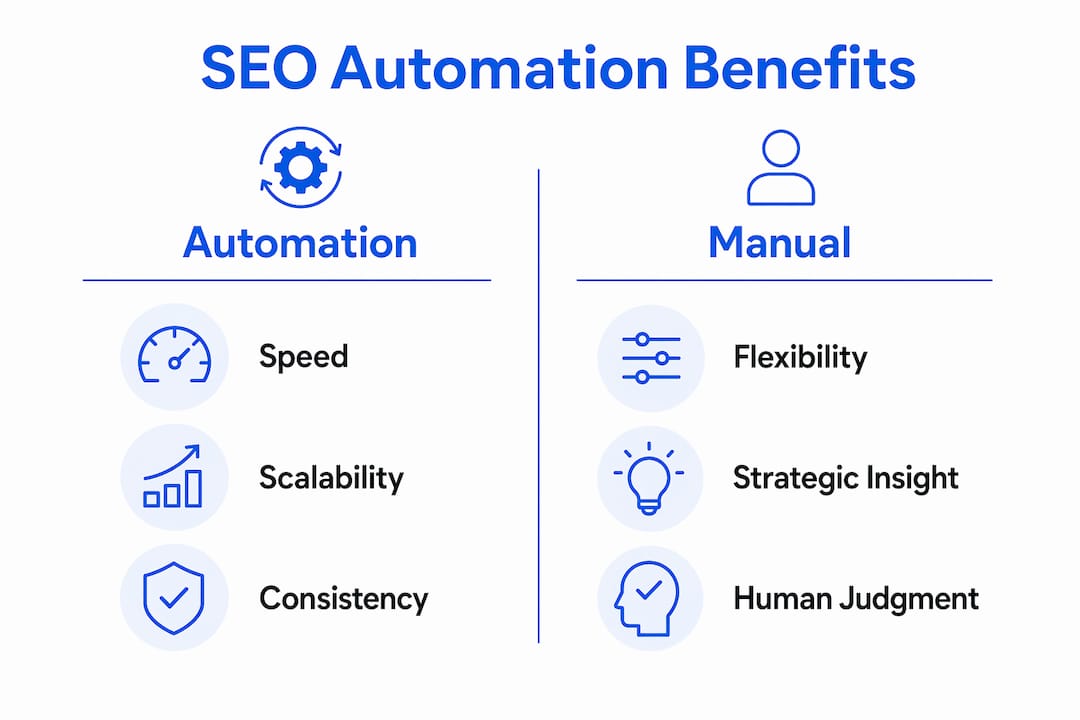
SEO automation is the practice of using software to handle the mechanical, data-heavy parts of search engine optimization without human intervention on every step. The industry term you’ll see in technical circles is programmatic SEO, though “SEO automation” has become the standard label for the broader category of tools and workflows.

The tasks best suited for automation fall into a clear pattern: anything rules-based, repetitive, and data-driven.
Tasks that automation handles well:
- Technical site audits (crawling for broken links, missing tags, slow pages)
- Keyword clustering and grouping by search intent
- Metadata generation and bulk updates across hundreds of pages
- Rank tracking and performance reporting
- Broken link detection and redirect mapping
- Schema markup implementation
Tasks that still require human judgment:
- Mapping content to nuanced search intent
- Final editorial decisions on tone and brand voice
- E-E-A-T assessments (expertise, experience, authoritativeness, trustworthiness)
- Strategic link building outreach
- Content ideation tied to audience psychology
Yoast experts describe automation as a “digital helper” that handles busywork, not decision-making. That framing matters. Automation clears the path so your strategists can focus on the work that actually requires a human brain.
Pro Tip: Start by auditing your current SEO workflow and marking every task you do more than once a week. Those repeating tasks are your automation candidates.
How do modern SEO automation platforms work?
The gap between basic SEO tools and modern agentic platforms is significant. A traditional reporting tool like an early version of Google Search Console surfaces data and stops there. You see the problem, then you go fix it manually. Modern agentic SEO platforms close the full loop: they detect an issue, propose a fix, wait for your approval, and then push the change live directly to your CMS.
Here is how that workflow looks in practice with a platform like Optimatio:
- The system crawls your site and identifies a technical issue, such as 47 product pages missing meta descriptions.
- It generates proposed fixes with previews showing the exact affected elements.
- You review and approve the batch.
- The platform pushes changes to WordPress, Shopify, or Webflow with a full audit log and rollback option.
That approval-first design is not a limitation. Full autopilot without approval is risky, and the best platforms require user sign-off by default, with an option to enable autonomous mode selectively for lower-risk tasks. This keeps automation fast while protecting brand consistency.
| Feature | Basic SEO tools | Agentic SEO platforms |
|---|---|---|
| Issue detection | Yes | Yes |
| Fix recommendations | Sometimes | Yes, with previews |
| Autonomous execution | No | Yes, with approval controls |
| CMS integration | Limited | WordPress, Shopify, Webflow |
| Audit logs and rollback | No | Yes |
| Real-time adaptation | No | Yes |
The table above shows why agentic platforms represent a genuine category shift. They don’t just tell you what’s wrong. They act on it.
Pro Tip: When evaluating any SEO automation platform, test the rollback feature before you go live. A system that can’t undo a bad batch update is a liability, not an asset.
What are the measurable benefits of SEO automation?
The benefits of SEO automation are concrete and well-documented across real deployments. Automated audits complete in minutes rather than hours, which means your team gets accurate data faster and can act on it sooner.
Here are the outcomes marketers consistently report:
- Faster rankings: Businesses typically see measurable ranking improvements within 30–60 days of implementing SEO automation, with some technical fixes showing results in as little as two weeks.
- Higher data accuracy: Automated systems don’t miss pages, skip checks, or make transcription errors. The data is cleaner.
- Scalability: You can manage SEO across 10,000 pages with the same effort it once took to manage 100.
- Cost efficiency: Professional-grade SEO automation platforms start at around $99 per month for small to mid-sized businesses, which is a fraction of the cost of hiring additional SEO staff.
- Time reclaimed: Teams report reclaiming entire workdays previously spent on manual audits and reporting.
“SEO automation tools free marketers to invest more time in strategic, high-impact activities by managing the repetitive SEO busywork.” — Yoast
The cost-to-value ratio is particularly compelling for business owners who don’t have a full SEO team. At $99 per month, a platform that catches broken links, updates metadata, and tracks rankings automatically pays for itself the first time it catches a crawl error before it tanks a product page’s ranking.
For a deeper look at how AI fits into your broader content strategy, the role of AI in content for small businesses is worth reading alongside this guide.
How to choose and implement SEO automation tools effectively
Choosing the right platform starts with matching tool capabilities to your actual workflow gaps. Not every business needs a full agentic system on day one. A small business running a 50-page site has different needs than an e-commerce store with 10,000 product pages.
Step-by-step implementation approach:
- Audit your current SEO tasks. List every recurring task your team performs. Rank them by time cost and error rate.
- Start with one automation category. Technical auditing is the lowest-risk entry point. Tools like Ahrefs and Search Atlas handle this well without requiring deep CMS integration.
- Evaluate approval controls. Any platform you consider should show you exactly what it plans to change before it changes anything. Agentic platforms that detect, propose, and execute with user oversight are the current standard.
- Test CMS integration in a staging environment. Push a small batch of metadata updates to a test version of your site before going live.
- Set manual review checkpoints. Even with strong automation, human supervision remains critical for search intent mapping, E-E-A-T validation, and final content tone.
- Scale after validation. Once your first automation category runs cleanly for 30 days, add the next one.
The most common mistake marketers make is automating everything at once and then losing visibility into what the system is doing. Automation should increase your control over SEO outcomes, not reduce it. Platforms like Optimatio and Search Atlas are built with this principle in mind, giving you dashboards that surface what changed, when, and why.
For business owners looking to extend automation beyond SEO, the guide on automating your SMB marketing covers the full picture of what’s possible in 2026.
Key Takeaways
SEO automation delivers the most value when agentic AI handles repetitive technical tasks while human strategists retain control over content quality, search intent, and brand voice.
| Point | Details |
|---|---|
| Define your automation scope | Automate technical audits, metadata, and rank tracking first before tackling content-level tasks. |
| Choose approval-first platforms | Platforms like Optimatio require user sign-off by default, protecting brand consistency. |
| Expect measurable results fast | Technical fixes can impact rankings within two weeks; broader gains appear within 30–60 days. |
| Keep humans in the loop | E-E-A-T validation, search intent mapping, and tone decisions require human judgment, not automation. |
| Start small, then scale | Validate one automation category over 30 days before expanding to the next workflow area. |
Where automation ends and strategy begins
I’ve watched a lot of marketing teams adopt SEO automation tools with the wrong expectation. They think the software will handle SEO. What it actually does is handle the mechanics of SEO, which is genuinely valuable, but it’s not the same thing.
The teams that get the best results treat automation as a force multiplier for their strategists, not a replacement for them. When your platform is catching broken links and updating metadata automatically, your best people can spend that reclaimed time on the work that actually moves the needle: understanding why a piece of content isn’t converting, identifying a keyword cluster your competitors haven’t touched, or rewriting a landing page to better match what users actually want.
The agentic SEO trend is real and accelerating. Systems that close the full detect-decide-execute loop are becoming the baseline expectation, not a premium feature. But the marketers I’ve seen succeed with these tools are the ones who stayed curious and skeptical in equal measure. They approved changes before they went live. They checked the audit logs. They kept their hands on the wheel even when the car could technically drive itself.
My honest recommendation: adopt agentic SEO tools now, because the efficiency gains are too significant to ignore. Just don’t confuse automation speed with strategic clarity. Those are two different things, and only one of them comes from software.
— Mike
Put your SEO on autopilot with Mysearchhero
If you want the benefits of SEO automation without building the infrastructure yourself, Mysearchhero does it for you.
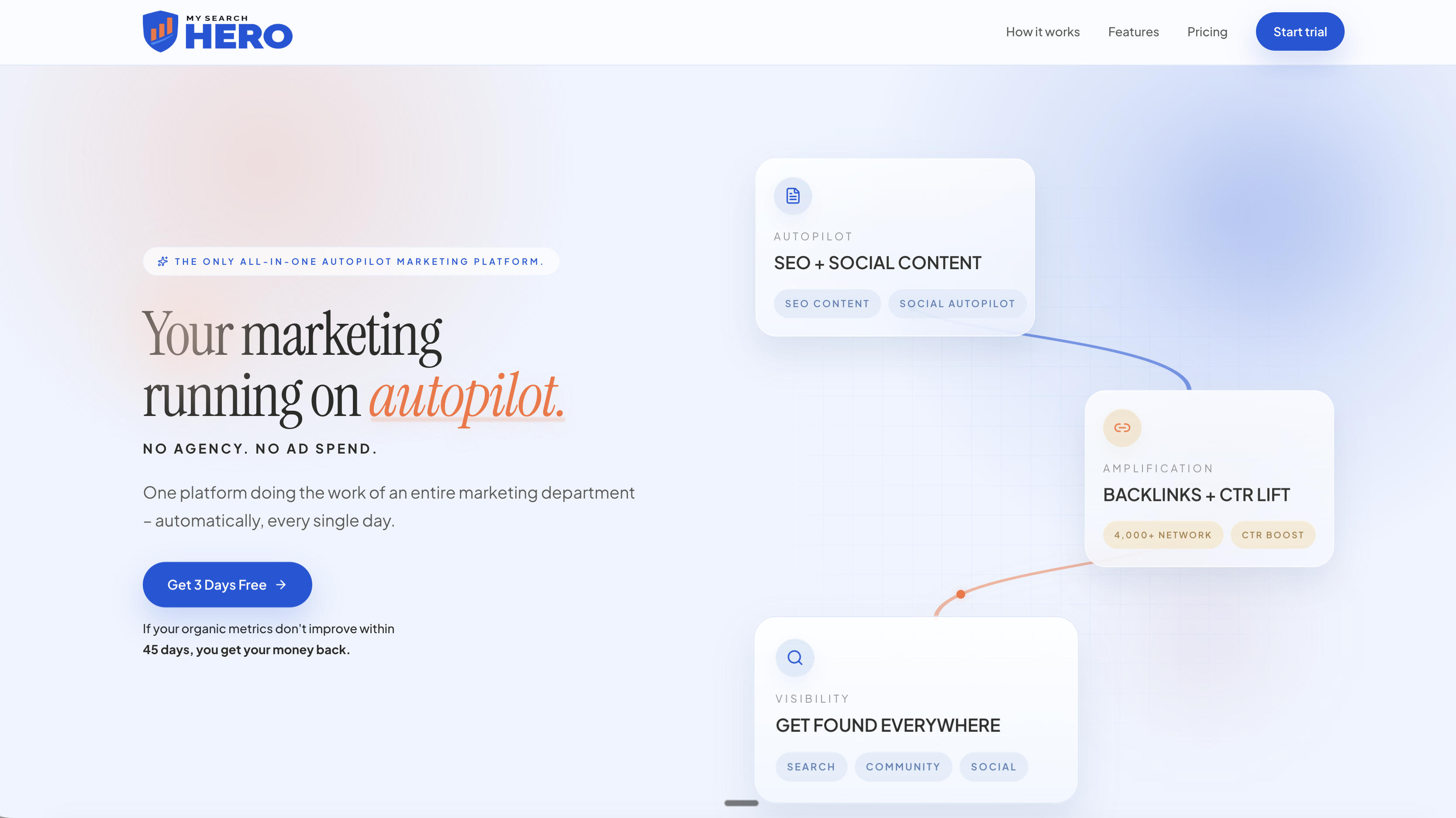
Mysearchhero is a done-for-you SEO and content marketing service that runs your entire SEO pipeline automatically each month. Subscribers get published articles, backlinks, Reddit mentions, and AI-generated social media posts pushed out through a fully automated system. You don’t manage the tools, the workflows, or the reporting. You just grow. Visit Mysearchhero to see how it works and get started.
FAQ
What is SEO automation in simple terms?
SEO automation is the use of software to handle repetitive SEO tasks like audits, metadata updates, and rank tracking automatically, without manual effort on each step.
What does SEO automation do that manual work can’t?
Automated systems process technical site audits in minutes and can manage thousands of pages simultaneously, a scale that is simply not achievable through manual workflows.
What is agentic SEO and how does it differ from basic automation?
Agentic SEO platforms detect issues, propose fixes, and execute changes autonomously with user approval controls, while basic tools only report problems and leave the fixing to you.
How much do SEO automation tools cost?
Professional-grade SEO automation platforms start at around $99 per month for small to mid-sized businesses, with enterprise pricing scaling based on site size and feature depth.
Can SEO automation replace an SEO strategist?
No. Automation handles mechanical, rules-based tasks, but search intent mapping, E-E-A-T validation, and brand voice decisions still require human judgment and oversight.