
AI Overviews are Google’s generative summaries, built on Gemini, that pull from multiple indexed pages and stitch together a single cited answer at the top of search results. That’s the whole definition. The strategic shift for AI overviews SEO is smaller than most people think: you don’t need a new discipline, you need to make your existing top-20 pages easier to extract and cite.
Here’s what to do this week:
- Check crawl and index status for your priority pages in Google Search Console.
- Add a two-sentence, answer-first block to the top of any page targeting a question query.
- Add FAQPage schema that matches your visible FAQ content word for word.
Get those three right, and you’ve done more than most competitors optimizing for AI Overviews will ever bother to do. A tool like Mysearchhero can help execute this at scale once you know which pages to prioritize.
Key Takeaways
Citation in AI Overviews depends less on ranking first and more on making already-ranking pages extractable through answer-first structure, accurate schema, and real topical coverage.
| Point | Details |
|---|---|
| Definition matters first | AI Overviews synthesize three to five sources with Gemini and RAG, unlike single-source featured snippets. |
| Query fan-out drives selection | Cover every subquestion on one page instead of splitting thin content across several posts. |
| Technical baseline is non-negotiable | Pages need clean indexing and no accidental noindex or robots.txt blocks to be citation-eligible. |
| CTR decline requires new tracking | Watch for rising impressions paired with falling clicks as a signal of AI Overview presence. |
| Mysearchhero automates the fixes | Its monthly content, backlink, and reporting bundle executes this exact checklist without added headcount. |
Table of Contents
- What Makes AI Overviews Different From Featured Snippets?
- How Does Google Generate AI Overviews?
- Which Search Queries Trigger AI Overviews?
- How to Optimize Content for AI Overviews
- What Technical Settings Control AI Overview Eligibility?
- How Do You Measure AI Overview Performance in Search Console?
- What to Do When Your Content Isn’t Cited (or Is Cited Wrong)
- What Does the Research Say About Rank and Citation Odds?
- Your AI Overview Readiness Checklist
- What Running These Tests Actually Taught Us
- Let Mysearchhero Run This Playbook for You
- Where to Go for Deeper Reading
- Sources
- FAQ
What Makes AI Overviews Different From Featured Snippets?
A featured snippet pulls one excerpt from one page. An AI Overview synthesizes several pages into a generated paragraph, then cites the sources it drew from. That difference changes everything about how you optimize.
With a featured snippet, you’re competing to be the single best answer. With an AI Overview, you’re competing to be one of several good answers Gemini decides to stitch together, which means a page that’s merely “pretty good” on a well-covered subtopic can still earn a citation slot. Google’s own guidance on succeeding in AI experiences on Search makes clear that this is still governed by standard Search fundamentals, not a separate ranking system.
Quick gut check: if a query has one clean, factual answer (a date, a definition, a number), treat it as a featured-snippet play. If the query needs context pulled from multiple angles (comparisons, multi-step processes, “it depends” nuance), it’s an AI Overview candidate.
A few practical distinctions worth internalizing:
- Featured snippets show one source; AI Overviews typically cite several.
- Knowledge panels pull structured facts from entities like Wikipedia or your Business Profile, not prose you write.
- AI Overviews can appear even when your page doesn’t rank in the top three organic spots, provided it’s a strong supporting source for one subquestion.
How Does Google Generate AI Overviews?
Gemini doesn’t hallucinate an answer from training data alone. It uses retrieval-augmented generation, or RAG: the model retrieves a set of current, indexed web pages relevant to the query, then grounds its generated response in what those pages actually say. Google explains this retrieval step directly in its documentation on how AI features work in Search, which is why freshness and indexability matter more here than in traditional ranking.
The second mechanism is query fan-out. Instead of treating “best running shoes for flat feet” as one search, Gemini breaks it into related subquestions: what is flat-footedness, what shoe features matter, what do podiatrists recommend, what do reviewers say. Each subquestion can pull a different supporting page, often from outside your primary keyword’s top-ranking results. According to HubSpot’s AI Overviews playbook, Overviews commonly synthesize three to five sources this way, with each contributing to a different piece of the generated answer.
That has a direct editorial consequence: a single comprehensive page that answers four or five related subquestions has more surface area to get cited than four separate thin pages competing for the same fan-out slots.
- RAG grounds the answer in retrieved pages, not memorized text.
- Query fan-out means you’re not just competing on the head term.
- Coverage depth on one page beats fragmentation across many.
Pro Tip: Write your definition sentence as if it could be lifted whole into an AI-generated paragraph. Short, declarative, no throat-clearing. “X is Y that does Z” beats three sentences of setup every time.
Which Search Queries Trigger AI Overviews?
Not every query gets one. Overviews cluster around informational intent, especially where synthesizing multiple sources adds real value over a single link.
The pattern shows up most on:
- Multi-step “how to” guides where a process has several stages.
- Comparative questions (“X vs. Y,” “best options for Z”) that benefit from combining perspectives.
- Definitional queries with nuance attached, like “what is X and when does it apply.”
- Long-tail phrases, usually three to five words, with informational rather than transactional intent.
If you’re not sure where to start, look at Search Console for queries where impressions are climbing but clicks are flat or falling. That pattern often signals an AI Overview has started appearing and is absorbing clicks that used to land on your page.
How to Optimize Content for AI Overviews
This is the part that actually moves the needle. Five levers matter, in roughly this order of impact.
- Restructure for answer-first extraction. Use question-format H2 and H3 headings, then answer each one in the first one to two sentences before adding detail. Gemini favors content it can lift cleanly, not paragraphs that bury the answer in sentence four.
- Apply schema that matches what’s visible. Article or BlogPosting schema plus FAQPage markup helps, but only when the schema text mirrors your on-page copy exactly. Keep FAQ answers to 40 to 60 words. Mismatched schema is a trust signal in the wrong direction.
- Confirm the technical baseline. Pages need to return a clean HTTP 200, stay crawlable, and remain indexable. No robots.txt block, no accidental noindex tag. This sounds obvious until you audit a site and find half the money pages blocked by an old staging directive.
- Cover the full query fan-out on one page. Map the subquestions a topic naturally splits into and answer each one directly, rather than spreading thin coverage across five separate posts. This is the single highest-leverage content change most teams skip.
- Build E-E-A-T signals that support citation. Visible author credentials, links to credible external sources, and backlinks from sites Google already trusts all feed into whether Gemini treats your page as citation-worthy. Google’s guidance on generative AI features is blunt about this: there’s no shortcut file or hack that substitutes for actual authority.
Quick effort map for your backlog:
- Quick (under an hour per page): rewrite the opening two sentences to be answer-first; verify indexability in Search Console.
- Medium (half a day): add or fix FAQPage schema; restructure H2s into question format.
- Long (ongoing): earn backlinks and mentions from sites with existing authority; build out author bio pages with real credentials.
Pro Tip: Don’t rewrite everything at once. Pick five pages that already rank in the top 20 for a target query but show falling CTR, fix those first, and measure before you scale the approach site-wide.
What Technical Settings Control AI Overview Eligibility?
Google has stated plainly that there are no special technical requirements beyond standard Search eligibility. If a page is indexed and eligible for a regular snippet, it’s eligible to be cited in an AI Overview. Google’s own developer guide on generative AI optimization explicitly warns against manufactured fixes like an llms.txt file or artificially “chunking” content into AI-only formats. None of that does anything.
What actually controls exposure are existing meta directives:
noindexremoves the page from Search entirely, including AI Overviews.nosnippetblocks both regular snippets and AI Overview citations.data-nosnippetlets you exclude a specific HTML block while the rest of the page stays eligible.max-snippetcaps how much text Google can use, which indirectly limits how much material an Overview can draw from.
The trade-off is straightforward: opting out with any of these removes your citation chance and the click that comes with it. Use them deliberately, not defensively.
Pro Tip: If you’re worried about proprietary data appearing in an AI-generated summary, use data-nosnippet on that specific paragraph instead of noindex-ing the whole page. You keep the traffic and lose only the sensitive snippet.
How Do You Measure AI Overview Performance in Search Console?
Search Console groups AI Overview activity under the standard Web search type, so it won’t hand you a clean “citation count.” The Generative AI performance report gets you closer, but you still need to build your own signal stack.
Track these together:
- Impressions rising while clicks fall or flatten, a strong hint an AI Overview is now absorbing the click.
- Pages ranking in the top 20 that show this exact pattern, since those are your best rewrite candidates.
- Downstream engagement, like time on page and conversions, from the traffic that does arrive.
- Third-party citation-rate tools, since HubSpot’s playbook on optimizing for AI Overviews recommends pairing Search Console data with specialized tracking to estimate actual citation frequency.
Set up this filtering as a recurring monthly pull, not a one-time audit. Overviews change which queries they appear for constantly.
What to Do When Your Content Isn’t Cited (or Is Cited Wrong)
Not being cited usually traces back to one of a few causes. First, confirm the page is actually indexed and check whether it ranks anywhere in the top 20 for the target query. No ranking presence, no citation. Second, check whether the content leads with a direct answer or buries it under three paragraphs of preamble. Third, validate your schema against a testing tool. Broken FAQPage markup gets ignored entirely.
If your page is cited but the summary misstates something, fix the source content immediately and note the correction date visibly on the page. Gemini re-retrieves from current pages, so a quick correction can resolve a misquote faster than a support ticket.
If you want out entirely, nosnippet or noindex will do it. Just remember: no citation also means no click.
What Does the Research Say About Rank and Citation Odds?
Ranking well and getting cited are related but not the same job. Higher organic rank correlates with a better shot at citation, since Gemini draws heavily from pages already earning trust signals, but plenty of page-two content still gets pulled in when it answers a specific fan-out subquestion better than the top three results do.

The bigger number to watch is on the click side. Pew Research found that users click outbound links significantly less often when an AI-generated summary appears in the results. Some industry analyses also point to a “citation premium,” where brands that do get named inside an Overview capture a disproportionate share of whatever clicks remain, compared to sources mentioned nowhere in the summary.
The operational takeaway: rank optimization and citation optimization are two different projects that happen to share a starting point. Prioritize pages already sitting in the top 20 with falling CTR. Those are your highest-ROI rewrites, because you’ve already done the hard part of earning relevance. You just need to make the page easier to lift.
Your AI Overview Readiness Checklist
Work through this in order, and don’t skip to step three before step one is done.
- Verify indexability (quick, 15 minutes per page): confirm no accidental noindex or robots.txt block in Search Console.
- Add answer-first openings (quick, 30 to 60 minutes per page): rewrite the first two sentences under each H2 to directly answer the heading’s question.
- Add or fix FAQ schema (medium, half a day): match FAQPage markup exactly to visible Q&A content, 40 to 60 words per answer.
- Refine headings into question format (medium, a few hours per page): audit existing H2s and H3s and rewrite the ones that read as noun phrases.
- Build authority signals (long, ongoing): pursue backlinks and mentions from established sites, and add visible author credentials.
Run this against five test pages first. Compare Search Console impressions and CTR trends four to six weeks after publishing before rolling the process out across the rest of the site.
What Running These Tests Actually Taught Us
Rewriting pages for citation focus, without touching rank at all, moved the needle on how often those pages showed up as supporting sources. But the pages that held onto traffic best combined citation-focused structure with continued rank work. One without the other left something on the table.
Brand visibility matters more than most SEO checklists admit. Pages that had already earned outside mentions, through press pickups or industry roundups, got cited more consistently than isolated pages saying the same thing with zero outside signal. Authority isn’t just an on-page checkbox.
Let Mysearchhero Run This Playbook for You
Every task on that checklist above takes real hours: answer-first rewrites, schema audits, backlink outreach, monthly tracking. Mysearchhero exists to take that off your plate entirely, publishing done-for-you SEO content, structured for extraction, straight to your site on autopilot every month.
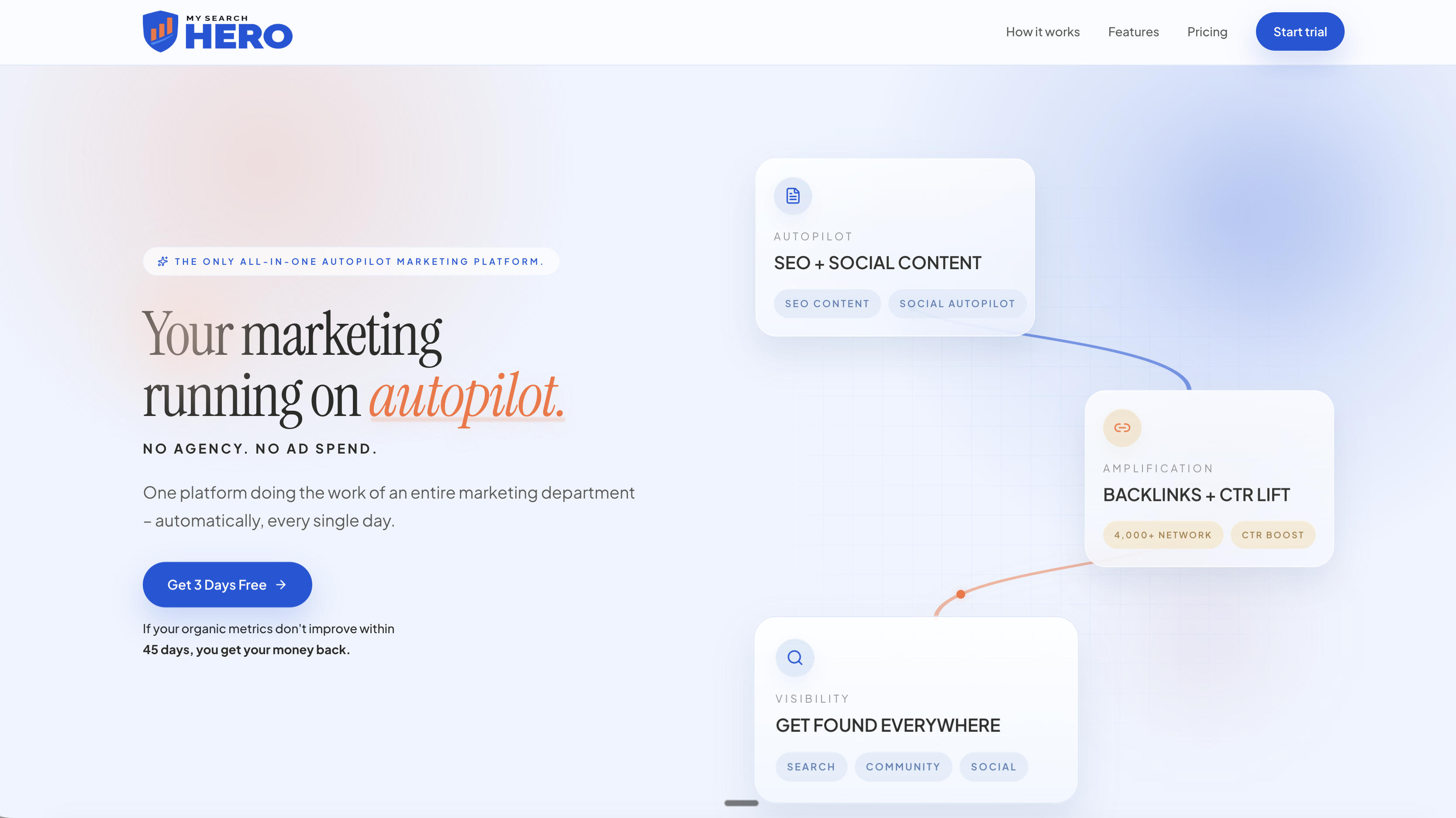
The subscription bundles what this playbook calls for into one pipeline: AI-generated articles built with answer-first structure and matching schema, authority backlinks from a publisher network to build the E-E-A-T signals Gemini weighs, Reddit mentions that build the kind of outside brand presence that correlates with citation odds, and monthly reporting so you can see impressions and CTR trends without digging through Search Console yourself. If you run a local or service business and don’t have a content team to execute five prioritized fixes a month, this is built for exactly that gap. Start a trial at Mysearchhero and see which of your existing pages are already close to citation-ready.
Where to Go for Deeper Reading
For implementation details straight from the source, start with Google’s own generative AI optimization guide and its blog post on succeeding in AI experiences. For measurement tactics beyond Search Console, SemDash’s guide to AI search visibility covers tooling options worth testing.
Sources
- Google users are less likely to click on links when an AI summary appears in the results | Pew Research Center (Short Reads)
FAQ
Is There an AI Tool for SEO?
Yes. Search Console’s Generative AI performance report is Google’s own tool, and third-party AEO platforms track citation rates more precisely. Mysearchhero also automates much of the content and schema work this playbook describes.
What Is the 80/20 Rule in SEO?
How Do You Do SEO for AI Search?
Focus on indexability, answer-first content structure, accurate FAQPage schema, and full coverage of a topic’s query fan-out subquestions on a single page, rather than chasing a single keyword.
What Is AI SEO Called Now?
The industry increasingly uses “AI Overview optimization” or “AEO” (answer engine optimization) alongside traditional SEO, though Google maintains that standard Search fundamentals still govern eligibility.