
Automating meta descriptions is the right call once your site has too many pages for manual writing to keep up, but only when the generation method reads each page’s own content rather than filling in a generic template. Google’s own guidance backs this for large, database-driven sites. The safe path is a simple pipeline: audit your existing tags, generate from page-specific data, review a sample, then publish in batches.
TL;DR:
- Automated meta descriptions are advisable for large sites when they are unique, relevant, and reflect actual page content, especially beyond a few hundred pages.
- Prioritize automation for pages with high business value, such as top-converting landing pages, and review only a sample to manage editorial resources effectively.
- Use a five-stage pipeline—discovery, data enrichment, generation, review, and publishing—and always build in fallback options for pages with limited content.
- Implement quality checks like duplicate detection, length rules, and fact-based content to meet Google’s guidelines and avoid low-value, generic output.
- Measure success via click-through rates in Search Console and adjust descriptions quarterly based on traffic and conversion improvements.
Table of Contents
- Why meta descriptions matter and what Google recommends
- Which pages to automate and how to prioritize
- End-to-end workflow to automate meta description creation
- Tooling and integration patterns that scale
- Quality gates, Gen-AI compliance, and guardrails
- Measuring impact and setting an iteration cadence
- Publisher perspective: lessons and when to hire a managed service
- MySearchHero: a managed option for automating metadata and ongoing SEO
- Key documentation and reference links
- FAQ
Why meta descriptions matter and what Google recommends
Meta descriptions don’t move rankings directly, but they shape whether someone clicks your result once it’s on the page. Google has said for years that it often prefers to pull the meta description for snippets because a well-written summary gives searchers a clearer sense of what they’ll get, which can lift click-through even though it doesn’t touch the ranking algorithm itself.
For sites with thousands of pages, writing each one by hand isn’t realistic, and Google’s Search Central guidance on controlling snippets explicitly allows programmatic generation for large, database-driven sites, provided the output stays unique, specific, and relevant to each page.
That permission comes with conditions:
- Descriptions must vary meaningfully across pages, not just swap a product name into an identical sentence.
- Generated text needs to reflect what’s actually on the page, not a boilerplate promise.
- Google may quietly rewrite your description in the snippet if it decides your content better matches the query.
Google allows programmatic meta descriptions for very large sites when they stay unique and high quality, according to its snippet documentation, which means scale alone isn’t a defense for repetitive output.
Which pages to automate and how to prioritize
Not every page deserves the same treatment. A cornerstone landing page that converts well is worth a human’s time. A catalog of 20,000 product variants is not.
- Rank pages by business value first: traffic, conversion rate, and revenue contribution, not just page count.
- Group pages by template type: product listings, category pages, and location pages usually share enough structure to automate safely.
- Keep editorial content, cornerstone landing pages, and anything tied to a campaign on manual review.
- Use a scale threshold as your trigger. Google’s own office-hours guidance points to programmatic generation as the sensible choice once a site is operating at the scale of large, database-driven catalogs rather than a few hundred pages.
- Reassess quarterly. A page that gains traffic or converts well is a candidate to pull out of the automated pool and hand to a writer.
This prioritization also protects your review capacity. If you’re only able to spot-check a fraction of output, you want that fraction spent on pages that matter most.
End-to-end workflow to automate meta description creation
A repeatable pipeline beats a one-off script. Five stages cover most implementations:
- Discovery. Crawl the site with a tool like Screaming Frog or Sitebulb, then cross-reference with Google Search Console to find pages with missing, duplicate, or truncated descriptions.
- Data enrichment. Pull structured fields into your generation source: price, specs, author, publish date, category. These fields give the model or template something concrete to reference instead of vague filler.
- Generation. Choose between template-based generation (token substitution into a fixed sentence structure) and content-driven AI generation that reads the actual page text. When uniqueness matters, for example on near-identical product variants, content-driven generation tends to produce better differentiation than fixed templates.
- Review and QA. Sample a percentage of each batch before publishing, set an editorial service-level agreement for turnaround, and keep a rollback plan so you can revert a batch if something breaks.
- Publish. Push in bulk through a CMS connector, a CSV import, or a lightweight staging script, then monitor Search Console for crawl errors or unexpected snippet rewrites.
Pro Tip: Always build in a deterministic fallback, like a structured field default, so pages with thin content still get a coherent description instead of an empty or broken tag.
Google’s guidance on generative AI content ties automated metadata directly to its spam policies, so the review stage isn’t optional even when the generation itself runs unattended.
Tooling and integration patterns that scale
The right tooling depends less on the CMS you use and more on how much engineering support you have.
- Bulk spreadsheet editors let you export current tags, edit or regenerate them in a familiar grid, and re-import, which suits teams without developer resources.
- No-code pipelines connect a Google Sheet or CSV export to an AI generator, route output to a QA sheet for review, then import approved rows back into the CMS.
- API-first workflows scrape page content programmatically, call a language model for generation, validate the output against length and duplicate rules, then push through the CMS API or a staging script tag before going live.
- WordPress sites usually route through an SEO plugin’s bulk editor or a custom field mapped to the plugin’s meta tag.
- Shopify stores often generate from product metafields, since price and specs are already structured there.
- Headless or static sites typically need an API-first approach since there’s no plugin layer to hook into.
Related reading on what SEO automation actually involves covers the broader workflow patterns behind this kind of pipeline.
Quality gates, Gen-AI compliance, and guardrails
Automation at scale is only safe if it’s paired with checks that catch pattern failures before they go live.
- Run duplicate detection across the full batch before publishing, not just within a single template group.
- Set length and readability rules, and keep taxonomy-specific tokens (brand, category, model number) consistent so descriptions don’t drift into generic phrasing.
- Tie every generated sentence to a real page fact, price, date, or spec, rather than a generic value statement, since generic output is exactly what Google’s guidance on generative AI content warns against when it discusses low-value mass-produced text.
- Use human review on a sample of each batch, not the whole set, so the editorial load stays sustainable while still catching systemic errors.
Descriptions must stay unique and page-specific to satisfy Google’s own bar, as stated in its guidance on generative AI content, which means a passed spot check on ten pages doesn’t guarantee the other nine thousand are fine.
More on avoiding these compliance risks is covered in this guide to AI in content for small businesses.
Measuring impact and setting an iteration cadence
Meta descriptions succeed or fail on click-through, so that’s where measurement starts.
- Track click-through rate, clicks, and impressions in Search Console at the page or template level, not just site-wide.
- Run controlled rollouts, generating new descriptions for half a template group and comparing against the untouched half before rolling out fully.
- Set a threshold, such as a sustained CTR drop against a page’s own historical baseline, that triggers automatic regeneration or flags the page for manual review.
- Report on a fixed cadence, weekly for high-traffic templates and monthly for the long tail, so drift gets caught early.
Case examples of measurable gains from automated approaches are covered in this piece on AI-driven local SEO visibility.
Publisher perspective: lessons and when to hire a managed service

The failures I see most often trace back to two things: under-audited inputs and no rollback plan. A generation script fed thin or missing structured data will produce thin, repetitive descriptions no matter how good the model is.
Building in-house makes sense when you have engineering time to maintain the pipeline. When you don’t, a managed service that already runs quality gates and review workflows is often the faster route to the same result.
— Mike
MySearchHero: a managed option for automating metadata and ongoing SEO
If building and maintaining your own generation pipeline isn’t where you want to spend engineering time, MySearchHero handles the automated content and metadata work as part of its ongoing service. Instead of assembling crawlers, generation scripts, and review workflows yourself, you get the output already built into a managed pipeline.
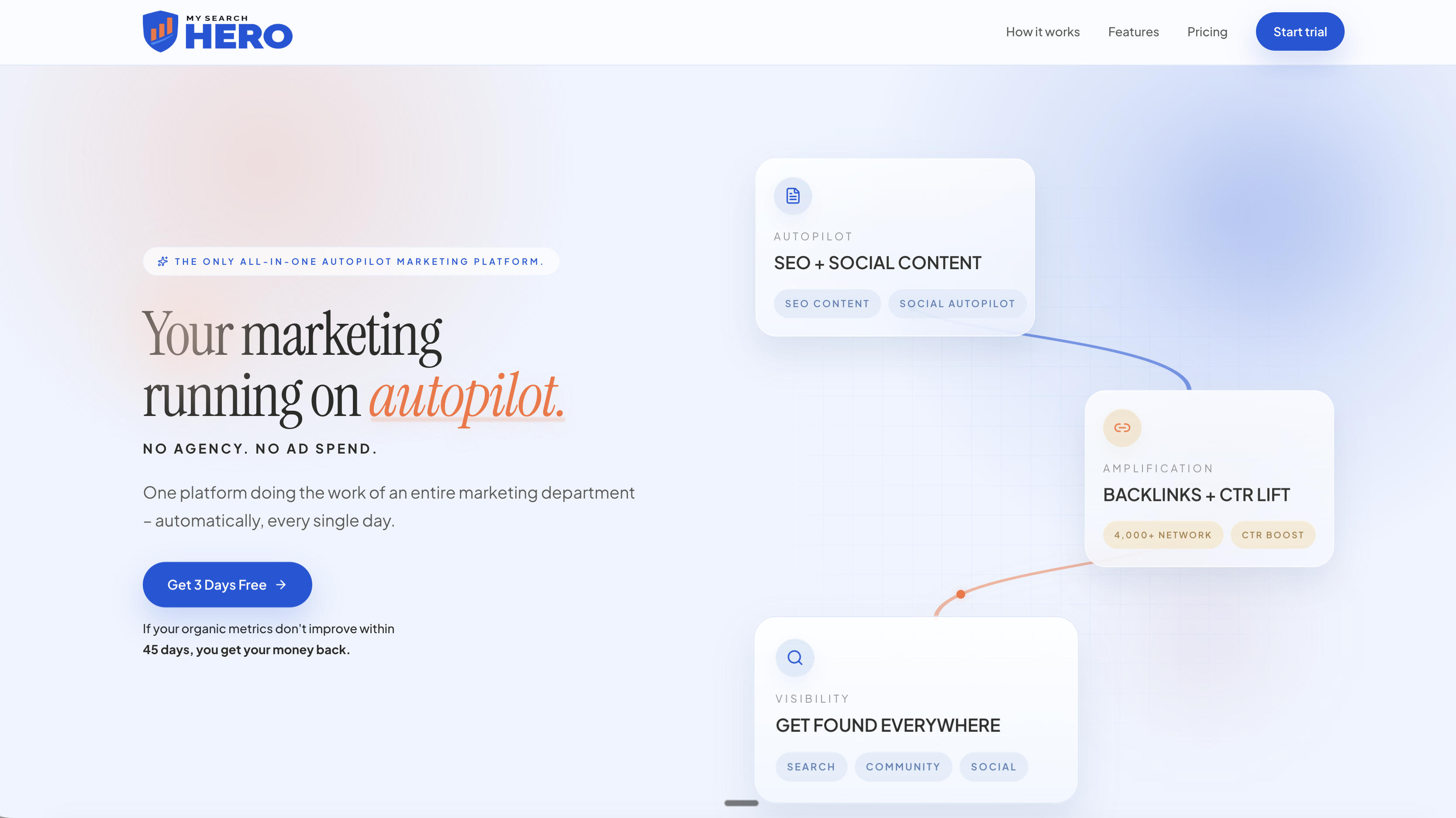
- Monthly deliverables include AI-generated SEO articles, backlinks, and Reddit brand mentions, processed through an automated pipeline.
- Plans range from Spark to Enterprise and include a money-back guarantee if organic metrics do not improve.
- A managed approach suits teams that would rather review finished output than build and maintain the generation and QA infrastructure themselves.
See current plans and start with MySearchHero if you’d rather hand off the pipeline than build it.
Key documentation and reference links
For policy details, start with Google’s snippet control guidance, its generative AI content policy, and the title link documentation covering when Google rewrites snippets.
FAQ
Can you give examples of effective meta descriptions?
An effective meta description states what the page actually offers using specific details, like price, model, or key features, rather than a vague promise. It should read like a short, honest pitch that matches what the searcher will find, not a repeated template with only the product name swapped in.
How do you generate a meta description?
Pull structured page data (title, price, specs, category) and either fill it into a page-aware template or feed it to a content-driven AI generator that reads the actual page text. Google’s guidance on large sites supports programmatic generation as long as the result stays unique and specific to each page.
Do meta descriptions still matter?
Yes, though they influence click-through rather than ranking directly. Google has said it frequently uses the meta description for snippet text because a clear summary helps searchers decide whether to click.
What goes in a meta description?
A meta description should summarize the specific page content in plain language, typically referencing what makes that page distinct, such as a product’s price or a location’s specifics. It should not duplicate the title tag or use the same phrasing across multiple pages, since Google’s generative content guidance flags repetitive, low-value text as a risk.