
A content automation workflow is the system of tools, roles, and rules that moves content from idea to published, distributed asset with minimal manual handling at each step. The pattern worth building is orchestration first, human review second: a single coordination layer, often called an MCP server, feeding approved data to AI tools while an AI Marketing Ops Manager and AI QA Analyst keep quality in check.
TL;DR:
- Connecting tools directly without a centralized orchestration layer causes data mismatches and breaks automation when APIs update or tools change.
- Successful automation pilots focus on a single content type, using existing weekly assets to measure improvements in speed and quality without scope creep.
- Prioritize integrating your CMS and DAM with an orchestration layer before adding other tools, ensuring live data access and reducing hallucinations.
- Clearly defined roles like AI Marketing Ops Manager, Prompt Librarian, and AI QA Analyst improve accountability and streamline approval processes.
- Automate routine, low-risk content first, such as social captions or product updates, and always measure key performance indicators using a consolidated dashboard to guide adjustments.
Table of Contents
- Core components of an automation-ready workflow
- Step-by-step implementation: audit, pilot, scale
- Orchestration and tech stack: prioritize data flow, not features
- Roles, governance, and review matrix for AI-enabled content teams
- Human-in-the-loop and QA tactics to prevent low-quality AI output
- Measurement and optimization: KPIs that close the loop
- Your first 90 days: a practical playbook
- When automation helps and when it gets in the way
- How MySearchHero builds your automated content pipeline for you
- Sources
- FAQ
Core components of an automation-ready workflow
Before you connect a single tool, you need the pieces that make automation safe rather than chaotic. A framework that unifies intelligence, strategy, workflows, and measurement is what separates teams that scale content from teams that just add software.
The checklist below covers what needs to exist before you automate anything:
- Ideation intelligence and reusable templates that capture what has already worked.
- A digital asset management system connected to your content management system, so briefs and assets stay in one traceable place.
- An orchestration layer, ideally an MCP server, that lets AI tools pull live, approved data instead of guessing.
- A prompt library tied to approved briefs, not ad hoc prompts written fresh each time.
- An approval matrix and a KPI dashboard that make review and measurement automatic, not an afterthought.
The most common failure mode is skipping the orchestration layer and connecting tools directly to each other. That creates a tangle of point-to-point integrations that breaks the moment one tool updates its API. If your team cannot say which system is the source of truth for a brief, an asset, or a metric, you are not ready to automate yet.
Step-by-step implementation: audit, pilot, scale
Rolling out automation in fixed stages keeps risk contained and gives you real data before you commit budget to a full rebuild. A pilot-with-guardrails approach that proves one content category end-to-end avoids amplifying whatever gaps already exist in your process.
- Audit (days 1 to 30): Map every step of your current content process and flag which tasks are repeatable, rules-based, and low-risk enough to automate first.
- Pilot (days 30 to 90): Choose one content type, build templates for it, connect your CMS and DAM, and run it end-to-end while tracking output quality and time saved.
- Scale (the following 60 days): Add connectors for other systems, extend templates to new content types, and tighten your approval rules as volume grows.
Success in the pilot looks like faster time-to-publish and stable or improved quality scores. If review cycles get longer instead of shorter, or if editors keep rewriting AI drafts from scratch, that is a signal to pause and fix the brief or prompt library before adding more volume.
Pro Tip: Run your pilot on a content type you already produce weekly, so you have a clean before-and-after comparison instead of guessing at improvement.

Orchestration and tech stack: prioritize data flow, not features
The instinct when scaling content is to add another tool for every new task. That instinct is the problem. Tool-piling without orchestration fragments data and work, and marketing leaders report wasted budget when point tools get bolted on without a coordination layer underneath them.
An MCP server, or a similar orchestration layer, lets your AI tools fetch live, proprietary data from your CMS, DAM, and CDP at the moment of generation. That single change reduces hallucinations and version mismatches, because the model is working from your current source-of-truth documents instead of stale training data.
When building your stack, prioritize connections in this order:
- CMS and DAM first, since every asset and brief lives there.
- Analytics and your marketing automation platform or CDP next, so personalization and targeting have real data behind them.
- Social schedulers and distribution tools last, once the content itself is reliably good.
Custom-code a connector only when a no-code orchestrator cannot reach a system you depend on daily. Otherwise, one orchestration layer beats five disconnected point tools every time, because it is the layer that makes governance and auditability possible.
Roles, governance, and review matrix for AI-enabled content teams
Automation without defined roles turns into automation without accountability. Organizations that adopt structured AI roles report improved workflow efficiency and less time lost to tedious manual tasks, and the roles work because they map cleanly to a review chain, a pattern also described in general terms in guides to the marketing ops function.
- AI Marketing Ops Manager: owns the orchestration layer, the connector map, and the overall pipeline health.
- Prompt Librarian: maintains the approved prompt library so outputs stay consistent across writers and tools.
- AI QA Analyst: runs quality checks on AI output before it reaches a human reviewer.
- Brand reviewer and final approver: sign off on voice, accuracy, and publish readiness in that order.
A three-layer approval matrix, automated check, QA analyst, brand reviewer, with a set turnaround time per layer keeps volume from stalling in review. Back it with a written AI acceptable use policy, an attribution protocol, and usage logs so every asset’s origin is traceable.
Human-in-the-loop and QA tactics to prevent low-quality AI output
The brief is the contract that keeps AI output on brand. It should specify audience, core message, real examples, brand rules, and the exact approved prompt to use, a practice CreativeOps frames as the fix for AI content that stalls in review.
- Run automated pre-publish checks for facts, tone, and formatting before any human touches the draft.
- Layer manual QA on top: one pass for accuracy, one for brand voice.
- Fast-track low-risk assets, like routine social captions, through a shorter review lane.
- Escalate high-risk content, anything regulated, financial, or reputation-sensitive, to full manual review with no shortcuts.
Pro Tip: Give every asset tier a maximum review window, so a fast-track post cannot accidentally sit in a queue built for a compliance-heavy article.
Measurement and optimization: KPIs that close the loop
Automation only helps if you can see whether it is working. Track visibility, engagement, conversion lift, time-to-publish, review-cycle time, and a quality score for each asset tier.
- Pull all of it into one dashboard instead of checking five separate tools.
- Review the numbers on a fixed schedule, not just when something breaks.
- Adjust workflow rules, not just content, when a metric moves.
A centralized dashboard combining CMS, analytics, and distribution metrics is what turns fragmented numbers into decisions you can actually act on. Run small experiments, one prompt change or one template tweak at a time, and roll changes into your standard workflow only after they hold up.
Your first 90 days: a practical playbook
Weeks 1 to 4: audit and pick your pilot content type. Weeks 5 to 12: build templates, connect your CMS and DAM, and publish through the pilot. Weeks 13 and beyond: add connectors and expand. Our own 90-day pipeline playbook and content calendar templates walk through each stage in more detail.

When automation helps and when it gets in the way
Automate high-volume, repeatable, low-regulatory-risk content: product updates, listicles, social captions. Leave strategy, sensitive topics, and anything requiring judgment to human writers. Ask three questions before automating anything: is it repeatable, is it low-risk, and can you measure the result?
The workflow that wins is not the one with the most tools connected. It is the one where a human still owns every decision that matters.
— Mike
How MySearchHero builds your automated content pipeline for you
If building this stack yourself sounds like more infrastructure than your business needs, MySearchHero runs the whole pipeline for you. Each month you get published SEO articles, backlinks through a publisher network, Reddit mentions, and AI-generated social posts, all handled through one subscription instead of separate tools and vendors.
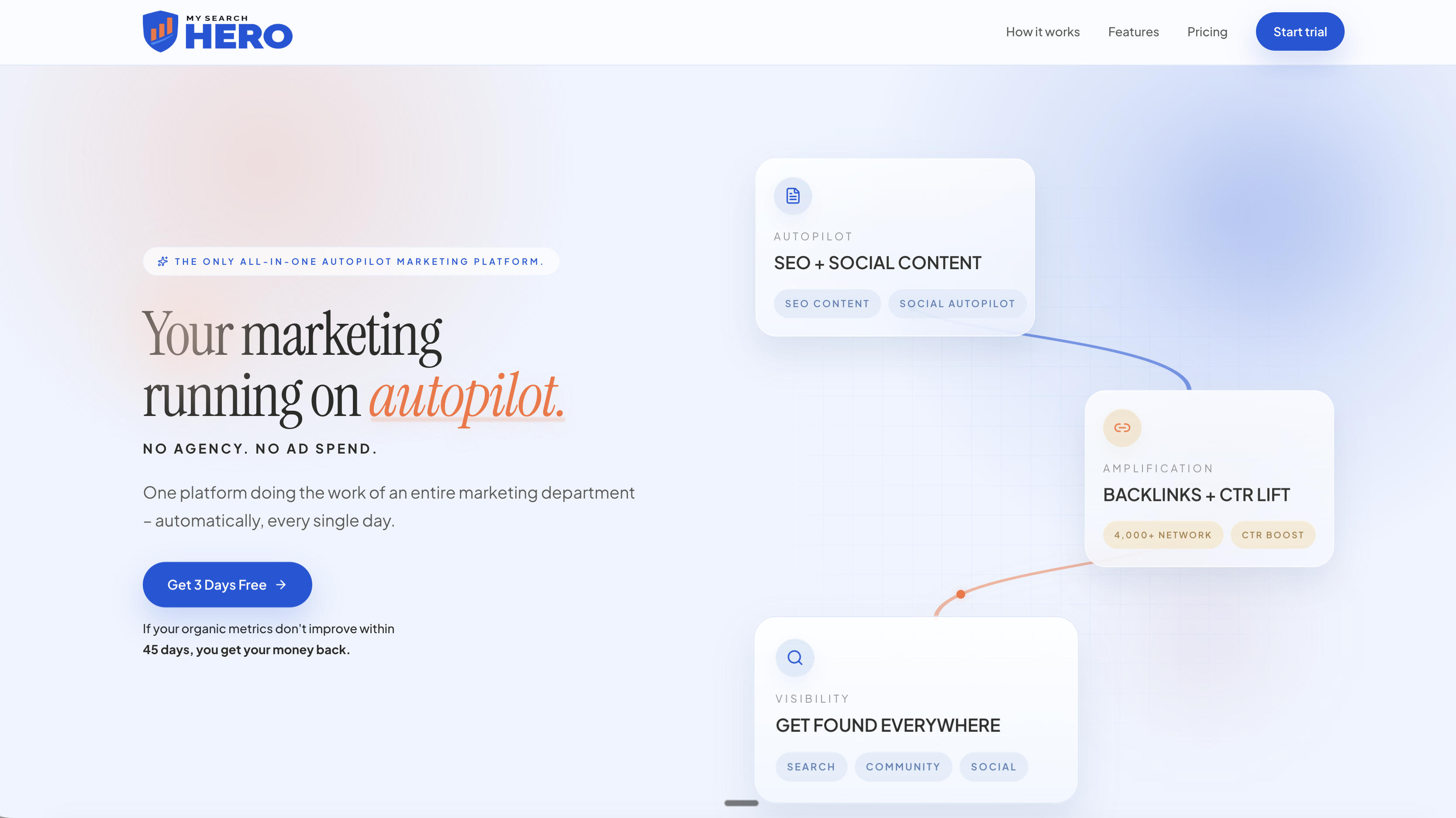
Plans start with Spark at $197 per month, with Authority, Hero, and Enterprise tiers available as your content needs grow. A money-back guarantee is offered if your organic metrics don’t improve. Visit MySearchHero to see which plan fits your business.
FAQ
What is the content workflow process?
The content workflow process moves an idea through defined stages: ideation, creation, review, publishing, distribution, and measurement. Each stage has an owner and a set of rules, so content does not get stuck or published without review, a structure described in CreativeOps’ approach to AI content.
How do I automate content creation?
Start by auditing your current process to find repeatable, low-risk tasks, then build an orchestration layer that connects your CMS, DAM, and AI tools before adding point solutions. Pilot one content type first, track time-to-publish and quality score, then expand connectors and templates once the pilot holds up.
What are the five steps of a content workflow?
Definitions vary, but a common version covers ideation, creation, review and approval, publishing, and distribution, with measurement feeding back into ideation for the next cycle. Some teams treat measurement as a sixth step rather than folding it into distribution.
What roles do I need for an AI-enabled content team?
The core roles are an AI Marketing Ops Manager who owns the pipeline, a Prompt Librarian who maintains approved prompts, and an AI QA Analyst who checks output before human reviewers see it. Organizations using these roles report improved workflow efficiency and less time lost to repetitive tasks.
How much does MySearchHero cost?
MySearchHero’s plans start at $197 per month for Spark, with Authority, Hero, and Enterprise tiers priced higher for larger content and backlink volumes. Annual billing is also available, and every plan includes a 45-day money-back guarantee tied to organic metric improvement.