
TL;DR:
- Marketing automation helps SMBs increase efficiency, revenue, and customer engagement through automated workflows. To succeed, they must audit processes, ensure data quality, and select scalable tools aligned with customer journeys. Gradual implementation and continuous measurement enable growth, while agentic AI offers autonomous decision-making to optimize results.
Running a small or medium-sized business means wearing every hat. You are the strategist, the writer, the social media manager, and the email sender, all at once. That grind is why learning how to automate marketing is one of the highest-leverage decisions you can make this year. Organizations using automation meet content demands 24% more often and report 29% greater revenue impact from their content efforts. This guide walks you through exactly what to do, from picking the right tools to launching your first automated workflow, so you can stop doing everything manually and start growing.
Table of Contents
- Key takeaways
- How to automate marketing: the foundation you need first
- Picking the right tools and preparing your workflows
- Building and launching your automation workflows
- Measuring results and improving over time
- My take on automation after watching hundreds of SMBs try it
- Let Mysearchhero handle this for you
- FAQ
Key takeaways
| Point | Details |
|---|---|
| Automation is not optional anymore | SMBs that automate marketing see measurable gains in efficiency, revenue, and customer engagement. |
| Start with a process audit | Map your repetitive tasks before selecting any tool to avoid buying software that does not fit your workflow. |
| Data quality drives results | Automation is only as good as the data feeding it. Clean, unified data is non-negotiable. |
| Test before scaling | Launch small pilot workflows, measure results, then expand. Gradual rollout prevents costly mistakes. |
| AI goes beyond scheduling | Modern tools use agentic AI to make real-time decisions autonomously, not just send pre-set emails on a timer. |
How to automate marketing: the foundation you need first
Marketing automation is software that handles repetitive marketing tasks without manual input. That includes sending welcome emails, posting to social media, segmenting leads by behavior, and nurturing prospects through a funnel. The role of automation in marketing has grown far beyond simple scheduling tools. Today, AI-powered platforms adapt in real time based on what your audience actually does.
Here is what modern marketing automation typically covers:
- Email marketing automation: triggered sequences based on user actions like signing up, clicking a link, or abandoning a cart
- Social media automation: scheduled posts, auto-responses, and performance tracking across platforms
- Lead scoring and CRM sync: automatically ranking leads by behavior and pushing that data to your sales team
- Content personalization: showing different messages to different audience segments without manual effort
- Ad campaign adjustments: AI tools that shift budget toward the best-performing ads in real time
The most forward-looking development is agentic AI. Agentic AI enables systems to make decisions, adapt actions in real time, and optimize marketing execution without a human approving every step. Instead of following a fixed ruleset, these systems pursue goals autonomously. You tell the system “increase qualified leads by 20%” and it figures out how.
Pro Tip: Before you get excited about agentic AI, make sure your data infrastructure is solid. Unified, accurate data is the backbone of every automated decision your system makes. Garbage in, garbage out.
Successful automated customer engagement also depends on your ability to shift from reactive to proactive strategy. That means setting up systems that act on customer signals before you even notice them, not just responding to what already happened.
Picking the right tools and preparing your workflows
Most business owners skip this step and pay for it later. Before you choose any software, audit your current marketing tasks. Write down every repetitive action your team takes each week. If a task follows a predictable pattern, it is a candidate for automation.

Common tasks worth automating include email follow-ups after form fills, social media post scheduling, lead segmentation by source or behavior, and monthly performance report generation. Once you have that list, map the customer journey. Where do people first discover you? What actions do they take before buying? Your automation should mirror that path.
When evaluating tools, these criteria matter most:
- Integration: Does the platform connect with your CRM, website, and ad accounts without custom development?
- Scalability: Can it handle 10x your current volume when you grow?
- Ease of use: Will your team actually use it, or will it sit idle?
- Support: Is there onboarding help or a knowledge base that fits your technical level?
- Pricing transparency: Setup costs range from $2,000 to $10,000 depending on your needs and training requirements, so budget accordingly.
Here is a comparison of commonly used platforms to help you decide:
| Platform | Best for | Key strength | Starting price range |
|---|---|---|---|
| HubSpot | Full funnel automation | CRM plus email plus social in one | $50/month and up |
| Mailchimp | Email-first SMBs | Simple setup, solid email automation | Free tier available |
| ActiveCampaign | Email and CRM together | Advanced segmentation and automation maps | $29/month and up |
| Hootsuite | Social media focus | Scheduling and analytics across platforms | $99/month and up |
| Klaviyo | E-commerce brands | Deep behavioral triggers tied to purchases | $45/month and up |
Pro Tip: If you sell to other businesses and need AI-powered lead generation on LinkedIn, learning to build a B2B pipeline with AI can layer on top of your automation stack and fill the top of your funnel automatically.
A strong content calendar is also part of your preparation. Automation tools need content to publish and send. If you do not have a pipeline of content ready, your automation will run dry fast.
Building and launching your automation workflows
Now you execute. Here is the step-by-step process for implementing marketing automation from scratch.
-
Clean and connect your data. Export your existing customer and lead data. Remove duplicates, fill in missing fields, and import everything into your chosen platform. Your CRM should sync with your email tool and your website analytics from day one. Poor data integration directly reduces automation effectiveness, no matter how good your software is.
-
Design your first workflow around a single use case. Do not try to automate everything at once. Start with a welcome email sequence for new subscribers, or a re-engagement flow for leads who went cold. Map it visually: trigger, condition, action, timing.
-
Add dynamic content where it matters. Automated systems using generative AI can create personalized copy and landing pages at scale. Use this to send different email versions to different customer segments based on what they clicked or bought.
-
Build in real-time adjustments. AI marketing moves from fixed plans to continuous loops that update based on live performance data. If an email subject line is underperforming by Tuesday, the system should test a new one, not wait for your monthly review.
-
Test every path before going live. Walk through your workflow as a test user. Trigger every branch. Check that emails send correctly, that CRM records update, and that follow-up timing is accurate. A broken welcome sequence is a poor first impression.
-
Launch with a small segment first. Send your new workflow to 10% of your list or a pilot group before full deployment. This is standard best practice when implementing marketing automation for the first time. Review open rates, click rates, and conversion within 48 hours.
-
Document your workflows. Write down what each automation does, why it exists, and who owns it. This matters when you hire, when you scale, and when something breaks at the worst possible moment.
Automate social media using the same phased approach. Start with scheduling posts on two platforms. Then add auto-replies for common questions. Then layer in performance-triggered boosts for top posts. Each layer builds on a tested foundation.
Measuring results and improving over time
Launching is only the beginning. The best marketing automation strategies include a clear measurement plan from day one.

The metrics that matter most for SMBs are:
| Metric | What it tells you | Target benchmark |
|---|---|---|
| Email open rate | Whether your subject lines and timing are working | 20% to 35% depending on industry |
| Click-through rate | Whether your content drives action | 2% to 5% is solid for most industries |
| Lead-to-customer conversion | Whether automation is closing the loop | Varies by funnel, track directionally |
| Cost per lead | Whether automation is reducing acquisition cost | Should decrease over time with optimization |
| Content throughput | Whether your content supply chain is scaling | High performers improve throughput significantly with automation |
AI-driven analytics tools within platforms like HubSpot and ActiveCampaign surface these numbers automatically. Use them weekly, not monthly. Generative AI users save an average of 11.4 hours per week by automating content creation and analysis. That time savings compounds when you are reviewing and acting on data faster than your competitors.
One of the biggest traps is over-automating. When every touchpoint feels robotic, customers disengage. Keep personalization in your automated flows by using first names, referencing specific behaviors, and leaving room for a human to step in at high-value moments.
Pro Tip: Set a monthly automation audit on your calendar. Review which workflows are performing, which are stale, and which customer segments are not being nurtured at all. Automation reduces costs only when you actively manage and improve the system, not when you set it and forget it.
Agentic AI takes this further by making decisions autonomously toward your stated goals in real time. That means your system can shift messaging, reallocate budget, or suppress a poorly performing campaign without waiting for you. For SMBs, that level of scale was previously only available to enterprise marketing teams.
My take on automation after watching hundreds of SMBs try it
I have seen a lot of business owners invest in marketing automation and underuse it. They connect the tools, build one email sequence, and call it done. The real opportunity is treating automation as a system that evolves, not a task you complete.
What I have learned is that the biggest mistake is not technical. It is strategic. Business owners automate execution before they have clarity on their customer journey. They send sequences to segments that are too broad. They measure vanity metrics instead of revenue impact. The tools are not the problem. The thinking before the tools is.
I also think the fear around AI replacing creativity is overblown. Treating AI as just a content generator misses the point. The real win comes from deploying AI as an autonomous system that manages entire workflows so your team can focus on strategy, relationships, and creative direction. That is a better use of everyone’s time.
My advice is to start with the one marketing task that eats the most of your week. Automate just that. See what happens over 30 days. Then add the next layer. Businesses that scale their automation gradually get far better results than those who try to do everything at once. You can explore marketing automation insights and build your knowledge base as you go, but the fastest learning comes from running a real workflow and measuring what it does.
— Mike
Let Mysearchhero handle this for you
If reading this made you realize you need help actually executing, that is exactly what Mysearchhero was built for.
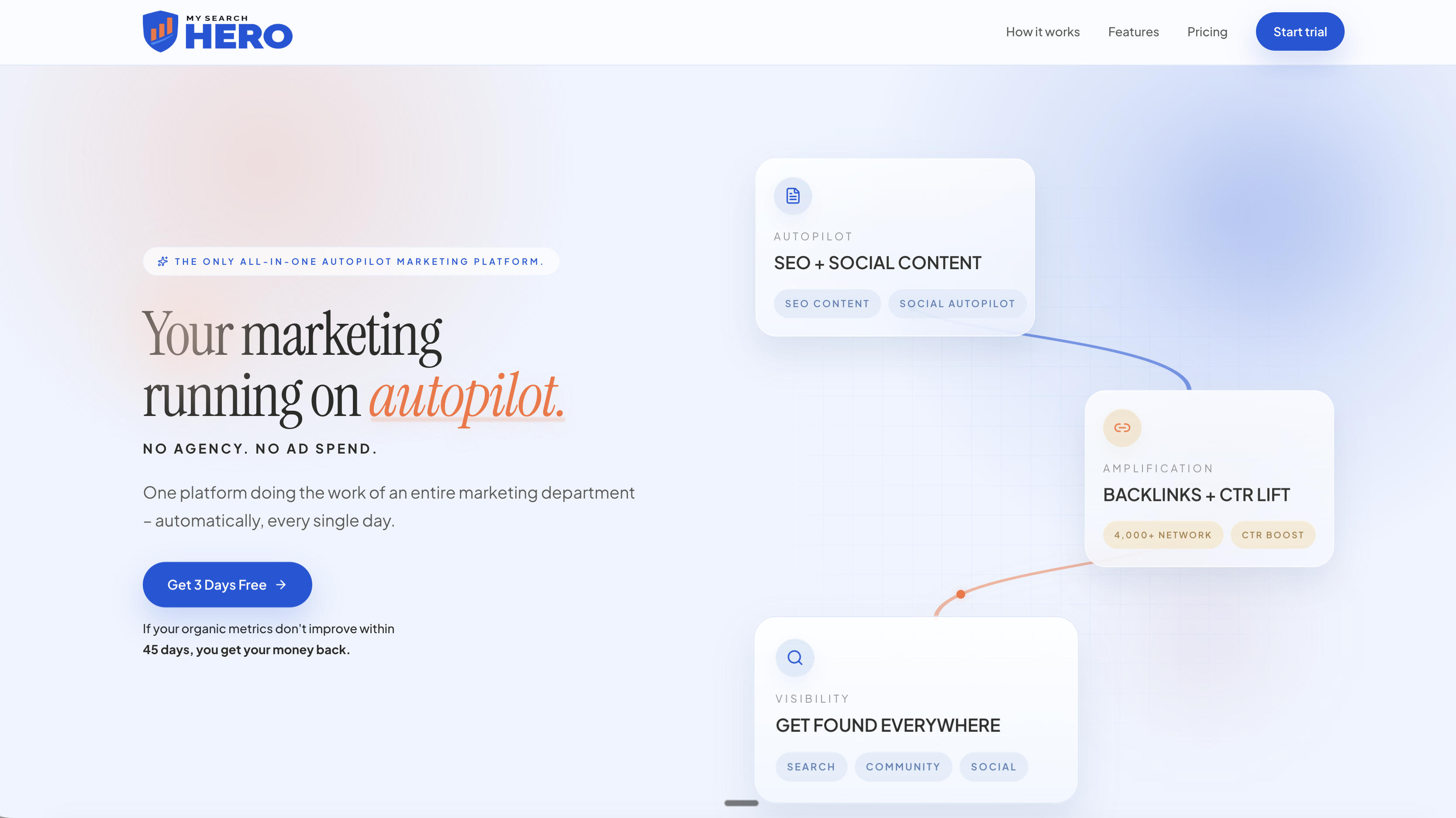
Mysearchhero is a done-for-you SEO and content marketing service built for small and medium businesses. Each month, subscribers get published articles, backlinks, Reddit mentions, and AI-generated social media posts pushed out through a fully automated pipeline. You do not need to manage tools, write the content, or figure out the publishing schedule. It is all handled. If you are ready to see what automated marketing on autopilot looks like without the setup headaches, visit Mysearchhero and explore what a monthly plan covers. Your competition is already automating. This is how you keep up.
FAQ
What is the easiest way to start automating marketing?
Start with email marketing automation. Set up a triggered welcome sequence for new subscribers using a tool like Mailchimp or ActiveCampaign, then expand from there once you see results.
How much does marketing automation cost for a small business?
Setup costs typically range from $2,000 to $10,000 depending on complexity, plus ongoing monthly software fees that can start as low as $29 per month.
How do CRM tools fit into marketing automation?
Learning how to use CRM tools is central to automation success. Your CRM stores customer data that triggers automated emails, segments audiences, and tracks where each lead is in your sales funnel.
What is agentic AI and why does it matter for SMBs?
Agentic AI systems pursue goals autonomously instead of following fixed rules. For SMBs, this means your marketing software can make real-time decisions on budget, messaging, and timing without waiting for your input.
How do you automate social media without losing authenticity?
Use scheduling tools to plan posts in advance, but personalize content for each platform and leave room for real-time engagement. A social media content plan gives you structure while keeping your brand voice intact.