
For a local or service business, the honest answer is that you need both, in the right order. Quality decides whether a page deserves to rank and convert. Consistency decides whether enough of those pages ever get published to matter. Most owners lose on consistency, not on quality: one great article in March, nothing until August. We built MySearchHero so that a steady stream of useful content, backlinks and social posts goes out every month without you having to find the hours for it.
This guide explains what “quality” means in Google’s own terms, when publishing more helps, when it hurts, and how to set a pace you can actually keep.
TL;DR
- Google says it has no preferred word count and ranks content that is helpful, original and written for people, so quality is about usefulness, not length.
- Publishing more only works when each page answers a real question your customers ask. Padding the site with thin pages can backfire.
- Consistency is the part most small businesses fail at. A realistic, steady schedule beats bursts of effort followed by silence.
- Measure content by leads and revenue, not by traffic or post counts alone.
- Our Hero plan is $397 per month and bundles articles, backlinks, Reddit mentions and social posts, so quality and consistency both get handled.
Table of Contents
- What “quality” and “quantity” actually mean
- Why quality matters more when you are a small business
- A quick quality check for any page
- What the data says about publishing less
- When publishing more does help
- The real problem: consistency, not the quality-quantity trade-off
- A sample cadence for a local service business
- How to measure whether it is working
- Doing both with MySearchHero
- Our view on quality versus quantity
- Common mistakes to avoid
- FAQ
- Sources
What “quality” and “quantity” actually mean
Quantity is how many pieces you publish: blog posts, service pages, social posts, local guides. Quality is how well each piece does its job for the person reading it.
The debate gets muddy because people treat quality as “long and polished” and quantity as “short and rushed.” Google does not see it that way. Its guidance on creating helpful, reliable, people-first content says its ranking systems prioritize information created to benefit people, not content made to manipulate rankings. It also says there is no preferred word count. A 600-word page that fully answers “how much does it cost to repaint a two-bedroom apartment” beats a 3,000-word page that circles the question.
So the useful definition for a service business is this:
- Quality means the page has a clear audience, original information, enough depth to settle the question, and leaves the reader able to do what they came to do.
- Quantity means how many of those pages exist, and how often new ones appear.
Seen that way, the two are not opponents. Quantity is the number of times you get to be useful. Quality is whether you are.
Why quality matters more when you are a small business
A national brand can survive weak pages because its domain is already trusted. A local plumber, dentist or landscaper has no such cushion. Your site has a few dozen pages at most, and each one is a large share of how Google and potential customers judge you.
Two things follow.
First, thin or generic pages do not just fail to rank, they cost you credibility. A visitor who lands on a vague “5 tips for a healthy lawn” post that says nothing specific to your climate, grass types or service area leaves, and does not call.
Second, your advantage over big competitors is local, first-hand knowledge. Google’s self-check questions ask whether content provides original information or analysis, adds value beyond other results, and demonstrates first-hand expertise. You have that expertise. You know which pipes fail in homes built before 1970 in your town, or what a typical estimate looks like for your service area. A page that says so is quality in the exact sense Google describes.

For ideas on what that looks like in practice, see our examples of content marketing that attracts more local clients and content ideas that build community.
A quick quality check for any page
Before you publish anything, run it through these questions. They are adapted from the self-assessment in Google’s helpful content guidance.
- Who is this for? Name the customer: a homeowner with a leaking water heater, not “people interested in plumbing.”
- What does it say that other results do not? Your pricing ranges, your process, your photos, your local rules and conditions.
- Does it show real experience? Specific jobs, specific problems, specific outcomes.
- Is it deep enough to settle the question? The reader should not need to go back to search results.
- What should the reader do next? Call, request a quote, book a visit. A page without a next step is information without a business result.
A page that passes all five is high quality whether it is 500 words or 2,500.
What the data says about publishing less
The strongest argument for quality over quantity comes from sites that cut content and grew. According to Search Engine Land’s analysis, QuickBooks removed more than 2,000 pieces of content from its resource center, and within weeks traffic rose 20%, followed by more than 70% more lead signups.
The same article makes a point that applies to any site: every content strategy reaches diminishing returns, where more output delivers less than improving what is already published. It suggests concentrating on the topics where you have the deepest expertise, with one to four strong articles per topic rather than 50 or more near-duplicates.
What does this mean for a service business? You probably do not have 2,000 weak pages. But you may have ten posts that all say roughly the same thing about “why you should hire a professional,” and those compete with each other instead of helping. Here is what to do about that:
- Merge overlapping posts into one thorough page on each topic.
- Update old pages whose prices, laws or seasonal advice have gone stale. Our guide to diagnosing content decay walks through the signs and fixes.
- Retire pages that have no traffic, no leads and nothing useful to say.
The lesson is not “publish as little as possible.” It is that pages without a purpose do not earn their place.
When publishing more does help
The opposite failure is just as common among small businesses: a site with eight pages, a blog last updated two years ago, and no answer to most of the questions customers ask before they call.
A customer’s journey has many questions in it. What does it cost? How long does it take? Do you serve my neighborhood? What happens if something goes wrong? Is it better to repair or replace? Each question is a chance to show up in search, and one page cannot answer them all. A site that covers twenty well-chosen questions simply has more ways to be found than a site covering two.
Quantity helps when:
- Each new page targets a different, real question. Not the same topic reworded.
- Each page meets the quality check above. Volume of thin pages is the version that fails.
- You cover different services and different service areas with genuinely different information for each.
- You are starting from a small base. A site with few pages has the most room to gain from filling obvious gaps.
Publishing regularly also gives search engines and customers a reason to see your business as active. We cover that in more detail in why publishing regularly matters for small businesses.
The real problem: consistency, not the quality-quantity trade-off
In theory, you pick a sensible pace and hold it. In practice, a service business owner is on job sites, answering calls and managing staff. Content is the first task to slip.
That is why the trade-off feels real. When you write alone, a higher pace usually does cost quality, because the time comes out of evenings and weekends. When you write less, the site stagnates. Both outcomes come from the same cause: content production depends on one busy person.
The fix is a workflow that does not depend on your spare hours. At minimum it needs:
- A topic list drawn from real customer questions.
- A fixed publishing rhythm that you can keep in your worst month, not your best.
- A review step to make sure each piece reflects how your business actually works.
- A way to distribute the content, through links, social posts and community mentions, so it is seen.
Our breakdown of a content marketing workflow for small business shows how those pieces fit together, and our guide on writing SEO content that ranks covers the page-level craft.
A sample cadence for a local service business
There is no universal number. The right pace is the one you can hold without quality slipping. Here is a sensible way to think about it, using an example of a hypothetical HVAC company with a six-person team:
| Stage | What gets published | Goal |
|---|---|---|
| Months 1 to 2 | Core service pages and the ten most common customer questions | Cover the basics customers search for |
| Months 3 to 6 | Steady stream of new articles: cost guides, seasonal tips, local topics | Widen the number of searches you can appear for |
| Month 7 onward | New articles plus updates to the best and oldest pages | Keep what works fresh and retire what does not |
The exact numbers matter less than the habit. If your pace starts hurting the quality check, slow down. If your site has obvious unanswered questions, speed up.
How to measure whether it is working
Counting posts tells you about effort, not results. Traffic alone is not much better. The Content Marketing Institute’s March 2026 report on measuring content ROI says measurement should connect to revenue quality, customer lifetime value, retention and pipeline contribution, not raw traffic or follower growth alone.
For a local business, translate that into numbers you already know:
- Calls and form submissions that come from organic search.
- Quote requests by page, so you see which articles bring in work.
- Customer value, because a page that brings repeat maintenance clients is worth more than one that brings one-time bargain hunters.
- Rankings and impressions for the service-plus-city searches that matter to you.
Review them monthly. Pages that earn calls get expanded and updated. Pages that earn nothing after several months get merged or removed, which is the same discipline the QuickBooks example shows at scale.
If you want the reasoning behind blogging at all, why blog for business lays out the traffic and lead case.
Doing both with MySearchHero
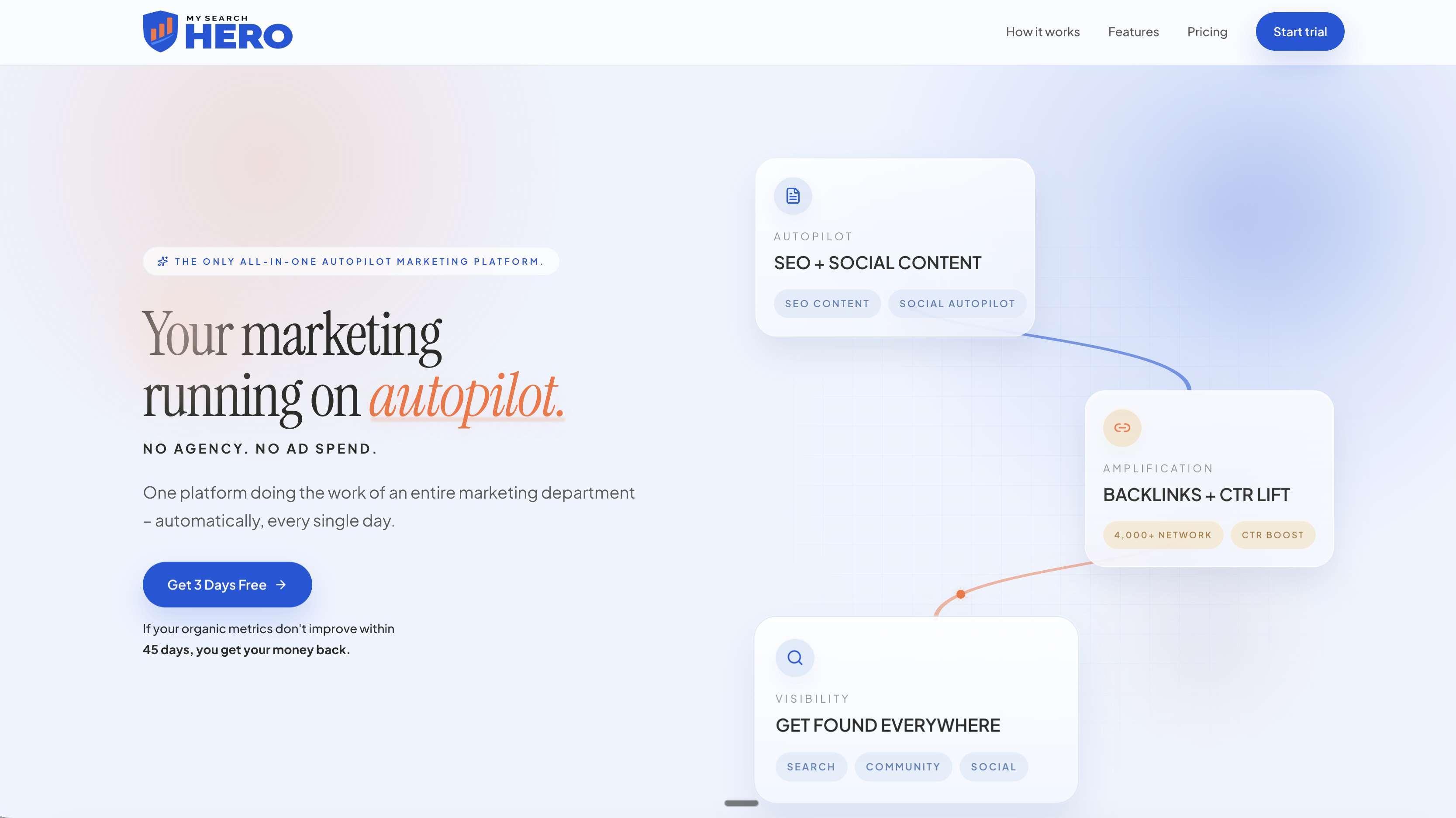
This is where our service fits. MySearchHero is a done-for-you SEO and content marketing service for small and local service businesses. Each month, subscribers receive a bundle of deliverables: AI-generated SEO articles published to your website, authority backlinks through a publisher network, Reddit brand mentions in relevant conversations, and AI-generated social media posts across multiple platforms, with CTR signal boosting and reporting included.

That covers the four things above that stall when one person does them: topics, rhythm, publishing and distribution. You keep your focus on your customers, and visibility builds month after month without ad spend or an agency retainer.
Plans are tiered. Spark is $197 per month, Authority is $297 per month, and Hero is $397 per month, which combines SEO, backlinks, CTR boosting, Reddit presence and social posting in one platform. Annual billing is $1,970 for Spark, $2,970 for Authority and $3,970 for Hero. An Enterprise plan is $2,997 per month. You start with a free trial, and our 45-day money-back guarantee applies if your organic metrics do not improve. You can compare the plans on the MySearchHero plans page.
Our view on quality versus quantity
Business owners ask us this question as if they had to choose a side. We do not think they do.
The sites that win in local search are rarely the ones with the most pages, and they are rarely the ones with one perfect article from two years ago. They are the ones that keep showing up with something useful: an answer to a real customer question, a link from a respected site, a mention in a conversation where people are already asking for recommendations.
That is why we built MySearchHero as a single monthly bundle rather than a menu of separate tasks. Articles, backlinks, Reddit mentions and social posts reinforce each other. An article gives people something worth linking to and sharing. Backlinks and mentions get it seen. Reporting shows what is moving. When these run together every month, visibility compounds, and that compounding is what a service business owner with no spare hours needs.
Quality is the standard. Consistency is what makes the standard pay off. We would rather take the second problem off your plate so you can spend your time on the work only you can do.
Mike
Common mistakes to avoid
Chasing word count. Google says it has no preferred length. Write until the question is answered, then stop.
Publishing the same page ten times. Ten articles on “signs you need a new roof” compete with each other. One strong page wins more than ten weak ones.
Writing for search engines instead of customers. Pages stuffed with keywords and no specifics fail Google’s helpfulness standard and fail the person reading.
Going quiet after a burst. A flurry of posts followed by months of nothing signals an inactive business. Choose a pace for your slowest month.
Never revisiting old content. Prices, regulations and seasonal advice change. Refresh your best pages instead of only adding new ones.
Ignoring the next step. Every page needs a clear call to action, such as a phone number, a quote form or a booking link. Our guide to creating engaging content that converts covers this.
FAQ
Is quality or quantity more important for SEO?
Quality decides whether a page is worth ranking, and Google says its systems prioritize helpful, people-first content. Quantity matters because each useful page is another question you can answer for customers. For a small site, the best approach is a steady flow of pages that each pass a quality check.
How many articles should a local business publish per month?
There is no single correct number. Pick a pace you can hold every month without the quality of your pages slipping, and adjust as you see which pages bring calls. A consistent, modest schedule beats a burst of posts followed by silence.
Does longer content rank better?
Not by itself. Google states that it has no preferred word count. A page should be as long as it takes to fully answer the question for your intended reader, and no longer.
Can I delete old content without hurting my site?
Often it helps. Search Engine Land reports that QuickBooks removed more than 2,000 pieces of content and then saw traffic rise 20% and lead signups increase by more than 70%. Merge overlapping pages and remove those that serve no purpose, but review each page’s traffic and leads before you decide.
Sources
- Creating Helpful, Reliable, People-First Content, Google Search Central
- The data-backed case for publishing less content, Search Engine Land
- The New Rules of Measuring and Proving Content ROI, Content Marketing Institute