
Local marketing ROI is the profit your marketing earns compared with what it costs you, counted on gross profit and on new business you would not have won anyway. For a service business, that means tracking every dollar from the ad, article, listing or post through to a booked job. Most owners can do the math in an afternoon. The harder part is keeping the inputs honest month after month, and that is where a steady, bundled program like ours pays off: visibility that compounds is far easier to measure than a string of one-off campaigns.
TL;DR
- ROI = (gross profit from marketing − marketing cost) ÷ marketing cost × 100. Use gross profit, not revenue, and count your own time as a cost.
- Count only incremental business: jobs you would not have booked without the marketing.
- Tag every channel (tracking numbers, UTM links, a “how did you hear about us?” question) so leads can be tied to sources.
- Organic channels such as SEO content and backlinks build slowly, so judge them over quarters, not weeks.
- A bundled monthly plan makes the cost side of your ROI formula one predictable number.
Table of Contents
- What local marketing ROI means for a service business
- The formula, step by step
- Attributing leads when customers use several channels
- What is a good ROI for local marketing?
- Two marketing rules of thumb, in plain terms
- Track results and decide what to change
- Why a bundled program makes ROI easier to read
- Where MySearchHero fits
- Perspective
- FAQ
- Sources
What local marketing ROI means for a service business
Return on investment answers one question: for every dollar I put into marketing, how many dollars of profit came back? If you spend $1,000 and it produces $3,000 of profit beyond the cost, your ROI is 200%. If it produces exactly $1,000 of profit beyond the cost, you broke even on the spend.
For a plumber, roofer, dentist, cleaner or electrician, “marketing” is rarely one thing. It is your Google Business Profile, your website, the articles that bring searchers in, reviews, referrals, flyers, and perhaps paid ads. ROI becomes useful when you can say which of those pieces pays for itself and which does not. That is what lets you move budget instead of guessing.
What you are not measuring is vanity: likes, impressions and page views matter only to the extent they lead to calls, form fills and booked jobs. A guide to tracking SEO metrics covers which of those upstream numbers are worth watching on the way to a booked job.

The formula, step by step
The version that works for local businesses is the incremental, gross-profit version described in Constant Contact’s guide to measuring marketing ROI:
ROI = (incremental gross profit − total costs) ÷ total costs × 100
1. Use gross profit, not revenue
Gross profit is what a job brings in after the direct cost of delivering it: materials, subcontractors, labor on the job, fuel. Revenue overstates the return because you never keep all of it. A $4,000 sale at a 30% gross margin leaves $1,200, not $4,000.
Take a $1,000 monthly spend that brings in $4,000 of work. On revenue, it looks like a 300% return. On a 30% margin, gross profit is $1,200, so the real ROI is ($1,200 − $1,000) ÷ $1,000 = 20%. Same campaign, very different verdict. Your bookkeeper or accounting software can give you your gross margin by job type, and it is worth knowing it for each service you sell.
2. Count every cost
The cost base is more than the invoice. Include:
- Ad spend, agency or software subscriptions, and any content or backlink fees
- Design, printing and signage
- Discounts you gave to win the job
- Your own time (or a staff member’s) at a fair hourly rate
Owners who skip their own time tend to overrate channels like social media and flyers, which look free but are not.
3. Count only incremental profit
Incremental means profit you would not have earned without the marketing. Suppose a regular customer uses your 20% off coupon for a job she would have booked at full price. That coupon did not earn you anything. It cost you money. The same logic applies to a customer who already knew your name and typed it into Google.
A simple way to estimate lift: compare the weeks or months with the marketing against a baseline period without it, and separate new customers from existing ones. Constant Contact’s own bakery example shows the gap: counting all sales made a promotion look like a 257% return, while counting only the lift over normal sales gave 114%.
4. Run the numbers on a worked example
Say you are a residential cleaning company. In one quarter you spend:
| Cost item | Amount |
|---|---|
| Monthly marketing subscription (3 months) | $1,191 |
| Your time, 10 hours at $30 | $300 |
| First-visit discounts | $150 |
| Total cost | $1,641 |
The marketing brings 12 new customers who would not have booked otherwise. Each brings $400 of revenue in the first 90 days at a 45% gross margin, which is $180 of gross profit. Twelve customers produce $2,160.
ROI = ($2,160 − $1,641) ÷ $1,641 × 100 ≈ 32%.
That is a positive but modest return in quarter one. If those customers rebook, the same cost base produces far more over the following year. This is why many owners also measure lifetime value, covered below. These figures are an illustration, so swap in your own margin and costs.
Attributing leads when customers use several channels
A homeowner might see your article, read your reviews, glance at a social post and then phone you. No single channel “owns” that job, and perfect attribution does not exist. The goal is reasonable attribution that supports a decision. Four low-cost methods, used together, get you there.
Unique phone numbers and forms
Give each channel its own tracking number or form so that calls and requests carry a source. This is the single best fix for service businesses, because so many jobs start with a phone call that analytics never sees.
UTM-tagged links
UTM parameters are short tags added to the end of a URL that tell your analytics where a click came from. Google explains how the URL builder and UTM parameters work in Analytics, including the source, medium and campaign fields. Use them on social posts, email, directory listings and any link you control.
Ask every new customer
Add “How did you hear about us?” to your booking form and to the first phone call. Self-reported answers are imperfect, but they catch things tags miss: word of mouth, a Reddit thread, an article someone read last month. Record the answer in the same place as the job value.
Compare against a baseline
When you start something new, note your average weekly leads for the prior 8 to 12 weeks. If you can, hold one service area or service line steady while you push another. A gap between the two is a lift estimate you can trust more than any dashboard.
What is a good ROI for local marketing?
There is no single answer, because it depends on your margin, close rate and how long customers stay with you. Two ways of thinking help.
ROI on the first job. If your average job has thin margins and customers rarely return, you need a clearly positive ROI on that first sale. Aim well above break-even so that slow months do not erase the gain.
Lifetime value against acquisition cost. Many owners track customer lifetime value (the gross profit a customer brings over the years) against customer acquisition cost (what it cost to win them). A 3:1 ratio is a commonly quoted rule of thumb, described in one benchmark review of acquisition costs by industry as a guideline rather than a rule. Treat it as a starting point. A business with repeat customers, such as lawn care or HVAC maintenance, can accept a higher up-front cost than a one-time job like a roof replacement.
To set your own target, work backward:
- Average customer value × gross margin = gross profit per customer.
- Multiply by your lead-to-customer rate to get your break-even cost per lead.
- Divide by your target ratio (say 3) to get the most you should pay per lead.
If a customer brings $1,500 over time at 40% margin, that is $600. If one in four leads becomes a customer, break-even cost per lead is $150. At a 3:1 target, you want to pay $50 or less per lead.
Two marketing rules of thumb, in plain terms
The “70/20/10 rule” is a budget-split guide: roughly 70% on proven channels, 20% on promising ones, 10% on experiments. The “3-3-3 rule” has several versions in circulation and no single authoritative definition. For ROI, the 70/20/10 idea is the useful one, because it forces you to know which channels are proven. You can only call a channel proven if you have measured it with the methods above.
Track results and decide what to change
A monthly review takes about 30 minutes. Build one sheet with these columns: channel, cost, leads, booked jobs, gross profit, ROI. Then ask three questions:
- Which channel has the lowest cost per booked job?
- Which has produced the most repeat customers?
- Which has cost me the most hours for the least return?
Move budget gradually from the bottom to the top. Do not judge slow-building channels on one month’s data. Content that ranks on Google and links from other sites usually take weeks before they show in calls. Our local visibility playbook lays out what that early timeline typically looks like, and the guide on growing local traffic for service businesses shows which actions feed it.
It also helps to measure a few supporting numbers alongside ROI: website calls and form fills, review count and rating, ranking for your main service keywords, and share of leads you actually answer. Missed calls quietly destroy ROI, because you paid to generate a lead and then lost it. If you work in or near Los Angeles or San Diego, seeing how local business features in Southern California are framed can also give you ideas for the community-facing KPIs worth tracking, such as mentions and referral traffic.
Why a bundled program makes ROI easier to read
The cost side of an ROI calculation gets messy when you pay a freelance writer, a link vendor, a social media tool and an ad platform on different schedules. Every extra vendor adds an invoice to reconcile and a source to tag. A single monthly subscription gives you one cost line, and a single report to compare against your booked jobs.
SEO also compounds. A published article keeps working after the month it was written, and a backlink keeps passing authority. That makes the ROI of organic work typically improve over time against a fixed monthly cost, while ad ROI resets to zero when you stop paying. Our local marketing guide for 2026 and service business marketing steps walk through how the channels fit together.
Where MySearchHero fits

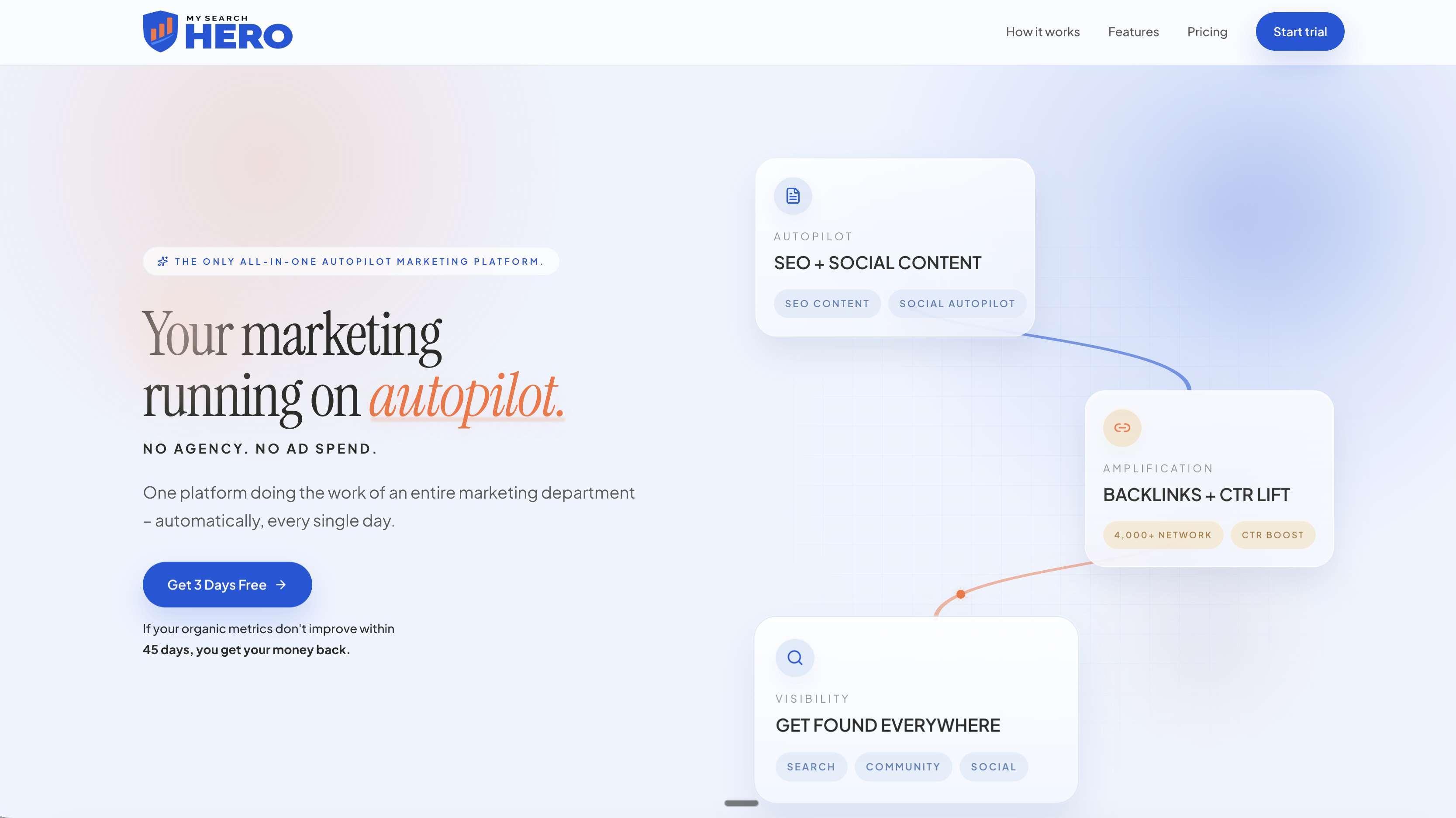
MySearchHero is a done-for-you SEO and content marketing service for local and service-based businesses. Each month the subscription delivers AI-generated SEO articles published to your website, authority backlinks through a publisher network, Reddit brand mentions in relevant conversations, and AI-generated social posts across platforms, with CTR signal boosting and reporting included.
Plans are billed monthly or yearly:
| Plan | Monthly | Yearly |
|---|---|---|
| Spark | $197 | $1,970 |
| Authority | $297 | $2,970 |
| Hero | $397 | $3,970 |
| Enterprise | $2,997 | n/a |
The Hero plan combines SEO, backlinks, CTR boosting, Reddit presence and social posting for $397 per month, and it comes with a 45-day money-back guarantee if organic metrics do not improve. For your ROI sheet, that is one cost line of $397 a month, or $1,191 a quarter, set against the booked jobs it produces. See the plans and start with the free trial.
The reporting is what feeds the review habit above: you compare what you paid against what came in, and keep the channels that earn their place.
Perspective
Most small business owners we talk about measure marketing in the wrong currency. They watch impressions, then wonder why the phone is quiet. The number that matters is booked jobs, and the cost that matters is one you can predict.
That is why we built MySearchHero as a single bundle. Articles, backlinks, Reddit mentions and social posts go out every month through one automated pipeline, so your cost is a flat subscription and your results land in one report. Visibility that builds daily, without ad spend or agency retainers, is simply easier to hold to an ROI standard.
Our advice: pick your gross margin, set your break-even cost per lead, tag your sources, and review monthly. Then let consistent publishing and link building do the compounding.
Mike
FAQ
What is a good ROI for marketing a local business?
It depends on your margin and how often customers come back. Many owners aim for a lifetime value of about three times acquisition cost, a common rule of thumb, and repeat-business models can accept a lower first-job return. Calculate your own break-even cost per lead first, then set a target above it.
What is a local marketing strategy?
It is a plan to reach customers in your service area through the channels they use to find you: Google search and maps, your website, reviews, community mentions and social posts. Measuring ROI turns the plan into a feedback loop, because you keep what produces booked jobs and cut what does not. Our local business marketing tips cover the main channels.
How long before SEO shows a return?
Organic work builds over time, so expect to judge it across several months rather than a few weeks. Track calls, form fills and rankings monthly and compare them to your pre-launch baseline. Our visibility playbook gives a typical range for early local gains.
Should I count my own time in the calculation?
Yes. Value your hours at a fair hourly rate and add them to total cost. It stops channels that eat your evenings from looking free, and it shows the real saving when a done-for-you service takes the work off your plate.
Sources
- How to Measure Marketing ROI, Constant Contact
- URL builders: Collect campaign data with custom URLs, Google Analytics Help
- Paid Acquisition Lead Benchmark: CPL and CAC by Industry