
TL;DR:
- Optimizing your Google Business Profile is the most important step for local SEO success and visibility.
- Maintaining consistent NAP data, fast websites, and high-quality local content improves search rankings and trust.
An SEO best practices list is the defined set of actions local businesses must take to rank higher in Google’s map pack, organic results, and AI-driven answer surfaces. Search engine optimization (SEO) for local businesses is not a single tactic. It is a layered system built on Google Business Profile (GBP) signals, LocalBusiness schema markup, consistent name/address/phone (NAP) data, and content quality. Get these right, and you compete. Miss them, and you hand customers to the business next door. This guide covers every high-leverage action you need, in order of impact.

1. The SEO best practices list every local business needs
The highest-return item on any local SEO checklist is your Google Business Profile. It feeds the map pack, powers AI Overviews, and is the first thing a potential customer sees before they ever visit your website. Every other practice in this list builds on top of a well-maintained GBP.
Focusing on AI signals in your GBP and website structured data is the fastest path to gaining local pack visibility right now. That means treating your profile as a living document, not a one-time setup task.
2. How to optimize your Google Business Profile for SEO success
Your GBP is the single most powerful local SEO asset you control directly. Claim and verify it first. Then choose one precise primary category and add every relevant secondary category your business qualifies for. Businesses that skip category updates risk losing visibility in filtered map searches and AI summary results.
Reviews are the next lever. Review velocity and recency influence map-pack positions more strongly than total review count. Aim for 2–5 new reviews per week and respond to every one of them. Your responses signal activity to Google and give you a natural place to include service-related keywords.
The Q&A section of your GBP is massively underused. Adding specific service questions to your own Q&A section improves your chances of appearing in AI Overview citations. Write questions your customers actually ask, then answer them in 2–3 sentences with your service name and city included.
- Claim and verify your GBP before anything else
- Select one precise primary category and all relevant secondary categories
- Respond to every review within 48 hours using natural service language
- Populate the Q&A section with 5–10 real customer questions
- Rewrite your business description to answer common search queries directly
- Update attributes (accessibility, payment methods, service options) to match your actual offerings
Pro Tip: Write your GBP business description as if answering the question “What does this business do and who does it serve?” Include your city, your main service, and one specific benefit. That structure aligns with how AI Overviews pull summary content.
3. Website factors: building fast, mobile-friendly, and well-structured pages
Your website must do two jobs: rank and convert. Slow or thin websites cause high bounce rates and reduced rankings even when your GBP is strong. Page load time under 3 seconds and a mobile-first layout are non-negotiable ranking requirements.
Create a dedicated page for each service and each city you serve. These pages must contain unique, localized content. Generic copy pasted across multiple city pages is a doorway page pattern that Google penalizes. Each page should answer the specific questions a customer in that location would ask.
LocalBusiness schema markup is mandatory for local businesses that want AI-driven search engines to accurately represent their details. Without it, Google guesses your business data, which leads to inaccuracies and lower trust signals. Implement schema with your exact NAP, hours, services, and service area.
| Page element | Minimum standard |
|---|---|
| Page load speed | Under 3 seconds on mobile |
| Word count per page | 500–800 words of unique content |
| Schema markup | LocalBusiness and FAQ schema aligned with GBP |
| Internal links | 3–5 per page to related services or blog content |
| Mobile design | Responsive layout, no horizontal scrolling |
- Use FAQ schema on service pages to increase eligibility for AI answer boxes
- Write at least 500 words per service page focused on customer questions
- Avoid copying content between city pages; localize each one with unique details
- Include a clear call to action (phone number, contact form, booking link) on every page
4. Ensuring NAP consistency and authoritative local citations
NAP consistency means your business name, address, and phone number appear identically everywhere online. Even minor discrepancies reduce search engine confidence and can remove your business from AI-generated citations. A period after “St” versus “St.” or “Suite” versus “Ste” is enough to create a mismatch.
Run a citation audit across your GBP, website footer, Yelp, Facebook, Apple Maps, and any industry directories. Fix every discrepancy before you build new citations. Adding more listings on top of inconsistent data amplifies the problem.
Quality beats quantity when it comes to citations. A listing in your local chamber of commerce directory, a mention in a regional news article, or a sponsorship link from a local nonprofit carries far more weight than 50 generic directory submissions.
- Audit your NAP across GBP, website, Yelp, Facebook, and Apple Maps
- Fix all discrepancies before adding new listings
- Prioritize authoritative local sources: chambers, local press, industry associations
- Build genuine local links through sponsorships, events, and community partnerships
- Remove or claim duplicate listings that show outdated information
Pro Tip: Copy your exact business name, address, and phone number into a plain text document and use it as your master reference every time you create or update a listing. One source of truth prevents drift.
5. Content quality and internal linking strategies that enhance SEO value
Thin content is one of the most common and most damaging mistakes local business websites make. Pages with fewer than 300 words hurt rankings and increase bounce rates, which signals to Google that the page did not satisfy the searcher. Expanding those pages to 500–800 words focused on real customer questions fixes both problems at once.
Original content tailored to your local audience builds topical authority over time. A plumber in Austin writing about common pipe issues in older Austin homes ranks better than one publishing generic plumbing tips. Specificity is what separates local content from national filler. For a deeper look at how content depth drives rankings, the role of content in SEO is worth understanding before you write another word.
Internal linking with descriptive anchor text helps search engines understand your site’s structure and topical relationships. Use 3–5 internal links per important page and connect your service pages to relevant blog posts and vice versa. This distributes ranking power across your site rather than concentrating it on one page.
- Write at least 500 words per service page, focused on what customers actually ask
- Link each service page to 2–3 related blog posts using descriptive anchor text
- Link blog posts back to the most relevant service page
- Add descriptive alt text to every image using natural, keyword-relevant language
- Avoid duplicate content across pages; each URL must offer something unique
6. Technical SEO essentials for local websites
Technical SEO is the foundation that makes everything else work. Google requires full access to your CSS, JavaScript, and images to render and evaluate your pages correctly. Blocking these resources in your robots.txt file leads to improper indexing and ranking loss.
Every page on your site should return an HTTP 200 status code. Broken links, redirect chains, and 404 errors waste crawl budget and frustrate users. Run a site crawl monthly using any standard crawl tool to catch and fix these issues before they compound.
Duplicate meta descriptions and multiple H1 tags on a single page are common technical errors on local business sites built with page builders. Each page needs one unique H1, one unique meta description, and a URL structure that reflects the page’s topic clearly.
| Technical factor | What to check |
|---|---|
| Crawl access | No CSS, JS, or images blocked in robots.txt |
| Page status | All pages return HTTP 200, no broken links |
| H1 tags | One unique H1 per page |
| Meta descriptions | Unique per page, 150–160 characters |
| Schema alignment | LocalBusiness schema matches GBP data exactly |
| URL structure | Short, descriptive, no duplicate location pages |
Align your LocalBusiness schema data with your GBP data exactly. If your GBP lists your hours as 9 AM to 5 PM Monday through Friday, your schema must say the same. Mismatches confuse AI systems and reduce the trust score your business earns across both surfaces. For a full walkthrough of what moves local rankings, the local SEO checklist from Mysearchhero covers each step in detail.
Understanding Google Maps ranking factors also helps you prioritize which technical and profile signals to fix first, especially when you have limited time.
Key takeaways
The most effective local SEO approach in 2026 combines a fully optimized Google Business Profile, fast and well-structured website pages, consistent NAP data, quality content, and clean technical fundamentals.
| Point | Details |
|---|---|
| GBP is the top priority | Claim, verify, and actively maintain your Google Business Profile with categories, reviews, and Q&A. |
| Review velocity beats review count | Aim for 2–5 new reviews per week and respond to each one to signal activity. |
| LocalBusiness schema is mandatory | Implement schema with exact NAP, hours, and services to earn AI citation trust. |
| NAP consistency prevents ranking loss | Fix every discrepancy across all platforms before adding new directory listings. |
| Thin content hurts rankings | Expand pages to 500–800 words focused on real customer questions and clear calls to action. |
What I’ve learned working with local businesses on SEO
Most local business owners I work with start in the same place: a GBP that was set up years ago and never touched again. That single issue accounts for more lost visibility than almost anything else. Fixing it takes less than two hours and produces results within weeks.
The second pattern I see constantly is NAP inconsistency. A business moves, updates Google, and forgets about Yelp, Apple Maps, and the local chamber directory. AI systems now cross-reference these sources. When they find conflicts, they reduce confidence in your listing. That costs you citations you should be winning.
Review velocity surprises most owners. They assume a 4.8-star rating with 200 reviews is enough. It is not. A competitor with 80 reviews and 4 new ones this week often outranks them. Recency signals current activity, and Google rewards businesses that look open and engaged.
The owners who see the fastest results treat SEO as a weekly habit, not a one-time project. They ask for reviews after every job, update their GBP Q&A monthly, and publish one localized blog post every few weeks. That consistency compounds. The businesses that treat SEO as a setup task plateau quickly and wonder why their rankings stall.
— Mike
How Mysearchhero helps local businesses grow through search
Local SEO has a lot of moving parts. Mysearchhero handles them for you through a fully automated monthly pipeline that covers published articles, backlinks, and social content, all built around the top SEO strategies that move local rankings.
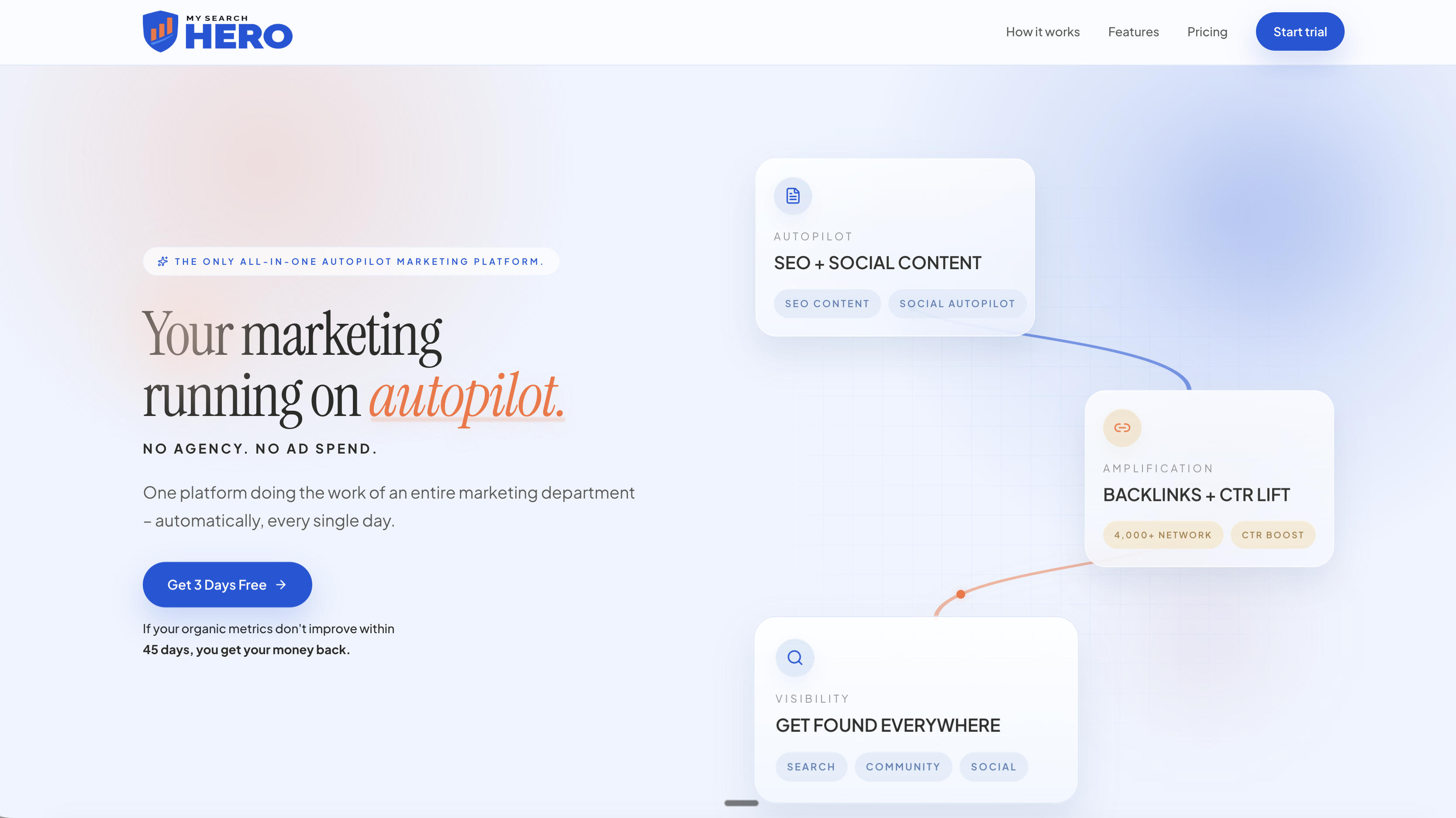
Every month, your business gets fresh content, citation-building activity, and structured link placements without you managing a single deadline. Mysearchhero’s done-for-you model is built specifically for local business owners who want consistent search growth without hiring an in-house team. If you want your marketing running on autopilot while you focus on serving customers, Mysearchhero is built for exactly that.
FAQ
What is the most important item on a local SEO checklist?
Claiming and fully optimizing your Google Business Profile is the single highest-leverage action for local search visibility. It directly influences map pack rankings and AI Overview citations.
How often should I ask customers for reviews?
Ask after every completed job or service interaction. Maintaining 2–5 new reviews per week signals current activity to Google and improves map pack rankings more than total review count.
Does NAP consistency really affect rankings?
Yes. Even minor differences in your business name, address, or phone number across platforms reduce search engine trust and can remove your business from AI-generated local citations.
What is LocalBusiness schema and do I need it?
LocalBusiness schema is structured data code added to your website that gives search engines machine-readable details about your business. Without it, Google guesses your information, which leads to inaccuracies and lower trust scores.
How long should my local service pages be?
Each service page should contain at least 500–800 words of unique, localized content focused on customer questions. Pages under 300 words hurt rankings and increase bounce rates.