
TL;DR:
- A local SEO checklist prioritizes actions such as Google Business Profile optimization, citation consistency, and review acquisition to improve local rankings. Consistent effort through ongoing updates, content creation, and on-page SEO supports sustained visibility and rankings over time. Regular quarterly audits ensure that all local SEO elements remain accurate and effective.
A local SEO checklist is a prioritized set of actions that local businesses must complete to appear in Google’s local pack and attract nearby customers. The industry term for this discipline is local search optimization, and it covers everything from Google Business Profile setup to on-page SEO fundamentals. GBP optimization produces the fastest local pack lift, while citation management and content strategies compound results over 60–180 days. This guide breaks the full process into 12 concrete steps, ordered by impact, so you know exactly where to start.

1. What belongs on a high-impact local SEO checklist first?
The first priority on any local SEO checklist is your Google Business Profile (GBP). GBP is the primary ranking factor for local pack placement. That means an incomplete or inaccurate profile directly costs you visibility before a single customer ever sees your website.
Complete every field: business name, address, phone number, website, hours, service areas, and business attributes. Select the most specific primary category available. A plumber should choose “Plumber,” not “Contractor.” Add secondary categories only when they accurately describe additional services you offer.
Pro Tip: Add your service area at the neighborhood level, not just the city. Google uses this data to match your profile to hyper-local searches like “roof repair near Bucktown.”
2. Build NAP consistency across every directory
NAP stands for Name, Address, and Phone number. Consistent NAP across directories like Yelp, Facebook, and Apple Maps signals to Google that your business is legitimate and accurately located. Any mismatch, even a suite number formatted differently, weakens that signal.
Audit your existing citations before adding new ones. Search your business name plus city and check every listing that appears. Fix discrepancies one by one. Then build out new citations on the top 20–30 general directories and any niche directories relevant to your industry.
3. Reach 50+ Google reviews with recent activity
Review volume and recency both influence local rankings. Achieving over 50 Google reviews is a Tier 1 milestone that produces a measurable lift in local pack placement. A business with 12 reviews from three years ago ranks below a competitor with 60 reviews from the past six months.
Build a simple review request process. Send a follow-up text or email to every customer within 24 hours of service. Include a direct link to your Google review page. Respond to every review, positive or negative, within 48 hours. This response habit signals active management to both Google and prospective customers.
Pro Tip: Getting reviews on multiple platforms beyond Google, including Yelp and Facebook, strengthens your overall local authority and reduces dependence on a single platform.
4. Upload 30+ photos and keep adding more
Photo quantity and freshness are direct engagement signals. A profile with 30 or more photos consistently outperforms profiles with fewer images. Adding 5–10 new photos monthly keeps your profile active and tells Google your business is current.
Upload photos across multiple categories: exterior shots, interior shots, team photos, work-in-progress images, and completed project photos. For restaurants, food photos drive the most clicks. For service businesses, before-and-after shots build trust faster than any written description.
5. Write accurate service and product descriptions
Your GBP services section is indexed by Google. Write a clear description for each service you offer. Include the service name, what it involves, and where you provide it. Pricing is optional but adds trust, especially for fixed-cost services like oil changes or haircuts.
Avoid generic descriptions copied from your website. Write each GBP service description as a standalone answer to the question a customer would type into Google. “Emergency furnace repair in Chicago, available 24/7” outperforms “HVAC services” every time.
6. Create dedicated service-area landing pages
Service-area pages are standalone pages on your website targeting specific geographic markets. Pages of 600–1,200 words with authentic local detail outperform simple city-name swaps. Google’s E-E-A-T framework rewards content that demonstrates real experience in a specific place.
Build 3–10 of these pages depending on your coverage area. Each page should reference local landmarks, neighborhoods, and project examples specific to that area. A landscaping company serving the north suburbs of Chicago should mention Evanston, Wilmette, and Skokie by name, with photos from jobs in those towns.
| Page element | What to include |
|---|---|
| Local landmarks | Nearby streets, parks, or neighborhoods |
| Project examples | Real jobs completed in that specific area |
| Service details | Full description of what you offer there |
| Customer reviews | Quotes from clients in that location |
| Schema markup | LocalBusiness and Service schema for that page |
Pro Tip: Interview a customer from each target area and use their words in the page copy. Real quotes from real locations are the fastest way to build E-E-A-T on a service-area page.
7. Populate your GBP Q&A section
The Google Business Profile Q&A section is one of the most neglected trust signals in local SEO. Posting 10–20 owner-answered questions to your own Q&A section gives you control over the information customers see. Left empty, anyone can post questions, and they often go unanswered for months.
Write questions your customers actually ask. “Do you offer free estimates?” “Are you licensed and insured?” “Do you serve the Oak Park area?” Answer each one clearly and completely. These answers appear directly in search results and reduce friction for customers deciding whether to call.
8. Post weekly updates on Google Business Profile
Weekly GBP posts with photos, headlines, and a clear call to action increase engagement and send fresh content signals to Google. Think of GBP posts like a social media feed that lives directly in search results. Businesses that post consistently rank above businesses that do not.
Each post should include one image, a headline under 58 characters, two to three sentences of body text, and a button linking to your website or booking page. Rotate through post types: promotions, new services, seasonal tips, and project spotlights. Batch-create four posts at a time to stay consistent without spending hours each week.
9. Run a monthly citation audit
Citations decay over time. Businesses move, change phone numbers, or rebrand, and old listings persist across dozens of directories. A monthly citation audit catches these discrepancies before they compound. Check your top 10 citation sources every month and your full citation profile every quarter.
Beyond fixing errors, add new citations each month. Target industry-specific directories first. A dentist should be listed on Healthgrades and Zocdoc. A contractor should appear on Houzz and Angi. These niche citations carry more relevance weight than a generic directory listing.
10. Apply on-page SEO fundamentals to every local page
On-page SEO is the practice of optimizing individual web pages to rank for specific search queries. Keyword research, URL structure, meta tags, heading hierarchy, and schema markup all influence how Google interprets and ranks your local pages. Skipping these fundamentals means your service-area pages will underperform regardless of how well-written they are.
For each local page, follow this website optimization checklist:
- Write a title tag of 50–60 characters that includes the service and city name
- Write a meta description of 145–155 characters that includes a local keyword and a clear benefit
- Use one H1 that matches the page’s primary search intent
- Add LocalBusiness schema and FAQPage schema where applicable
- Confirm the page loads in under three seconds on mobile
Pro Tip: Use Google Search Console to find which local queries already bring traffic to your site. Those are your highest-priority pages for on-page optimization.
11. Prioritize mobile speed and Core Web Vitals
Mobile SEO is not optional for local businesses. Most local searches happen on a phone, often while someone is standing outside a business or driving to one. A page that loads slowly on mobile loses that customer to a faster competitor.
Core Web Vitals, Google’s set of page experience metrics, directly affect local rankings. The three metrics to watch are Largest Contentful Paint (LCP), Interaction to Next Paint (INP), and Cumulative Layout Shift (CLS). Use Google PageSpeed Insights to check your scores and follow its specific recommendations. Compressing images and removing unused JavaScript resolve the majority of mobile speed issues.
12. Treat local SEO as a quarterly recurring process
Local SEO requires a quarterly routine, not a one-time setup. Tier 1 tasks like GBP optimization and NAP cleanup create immediate impact. Tier 2 tasks like weekly posts, monthly photo uploads, and ongoing review acquisition compound that impact over 60–180 days. Businesses that treat local SEO as a project they finish once lose ground to competitors who treat it as an ongoing practice.
Schedule a quarterly audit that covers your GBP completeness, citation accuracy, review count and recency, service-area page freshness, and Core Web Vitals scores. This local marketing guide covers the full quarterly review process in detail.
Key Takeaways
A complete local SEO checklist combines GBP optimization, NAP consistency, review acquisition, service-area content, and on-page SEO into a tiered quarterly routine that compounds results over time.
| Point | Details |
|---|---|
| GBP is the top priority | Complete every GBP field and reach 50+ reviews for immediate local pack lift. |
| NAP consistency matters | Fix citation mismatches across all directories before building new ones. |
| Service-area pages need depth | Write 600–1,200 words of authentic local content per page, not city-name swaps. |
| Ongoing activity compounds | Weekly posts and monthly photos signal freshness and drive sustained ranking gains. |
| On-page SEO supports local rankings | Optimize title tags, meta descriptions, schema, and mobile speed on every local page. |
Why most local SEO efforts stall after the first month
I’ve seen this pattern repeat across dozens of local businesses. The owner sets up their Google Business Profile, fixes a few citations, and then stops. Six weeks later, they wonder why rankings haven’t moved. The answer is almost always the same: they completed Tier 1 but never started Tier 2.
The GBP Q&A section is the clearest example. Neglecting GBP Q&A and photo refreshes are two of the most common reasons local profiles stall. These tasks take 20 minutes a month. Yet most business owners skip them because they feel minor. They are not minor. They are the difference between a profile that looks active and one that looks abandoned.
My honest recommendation: block two hours per quarter to run through the full checklist. Do not try to do everything at once. Prioritize the items with the highest impact, complete them, and then move to the next tier. Local SEO rewards consistency far more than it rewards effort concentrated in a single sprint. The businesses I’ve seen rank in the top three local pack positions are not doing anything exotic. They are doing the basics, repeatedly, without stopping.
— Mike
Mysearchhero handles your local SEO on autopilot
Running a local business leaves little time for weekly GBP posts, citation audits, and service-area page updates.
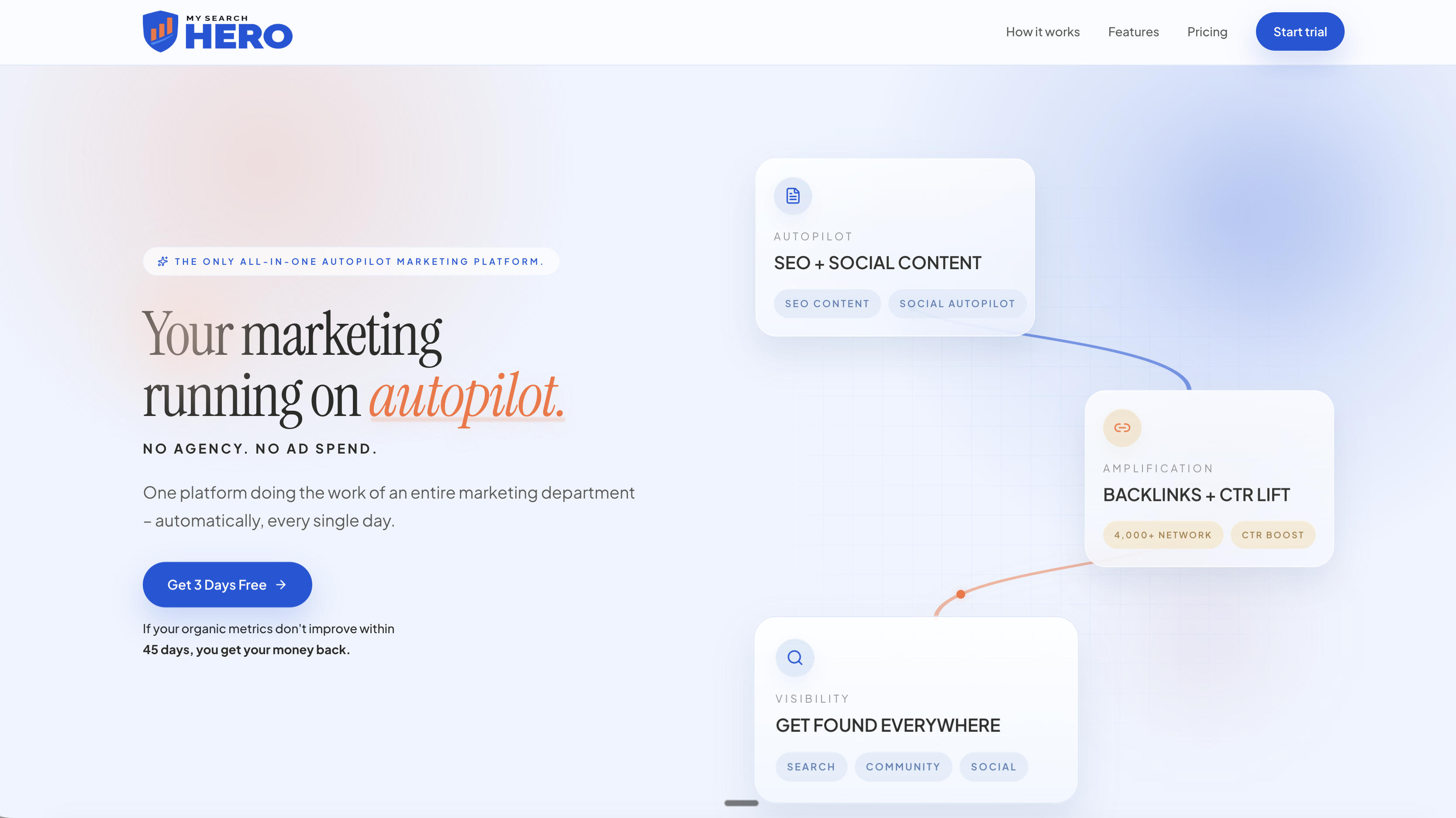
Mysearchhero is a done-for-you SEO and content marketing service built for exactly this situation. Each month, subscribers receive published articles, backlinks, and social media posts pushed out through a fully automated pipeline. For local businesses, that means your local SEO services keep running whether you have time to manage them or not. If you want your Google Business Profile optimized and your content calendar filled without lifting a finger, Mysearchhero delivers that. Check out these local business marketing tips to see what a full local SEO program looks like in practice.
FAQ
What is the most important item on a local SEO checklist?
Google Business Profile optimization is the single highest-impact item. A complete, accurate GBP with 50+ reviews produces the fastest local pack ranking improvement.
How long does local SEO take to show results?
Tier 1 tasks like GBP setup and NAP cleanup show results within weeks. Tier 2 ongoing tasks like weekly posts and review acquisition compound results over 60–180 days.
How many service-area pages should a local business have?
Build 3–10 dedicated service-area pages depending on your coverage area. Each page needs 600–1,200 words of authentic, location-specific content to rank effectively.
What is on-page SEO and why does it matter for local businesses?
On-page SEO is the practice of optimizing individual web pages for specific search queries through title tags, meta descriptions, headings, and schema markup. These elements help Google understand your local relevance and rank your pages accordingly.
How often should you update your Google Business Profile?
Post weekly updates with photos and a call to action. Add 5–10 new photos monthly. Review and update your business information, hours, and services every quarter.