
An SEO blog writer is a professional who writes blog posts designed to rank for target keywords while converting readers into leads or customers. Their core deliverables range from a 1,500-word how-to post optimized for a single keyword cluster to a full topic cluster: one pillar article plus four to six supporting posts that build topical authority across a subject. If you’re deciding whether to hire one, your first decision isn’t “who” — it’s “which model”: freelance, full-time, agency, or a done-for-you SaaS. Each fits a different volume and budget profile, and getting that choice right matters more than any individual hire.
Table of Contents
- What does an SEO blog writer actually do?
- What does a typical day look like for an SEO blog writer?
- What skills and tools should you look for?
- Which hiring model fits your situation?
- What does SEO blog writing cost in the U.S.?
- How to write a job post, run a test, and screen candidates
- How do you measure an SEO blog writer’s performance?
- When does a hybrid model outperform a single approach?
- Key Takeaways
- The part most hiring guides skip
- Steady content without the management overhead
- Useful sources and further reading
- FAQ
What does an SEO blog writer actually do?
The title “SEO blog writer” is informal shorthand for what the industry more precisely calls an SEO content writer or SEO content creator. The distinction matters because the role goes well beyond writing. A competent SEO content writer handles keyword research and intent mapping, content structure, on-page optimization, and basic performance tracking. Writing is the visible output; the research and optimization work underneath it is what actually drives rankings.
Typical deliverables include:
- Optimized blog posts (usually 1,200–2,000 words) targeting a primary keyword and two to four secondary terms
- Content outlines with proposed H2/H3 structure, target keywords per section, and word-count guidance
- Meta titles and descriptions written to maximize click-through rate from search results
- Internal link recommendations pointing to relevant existing pages on the site
- Content briefs summarizing the target audience, search intent, competitor gaps, and key points to cover
The format varies by goal. A pillar article covers a broad topic comprehensively (think “complete guide to X”) and earns links. A how-to post targets a specific transactional or informational query and drives conversions. A short FAQ post captures featured-snippet real estate for quick-answer queries. Knowing which format to deploy for which goal is part of what separates a skilled SEO content writer from someone who just writes blog posts.
In the U.S., these writers work across all three contexts: freelance (the most common), in-house at brands and agencies, and as part of content marketing agencies. Blogging for business remains one of the highest-ROI organic channels, which is why demand for writers who understand SEO has stayed strong.
What does a typical day look like for an SEO blog writer?
The workflow from brief to published post follows a consistent pattern for experienced writers, even if the tools vary.
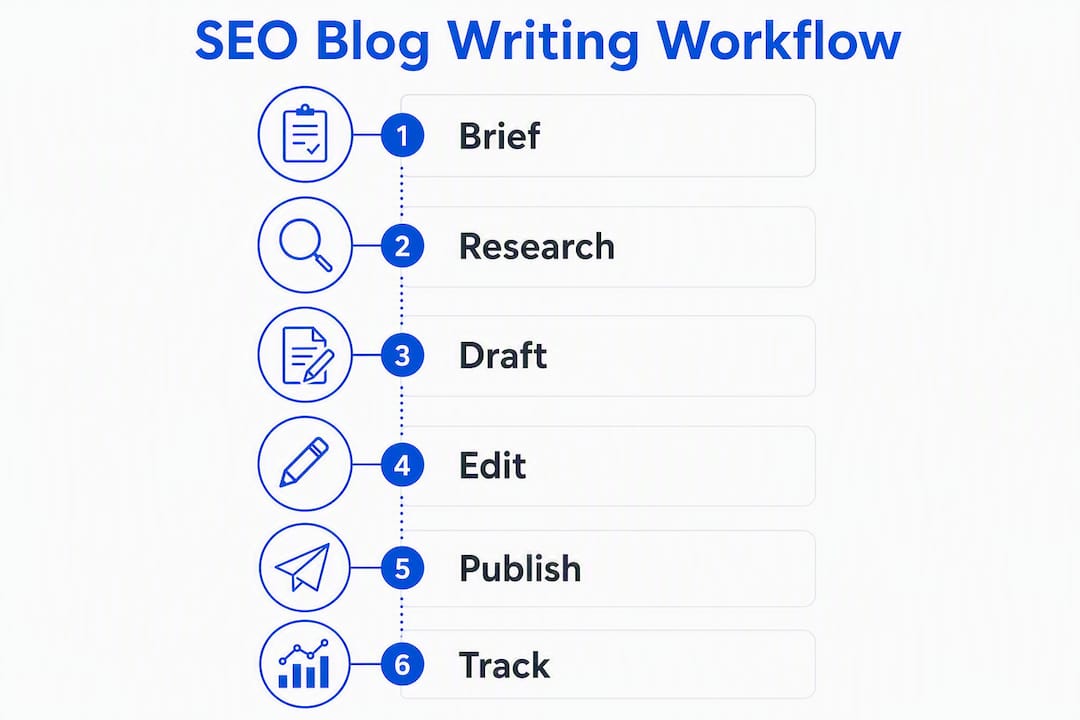
It starts with the brief. A good writer either receives a detailed brief from an SEO strategist or builds one themselves: target keyword, search intent, audience, word count, and a short competitor analysis. From there, they map the keyword to related terms using a tool like Ahrefs, Semrush, or Google’s own “People Also Ask” data, then build an outline that mirrors the structure of top-ranking pages while identifying gaps those pages miss.
The draft comes next. A skilled SEO content creator writes for the reader first, search engine second: clear headers, short paragraphs, a logical argument, and a call to action that fits the page’s conversion goal. On-page optimization follows: keyword placement in the title tag, H1, first 100 words, and at least one H2; image alt text; internal links; and a meta description under 160 characters.

What the writer typically does not own: schema markup, site speed fixes, canonical tags, or technical redirects. Those belong to a developer or SEO technician. The handoff format clients should expect is a Google Doc draft with a separate meta sheet, or a CMS-ready upload if the writer has WordPress access.
Signs of a mature workflow: the writer uses a documented brief template, tracks articles in a content calendar, and specifies revision limits upfront (usually one to two rounds).
Pro Tip: Ask any candidate to walk you through their last three published pieces from brief to live URL. A writer who can’t explain their own process in concrete steps probably doesn’t have one.
What skills and tools should you look for?
Vetting an SEO blog writer means checking five skill categories, not just reading samples.
Core skills to assess:
- Keyword research and intent mapping: Can they distinguish navigational, informational, and transactional intent? Do they know how to find secondary keywords and cluster them?
- Structure for scanning: Do their drafts use H2/H3 hierarchy logically? Are paragraphs short enough to read on mobile?
- SEO technical fluency: Do they understand title tag length limits, meta description best practices, and basic internal linking strategy?
- Analytics literacy: Can they read Google Search Console data to identify which posts need updates and why?
- Persuasive writing: Does the copy move the reader toward a next step, or does it just inform?
Tools a competent writer will know:
- Google Search Console and GA4 for performance tracking
- Ahrefs, Semrush, or Moz for keyword research
- WordPress or a comparable CMS for publishing
- A grammar and readability tool like Grammarly or Hemingway Editor
Pro Tip: Request two portfolio samples: one that ranks on page one for its target keyword (with a live URL you can verify in Search Console or a rank-checker), and one that drove measurable conversions. Writers who can show both are rare and worth paying for.
Portfolio evidence worth requesting: live URLs with visible traffic data (a screenshot from Search Console is fine), before-and-after optimization results if they’ve done content refreshes, and at least one sample from an industry adjacent to yours. Storytelling that converts is a skill distinct from SEO fluency; the best writers combine both.
SEO writing commands a market premium when the output includes demonstrable expertise, original research, or hands-on testing that AI alone cannot replicate. That’s the E-E-A-T argument in practical terms: if your content looks like everyone else’s, it ranks like everyone else’s.
Which hiring model fits your situation?
The four options each carry different trade-offs on cost, control, speed, and scalability.
| Model | Best for | Cost range | Control | Scalability |
|---|---|---|---|---|
| Freelance writer | Variable volume, specific topics | $75–$300+ per article | High | Limited by one person’s capacity |
| Full-time hire | High volume, consistent brand voice | a salary range typical for full-time SEO writer roles | Highest | Capped at one FTE |
| Content agency | Managed production, multiple formats | $150–$500+ per article | Medium | High |
| Done-for-you SaaS | Steady low-management monthly content | Subscription-based | Lower | High, automated |
Decision criteria to apply before choosing:
- Volume: Under four posts per month, a freelancer is usually the most cost-effective. Over eight, an agency or SaaS model starts to make more sense.
- Stakes per piece: A flagship case study or product comparison page warrants a senior human writer. A high-volume informational post doesn’t.
- Editorial management capacity: If you don’t have someone to brief, review, and manage a writer, a done-for-you model removes that overhead entirely.
- Budget predictability: Freelancers invoice variably; SaaS subscriptions are fixed. For small businesses with tight cash flow, predictability often wins.
A local service business needing four to eight posts per month with no in-house editor is the clearest case for a done-for-you SaaS. A funded startup building a content moat around a competitive keyword set probably needs a full-time senior writer plus a strategist.
Red flags for the wrong model: hiring a full-time writer when you only need two posts per month (you’ll pay for idle time); relying entirely on AI-generated content without a human editorial pass (quality degrades fast and Google’s systems notice); choosing an agency without confirming they assign a dedicated writer to your account rather than rotating generalists.
What does SEO blog writing cost in the U.S.?
Rates vary more than most job posts suggest. Here’s a realistic breakdown of the U.S. market.
| Tier | Per-article rate | Typical turnaround | Notes |
|---|---|---|---|
| Entry-level freelancer | $50–$100 | 5–7 business days | Limited SEO fluency; needs heavy editing |
| Mid-level freelancer | $100–$250 | 3–5 business days | Solid keyword research; some portfolio proof |
| Senior freelancer | $250–$500+ | 3–5 business days | Ranked samples, analytics literacy, niche expertise |
| Agency | $300–$800+ | 5–7 business days | Managed process; includes strategy and editing |
| Full-time hire (annual) | $56K–$72K+ | Ongoing | PayScale reports an average salary reported for content writers with SEO skills; Salary.com shows $69,000–$72,000 for SEO-specific roles |
A human writer typically delivers a polished first draft in 3–7 business days; AI tools produce raw drafts in minutes but require substantially more editing time to reach publish quality. That editing overhead is real and often underestimated when businesses calculate AI-only content costs.
Factors that push rates higher:
- Original research or data collection (surveys, interviews)
- Technical or regulated industries (healthcare, finance, legal)
- Localization for specific U.S. markets or regions
- Content refreshes requiring a full audit before rewriting
Senior-level and sector-specific roles in industries like pharma and finance pay materially above the averages above. Budget accordingly if your content requires demonstrated subject-matter expertise.
How to write a job post, run a test, and screen candidates
Sample job post framework
Role: SEO Blog Writer (Freelance / Contract)
Deliverables: Two to four optimized blog posts per month (1,200–2,000 words each), content outlines, meta titles and descriptions, and internal link recommendations.
Required experience: Two or more years writing SEO content with live ranked samples; proficiency with at least one keyword research tool; familiarity with WordPress or similar CMS.
Compensation: Per-article rate ($150–$350 depending on experience) or monthly retainer.
Application requirement: Submit two live URLs with visible rankings or traffic data, plus a 200-word note on your research process.
Test assignment template
Assign a real (not hypothetical) brief: a 600-word blog post targeting a specific keyword relevant to your business. Grade it on five criteria:
- Keyword intent match: does the post answer what the searcher actually wants?
- Topical coverage: does it hit the key subtopics a top-ranking page would cover?
- Structure: logical H2/H3 hierarchy, short paragraphs, scannable format?
- On-page basics: keyword in title, H1, first paragraph, and at least one H2?
- Accuracy: fact-check two to three specific claims against primary sources.
Top interview questions to ask
- Walk me through how you research a topic before writing. What’s your first step?
- How do you determine the right word count for a post?
- Show me a piece that ranks. What did you do to get it there?
- How do you handle a brief where the keyword has unclear or mixed intent?
- What’s your process for updating an existing post that’s lost rankings?
- Which keyword research tools do you use, and why?
- How do you balance AI writing tools with your own editing? What’s your workflow?
- Have you ever pushed back on a brief? What was the situation?
A strong candidate’s research process looks like: SERP review, competitor gap analysis, primary-source verification, and expert outreach where applicable. That’s the standard to hold them to.
Red flags in portfolios or interviews:
- No live ranked samples (only PDFs or Google Docs with no verifiable URL)
- Can’t explain their keyword research process beyond “I use Google”
- Claims AI writes everything and they just “clean it up”
- No awareness of search intent differences between query types
- Revision policy is “unlimited” with no scope definition
How do you measure an SEO blog writer’s performance?
Set KPIs before the first post goes live, not after. Without a baseline, you can’t prove ROI.
Primary KPIs to track:
- Organic sessions to posts the writer produced (Google Analytics / GA4)
- Keyword rankings for target terms (Search Console or a rank tracker)
- Organic conversion rate from blog traffic (goal completions in GA4)
- Pages that earned backlinks (Search Console “Links” report)
- Click-through rate from search results (Search Console “Performance” tab)
Secondary metrics worth monitoring:
- Average engagement time per post (replaces bounce rate in GA4)
- Internal link click-through from blog posts to money pages
- SEO metrics like domain authority changes over time
Recommended reporting rhythm:
- 30 days: confirm posts are indexed and crawled; check for any immediate ranking movement on low-competition terms
- 60 days: first meaningful ranking data; identify which posts are gaining impressions
- 90 days: full performance review; decide which posts need optimization passes and which are performing as expected
- Monthly: brief performance report from the writer or provider covering new rankings, traffic changes, and recommended updates
- Quarterly: strategy review to adjust keyword targets and content mix
A simple dashboard request for any candidate or provider: a shared Google Sheet or Data Studio report showing target keyword, current rank, monthly impressions, clicks, and CTR for each published post. If they can’t produce that, they’re not tracking performance.
A note on realistic timelines: SEO content rarely ranks in under 60 days for competitive terms. Set expectations with stakeholders accordingly, and use early indexing and impression data as the leading indicator, not page-one rankings.
When does a hybrid model outperform a single approach?
The most efficient content operations don’t choose between automation and human writers. They assign each type of content to the model that fits its stakes.
Automate high-volume, low-stakes informational posts: FAQ pages, location pages, product category descriptions, and evergreen how-to content where the information is stable and the competitive bar is low. Reserve human writers for flagship content: original research, product comparisons, case studies, and any piece where first-person experience or named expert input is part of the value proposition.
Implementation checklist for a hybrid model:
- Build a content taxonomy that classifies every planned post as “automated,” “human-assisted,” or “full human”
- Maintain a prompt library for automated content with brand voice, formatting, and keyword guidelines baked in
- Assign one human editor to review all automated output before publishing
- Run a QA pass on automated posts every six months to catch outdated information
- Reserve budget for human writers on any post targeting a high-value commercial keyword
Original research, case studies, and product comparisons generate E-E-A-T signals that commodity AI cannot replicate: named experts, first-person testing, and original data are the assets that earn links and rank for competitive terms. Those pieces justify the higher per-article cost.
On cost: hybrid blended per-article costs can run $50–$80 per post for automated-plus-edited content, versus $120 or more for fully human flagship pieces. Allocating budget by funnel stage (automated for top-of-funnel awareness, human for bottom-of-funnel conversion content) keeps total spend in check while protecting quality where it matters most.
Pro Tip: Use SEO automation tools to handle distribution, internal linking, and performance tracking even when the writing itself is human. The leverage is in the workflow, not just the content.
Key Takeaways
Hiring the right SEO blog writer comes down to matching the model to your volume and stakes, vetting for a documented research process, and setting measurable KPIs before the first post goes live.
| Point | Details |
|---|---|
| Match model to volume | Freelancers fit under four posts per month; SaaS or agency models suit higher-volume, low-management needs. |
| Require ranked samples | Ask for live URLs with verifiable traffic or ranking data — PDFs and Google Docs don’t prove SEO performance. |
| Set KPIs before day one | Track organic sessions, keyword rankings, and conversion rate from the first post, not after 90 days. |
| Use a hybrid content model | Automate informational posts at $50–$80 blended cost; reserve human writers for flagship content at $120 or more per article. |
| Mysearchhero for done-for-you content | Mysearchhero delivers monthly article bundles, backlinks, and social posts on autopilot for businesses that need steady content without managing a writer. |
The part most hiring guides skip
The conventional wisdom on hiring SEO blog writers focuses almost entirely on cost per article and keyword tool proficiency. Both matter, but neither predicts long-term ROI as reliably as the onboarding process does.
Most content hires underperform in the first 90 days not because the writer is bad, but because the business gave them no real context: no brand voice guide, no competitor positioning, no clarity on which pages actually convert. A skilled writer handed a vague brief will produce technically correct but strategically useless content. The brief is the leverage point.
What actually separates a good hire from a great one isn’t the portfolio. It’s whether the writer asks the right questions before writing a single word. Do they want to know your conversion goals? Do they ask which pages already rank and why? Do they push back when a keyword target doesn’t match the page’s actual purpose? Those questions signal a writer who thinks about outcomes, not just output.
For the first 90 days, treat onboarding as an investment: share your top five performing pages, your three biggest competitors, and your conversion data. A writer who can’t use that context to improve their work by day 60 probably won’t improve at all.
Steady content without the management overhead
Most businesses that need consistent SEO content don’t lack budget. They lack bandwidth. Managing a freelancer means briefing, reviewing, revising, and tracking performance every single month. Hiring full-time means recruiting, onboarding, and paying benefits for a role that may not need 40 hours a week.

Mysearchhero is built for exactly that gap. Each month, subscribers get a bundle of published SEO articles, authority backlinks, Reddit brand mentions, and social media posts, all pushed live through an automated pipeline with no editorial management required on your end. It’s the done-for-you model described in the decision framework above: fixed monthly cost, predictable output, and zero hiring overhead.
If you’re a local or service-based business that needs steady content and measurable organic growth without building an in-house content team, see how Mysearchhero works and start a trial to see the deliverables firsthand.
Useful sources and further reading
The sources below back the claims in this guide and are worth bookmarking if you’re building a content hiring process from scratch.
- What Is an SEO Content Writer: Role, Skills, and Day-to-Day — Studio4Motion’s breakdown of daily tasks and toolset expectations; best for understanding the role scope.
- SEO Writer Salary Data — Salary.com’s U.S. compensation data for SEO-specific writing roles; best for full-time hiring budgets.
- Content Writer with SEO Skills Salary — PayScale’s 2026 average for content writers with SEO skills; useful for benchmarking freelance rates.
- Write SEO Content That Ranks: A Practical Guide — Mysearchhero’s implementation guide; best for onboarding new hires and setting content standards.
- Why Track SEO Metrics — Mysearchhero’s KPI guide for small businesses; best for building your reporting dashboard.
- Types of SEO Strategies: A 2026 Guide — strategic context for where blog content fits in a broader SEO program.
- Multi-Link Strategy for Marketers — partner guide on link strategies and site architecture; useful for internal linking tactics.
FAQ
What is an SEO blog writer?
An SEO blog writer is a content specialist who writes blog posts optimized for target keywords, search intent, and on-page SEO signals, with the goal of ranking in search results and converting organic traffic into leads or customers.
How much does an SEO blog writer charge per article?
Rates in the U.S. range from lower rates typical for entry-level freelance SEO writers to higher rates typical for senior freelance SEO specialists or agencies; full-time hires average an amount typical for full-time SEO writer roles depending on experience and industry.
What’s the difference between a freelance SEO writer and a done-for-you service?
A freelance SEO writer requires briefing, review, and ongoing management from your team; a done-for-you service like Mysearchhero handles the full production and publishing pipeline, including articles, backlinks, and social posts, with no editorial management on your end.
How long does it take for SEO blog content to rank?
Human-written posts typically take 60–90 days to show meaningful ranking movement for competitive terms; low-competition keywords can surface in Search Console impressions within 30 days of indexing.
What KPIs should I use to measure an SEO blog writer’s performance?
Track organic sessions, keyword rankings for target terms, organic conversion rate, and click-through rate from search results; review these on a 30/60/90-day cadence using Google Search Console and GA4.