
A sponsored backlink is a link to your website that someone placed in exchange for payment or another form of compensation. Google asks the publisher to mark that link with rel=“sponsored” so its systems know money was involved. Used openly, sponsored links can bring real visitors and visibility. Used carelessly, with no tagging and no disclosure, they are the kind of link pattern Google’s spam systems are built to catch.
This guide explains what the attribute means, how it differs from nofollow and UGC, what to expect from sponsored links in search, and how a local or service business can handle them without risk.
TL;DR
- A sponsored backlink is a link from an advertisement, sponsorship or other paid arrangement, and Google recommends the rel=“sponsored” attribute for it.
- Google treats sponsored, nofollow and UGC as hints, not commands, so the tag does not tell you exactly how a link will be counted.
- Tagging a link for search engines is separate from telling readers about a paid relationship. Do both.
- Untagged paid links at scale can lead to algorithmic or manual action, so tag them or work with publishers who do.
- For a small business, the practical goal is relevant placements on real sites, not a pile of links.
Table of Contents
- What a sponsored backlink actually is
- Sponsored vs nofollow vs UGC vs an ordinary link
- Do sponsored links help SEO?
- Tagging and disclosure are two different jobs
- What goes wrong with untagged paid links
- How to evaluate a sponsored placement
- How local and service businesses should think about it
- Our view on sponsored backlinks
- Getting placements without managing them yourself
- Frequently asked questions
- Sources
What a sponsored backlink actually is
A backlink is a link from one site to a page on another site. It becomes a sponsored backlink when the placement is part of a deal: a paid article, a sponsorship, an ad placement or any compensation agreement.
Google’s outbound link documentation defines rel=“sponsored” as the value for advertisements and paid placements, the links most people call paid links. Google’s 2019 announcement describes the same idea more broadly: links created as part of advertisements, sponsorships or other compensation agreements.
The attribute lives in the link’s HTML. A tagged link looks like this in the page code:
<a href="https://example.com" rel="sponsored">anchor text</a>
The publisher adds it, not you. That matters, because you can only control your own outbound links and the terms you agree to when you buy or earn a placement.

Sponsored vs nofollow vs UGC vs an ordinary link
There are four things you will run into. They differ in what the link represents.
| Link type | What it represents | Typical rel value |
|---|---|---|
| Ordinary editorial link | A site linked to you on its own judgment | None |
| Sponsored link | Advertisement, sponsorship or paid placement | sponsored |
| UGC link | Link inside user-generated content such as comments or forum posts | ugc |
| Nofollow link | A link the publisher would rather not associate with or crawl from its site | nofollow |
This follows Google’s own descriptions and Search Engine Land’s explainer, which distinguishes a paid agreement, user-generated content and a signal that ranking credit should not be passed. A regular link is normally crawlable with no qualifying value at all.
Two details are worth remembering:
- Google says rel=“nofollow” remains acceptable for paid links, but it prefers sponsored. Publishers do not need to rewrite old nofollow-tagged paid links, and Google recommends switching to sponsored going forward when convenient (Google, 2019).
- Values can be combined. Google permits combinations such as rel=“ugc sponsored” or rel=“nofollow sponsored”, which helps when a link is both paid and user-generated or when an older system only recognizes nofollow.
If you want a longer walk through the dofollow side of this, our guide to nofollow vs dofollow links includes a weekly checklist you can reuse.
Do sponsored links help SEO?
The honest answer is that it depends on the link and on how Google’s systems treat it. Google states that sponsored, UGC and nofollow are hints rather than absolute commands, and that it may use them alongside other signals to decide how to analyze links (Google, 2019).
In practice, that means a sponsored backlink has value beyond a single ranking calculation:
- Referral traffic. A relevant article on a site your customers read sends real people to your pages, regardless of how a crawler treats the link.
- Discovery. Links help crawlers and readers find your pages, and a mention on an established site adds a trust signal for your brand.
- Brand search. People who meet your name in a few relevant places often search for you directly later.
- Topical association. A placement that sits in content about your service area ties your business to the subjects you want to be known for.
What you should not do is plan around a promise that a tagged link will pass a precise amount of ranking power. Nobody outside Google can guarantee that, and the attribute is a hint. Plan around relevance, readership and the quality of the site instead.
For the wider case for links in general, see our overview of the benefits of backlinking.
Tagging and disclosure are two different jobs
There are two audiences for a paid relationship: search systems and readers.
The rel=“sponsored” attribute speaks to search systems. A visible disclosure, such as a label on the article saying it is sponsored, speaks to readers. Google’s 2021 reminder on qualifying links keeps the SEO markup question separate from the reader-facing one, and neither replaces the other.
For a U.S. business, that means three habits:
- If you pay for a placement, ask the publisher how they label it for readers and how they tag the link.
- If you publish sponsored content on your own site and link out, tag those outbound links yourself and label the content clearly.
- If your placements include endorsements or reviews, check the Federal Trade Commission’s endorsement guidance or ask your attorney what disclosure your situation requires.
What goes wrong with untagged paid links
Google has said it may take algorithmic or manual action against excessive sponsored or guest-post links that lack proper link tags (Google, 2021). It has also said it has improved at detecting and nullifying low-quality sponsored and guest-post link schemes, while still strongly recommending that publishers apply the right rel values.
The pattern to avoid is volume without quality: dozens of identical paid links, exact-match anchors repeated across unrelated sites and placements on pages that exist only to sell links. The pattern to aim for is a small number of relevant, readable placements on sites that have an audience.

Do you need the disavow tool?
Probably not. Google’s Search Console guidance says most sites do not need disavow because Google can assess which links to trust. It suggests considering the tool only when a site has a considerable number of spammy, artificial or low-quality links and those links have caused, or are likely to cause, a manual action (Search Console Help). A sponsored or nofollow link is not, on its own, a reason to disavow.
How to evaluate a sponsored placement
Whether you are buying one placement or a monthly batch, run through this list before you agree.
- Relevance. Does the site cover your industry, your region or the problems your customers have? A plumbing company gains more from a home-maintenance site than from a general-interest page.
- Real readers. Does the site publish regularly and look like something people visit? A site with no audience gives you no referral value.
- Context. Will the link sit naturally inside useful content, not a footer or a list of unrelated links?
- Link marking. Is the link tagged correctly, and is the content labeled for readers where that is appropriate?
- Anchor text. Natural wording, often your brand name or a descriptive phrase, tends to read better than a repeated keyword. Our guide on branded backlinks explains why.
- Pace. A steady monthly rhythm looks more natural than a burst of placements in a week.
- Your own page. Send the link to a page that deserves the visit: a clear service page, a helpful guide or a location page that answers what the visitor came for.
How local and service businesses should think about it
If you run a local service business, you probably do not need hundreds of links. You need a handful of relevant ones that sit alongside strong pages and consistent content. Local directories, regional publications, trade sites and industry articles all fit that profile. Our guide to the best backlink types for local SEO covers what each type does.
A few practical points:
- Links need something worth linking to. Pair placements with service pages and articles that answer customer questions. The role of content in SEO is the place to start.
- Paid placements are one route among several. Outreach, partnerships and community mentions all produce links too. Our backlink outreach strategy guide shows how that side works, and the guide on how to get backlinks that boost rankings lays out the options.
- Track what arrives. A monthly check of new links, their pages and their tags keeps surprises out of your profile.
Our view on sponsored backlinks
We build our service around one idea: a business owner should not need to run five different marketing vendors to be found online.
Paid and sponsored placements are a normal part of how the web works. The trouble starts when they are bought as a pile of cheap links with no thought for relevance, tagging or the audience on the other end.
That is why our backlink deliverables come through a publisher network and sit next to published articles, Reddit mentions and social posts. A link that arrives with real content around it, month after month, builds visibility that compounds. A one-off burst does not.
Our advice to any owner is simple: pick relevant sites, keep the pace steady, make sure links and labels are handled properly, and give every link a good page to land on. Do that consistently and the results add up without an agency retainer or ad budget.
Mike
Getting placements without managing them yourself
Sourcing publishers, negotiating terms, writing content and checking tags takes hours most owners do not have. MySearchHero is a done-for-you service: each month, subscribers get a bundle of deliverables that includes AI-generated SEO articles published to their website, authority backlinks through a publisher network, Reddit brand mentions and AI-generated social posts, with reporting included.
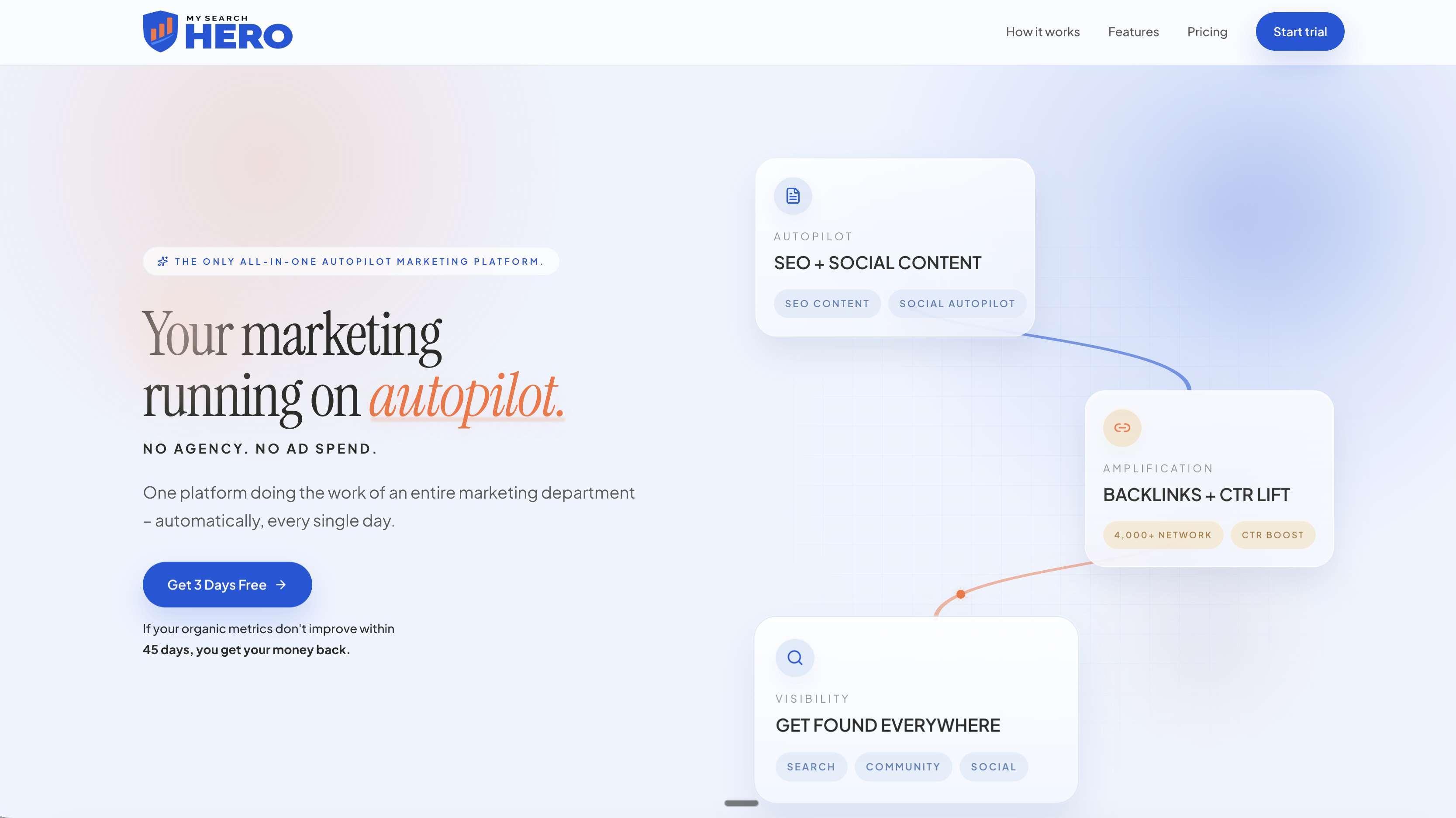
Plans start with Spark at $197 per month ($1,970 per year), Authority is $297 per month ($2,970 per year) and Hero is $397 per month ($3,970 per year). Hero combines SEO, backlink building, CTR boosting, Reddit presence and automated social posting in one plan, and we back it with a 45-day money-back guarantee if organic metrics do not improve. See the plans on the MySearchHero site, or read how we think about authority backlink placements first.
Frequently asked questions
Are sponsored backlinks allowed by Google?
Yes, paid placements are a normal part of advertising and sponsorship online. What Google asks is that paid links be qualified, and it recommends rel=“sponsored” for them. The risk comes from excessive paid links without proper tags, which Google says can lead to algorithmic or manual action.
Is rel=“sponsored” better than nofollow for paid links?
Google says nofollow remains acceptable for paid links, but it prefers sponsored because it describes the relationship more precisely. Existing nofollow-tagged paid links do not need to be changed. For new links, Google recommends sponsored, and you can combine values such as “nofollow sponsored” if an older system needs nofollow.
Do I need to disclose sponsored content to readers as well?
Yes, treat it as a separate step. The rel attribute informs search systems, while a visible label informs readers, and one does not stand in for the other. For the exact wording a U.S. campaign needs, check Federal Trade Commission guidance or ask your attorney.
Should I disavow sponsored or nofollow links pointing to my site?
Usually no. Google says most sites do not need the disavow tool and recommends it only for a considerable number of spammy or artificial links that have caused, or are likely to cause, a manual action. A single sponsored or nofollow link is not that situation.
Sources
- Qualify Outbound Links for SEO, Google Search Central
- Evolving “nofollow”: new ways to identify the nature of links, Google Search Central Blog
- A reminder on qualifying links and our link spam update, Google Search Central Blog
- Disavow links to your site, Search Console Help
- An SEO guide to nofollow, UGC and sponsored links, Search Engine Land