
A dofollow link is just a normal hyperlink with no rel attribute, and it can pass ranking signals to the page it points to. A nofollow link carries rel="nofollow", which tells Google you’re not vouching for the destination. Since 2019, Google treats both as hints rather than commands, and it prefers the more specific tags, rel="sponsored" and rel="ugc", when they apply. The rest comes down to knowing which tag fits which situation.
TL;DR:
- Nofollow links can still influence crawling and referral traffic, especially from high-authority sources, despite not passing PageRank directly.
- The 2019 update means Google treats nofollow as a hint, allowing it to decide whether to use the signal for ranking, rather than a strict rule.
- Proper tagging with sponsored, ugc, or nofollow depends on link context, with combining tags being a safe practice to satisfy current guidelines.
- Internal links should usually be dofollow unless linking to low-value or private pages to maintain authority flow within your site.
- Consistent link monitoring and ethical tagging are essential, as backlink profiles naturally drift and improper tagging can cause ranking issues.
Table of Contents
- Nofollow vs Dofollow Links: The Core Definitions
- What Is a Dofollow Link (the Default)?
- How Do Nofollow and Dofollow Affect Rankings?
- Why Nofollow Links Still Matter for Marketing
- When Should You Use Nofollow, Sponsored, or UGC?
- How to Check if a Link Is Nofollow or Dofollow
- A Publisher’s Weekly Link Monitoring Checklist
- Why Conservative Tagging Plus Active Moderation Wins
- Prefer a Done-For-You Approach to Link Tagging and Monitoring?
- Authoritative Links and Documentation
- Sources
- FAQ
Nofollow vs Dofollow Links: The Core Definitions
Before you can build a sane linking strategy, you need to know what each tag actually tells a search engine. They’re not opposites in the way “on” and “off” are opposites. One is a default state; the other is a flag you add on purpose.
What is a nofollow link?
A nofollow link looks like this in raw HTML:
<a href="https://example.com" rel="nofollow">example</a>
That rel="nofollow" attribute is a signal, not a lock. It tells Google you don’t want to formally endorse whatever’s on the other end of that link.
The tag has an odd origin story. Google introduced it in 2005 as a weapon against comment spam, back when blog comment sections were getting flooded with links to sketchy pharmacy sites and worse. For over a decade, webmasters treated it as a strict directive: nofollow meant zero PageRank passed, full stop. That changed in 2019, when Google announced it would treat nofollow as a hint it might use for crawling and ranking decisions, at its own discretion.
In practice, you’ll still reach for nofollow in a few recurring spots:
- Citing a source you need to reference but don’t want to endorse, like linking to a competitor’s claim you’re debunking
- A fallback tag for user-generated content when
rel="ugc"isn’t set up in your comment or forum system - Widget links, low-trust directories, or any outbound link where you want distance from the destination
What Is a Dofollow Link (the Default)?
There’s no such thing as a rel="dofollow" attribute. That term is shorthand the SEO industry invented to describe the absence of any rel attribute at all. A standard link, the kind you get when you just write <a href="https://example.com">example</a>, is dofollow by default.
That default state is the internet’s original design. Every link was an editorial vote until nofollow came along to let webmasters opt out of voting. A plain link still functions as an endorsement in Google’s eyes, and it’s the version most closely tied to historical PageRank flow.
You’ll want dofollow links for:
- Editorial citations to sources you trust and want to credit
- Internal links between your own pages, since these guide both readers and crawlers through your site’s structure
- Resource pages, partner mentions, and any reference you’d be comfortable standing behind publicly
For internal linking specifically, dofollow should be your default unless you have a concrete reason to withhold it, like linking to a login page, an internal search results page, or thin content you don’t want indexed. Most site navigation, footer links, and in-content references to your own pages should stay dofollow so authority flows naturally across your own domain.
How Do Nofollow and Dofollow Affect Rankings?
The technical mechanics matter more than the labels. Before 2019, the split was clean: dofollow links passed PageRank, nofollow links didn’t, and that was the entire story. The 2019 update blurred that line on purpose.
Here’s what changed and why it matters for anyone building links today:
- PageRank transfer became conditional. Google can now choose to count a nofollow link’s signal if it fits ranking or crawling needs, which means the old “nofollow equals zero value” assumption no longer holds with certainty.
- Crawling and indexing are separate problems entirely. A rel attribute signals a relationship between two pages, not a permission setting. If your actual goal is stopping a page from being crawled or indexed, rel attributes are the wrong tool, use
robots.txtor anoindextag instead. - Context now outweighs the tag itself. A nofollow link from a highly relevant, high-traffic page can still send real visitors and downstream editorial links, even if it never directly moves a ranking needle.
A high-authority nofollow mention can still pay off indirectly. A single feature on a major publication, even fully nofollowed, routinely drives enough referral traffic and brand searches that other sites pick up the story and link to it without any tag restrictions at all, according to Mangools’ analysis of nofollow versus dofollow links. The nofollow link becomes the spark, not the whole fire.
Why Nofollow Links Still Matter for Marketing
Treating nofollow links as worthless is one of the more expensive mistakes a marketing team can make. Link value was never only about direct ranking transfer, and the 2019 update made that fact impossible to ignore.
Three reasons nofollow links still earn a spot in your strategy:
- Referral traffic converts regardless of the tag. A visitor clicking through from a nofollow mention on a niche forum or a major news site doesn’t care what rel attribute sits on the anchor text; they just click and buy.
- Brand exposure compounds over time. Every mention, tagged or not, puts your name in front of a new audience and builds the kind of recognition that eventually turns into branded search volume.
- A mixed link profile looks natural. A backlink profile that’s 100% dofollow from paid placements is exactly the pattern Google’s spam systems are built to flag; a healthy mix of nofollow, sponsored, and dofollow links mirrors how real websites actually get linked to. Auditing that kind of backlink diversity is worth doing at least once a quarter.
Pro Tip: Don’t just track dofollow link counts in your outreach reports. Log nofollow placements too, and note their referral traffic separately. A nofollow mention from a niche industry publication with a highly engaged audience can outperform a dofollow link from a low-traffic directory on every metric except the one you’re used to measuring.
When Should You Use Nofollow, Sponsored, or UGC?

Google gives you three tags for a reason: sponsored, ugc, and nofollow each answer a different question about a link’s origin. Mixing them up isn’t just sloppy, it can cross into violating Google’s spam policies.
Run through this order every time you’re deciding how to tag an outbound link:
- Is money changing hands? Any paid placement, affiliate link, or sponsored content needs
rel="sponsored". Leaving it unmarked isn’t a gray area; it’s the exact scenario Google built the tag to catch. - Did a user post it, not your editorial team? Comments, forum posts, and reviews should carry
rel="ugc", since that content wasn’t vetted the way your own copy was. - Do you just not want to vouch for it? Use plain
rel="nofollow"for everything else you’d rather not formally endorse.
A few practical notes worth keeping close:
- Combining tags, like
rel="sponsored nofollow", is common and safe. It’s a belt-and-suspenders approach that keeps older tools and crawlers happy while satisfying current guidance. - Never reach for nofollow as a substitute for blocking a page from search entirely. That’s what
noindexandrobots.txtexist for, and using nofollow instead just muddies your link data without achieving your actual goal.
How to Check if a Link Is Nofollow or Dofollow
You don’t need expensive software to answer this for a single link. For anything beyond spot checks, though, you’ll want a repeatable process.
- Right-click and inspect. Right-click the link, choose “Inspect” or “Inspect Element,” and look at the anchor tag’s HTML for a
relattribute. No attribute means dofollow by default. - Use a browser extension. Several free extensions color-code links on a page as dofollow or nofollow automatically, which beats manually inspecting every link on a busy resource page.
- Run a site crawl for scale. If you’re auditing dozens or hundreds of outbound links, a crawler-based technical audit that extracts rel values programmatically will save hours compared to manual checks.
A Publisher’s Weekly Link Monitoring Checklist
Tagging links correctly once isn’t enough. Link profiles drift, comment sections get spammed, and paid placements slip through without the right attribute if nobody’s watching.
- Check link velocity weekly. A sudden spike in new backlinks, especially unnatural-looking dofollow links, deserves a closer look before it becomes a problem.
- Flag unexpected paid links immediately. If a sponsored post goes live without
rel="sponsored"attached, fix it the same day rather than letting it sit. - Audit your tagging rules quarterly. Confirm your CMS or comment plugin is still applying
rel="ugc"correctly, since platform updates sometimes reset custom configurations. - Follow up on strong nofollow mentions. If a nofollow link comes from a site with real relevance and traffic, a polite outreach email asking for an editorial dofollow citation costs you five minutes and sometimes pays off.
Pro Tip: Keep tagging responsibility with one person or a short checklist your whole content team follows. Split responsibility across multiple writers without a shared standard, and you’ll end up with three different tagging conventions on the same site within a month.
Why Conservative Tagging Plus Active Moderation Wins
Most sites either over-trust every outbound link or nofollow everything out of fear. Neither works. Editorial judgment, not a blanket rule, should decide whether a link deserves your endorsement. Tags don’t replace moderation, they support it. Run this week’s checklist against a sample of your own pages before you assume your tagging is clean.
— Mike
Prefer a Done-For-You Approach to Link Tagging and Monitoring?
Every checklist in this article works, but running it manually every week, on top of actually producing content and earning links, is where most site owners quietly fall behind. Mysearchhero is the alternative to hiring separate vendors for content, backlinks, and monitoring: one subscription covers published SEO articles, editorial backlinks through a publisher network, and ongoing reporting, so tagging and link velocity checks stop living on your personal to-do list.
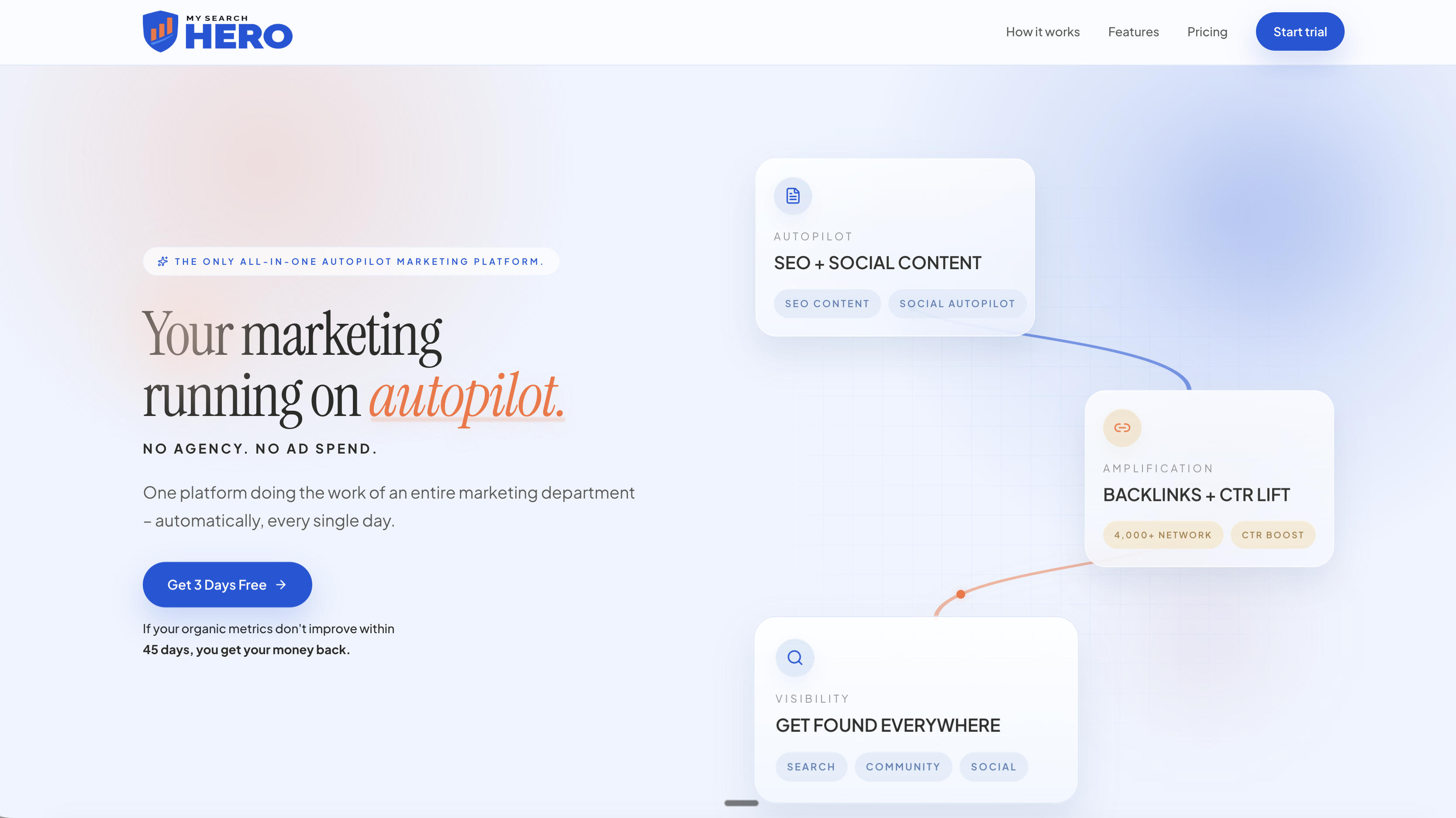
A managed workflow like this typically handles the parts this article just walked through: drafting and publishing content, securing editorial backlinks instead of low-quality directory links, and flagging unusual link activity before it becomes a ranking problem. Site owners who choose this route usually aren’t trying to avoid understanding SEO, they’re trying to avoid spending every Friday afternoon auditing rel attributes by hand. Plans start with the Spark tier at a monthly fee, and the Hero plan adds broader backlink and monitoring coverage. Current plan details and guarantee information are available on the Mysearchhero site. Check current plan details on the Mysearchhero site to see which tier fits your link-building workload.
Authoritative Links and Documentation
For the official rules on outbound link attributes, see Google’s guidance on qualifying outbound links and its 2019 announcement on evolving nofollow. For compliance specifics on paid links, the Link Building Journal’s deep dive covers sponsored and ugc tagging in detail.
Sources
- Evolving rel=“nofollow” — Google Search Central blog (2019)
- Sponsored, UGC, and Nofollow Attributes: A Compliance Deep-Dive – Link Building Journal
FAQ
How can you tell if a link is dofollow or nofollow?
Right-click the link and choose “Inspect” to view its HTML. If you see rel="nofollow", rel="sponsored", or rel="ugc" in the anchor tag, it’s not a standard dofollow link; no rel attribute means it’s dofollow by default.
Do backlinks still matter for SEO?
Yes. Backlinks remain one of the signals Google’s systems weigh for ranking, and a natural mix of dofollow, nofollow, sponsored, and ugc links from relevant sites still supports both visibility and referral traffic.
Are nofollow links worthless?
No. While nofollow links generally don’t pass the same ranking signal as dofollow links, they still drive referral traffic, build brand exposure, and contribute to a natural-looking backlink profile that protects you from spam-pattern flags.
What are the three main types of link attributes?
Google recognizes rel="nofollow" for general non-endorsement, rel="sponsored" for paid or affiliate links, and rel="ugc" for user-generated content like comments and forum posts. A standard link with none of these attributes is dofollow by default.
What does Mysearchhero do differently for link building?
This service combines published SEO content, editorial backlinks through a publisher network, and ongoing link monitoring into one monthly subscription, so tagging and velocity checks don’t fall on the site owner alone.