
TL;DR:
- Many small business owners mistake SEO for simple keyword stuffing, which is a costly misconception.
- Effective SEO enhances discoverability, trust, and long-term revenue by building authority and organic traffic.
- Focusing on targeted content, backlinks, and technical health yields lasting growth and reduces customer acquisition costs.
Most small business owners think SEO is about stuffing the right keywords onto a webpage and waiting for Google to notice. That misconception costs real money. The role of SEO in business is far broader: it shapes how customers find you, how much trust they extend before you ever speak to them, and how much you spend to acquire each new client. Done right, SEO is the only marketing channel that gets more valuable the longer you invest in it. This article breaks down exactly how it works and what you should focus on.
Table of Contents
- Key takeaways
- The role of SEO in business visibility
- Real business benefits beyond website visits
- Core SEO strategies that actually move the needle
- SEO vs. paid advertising: choosing the right mix
- My honest take on SEO for small businesses
- How Mysearchhero helps small businesses grow with SEO
- FAQ
Key takeaways
| Point | Details |
|---|---|
| SEO earns compounding traffic | Unlike paid ads, organic rankings build over time and keep delivering without ongoing spend. |
| Organic search dominates revenue | Organic search drives 53% of web traffic and contributes 44% of revenue share across industries. |
| SEO lowers customer acquisition cost | As rankings mature, the cost per lead from organic search drops significantly below paid channels. |
| Strategy beats tactics | Combining on-page content, backlinks, and technical health outperforms any single SEO tactic in isolation. |
| Timeline expectations matter | Technical fixes show results in 4 to 6 months; content authority compounds over 6 to 12 months. |
The role of SEO in business visibility
Search Engine Optimization is the practice of improving your website so it ranks higher on search engines like Google when potential customers look for products or services you offer. But that definition undersells it. SEO is really about showing up at the exact moment someone is ready to buy, learn, or compare.
Here is why that matters. When someone types “best accountant in Denver” or “how to fix a leaky faucet,” they are actively looking for a solution. Paid ads can put you in front of those people, but the moment your budget runs out, you disappear. Organic rankings, earned through SEO, keep working whether you are sleeping or on vacation.
The numbers make the case clearly. Organic search generates 53% of all online traffic and contributes 44% to revenue share across industries. No other single channel comes close to that scale for most businesses.
Here is what effective SEO does for your discoverability:
- Places your business in front of high-intent buyers who are already searching for what you sell
- Earns positions in featured snippets and SERP features, which boost clicks and trust without additional cost
- Builds owned traffic that does not disappear when you stop spending
- Compounds over time, meaning a strong SEO foundation from this year keeps paying dividends in future years
Paid ads rent visibility. SEO buys it. That is the core distinction every small business owner needs to understand before allocating a marketing budget.
Real business benefits beyond website visits
Traffic is a vanity metric unless it connects to revenue. This is where most conversations about the importance of SEO for businesses fall short. Let’s look at what SEO actually moves on the business side.
Customer acquisition cost drops as rankings mature. In the early months, SEO costs money with little return. But as you climb rankings, the same content that cost $2,000 to produce in year one is still driving leads in year three at zero additional cost. Paid ads require continuous spend. SEO does not.
You can tie SEO directly to revenue. The best way to do this is by linking CRM deals to organic sessions and calculating closed revenue divided by your total SEO investment. That gives you a real ROI number you can take to any stakeholder or use to justify a larger content budget.
- Filter all closed deals in your CRM that include an organic search touchpoint
- Total the revenue from those deals
- Divide that number by your total SEO spend for the same period
- Compare the result to your cost per acquisition from paid channels
Most businesses are shocked when they run this calculation. Organic SEO often outperforms paid search by a factor of two to five over a 12 to 24 month window.
Brand credibility compounds alongside rankings. Higher organic rankings drive more engagement, sales, and customer loyalty because customers associate top positions with authority. A business that consistently ranks at the top of search results for relevant queries earns trust before the first conversation happens.
“Connecting organic traffic to actual revenue via CRM-linked analytics enables leadership to fund and prioritize SEO with confidence.” — Siteimprove
The businesses that win long-term are the ones that stop thinking about SEO as a traffic tool and start treating it as a revenue system.
Core SEO strategies that actually move the needle
Small businesses do not need to do everything. They need to do the right things consistently. Effective SEO combines on-page optimization, backlink building, and technical health into a unified strategy that improves over time.
On-page SEO
This is where most businesses start, and for good reason. On-page SEO means creating content that matches what your ideal customer is searching for, using relevant keywords naturally, writing clear meta titles and descriptions, and structuring pages so both users and search engines can follow them easily.
The key is specificity. A plumber in Chicago should not just target “plumbing services.” Targeting “emergency pipe repair in Chicago” captures someone who is ready to call right now, not just browsing.
Off-page SEO and backlinks
When other websites link to yours, Google interprets those links as votes of confidence. The more authoritative those linking sites are, the more weight each link carries. Building quality backlinks is one of the highest-leverage activities in SEO, but it takes time and consistency.
Guest posts, local business directories, and getting mentioned in industry publications are all practical ways to build domain authority without resorting to link schemes that can backfire.
Technical SEO
Your site needs to load fast, work perfectly on mobile, and be easy for Google’s crawlers to index. A technically broken site will not rank well no matter how strong the content is. Core issues to fix include page speed, broken links, duplicate content, and proper use of structured data markup.

Pro Tip: Run a free site audit through Google Search Console at least once a quarter. It will flag crawl errors, mobile usability issues, and security problems before they silently kill your rankings.
Content as a compounding asset
Every piece of quality content you publish is a digital asset that can rank, attract backlinks, and bring in leads indefinitely. Content marketing examples show that businesses publishing consistent, targeted content build topical authority that makes every new piece of content rank faster. Think of it less like advertising and more like building a library that works for you around the clock.
The most common mistake is treating SEO as a one-time project. Publishing 10 articles and then going silent will not produce lasting results. Ongoing maintenance, content updates, and adaptation to algorithm changes are what separate businesses that grow through SEO from those that plateau.
SEO vs. paid advertising: choosing the right mix
Understanding how SEO fits into your broader marketing is critical for small businesses with limited budgets. Here is a straightforward comparison:
| Factor | SEO (organic) | Paid search (SEM) |
|---|---|---|
| Speed to results | 4 to 12 months | Immediate |
| Cost model | Investment that compounds | Ongoing spend required |
| Visibility when budget stops | Remains (if maintained) | Disappears immediately |
| Trust signal to users | Higher (organic results trusted more) | Lower (marked as ads) |
| Long-term ROI | Increases over time | Stays flat or rises with competition |

SEO is slower than paid ads but compounds; SEM offers immediate visibility that stops the moment your budget stops. Neither channel is universally better. The smartest approach for most small businesses is to use paid search for immediate lead flow while building organic rankings simultaneously.
Once your SEO kicks in, you can reduce paid spend without losing pipeline coverage. That is how you lower your overall customer acquisition cost while growing revenue. SEO planning horizons vary: technical and schema improvements tend to reflect in rankings within 4 to 6 months, while topical authority from content clusters takes 6 to 12 months to fully compound.
Pro Tip: Do not pause your SEO investment during a paid campaign push. The compounding nature of organic growth means pausing costs you far more than the short-term savings suggest.
One more factor worth considering in 2026: SEO visibility now includes appearing in AI Overviews and being cited by AI search tools, not just traditional blue link results. Structuring your content with clear headings, factual claims, and schema markup makes you more likely to appear in these new surfaces.
My honest take on SEO for small businesses
I have watched dozens of small business owners get burned by SEO because they treated it like a switch rather than a dial. They expected first-page rankings in 30 days, got frustrated after 90, and quit right before the results would have arrived.
In my experience, the single biggest predictor of SEO success is not budget or even strategy. It is patience combined with clear goal-setting. When you tie your SEO work directly to business goals, such as a specific number of organic leads per month or a target customer acquisition cost, you stop chasing rankings and start measuring what actually matters.
What I have also found is that most small businesses skip the technical fundamentals and jump straight to content. That is like decorating a house with a cracked foundation. Fix the crawlability issues, get your site loading in under three seconds, and then pour energy into content.
The role of SEO in marketing is not to replace every other channel. It is to build an asset that pays you back long after the initial investment. Why SEO matters for service businesses comes down to this: every month you invest in organic search, you are building equity. Every month you only run ads, you are renting attention you will eventually give back.
Start small, measure everything, and stay the course.
— Mike
How Mysearchhero helps small businesses grow with SEO
Running a small business means you rarely have hours to spare on keyword research, content publishing, and backlink outreach every week. That is the gap Mysearchhero fills.
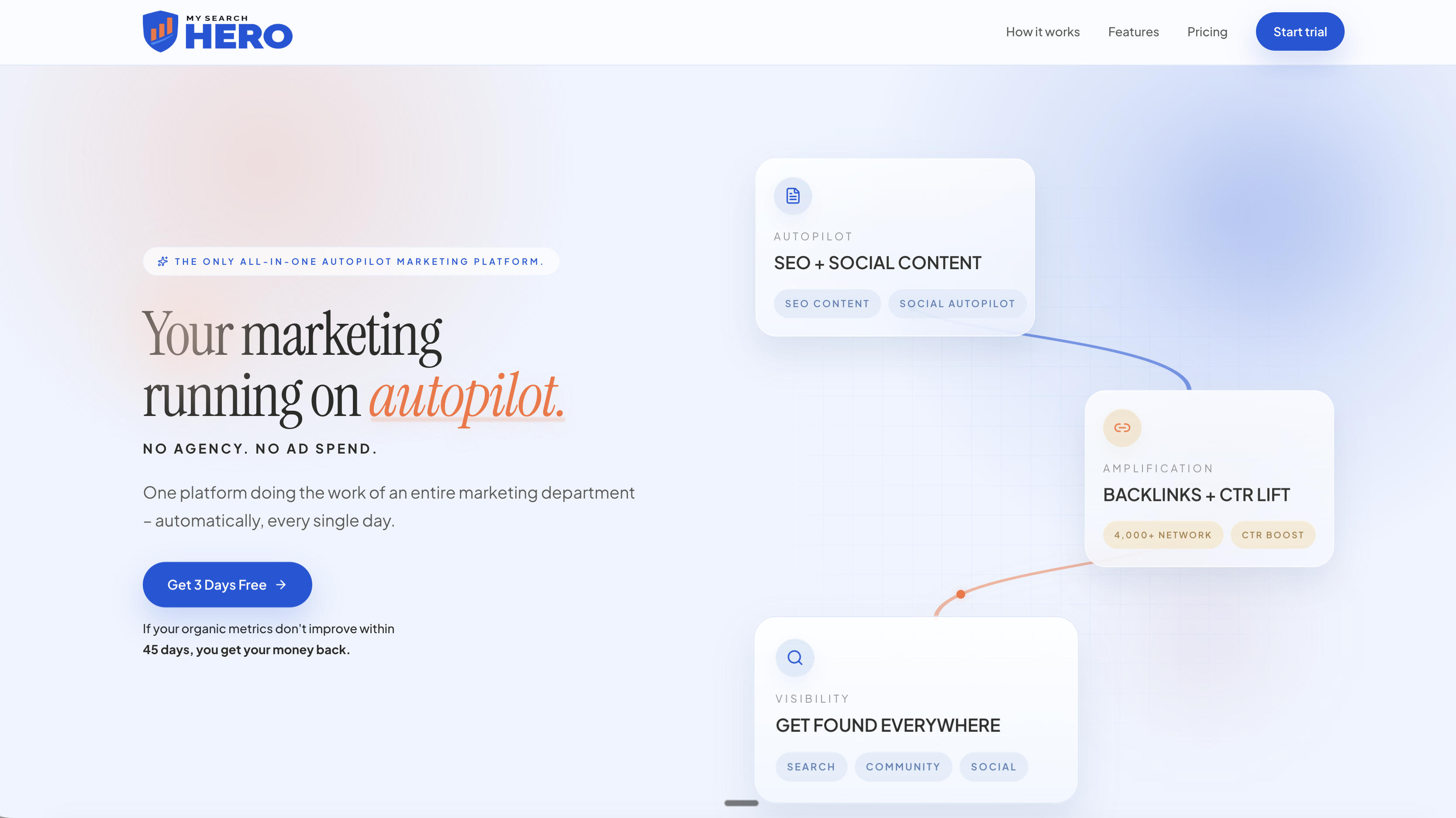
Mysearchhero is a done-for-you SEO and content marketing service built specifically for business owners who want organic growth without managing it themselves. Each month, subscribers receive published articles, quality backlinks, Reddit mentions, and social media posts, all pushed out through an automated pipeline. You focus on running your business while your online presence grows in the background. If you are ready to stop renting attention from ad platforms and start building an asset, visit Mysearchhero to see how the service works and what results look like for businesses like yours.
FAQ
What is the role of SEO in business growth?
SEO helps businesses attract qualified buyers through organic search, reducing reliance on paid ads over time and building a compounding traffic asset that lowers customer acquisition costs as rankings mature.
How long does SEO take to show results?
Technical SEO improvements typically show measurable impact within 4 to 6 months, while content authority and topical clusters generally take 6 to 12 months to fully compound in rankings.
How does SEO impact sales for small businesses?
SEO drives high-intent traffic from people actively searching for your product or service, which converts at higher rates than most paid channels and contributes directly to pipeline and closed revenue when tracked through CRM analytics.
Is SEO better than paid advertising?
Neither channel wins outright. Paid ads deliver immediate leads while SEO builds long-term, owned organic traffic that does not disappear when spending stops. The strongest strategy combines both, then shifts budget toward organic as rankings grow.
How do I measure SEO return on investment?
Filter your CRM for deals that include an organic search touchpoint, total the closed revenue from those deals, then divide by your total SEO costs for the same period. That calculation gives you a real ROI figure rather than a traffic count.