
An evergreen backlink is a link from another site that keeps delivering SEO value because it points to content that stays useful, accurate, and discoverable long after it was published. Unlike links tied to news stories or seasonal campaigns, these links don’t expire when the moment passes. They compound. Search Engine Land describes this category of content as assets that keep working long after publication and help build topical authority over time. For website owners and digital marketers, that distinction matters in one very practical way: a single well-placed evergreen backlink can drive referral traffic and ranking signals for years, not weeks.
Mysearchhero builds exactly this kind of link infrastructure for clients every month, pairing published evergreen assets with active outreach to place durable, high-quality links.
Table of Contents
- Why do evergreen backlinks matter for long-term SEO?
- What qualities actually make a backlink evergreen?
- How do you earn evergreen backlinks?
- How do you evaluate and prioritize link prospects?
- How do you measure the impact of evergreen backlinks?
- What risks threaten evergreen backlinks, and how do you manage them?
- Your evergreen backlink quick-start checklist
- How Mysearchhero builds evergreen backlinks for clients
- Key Takeaways
- The case for treating links as infrastructure
- Mysearchhero’s done-for-you evergreen link program
- Useful sources and tools
- FAQ
Why do evergreen backlinks matter for long-term SEO?
Most links depreciate. A link from a trending news post earns a spike of traffic, then fades as the story ages and the page loses relevance. Evergreen backlinks work the opposite way: because the destination page keeps attracting readers, other sites keep discovering and citing it. That passive accumulation is the compounding effect that separates durable SEO from short-term wins.
There are three concrete reasons to prioritize them:
- Compounding referral traffic. Evergreen content attracts backlinks over time because it remains useful and discoverable long after publication, generating traffic without additional spend.
- Lower cost-per-visit. Evergreen assets lower long-term cost-per-visit compared with continuous paid advertising or constant news-cycle content production when maintained properly.
- Topical authority signals. Google’s Helpful Content system rewards pages that demonstrate depth and sustained relevance. A cluster of evergreen pages with strong inbound links signals exactly that.
Stat to know: Good websites consistently link to comprehensive, reliable resources, and evergreen content attracts those backlinks for years, growing a site’s authority with each new referring domain.
The role of external links in SEO compounds further when evergreen pages are woven into a site’s internal linking structure, lifting the ranking performance of surrounding pages by reinforcing topical signals.
What qualities actually make a backlink evergreen?
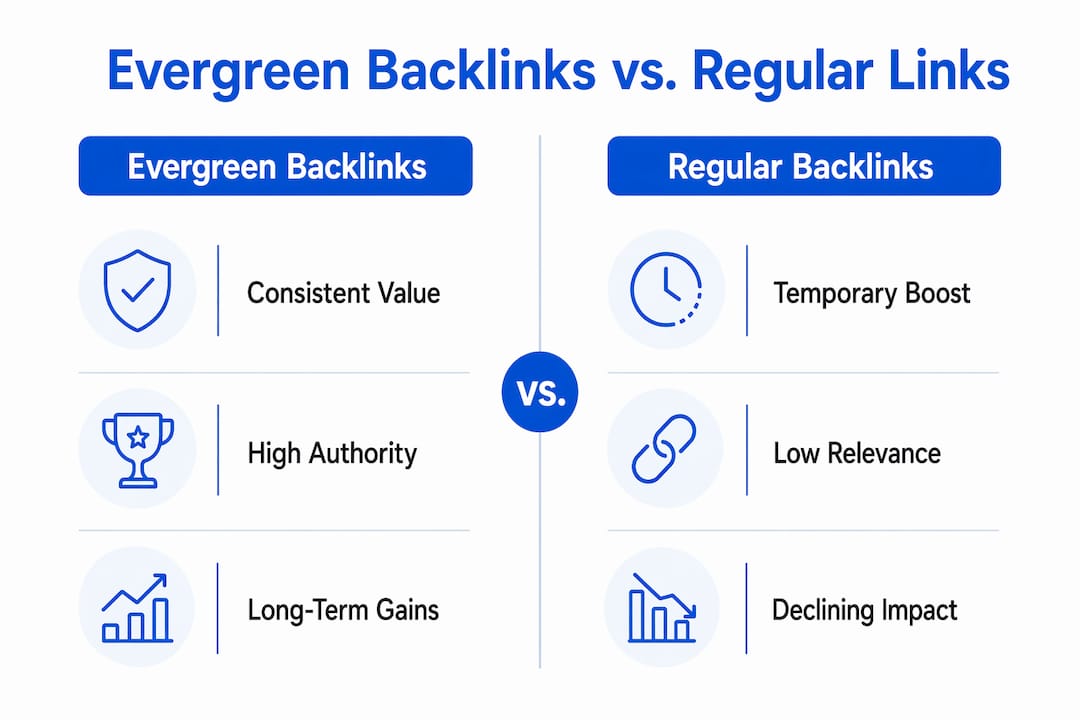
The “evergreen” label applies to two distinct things: the destination page and the link itself. Both have to hold up.
Destination page properties:
- Timelessness. The topic answers a question that doesn’t expire — how to write a meta description, what a backlink is, how compound interest works.
- Comprehensiveness. Shallow pages don’t earn links. Well-researched, comprehensive assets are what other creators reference and cite.
- Updateability. The page can absorb new data or examples without a full rewrite, keeping it accurate without losing its URL or link equity.
- Stable search demand. The topic matches what people frequently search for regardless of season or news cycle.
Link-level properties:
- Relevance. The referring page covers a topic closely related to the destination. A link from a marketing blog to a marketing guide carries more weight than the same link from an unrelated niche.
- Referring domain authority. A Domain Rating (DR) of 40+ is a reasonable floor for meaningful link equity; DR 60+ links tend to move rankings more reliably. These thresholds are guidance, not hard rules.
- Dofollow status. Backlinks pass link equity only when they carry a dofollow attribute. Nofollow links have indirect value but don’t directly transfer authority.
- Contextual placement. A link embedded in the body of a relevant paragraph outperforms a footer or sidebar link in every meaningful way.
Destination longevity alone doesn’t make a link high-quality. A link from a low-authority, irrelevant site to a timeless page is still a weak link.
How do you earn evergreen backlinks?
Earning durable links requires building something worth linking to, then making sure the right people see it. Ahrefs calls this 10x content: assets that are substantially more comprehensive and useful than anything already ranking. Here’s the sequence:
- Choose a topic with stable demand. Use keyword research to find queries that have held steady search volume for at least 12 months. Avoid topics tied to product versions, regulations, or news cycles.
- Build the definitive asset. Invest in depth: original data, clear frameworks, strong visuals, and examples that competitors haven’t covered. Check out how to write SEO content that ranks for a practical production framework.
- Internal link immediately. On publication, link to the new asset from at least three existing pages on your site. This passes early authority and helps Google find and index it faster.
- Run a targeted outreach sequence. Identify 20–40 sites that already link to similar resources. Personalize each pitch to the specific page and explain why your asset is a better reference. Follow up once after seven days.
- Promote to resource pages. Many sites maintain curated “resources” or “tools” pages. A short, direct pitch to the page editor often earns a placement that a standard guest-post pitch never would.
- Pursue editorial mentions. Respond to journalist and blogger queries (platforms like HARO connect sources with writers) to earn citations in articles that will themselves become reference material.
Evergreen content types that consistently earn links: definitive how-to guides, original research and data studies, canonical explainers, comprehensive glossaries, and free tools or calculators.
Pro Tip: After your asset earns its first five to ten backlinks, slice the data or add a new section and re-pitch it as “updated.” Editors who passed the first time often link to a meaningfully improved version.

How do you evaluate and prioritize link prospects?
Not every outreach target is worth your time. A simple scoring framework keeps you focused on the prospects most likely to deliver lasting value.
| Signal | What to check | Weight |
|---|---|---|
| Topical relevance | Does the referring page cover the same subject? | High |
| Referring domain DR | Is DR 40 or above? | High |
| Estimated organic traffic | Does the page itself get real visitors? | Medium |
| Placement likelihood | Is there an existing resource section or citation pattern? | Medium |
| Editorial fit | Does the site link out to third parties at all? | Low |
Score each prospect across these signals before you write a single outreach email. Sites that score high on relevance and DR but low on placement likelihood are worth a pitch but not a long follow-up sequence. Sites that score low on relevance should be dropped entirely, regardless of their authority.
For checking DR and traffic estimates, tools like Ahrefs, Moz, and Semrush are the standard options. For managing outreach at scale, backlink outreach strategies can help structure your pipeline.
Quick decision rules:
- Pursue: DR 40+, topically relevant, site links to external sources.
- Deprioritize: DR below 40, marginal relevance, no existing outbound link pattern.
- Batch outreach: group similar sites and customize only the opening line and the specific page reference.
How do you measure the impact of evergreen backlinks?
Backlink acquisition is gradual unless the asset receives heavy promotion. Set expectations accordingly and track the right signals.
Core metrics to monitor:
- New referring domains pointing to the target page (monthly)
- Organic traffic to the linked page (weekly after a new link is placed)
- Keyword ranking changes for the page’s primary and secondary terms
- Conversion events attributed to organic sessions on that page
| Milestone | Typical timing | What affects it |
|---|---|---|
| First organic backlinks appear | 1–3 months post-publication | Promotion intensity, niche competition |
| Measurable traffic lift | 3–6 months | DR of referring domains, keyword difficulty |
| Ranking movement | 4–8 months | Existing domain authority, content quality |
| Compounding referral traffic | 6–12+ months | Number of referring domains, page freshness |
Report on referring domain growth monthly. Check ranking changes every two weeks once the page has at least five referring domains. Attribution is imperfect: use a 90-day uplift window to compare organic traffic before and after a significant link placement.
What risks threaten evergreen backlinks, and how do you manage them?
Links don’t maintain themselves. Three threats erode value over time: link rot (the referring page is deleted or restructured), relevance drift (the referring site changes focus), and content decay (your destination page becomes outdated).
Maintenance checklist:
- Audit all referring domains quarterly using Ahrefs or a similar tool.
- Check for broken inbound links monthly; set up 301 redirects immediately when you change a URL.
- Refresh the destination page with new data or examples at least once a year.
- Monitor anchor text distribution to avoid over-optimization toward a single exact-match phrase.
- Review canonical tags after any site migration to prevent equity loss.
When a page starts losing rankings despite a healthy backlink profile, update the content before creating a replacement. A new URL loses all existing link equity unless you redirect the old one.
Pro Tip: Set a Google Alert for your page’s title and primary keyword. When someone mentions the topic without linking to you, that’s a free outreach opportunity — a simple “you mentioned X, here’s the source” email converts at a surprisingly high rate.
Your evergreen backlink quick-start checklist
- Identify a topic with stable, year-round search demand.
- Audit the top five ranking pages and define what a 10x version looks like.
- Publish the asset and immediately add internal links from three or more existing pages.
- Build a prospect list of 20–40 relevant sites using DR 40+ as the floor.
- Send personalized outreach with a single follow-up at seven days.
- Submit to relevant resource pages and respond to editorial queries.
- Set a quarterly calendar reminder to refresh the page and audit referring domains.
Expect to invest at least two to four hours per week on outreach and maintenance to see durable results. Shortcuts produce short-lived links.
How Mysearchhero builds evergreen backlinks for clients
Mysearchhero runs a done-for-you content and link-building program built around exactly this model. Each month, clients receive published evergreen articles, active link outreach, and placement activity, all managed through an automated pipeline.
The approach follows the same logic outlined here:
- Asset production: Long-form, research-backed articles built around stable search queries.
- Outreach and placement: Personalized pitches to relevant, DR 40+ referring domains.
- Maintenance signals: Internal linking updates and content refresh prompts built into the monthly cycle.
Clients in competitive niches typically see referring domain growth within the first 90 days, with measurable organic traffic lifts in the 3–6 month window, though exact results vary by niche and starting domain authority.
If you want the asset-building and outreach handled without managing it yourself, Mysearchhero’s SEO service covers the full cycle from content production to link placement. Start with an audit of your current evergreen assets, then let the team build and promote the gaps.
Key Takeaways
Evergreen backlinks are the most durable SEO asset you can build: they compound in value, lower your cost-per-visit over time, and signal topical authority to Google.
| Point | Details |
|---|---|
| Definition | An evergreen backlink points to content that stays useful and discoverable long after publication. |
| Why they compound | Referring domains accumulate gradually; expect measurable traffic lifts in the 3–6 month range. |
| Quality threshold | Target referring domains with DR 40+ and strong topical relevance for lasting link equity. |
| Top earning tactic | Build 10x content, then run personalized outreach to resource pages and editorial contacts. |
| Mysearchhero | Handles the full cycle — content production, outreach, and placement — for clients who want this done for them. |
The case for treating links as infrastructure
Most marketers treat link building as a campaign: run it for a quarter, check the numbers, move on. That framing is the problem. A link to a well-maintained evergreen page is closer to a rental property than a billboard. It keeps generating returns as long as the asset stays in good shape.
The sites that dominate competitive SERPs didn’t get there through a single outreach push. They built a library of reference-quality pages, linked them together, and kept them current. That’s the model worth copying.
When Mysearchhero works with a new client, the first question is always: what does your evergreen foundation look like? If the answer is “we don’t have one,” that’s where the work starts. For most sites, a managed program makes more sense than DIY at scale, simply because the outreach volume and content quality required to compete are hard to sustain without a dedicated system.
Mysearchhero’s done-for-you evergreen link program
Building a real evergreen backlink program takes consistent content production, disciplined outreach, and ongoing maintenance. Most website owners and marketers know what needs to happen; the gap is execution at the volume and quality level that actually moves rankings.
Mysearchhero delivers the full package on autopilot: monthly evergreen articles built around stable search queries, active outreach to relevant DR 40+ domains, and link placements tracked and reported each cycle. You get the compounding SEO value without managing writers, prospecting spreadsheets, or follow-up sequences yourself.
See what a managed evergreen link program looks like for your site at Mysearchhero and get started with a content and backlink audit.
Useful sources and tools
- Evergreen Content: The Secret To Earning Backlinks Over Time — Solid breakdown of why evergreen assets earn passive links and what content depth actually looks like in practice.
- What Is Evergreen Content? — Search Engine Land — Authoritative guide tying evergreen content to Google’s Helpful Content criteria and topical authority signals.
- What is Evergreen Content? — Ahrefs — Covers the 10x content standard and why established pages with strong backlink profiles dominate evergreen SERPs.
- SE Ranking: Evergreen Content and SEO — Practical overview of what makes content evergreen and how steady backlink accrual works over time.
- Ahrefs / Moz / Semrush — Use any of these for DR checks, referring domain audits, and keyword demand verification before building your prospect list.
- Benefits of Backlinking — Mysearchhero’s breakdown of how backlinks drive SEO value and what link quality signals actually matter.
FAQ
What is an evergreen backlink in simple terms?
An evergreen backlink is a link from another site that points to content designed to stay relevant and useful for years, so it keeps delivering SEO value long after it was placed.
How long does it take for evergreen backlinks to affect rankings?
Most sites see measurable organic traffic lifts several months after earning quality links, with ranking movement typically appearing a few months later depending on domain authority and keyword difficulty.
What DR should a referring domain have for an evergreen backlink to matter?
A Domain Rating of 40+ is a reasonable floor for meaningful link equity; DR 60+ links tend to produce more reliable ranking movement, though topical relevance matters just as much as raw authority.
Can evergreen backlinks lose their value over time?
Yes. Link rot, relevance drift, and content decay all erode value. Quarterly audits, annual content refreshes, and prompt redirect handling keep evergreen links working as intended.
Does Mysearchhero build evergreen backlinks for clients?
Yes. Mysearchhero’s monthly program includes evergreen content production, outreach to relevant DR 40+ domains, and link placement tracking, all managed through an automated pipeline.