
What is branded search, and why does it matter?
Branded search is any online query that includes a specific company name, product name, or recognizable brand term. When someone types “Nike running shoes,” “Salesforce pricing,” or “HubSpot CRM tutorial” into Google, that is a branded search. The user already knows the brand exists and is actively seeking it out.
That distinction carries real weight. A branded query signals something a generic search cannot: the person on the other end has already moved past the awareness stage. They are not browsing options. They are looking for you.
Key characteristics of branded search:
- Queries contain a company name, product name, sub-brand, or branded acronym
- They reflect existing familiarity with the brand, not general category curiosity
- They typically appear in Google Search Console as high-CTR, low-competition terms
- Branded search volume functions as a proxy for real-world authority, signaling trust to Google’s ranking systems
- Volume trends over time reveal brand health more reliably than most survey data
According to Ahrefs research, 45.7% of all Google searches are branded. That is not a niche signal. It is the dominant mode of commercial search behavior.
Table of Contents
- Types of branded keywords you need to recognize
- How branded search differs from non-branded search
- Why branded search is worth protecting and growing
- How to find your branded keywords in analytics tools
- Practical ways to optimize your branded search presence
- What recent research reveals about branded search trends
- How to measure branded search performance
- Common pitfalls in managing branded search campaigns
- Branded search strategy examples from the US market
- Key Takeaways
- FAQ
Types of branded keywords you need to recognize
Not every branded query looks the same, and treating them as a single bucket is a missed opportunity. There are several distinct categories, each with different strategic implications.
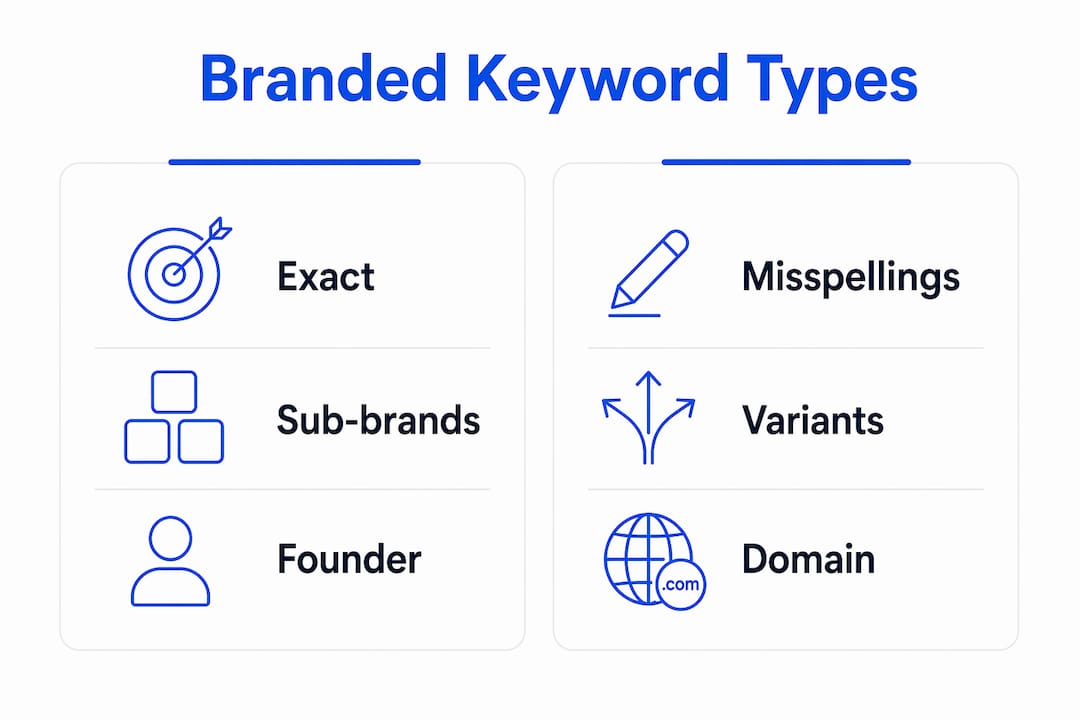
Exact brand name searches are the most straightforward: “Patagonia,” “Slack,” “Mailchimp.” These typically come from existing customers, people referred by word of mouth, or users who saw the brand in an ad and want to follow up.

Branded product searches add a product line or model to the brand name: “Apple MacBook Pro,” “Nike Air Max 270,” “Adobe Photoshop pricing.” These users are further down the funnel and often comparison-shopping within the brand’s own catalog.
Branded modifier searches attach a qualifier to the brand name:
- Location: “Starbucks near me,” “Whole Foods Chicago”
- Action: “Nike returns policy,” “Chase Bank login”
- Sentiment: “Is Robinhood safe,” “Zoom reviews 2026”
- Competitor comparison: “HubSpot vs Salesforce”
Sub-brand and product variant searches matter especially for large companies. “Courtyard by Marriott” or “Chevy Silverado” are branded queries even if the parent brand name does not appear verbatim.
Misspellings and phonetic variants are easy to overlook but show up consistently in Search Console data. “Amazone,” “Netflicks,” and “Addidas” all represent branded intent even when spelled wrong. Tracking these catches demand you would otherwise miss.
Founder and domain searches round out the picture. If your founder has public visibility, their name becomes a branded term. So does your domain when users type it directly into a search bar instead of the address bar.
How branded search differs from non-branded search
The difference is not just semantic. It shapes everything from bidding strategy to landing page design.
| Dimension | Branded search | Non-branded search |
|---|---|---|
| User intent | Targeted, brand-specific | Category-level, exploratory |
| Funnel stage | Mid to bottom | Top to mid |
| Traffic quality | High (warm leads) | Variable (cold to warm) |
| Competition | Low to moderate | High |
| Conversion rate | Higher | Lower |
| CPC in paid search | Lower | Higher |
| SEO difficulty | Low (you own your brand) | High |
Non-branded search is how you attract strangers. Branded search is how you convert people who already know your name. Both matter, but they require completely different playbooks.

A user searching “email marketing software” is still deciding. A user searching “Klaviyo pricing” has already shortlisted you. The stakes in that second moment are higher, and the margin for a poor SERP experience is much thinner. Branded search is your digital storefront: you would not leave a physical store cluttered and unstaffed, and the same logic applies to what people find when they search your name.
Why branded search is worth protecting and growing
The benefits of a strong branded search presence compound over time in ways that generic traffic simply does not.
Higher conversion rates. Branded visitors arrive pre-sold on the brand. They convert at significantly higher rates than cold organic traffic because the trust barrier is already lower.
Lower cost-per-click in paid search. Google rewards relevance. When you bid on your own brand terms, your Quality Score is typically high, which drives down CPC compared to bidding on competitive generic terms.
SEO trust signals. Brand marketing improves organic rankings for non-branded keywords. Google interprets consistent branded search volume as evidence that a site is a legitimate authority, which lifts rankings across the board.
Real demand measurement. Unlike surveys or focus groups, branded search volume reflects actual market behavior. Branded search captures the research phase of the buyer journey and signals the depth of organic demand in a way no self-reported metric can replicate.
Competitive moat. A brand with growing search volume is harder to displace. Competitors cannot easily buy their way into someone else’s branded intent.
Branded search volume share ranges from 19% for small businesses to 42% for established global brands, reflecting how brand equity directly translates into search behavior.
The gap between those two numbers is not just a vanity metric. It represents the difference between a business that competes on price and one that competes on reputation.
How to find your branded keywords in analytics tools
You cannot manage what you have not identified. Here is how to build a complete branded keyword list.
Google Search Console is the starting point. Open the Performance report, go to Queries, and filter for your brand name and its common variants. GSC now includes a native Brand Intelligence tab that automatically groups your brand, common misspellings, and sub-brands. Export monthly clicks and impressions, and track the trend monthly rather than daily. Daily data is noisy; monthly data tells you something real.
Ahrefs and Semrush let you pull organic keyword rankings filtered by brand term. In Ahrefs, use Site Explorer and filter the Organic Keywords report by your brand name. In Semrush, the Organic Research tool lets you segment branded vs. non-branded traffic with a keyword filter. Both tools surface branded terms you may not have thought to track, including long-tail variants and question-format queries.
Google Trends is underused for branded monitoring. Compare your brand name against category terms over a rolling 12-month window to see whether branded interest is growing relative to the category. Breakout queries in Trends often signal PR events or viral content that temporarily spikes branded demand.
What to include in your branded keyword list:
- Brand name and all known misspellings
- Product names unique to your company
- Sub-brands and product lines
- Founder name if publicly associated with the brand
- Your domain name (typed as a search query)
- Branded comparison queries (“YourBrand vs Competitor”)
Tracking branded mentions across platforms alongside your keyword data gives you a fuller picture of where demand originates before it shows up in search.
Practical ways to optimize your branded search presence
Owning your brand name in search results sounds automatic. It is not. Competitors bid on your brand terms. Review sites and aggregators rank for your name. AI-generated summaries answer branded queries without sending a click. Each of these requires a deliberate response.
Claim and optimize your brand SERP. The first page of results for your brand name is prime real estate. Your homepage, key landing pages, social profiles, Google Business Profile, and review platform listings should all appear. If third-party review sites dominate your brand SERP, that is a signal to invest in reputation management.
Bid on your own brand terms in Google Ads. Even when you rank organically, paid ads for branded terms protect against competitor conquesting and give you control over the messaging and landing page. Branded paid search preserves click volume but does not generate new branded demand. Paid branded campaigns are defensive, not growth-oriented.
Build brand awareness to grow branded search volume. New branded demand comes from offline and online brand-building: PR, social media, influencer partnerships, content marketing, and word of mouth. Awareness activities build branded search volume; PPC alone cannot create it.
Optimize for AI visibility. In 2026, flat clicks despite rising branded impressions often mean users are getting answers from AI Overviews without clicking through. Monitor your brand’s presence in AI-generated responses using tools like Semrush Brand Monitoring’s AI Visibility dashboard and Brand24’s AI mention alerts. Track referral traffic from chatgpt.com and perplexity.ai in GA4 as a signal of AI-driven branded discovery.
Monitor social sentiment. AI models are increasingly trained on real-time social data. Positive brand discussions on Reddit, X, and LinkedIn feed directly into how AI systems represent your brand in generated answers. Social signals now function as a precursor to AI search visibility.
Pro Tip: Never pause branded paid campaigns during a product launch or PR moment. That is exactly when competitors increase their bids on your brand terms, and the cost of losing that click to a competitor’s ad far exceeds the CPC you would have paid.
What recent research reveals about branded search trends
The data on branded search in 2026 points in two directions simultaneously: branded intent is strong, but the way that intent gets satisfied is changing fast.
Several findings from recent industry research are worth keeping in mind:
- Zero-click branded search is rising as AI-generated snippets answer branded queries directly, reducing site visits even when brand awareness is high
- Branded search volume reflects real market interest in a way surveys cannot, making it one of the most reliable leading indicators of pipeline health
- Rising impressions with flat clicks is the new warning sign: it means your brand is being seen in AI summaries but not clicked, which requires a different optimization response than a traffic drop
- Google Trends remains the best tool for high-level brand health tracking; comparing your brand against competitors over a 12-month rolling period surfaces breakout queries tied to PR events
The implication for marketers is that branded search strategy now has two layers: traditional SERP ownership and AI share of voice. Both need measurement.
How to measure branded search performance
Measurement starts with separating branded from non-branded traffic in every reporting tool you use.
In Google Search Console, filter the Performance report by branded queries and track clicks, impressions, average position, and CTR on a monthly basis. A rising impression trend with stable or growing clicks indicates healthy brand awareness. A declining impression trend over 90 days warrants investigation into brand health, competitive activity, or algorithm changes.
In Google Analytics 4, create a custom channel group that defines “Branded Organic” as sessions where the query contains your brand name or the landing page is your homepage. Then use the Conversion Paths report to see how branded search fits into multi-touch attribution. Many users first discover a brand through non-branded or AI-driven search, then return via a branded query before converting. That assisted-conversion data is where branded search proves its ROI.
Key metrics to track:
- Branded impressions: Total times your brand appeared in search results
- Branded CTR: Clicks divided by impressions for branded queries
- Branded click share: Branded clicks as a percentage of total organic clicks
- Branded conversion rate: How often branded sessions result in a goal completion
- AI referral traffic: Sessions originating from chatgpt.com, perplexity.ai, or similar sources
Avoid daily reporting for branded metrics. Short-term fluctuations are noise. Rolling 90-day and 12-month trend analysis reveals the true signal, which is whether brand awareness is growing, stable, or eroding over time.
Common pitfalls in managing branded search campaigns
Several mistakes show up repeatedly, even among experienced marketing teams.
Ignoring competitor conquesting. Competitors regularly bid on your brand name in Google Ads. If you are not running branded paid campaigns, you are handing them warm leads at the bottom of your funnel. Check the Auction Insights report in Google Ads to see who is bidding on your terms.
Conflating branded and non-branded performance. Mixing branded and non-branded traffic in a single organic report inflates your apparent SEO performance. Branded traffic converts better and has lower bounce rates, which skews averages. Always segment them separately before drawing conclusions about content or SEO effectiveness.
Treating branded search as a vanity metric. Some teams track branded volume as a feel-good number without connecting it to pipeline or revenue. Branded search volume as a pipeline leading indicator means a sustained decline should trigger the same urgency as a drop in MQLs.
Neglecting brand SERP hygiene. Negative reviews, competitor ads, and outdated listings on your brand SERP all affect conversion. Audit what appears when someone searches your brand name and treat that page of results as a managed asset.
Missing the AI visibility gap. In 2026, a brand can have strong traditional branded search volume while being nearly invisible in AI-generated answers. These are two different metrics, and optimizing only for one leaves a growing share of branded intent unaddressed.
Branded search strategy examples from the US market
Real-world branded search strategy looks different depending on company size and category, but the underlying principles are consistent.
A mid-size SaaS company noticed its branded impression volume in GSC was growing steadily while branded clicks had plateaued. Investigation revealed that Google’s AI Overviews were answering common “what is [Brand]” and “[Brand] pricing” queries directly. The team responded by restructuring key landing pages to include FAQ schema markup, which increased their presence in the AI-generated summaries and partially recovered the click-through rate.
A regional retail chain used Google Trends to compare branded search volume against two direct competitors over a 12-month period. When a competitor ran a major TV campaign, their branded search spiked while the retailer’s held flat. That data justified a counter-investment in local digital brand awareness, including digital branding tactics that drove measurable branded search growth over the following quarter.
A professional services firm discovered through GA4’s Conversion Paths report that over half of its closed clients had touched a branded organic search session in the 30 days before converting, even when the first touchpoint was a non-branded blog post. That finding shifted budget allocation toward brand awareness content, with the explicit goal of seeding future branded searches rather than driving immediate conversions.
For businesses in competitive local markets, the same logic applies. Branded search for local businesses often reflects the direct result of offline reputation: referrals, signage, and community presence all translate into people searching a specific business name rather than a generic category term.
Key Takeaways
Branded search is one of the highest-intent signals in digital marketing, and the gap between businesses that manage it deliberately and those that ignore it shows up directly in conversion rates and pipeline health.
| Point | Details |
|---|---|
| Branded search share | 45.7% of all Google searches are branded, making it the dominant mode of commercial search. |
| Volume range by size | Branded search volume ranges from 19% for small businesses to 42% for established global brands. |
| Impression trend as signal | A declining branded impression trend over 90 days signals a potential brand health or visibility problem. |
| AI visibility gap | Rising impressions with flat clicks indicates users are getting answers from AI summaries without clicking through. |
| Paid branded search role | Branded PPC preserves click volume but does not create new demand; awareness activities build branded search volume. |
FAQ
What is the difference between branded and non-branded search?
Branded search includes a specific company or product name in the query, signaling the user already knows the brand. Non-branded search uses generic category terms and targets users who have not yet chosen a provider.
What is an example of a branded keyword?
“Salesforce pricing,” “Nike Air Max reviews,” and “HubSpot CRM tutorial” are all branded keywords because they include a specific company or product name rather than a generic category description.
What is the difference between generic search and brand search?
Generic search reflects category-level intent (“best CRM software”), while brand search reflects brand-specific intent (“Salesforce CRM”). Generic searches attract new audiences; branded searches convert people who already have a relationship with the brand.
What drives branded search volume?
Branded search volume grows from offline and online brand awareness activities: PR, advertising, social media, word of mouth, and content marketing. Paid branded campaigns maintain existing click volume but do not generate new branded demand on their own.
Why should marketers track branded search separately?
Branded traffic converts at higher rates and has lower bounce rates than non-branded traffic, which skews aggregate performance data. Tracking them separately gives an accurate picture of SEO effectiveness and reveals whether brand awareness is growing or eroding over time.