
Link building is the process of earning hyperlinks from other websites that point back to yours, and those links signal to Google that your content is worth ranking. According to Ahrefs, it’s a core part of SEO strategy because search engines use backlinks to discover pages and estimate their authority.
Three things to know right now:
- Backlinks remain a top-3 Google ranking factor in 2026, but quality and relevance matter far more than raw count.
- Your first move: run a free backlink audit on your site so you know what you’re starting with.
- Your safest immediate tactic: claim your business listings on Google Business Profile, Yelp, and industry directories. These are free, legitimate, and take under an hour.
Bookmark the starter plan in Section 7 if you want a step-by-step checklist you can use this week.
Key Takeaways
Link building works when you focus on referring-domain diversity, topical relevance, and consistent monthly growth rather than chasing raw link counts or shortcuts.
| Point | Details |
|---|---|
| Relevance beats raw authority | A niche-relevant DR30 link often outperforms an unrelated DR70 link for ranking impact. |
| Start with three pages | Concentrate all early outreach on your homepage, top service page, and one high-potential post. |
| Grow referring domains steadily | Sudden spikes from similar domain types look like manipulation; consistent monthly gains are safer. |
| Measure what matters | Track referring domains, organic traffic to target pages, and anchor-text distribution monthly. |
| Mysearchhero automates delivery | Monthly articles, editorial backlinks, and reporting without managing outreach yourself. |
Table of Contents
- How link building helps your SEO and marketing goals
- What makes a backlink valuable today
- Common link types you’ll encounter
- White-hat vs. black-hat link building: what to avoid
- Which link-building tactics actually work today
- A simple starter plan for beginners
- What a link builder actually does day to day
- How long link building takes and what it costs
- How to measure link-building results
- What a done-for-you link-building service actually delivers
- What actually matters in your first 90 days
- Mysearchhero handles the link building while you run your business
- Sources
- FAQ
How link building helps your SEO and marketing goals
Every backlink pointing to your site works like a vote of confidence. When a credible, relevant site links to yours, Google reads that as an endorsement. Earn enough of them from the right sources, and your pages climb in search results.
The benefits go beyond rankings. Search engine crawlers follow links to discover new pages, so a fresh link from an active site can get a new page indexed days faster than waiting for a routine crawl. That same link also sends real human visitors your way. A mention in a local news article or a regional blog can drive referral traffic that converts at a surprisingly high rate because those readers already trust the source.
Consider a local plumber who gets a feature in a city newspaper’s “best home services” roundup. That single link can push the business’s homepage up several positions for local search terms while also sending a few hundred readers directly to the contact page. That’s the dual value of a well-placed editorial link: authority and audience.
Brand awareness is the third benefit most beginners overlook. A link from a respected industry publication puts your name in front of readers who may never have searched for you. Over time, that visibility compounds into branded searches, which Google treats as a trust signal in its own right.
Google’s systems still weight link signals heavily in 2026, but the emphasis has shifted decisively toward quality over quantity. A handful of relevant, editorially placed links from sites your audience actually reads will outperform dozens of low-grade directory submissions. The benefits of backlinking are real and measurable, but only when the links are earned from the right places.
What makes a backlink valuable today
Not all links are equal, and the gap between a great link and a mediocre one is wider than most beginners expect. Here are the signals that actually move the needle, ranked by practical impact.
- Topical relevance. A link from a site covering the same subject as yours carries far more weight than a high-authority link from an unrelated niche. Google’s systems increasingly evaluate whether the linking page’s topic matches the destination.
- Referring-page traffic. A link from a page that gets real visitors passes more value than one buried on a dead page nobody reads. Aim for pages with a meaningful amount of monthly visits as a rough floor.
- Editorial placement. Links embedded naturally in body copy, surrounded by relevant text, outperform links in footers, sidebars, or author bios.
- Anchor-text naturalness. A mix of branded anchors (“Acme Plumbing”), generic anchors (“this guide”), and occasional keyword anchors looks organic. Heavy keyword-match anchors on every link raise a red flag.
- Link permanence. A link that stays live for years compounds in value. Links that disappear within weeks contribute almost nothing.
- Site-level trust. The overall quality of the linking domain matters. A site with clean backlinks, real content, and genuine traffic passes more trust than one that looks manufactured.
Modern Google systems evaluate link patterns across networks over time, which means a single strong signal rarely tells the whole story. SpamBrain 3.0 looks at velocity, anchor distribution, and IP clustering to detect manipulation.
The relevance-versus-authority tradeoff is worth spelling out directly. A DR30 site that covers your exact niche, with a link placed in a relevant article read by your target audience, will often outperform a DR70 link from a high-authority site in a completely unrelated category. Raw domain rating is a useful proxy, but it’s not the whole picture. Early PageRank research had real limitations, and modern ranking uses far more contextual signals than any single metric captures.
| Signal | What to look for | Why it matters |
|---|---|---|
| Topical relevance | Same or adjacent niche | Contextual match amplifies ranking impact |
| Referring-page traffic | 500+ monthly visits | Real traffic signals a live, valued page |
| Editorial placement | In-body, surrounded by relevant text | Passes more link equity than footer/sidebar |
| Anchor-text mix | Branded + generic + occasional keyword | Natural distribution avoids over-optimization flags |
| Link permanence | Stable, long-lived pages | Compounding value over months and years |
| Site-level trust | Clean backlink profile, real content | Transfers credibility rather than risk |
Common link types you’ll encounter
Knowing where links come from helps you spot opportunities and decide which to pursue first.
-
Editorial links. These are the gold standard. Another site’s writer or editor links to your content because it’s genuinely useful. You can’t buy these directly; you earn them by publishing something worth citing.
-
Resource links. Many sites maintain “useful links” or “resources” pages in a given niche. If your content fits, a short outreach email asking for inclusion can land a durable, relevant link.
-
Guest post links. You write an article for another site and include a link back to yours. Quality varies widely depending on the host site’s editorial standards. Stick to sites with real audiences and editorial review.
-
Directory and profile links. Chamber of commerce listings, Google Business Profile, Yelp, and niche directories. These are low-effort and legitimate, especially for local businesses. They won’t move rankings dramatically on their own, but they establish a clean baseline.
-
PR and news links. Coverage in local or national press, trade publications, or industry blogs. These tend to carry high authority and real referral traffic. Local backlinks from chambers, local press, and sponsorships are a high-ROI option for small businesses specifically.
-
Sponsorship and event links. Sponsoring a local event, conference, or nonprofit often earns a link from the organization’s website. These are geographically relevant and harder for national competitors to replicate.
-
Educational and government citations. Links from .edu and .gov domains carry significant trust. They’re rare and usually earned through original research, data, or community involvement, but worth pursuing if the opportunity exists.
-
Social and forum mentions. Links from Reddit, LinkedIn, or niche forums are typically nofollow, meaning they don’t pass direct ranking equity. They still drive traffic and can attract editorial links from writers who discover your content there.
Pro Tip: For local businesses, prioritize types 4, 5, and 6 first. They’re faster to earn, geographically relevant, and often free or low-cost. National sites should focus on types 1, 2, and 3 for the strongest ranking impact.
White-hat vs. black-hat link building: what to avoid
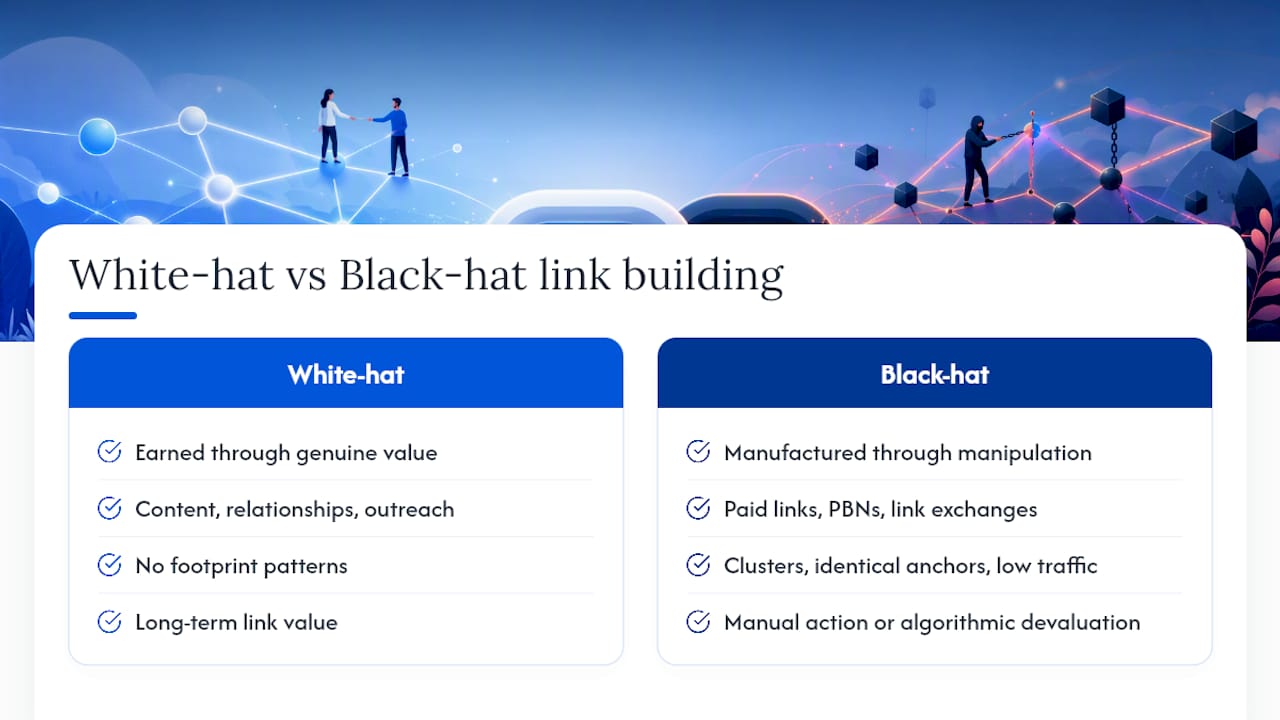
White-hat link building means earning links through genuine value: useful content, real relationships, and transparent outreach. Black-hat means manufacturing links through manipulation, and the risks are not theoretical.
Link building is the process of establishing inbound hyperlinks from external sites to your website; the distinction between white-hat and black-hat comes down to whether the link reflects real editorial judgment or was placed artificially. Paid link schemes, private blog networks (PBNs), and link exchanges at scale all fall into the black-hat category. Google’s SpamBrain detects these through footprint patterns: clusters of links appearing suddenly from similar IP ranges, identical anchor text across many domains, or links from sites with no real traffic or content.
The penalty risk is real. A manual action from Google’s spam team can suppress a site’s rankings for months. An algorithmic devaluation is quieter but equally damaging because the links simply stop passing value without any warning.
The good news is that every black-hat tactic has a white-hat alternative that works better long-term. Instead of buying links, invest that budget in a piece of original research or a free tool that earns editorial links naturally. Instead of a PBN, build genuine relationships with niche bloggers through guest contributions. Instead of link exchanges, pursue resource-page outreach where the link genuinely fits.
Pro Tip: If a vendor promises a specific number of links within days and won’t tell you where they’ll come from, walk away. Legitimate link building takes weeks, not hours, and placement transparency is non-negotiable.
Which link-building tactics actually work today
Here’s a prioritized list of tactics that hold up in 2026, starting with the highest-impact options.
-
Create linkworthy assets. Original data, free tools, local resource guides, and visual explainers attract links passively over time. A local HVAC company that publishes a seasonal energy-cost calculator for their city earns links from local blogs, news sites, and community pages without ever sending a cold email.
-
Resource page outreach. Find pages in your niche that list helpful links, then pitch your content as a natural addition. Response rates are low, but the links you earn are editorially placed and durable.
-
Broken-link reclamation. Use a tool like Semrush or Ahrefs to find pages in your niche linking to dead URLs. Reach out to the site owner with a working replacement from your own content. You’re solving a problem for them, which makes the ask easy.
-
Digital PR and journalist outreach. Platforms like Connectively (formerly HARO) connect journalists with expert sources. A well-timed, specific response to a journalist’s query can earn a link from a major publication. The key word is specific: generic responses get ignored.
-
Guest contributions on relevant sites. Write for publications your audience already reads. The link value is secondary to the audience exposure, but both matter. Avoid sites that publish guest posts from anyone willing to pay.
-
Partner and sponsorship links. Local event sponsorships, nonprofit partnerships, and supplier relationships often come with a link from the partner’s site. These are among the easiest links to earn for small businesses. A local restaurant sponsoring a youth sports league typically gets a link from the league’s website and the city parks department page.
-
Directory and profile cleanup. Audit your existing listings for accuracy and completeness. Inconsistent NAP (name, address, phone) data across directories hurts local SEO. Fixing it is free and takes an afternoon.
Pro Tip: When sending outreach, open with one sentence that shows you’ve actually read the target page (“I noticed your guide on X links to Y, which now returns a 404”). Personalization at that level doubles reply rates compared to generic templates.
For a deeper look at outreach mechanics, the backlink outreach strategy guide covers sequencing and follow-up timing in detail.
A simple starter plan for beginners
Follow these steps in order. You don’t need to complete all of them in week one.

Step 1: Run a backlink audit. Use Semrush’s Backlink Audit tool or Moz’s Link Explorer to see your current referring domains, anchor-text distribution, and any toxic links. Free tiers exist for both.
Step 2: Pick three priority pages. Choose the pages most important to your business: your homepage, your top service page, and one blog post with ranking potential. All outreach efforts focus here first.
Step 3: Build a prospect list of 30 sites. Use Semrush’s Link Building Tool or Ahrefs’ Content Explorer to find sites in your niche that link to similar content. Aim for topical relevance over raw authority.
Step 4: Create or adapt a linkworthy asset. If you have a strong existing piece of content, update it with fresh data or a new section. If not, write a focused resource guide or compile a local data set that other sites in your area would want to reference.
Step 5: Send outreach in small batches. Start with 10 emails per week. Small batches let you test subject lines and refine your pitch before scaling.
Step 6: Follow up once. A single follow-up email sent 5–7 days after the first increases response rates without burning the relationship.
Step 7: Track placements and results. Log every link you earn: the URL, anchor text, referring domain, and date. Check Google Search Console monthly for changes in organic impressions to your target pages.
Simple outreach template:
Subject: Quick note about [their page title]
Hi [Name], I was reading your [specific page] and noticed it links to [resource]. I recently published [your asset], which covers [specific angle] and might be a useful addition for your readers. Happy to share a preview if helpful.
Recommended tools:
- Semrush — backlink audits, prospect research, rank tracking
- Moz Link Explorer — domain authority checks, anchor-text analysis
- Google Search Console — free, shows which pages earn links and how organic traffic responds
For a full walkthrough of how to get backlinks that boost rankings, that guide covers content strategy and outreach sequencing together.
What a link builder actually does day to day
A link builder’s job is part researcher, part writer, part relationship manager. Here’s what the work actually looks like.
Core tasks:
- Prospect research: finding sites that are topically relevant, have real traffic, and accept external links
- Outreach sequencing: writing personalized emails, managing follow-ups, and tracking responses in a CRM or spreadsheet
- Content coordination: working with writers to produce assets worth linking to
- Placement verification: confirming that earned links are live, correctly attributed, and not nofollowed when dofollow was agreed
- Reporting: tracking referring domains, new links per month, and ranking changes for target pages
- Risk management: auditing the link profile for toxic or suspicious links and disavowing when necessary
Skills that matter: strong written communication, comfort with data tools, patience for low reply rates, and familiarity with Semrush, Moz, or Ahrefs for research and tracking.
Hire vs. DIY: If you have fewer than five target pages, a modest budget, and time to learn, DIY link building is viable for the first 3–6 months. Once you’re targeting competitive keywords, managing more than 30 outreach contacts at a time, or running a local business where every hour has a direct revenue cost, a managed service or freelance specialist typically delivers better ROI than the time you’d spend doing it yourself.
How long link building takes and what it costs
Set realistic expectations before you start, because the timelines are longer than most beginners expect.
Timeline:
- Weeks 1–4: New links get indexed; you may see small referral traffic bumps from high-traffic placements.
- Months 3–6: Ranking movement becomes visible for lower-competition keywords as domain authority builds.
- Months 6–18: Durable authority growth compounds. Competitive keywords start to move. Referring-domain diversity becomes a measurable asset.
Ballpark costs:
- DIY: Near zero in cash, but 5–10 hours per week in time. Tools like Semrush run from roughly $130/month for a starter plan.
- Freelance outreach: Per-link costs from freelancers typically range within a broad spectrum depending on the site’s authority and niche.
- Agency retainers: Full-service link building agencies generally charge significant monthly retainers for ongoing campaigns.
- Done-for-you subscription services: Structured monthly plans that bundle links with content and reporting, typically starting below agency retainer rates.
A key planning principle: grow your referring-domain count steadily rather than in sudden spikes. Sudden large spikes from similar domain types can look like manipulation to modern algorithms. Consistent monthly growth from diverse sources is both safer and more durable. For local businesses, diversifying backlink types across directories, press, and sponsorships is the most reliable path.
How to measure link-building results
Tracking the right metrics separates campaigns that improve from ones that just accumulate links.
Key metrics to monitor:
- Referring domains: Total unique domains linking to your site. This is the primary growth metric.
- New referring domains per month: Your growth rate. Steady month-over-month gains are the goal.
- Organic traffic to target pages: The downstream result of better rankings. Track in Google Search Console.
- Rankings for target keywords: Use Semrush or Moz to track weekly position changes for the 5–10 keywords tied to your priority pages.
- Referral clicks: How much traffic each new link actually sends. A link from a high-traffic page can send hundreds of visitors.
- Anchor-text distribution: Monitor the ratio of branded, generic, and keyword anchors. Over-optimization is a risk signal.
- Spam score: Moz’s spam score and Semrush’s toxicity score flag low-quality links that may need disavowing.
Tools and their best uses:
- Semrush: Backlink gap analysis, prospect research, rank tracking, and toxicity audits.
- Moz: Domain authority benchmarking, spam score monitoring, and anchor-text analysis.
- Ahrefs: Content Explorer for finding linkworthy topics, and referring-domain history to track growth trends.
Sample monthly report structure:
| Report element | What to include |
|---|---|
| New referring domains | Count of unique new domains added this month |
| Top 5 new links | URL, anchor text, estimated page traffic |
| Target keyword rankings | Current position vs. prior month for each priority keyword |
| Organic traffic to target pages | Sessions from Google Search Console, month over month |
| Action items | Links to follow up on, prospects to add, toxic links to review |
Quality matters more than volume: a relevant link from a trafficked page typically passes more value than many low-quality links, and referring-domain count matters more than raw backlink count. Keep that in mind when interpreting your monthly numbers.
What a done-for-you link-building service actually delivers
If you’re evaluating an agency or subscription service, here’s what a legitimate operation does and what red flags look like.
Agency checklist:
- Runs a baseline backlink audit before starting any outreach
- Defines a strategy tied to specific pages and keywords, not just “more links”
- Creates or coordinates content assets that give outreach a reason to succeed
- Verifies every placement: live URL, correct anchor, dofollow status confirmed
- Delivers a monthly report with referring domains, new links, and ranking changes
- Reviews the link profile for toxic additions and disavows when needed
Red flags to watch for:
- Promises a guaranteed number of links within days
- Won’t disclose where links will be placed before you pay
- Delivers links from sites with no real traffic or content
- Provides no reporting beyond a spreadsheet of URLs
- Uses the same anchor text on every link
Typical monthly deliverables from a subscription service: one or two published articles on your site, two to five editorial backlinks from a publisher network, directory and profile citations, and a reporting dashboard showing new links and ranking changes.
What actually matters in your first 90 days
Most beginners spread their effort too thin. They chase every tactic at once, build a handful of links to a dozen different pages, and then wonder why nothing moved.
The research is consistent on this: referring-domain diversity matters more than raw link count, and concentrated effort on a small number of pages produces faster, more visible results than spreading links across your entire site. Pick three pages. Build referring-domain diversity for those three pages specifically. That’s the whole strategy for the first 90 days.
The other thing beginners underestimate is how much the quality of the linking page matters relative to the linking domain. A link from a DR50 site buried on a page with zero traffic does almost nothing. A link from a DR30 site on a page that gets 2,000 monthly visits and covers your exact topic is worth far more. Stop chasing domain rating as a proxy for link value and start looking at page-level traffic and topical match instead.
One more thing: don’t wait until your content is perfect to start outreach. A perfect resource that never gets promoted earns none.
Mysearchhero handles the link building while you run your business
Building links consistently takes time, tools, and a system. For small and local businesses, the real cost isn’t the agency fee — it’s the hours spent on prospecting, writing outreach, following up, and verifying placements when that time could go directly into serving customers.
Mysearchhero is built for exactly that situation. Each month, subscribers get a bundle of published SEO articles, authority backlinks placed through a vetted publisher network, Reddit brand mentions, and social media posts, all pushed through an automated pipeline with no retainer negotiation and no long-term contract. You get the deliverables, the reporting dashboard, and the referring-domain growth without managing a single outreach sequence yourself.
If you’re a local or service-based business that wants consistent link building without hiring an agency or learning the tools yourself, see what Mysearchhero delivers and start with a free trial.
Sources
- Link building – Wikipedia
- How Google’s Algorithm Evaluates Backlinks in 2026 | Backlynk
- Are Backlinks a Google Ranking Factor? Complete 2026 Analysis
- What is Link Building? | Ahrefs
FAQ
What is link building in simple words?
Link building is getting other websites to link to yours so search engines see your site as trustworthy and relevant. More quality links from relevant sites generally means higher rankings.
What does a link builder do?
A link builder researches prospects, sends outreach emails, coordinates content, verifies that earned links are live, and tracks ranking and traffic changes month over month.
What is the difference between link building and SEO?
SEO covers everything that affects search rankings: technical setup, on-page content, and off-page signals. Link building is one part of off-page SEO, focused specifically on earning backlinks from other sites.
How much should I pay for link building?
Freelance outreach often costs a moderate amount per placed link, while agency retainers generally run at higher monthly rates. Done-for-you subscription services like Mysearchhero offer bundled monthly deliverables at rates below traditional agency retainers.