
Off-page SEO is the set of activities outside your website that build the trust and authority search engines use to rank your pages. While you control your content and code, off-page signals are what the rest of the web says about you. Three things to prioritize right now:
- Earn at least a few high-quality backlinks from relevant, authoritative sites
- Secure consistent local citations and claim your Google Business Profile
- Collect fresh reviews if you serve local customers
A single editorial link from a respected industry publication can significantly improve a page’s ranking in search results. One new five-star Google review can tip a local buyer’s decision before they ever visit your site. That is the practical reality of off-page SEO.
Key Takeaways
Off-page SEO builds the external authority and trust signals that search engines use to rank pages, and it requires a consistent, long-term program combining link earning, brand mentions, and reputation management.
| Point | Details |
|---|---|
| Off-page SEO defined | Activities outside your site (backlinks, mentions, citations, reviews) that signal authority to search engines. |
| Link quality over quantity | A few editorial links from relevant, authoritative sites outperform dozens of low-quality directory links. |
| Local priorities | NAP consistency, Google Business Profile, and fresh reviews drive local map pack rankings more than raw link volume. |
| E-E-A-T connection | Off-page signals are the primary way to earn Authoritativeness and Trustworthiness in Google’s quality framework. |
| Measure monthly | Track referring domains, referral traffic, brand mentions, and review count on a monthly cadence to catch gains and losses early. |
Table of Contents
- What is off-page SEO, and how does it differ from on-page and technical SEO?
- Why off-page SEO matters for rankings, trust, and AI discovery
- Core off-page SEO tactics and what each one actually delivers
- How to build links the right way: practical steps and outreach guidance
- Digital PR, brand mentions, and social amplification as off-page signals
- Off-page SEO for local businesses: citations, reviews, and local links
- Which metrics to track and how often to check them
- Common off-page SEO mistakes and safer alternatives
- A practical 3–6 month off-page SEO starter plan
- The honest truth about off-page SEO and when automation helps
- Sources
- FAQ
What is off-page SEO, and how does it differ from on-page and technical SEO?
Think of the three disciplines as three separate jobs. On-page SEO covers what you write and how you structure it: title tags, headings, content quality, internal links. Technical SEO covers how your site is built: crawlability, page speed, schema markup, Core Web Vitals. Off-page SEO, as Moz defines it, covers everything outside your site that influences how search engines and people perceive your authority.
The clearest way to see the difference is to think about control. On-page and technical SEO are fully in your hands. Off-page signals depend on what other sites, directories, and people choose to say about you. That dependency is exactly why they carry so much weight with Google: they are harder to fake.
| Discipline | What you control | Primary metrics moved | Typical time to impact |
|---|---|---|---|
| On-page SEO | Content, HTML, internal links | Rankings, dwell time, CTR | Weeks to months |
| Technical SEO | Site architecture, speed, crawlability | Crawl coverage, Core Web Vitals | Days to weeks |
| Off-page SEO | External links, mentions, citations, reviews | Domain authority, referral traffic, local pack | Months to a year |
Picture your site at the center of a web. Every editorial backlink, brand mention, and citation is a thread connecting you to the broader internet. Search engines follow those threads to assess how much trust to extend to your pages.
Why off-page SEO matters for rankings, trust, and AI discovery
Google’s ranking systems have always leaned on external signals to decide which pages deserve the top spots. Search Engine Land notes that off-page optimization has evolved from simple link-counting to a full trust-building framework that now feeds modern AI answer systems as well.
The framework Google uses to evaluate content quality is E-E-A-T: Experience, Expertise, Authoritativeness, and Trustworthiness. Off-page signals are the primary vehicle for earning the last two. A page can be perfectly written and technically flawless, yet still rank poorly if no authoritative source has ever pointed to it or mentioned the brand behind it.
Statistic to know: Backlinko’s research finds that E-E-A-T is the primary framework Google uses to assess content quality, and off-page signals are the main mechanism for earning Authoritativeness and Trustworthiness — which is precisely why manipulative link schemes carry serious penalty risk.
The AI angle matters more now than it did two years ago. Large language models like ChatGPT and Perplexity pull from indexed content and entity graphs when generating answers. A brand that appears consistently across authoritative sources, earns editorial mentions, and holds strong review signals is far more likely to surface in those AI-generated results than one that exists only on its own site.
Core off-page SEO tactics and what each one actually delivers
Off-page work covers more ground than most beginners expect. Here is a plain-language map of the main tactics and what each one is actually buying you.
Editorial backlinks are links from other sites that point to yours without any payment or exchange. They transfer authority directly and remain the strongest off-page signal Google recognizes.
Linkable assets are content pieces designed to attract links: original research, free tools, calculators, local resource guides. You create them once; they earn links passively over time.
Digital PR places your brand in news coverage, industry roundups, and expert commentary. The primary payoff is brand mentions and editorial links from high-authority domains.
Brand mentions without a hyperlink still carry weight. Search engines can parse unlinked mentions as entity signals, connecting your brand to a topic area even when no link is present.
Social amplification does not pass PageRank directly, but it puts content in front of journalists, bloggers, and potential link partners who might then link to it. Think of social as a distribution layer, not a ranking signal itself.
Local citations are directory listings that confirm your business name, address, and phone number (NAP) across the web. Consistency here is a foundational local ranking factor.
Reviews on Google, Yelp, and industry-specific platforms build trust with both users and search engines. For local businesses, review velocity and average rating influence map pack placement directly.
Guest posting on relevant sites earns contextual backlinks and exposes your brand to new audiences. Quality of the host site matters far more than volume of posts.
Partnerships and co-marketing with complementary businesses generate natural links, shared audiences, and local press coverage with minimal cold outreach.
When to prioritize: local businesses should lead with citations, reviews, and local links. Content sites should invest in linkable assets and digital PR. Service businesses benefit most from guest posting and strategic partnerships.
How to build links the right way: practical steps and outreach guidance
Link building is where off-page SEO gets tactical. The sequence below works for most sites starting from scratch.
-
Audit your current backlink profile. Use a tool like Ahrefs, Semrush, or Google Search Console to see which domains already link to you, which pages attract the most links, and where obvious gaps exist.
-
Create one strong linkable asset. Original data, a free calculator, or a definitive local resource guide gives other sites a reason to link without being asked. Search Engine Land confirms that linkable assets are the most reliable way to earn editorial links at scale without buying them.
-
Find resource pages in your niche. Search Google for
"keyword" + "resources"or"keyword" + "useful links". These pages exist specifically to link out; a short, value-focused pitch has a reasonable conversion rate. -
Run a broken-link reclamation campaign. Find pages in your niche that link to dead URLs, then offer your own relevant content as a replacement. Tools like Ahrefs’ broken-link checker make this fast.
-
Pitch guest posts strategically. Target sites with genuine topical overlap and real readership. One post on a mid-tier but highly relevant site beats ten posts on generic blogs. For a deeper outreach framework, the backlink outreach guide at Mysearchhero walks through the full sequence.
What to include in an outreach email: a one-line explanation of who you are, a specific compliment about their content (not generic flattery), a clear value offer (your asset, a replacement for their broken link, a guest post idea), and a preview of the asset or topic. Keep it under 150 words.
Pro Tip: Prioritize target sites by topical relevance and estimated referral traffic, not raw domain authority scores. A DR 40 site in your exact niche will move rankings more than a DR 80 site with no topical overlap. Check estimated organic traffic in Ahrefs or Semrush before you pitch.
Red flags to avoid: paid link schemes, private blog networks (PBNs), automated mass outreach tools that send hundreds of identical emails, low-quality directory submissions, and anchor text that is identical across every backlink pointing to the same page. Google’s manual actions team targets all of these. If you inherit a site with toxic links, use Google’s Disavow Tool as a last resort after attempting manual removal requests first.
For a deeper look at earning quality backlinks, Mysearchhero’s blog covers the full tactical sequence.
Digital PR, brand mentions, and social amplification as off-page signals
Digital PR does something link building alone cannot: it places your brand inside topical conversations that search engines and AI systems use to build entity graphs. A mention in a Forbes article or an industry newsletter tells Google not just that you exist, but what you are about and who considers you credible.
The tactics that generate the most useful mentions:
- Data-driven studies and surveys. Original research gives journalists a hook. A small survey of 200 customers can generate a dozen editorial mentions if the finding is genuinely surprising.
- HARO and journalist query platforms. Responding to journalist requests on platforms like Help a Reporter Out (HARO) or its successors places expert quotes in publications that would otherwise never cover you.
- Expert roundups. Contributing a sharp, specific answer to a roundup post earns a brand mention and often a link, with minimal effort.
- Influencer amplification. Micro-influencers in your niche (10,000–100,000 followers) often have higher engagement rates than large accounts and can put your content in front of exactly the right link-building audience.
Track the results with a brand-monitoring tool like Google Alerts, Mention, or Brand24. Watch for spikes in referral traffic after a PR placement, and check whether new editorial links appear in the weeks following a major mention. That lag between mention and link acquisition is normal and worth tracking.
Off-page SEO for local businesses: citations, reviews, and local links
Local off-page SEO follows a tighter, more predictable playbook than general link building. For small businesses, consistent NAP data, a handful of strong local links, and a steady stream of genuine reviews typically outperform a large volume of low-quality backlinks.
Priority checklist for local owners:
- Claim and fully optimize your Google Business Profile (hours, photos, service areas, Q&A)
- Confirm your NAP is identical across Google, Yelp, Apple Maps, Bing Places, and major industry directories
- Ask satisfied customers for Google reviews within 24–48 hours of a positive interaction
- Respond to every review, positive or negative, within a week
- Pursue local links from chamber of commerce pages, community event sponsorships, local press coverage, and complementary business partnerships
- Submit to a short list of high-quality, niche-relevant directories (avoid mass directory blasts)
Reviews and citation accuracy beat raw link count for local map pack rankings. A business with 80 consistent citations and 40 recent four-star reviews will usually outrank a competitor with 200 backlinks but inconsistent NAP data and no review activity. For more on building local authority, the local brand authority guide at Mysearchhero goes deeper on reputation signals.
Which metrics to track and how often to check them
Measuring off-page SEO requires tracking signals across several tools. No single dashboard covers everything.
| Metric | Tool | Reporting cadence |
|---|---|---|
| Referring domains (new and lost) | Ahrefs, Semrush, Google Search Console | Monthly |
| New backlinks by quality tier | Ahrefs, Semrush | Monthly |
| Referral traffic | Google Analytics 4 | Monthly |
| Brand mention volume and sentiment | Google Alerts, Mention, Brand24 | Weekly |
| Review count and average rating | Google Business Profile Insights | Monthly |
| Local pack visibility | BrightLocal, Whitespark | Monthly |
| Branded search volume | Google Search Console | Quarterly |
Monthly reporting should cover referring domain growth, any lost links worth reclaiming, referral traffic trends, and review activity. Quarterly reviews should zoom out to assess branded search volume growth and local pack ranking shifts. Those slower-moving metrics are the clearest signal that off-page work is compounding.
Common off-page SEO mistakes and safer alternatives
Most off-page penalties come from impatience. The shortcuts that seem to accelerate results almost always create problems that take longer to fix than the original ranking gap.
- Buying links from link brokers or “sponsored post” networks violates Google’s guidelines and risks a manual action. The safer alternative: invest that budget in creating one strong linkable asset and doing manual outreach to relevant sites.
- Link networks and PBNs are detectable by Google’s algorithms and have been for years. Replace them with genuine guest posting on real editorial sites.
- Spammy directory submissions dilute your link profile with low-authority noise. Submit to a short list of high-quality, niche-relevant directories instead.
- Identical anchor text across many links is a manipulation signal. Vary anchor text naturally: branded, partial-match, and generic anchors should all appear in a healthy profile.
- Automated mass outreach generates spam complaints and burns your domain’s sender reputation. Manual, personalized outreach at lower volume converts better and carries no risk.
If you discover a batch of toxic links pointing to your site (from a previous owner or a negative SEO attack), start with manual removal requests to the linking sites. Only escalate to Google’s Disavow Tool if removal requests fail and the links are genuinely harmful.
A practical 3–6 month off-page SEO starter plan
This timeline sequences the work in the order that builds the most durable foundation. Adjust the pace based on your available hours per week.
| Month | Primary objective | Key success metrics |
|---|---|---|
| 1 | Audit backlink profile; identify gaps and toxic links | Baseline referring domain count; list of reclamation targets |
| 2 | Create one linkable asset; claim and optimize Google Business Profile | Asset published; GBP fully complete |
| 3 | Begin outreach: resource pages, broken links, one guest post pitch | 3–5 new referring domains from relevant sites |
| 4 | Launch digital PR or HARO campaign; collect first review batch | 2–3 brand mentions in relevant publications; 10+ new reviews |
| 5 | Expand local citations; pursue one local partnership link | NAP consistent across top 20 directories; 1 local editorial link |
| 6 | Measure, iterate, and double down on what worked | Increase in branded search volume; referral traffic up from new links |
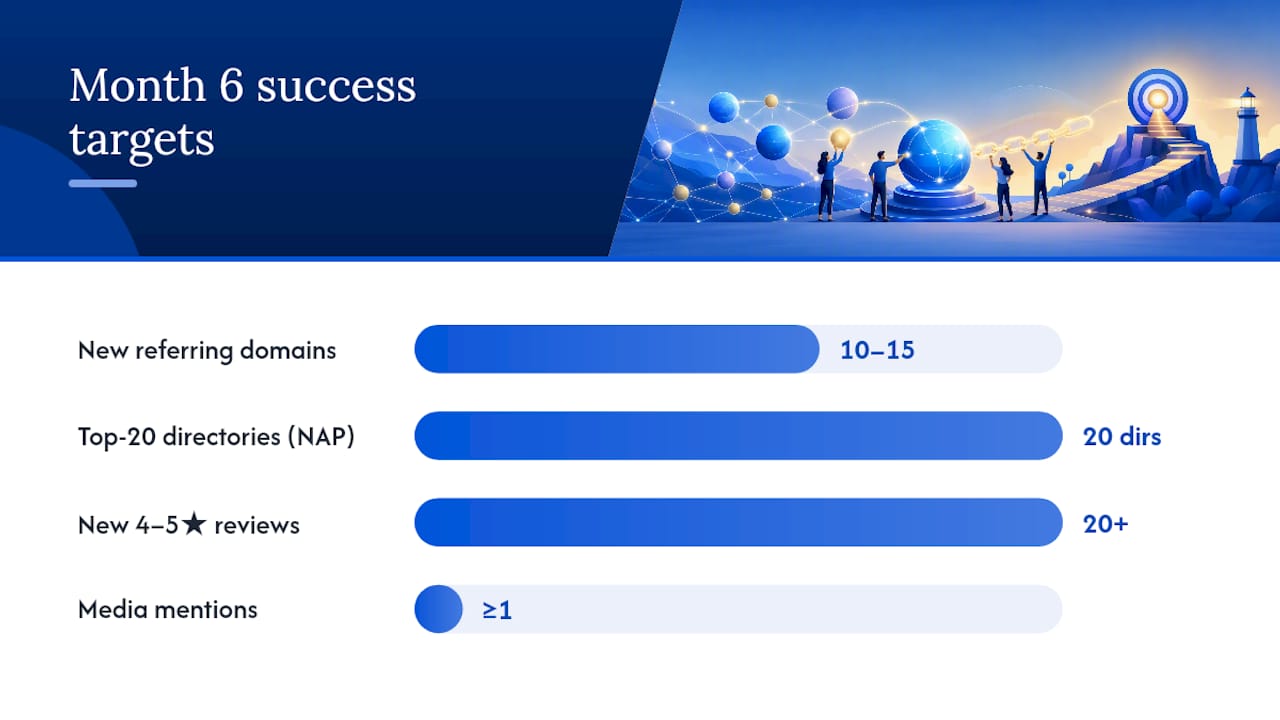
Concrete success criteria to aim for by month 6:
- At least 10–15 new referring domains from topically relevant sites
- NAP data consistent across your top 20 directory listings
- A minimum of 20 new four-star or five-star reviews on Google
- A measurable increase in branded search impressions in Google Search Console
- At least one piece of coverage or mention in a relevant publication or local outlet
The plan works for beginners because it sequences effort logically: you audit before you build, you create assets before you pitch, and you measure before you scale. Skipping the audit phase is the most common mistake new practitioners make.
The honest truth about off-page SEO and when automation helps
Off-page SEO is fundamentally relationship-driven work. The best links come from people who genuinely find your content useful, and the best reviews come from customers who had a real experience worth sharing. No shortcut changes that underlying dynamic.
That said, the repetitive, process-heavy parts of off-page work — publishing content consistently, distributing it across platforms, building citation listings, and maintaining a steady backlink acquisition cadence — are exactly where automation earns its keep. Mysearchhero’s automated SEO service handles the monthly publishing, backlink acquisition, and brand mention pipeline so you can focus on the relationship and strategy layer that automation cannot replace.
If you want your off-page program running on autopilot while you run your business, Mysearchhero handles the monthly deliverables: published articles, authority backlinks, Reddit brand mentions, and social posts, all pushed through a fully automated pipeline.
Sources
- What Is Off-Page SEO? How To Do It & Strategies That Work – Moz
- What is off-page optimization?
- Off-Page SEO: The Complete Guide for 2026
FAQ
What is off-page SEO in simple terms?
Off-page SEO is everything you do outside your own website to improve how search engines rank your pages, including earning backlinks, collecting reviews, and building brand mentions across the web.
How long does off-page SEO take to show results?
Most sites see measurable movement in referring domains and referral traffic within a few months of consistent effort, though competitive keywords can take longer to show significant ranking shifts.
Is off-page SEO the same as link building?
No. Link building is the most important component of off-page SEO, but the discipline also includes brand mentions, local citations, reviews, digital PR, and social amplification.
How many backlinks do I need to rank?
There is no fixed number. Link quality and topical relevance matter far more than volume. A handful of editorial links from authoritative, relevant sites will outperform hundreds of links from low-quality directories.
Can off-page SEO hurt my site if done wrong?
Yes. Buying links, using private blog networks, or building links with manipulative anchor text can trigger a Google manual action or algorithmic penalty. Stick to earning links through content and genuine outreach.