
TL;DR:
- Marketing automation is affordable and essential for small businesses to handle repetitive marketing tasks efficiently. It uses trigger-based workflows across multiple channels to engage customers at key moments, improving lead management and sales. Success depends on clean data, team alignment, and ongoing optimization, with providers like My Search Hero simplifying implementation.
Most small business owners picture marketing automation as something only enterprise companies with six-figure tech budgets can use. That’s the wrong picture entirely. What is marketing automation, really? It’s software that handles repetitive marketing tasks for you, automatically, so you’re not stuck manually sending follow-up emails at 11 PM or forgetting to post on social media for a week. This guide breaks down how it works, why it matters for businesses your size, and how to actually get it running without overcomplicating things.
Table of Contents
- What is marketing automation and how does it work?
- Why marketing automation matters for small and mid-sized businesses
- Orchestrating cross-channel customer journeys with marketing automation
- Marketing automation vs. personalization: What’s the difference?
- How to get started with marketing automation in your business
- The hidden pitfalls of marketing automation many businesses miss
- Streamline your marketing automation with My Search Hero
- Frequently asked questions
Key Takeaways
| Point | Details |
|---|---|
| Marketing automation defined | It uses software workflows triggered by customer behavior to automate repetitive marketing tasks like emails and posts. |
| Boosts small business efficiency | Automating lead nurturing and segmentation saves time and increases qualified leads and sales productivity. |
| Cross-channel message orchestration | Automation ensures consistent, timed customer engagement across email, social, web, and text. |
| Automation vs personalization | Automation controls delivery timing, while personalization focuses on tailoring the message content. |
| Start simple and align teams | Begin with key triggers and coordinate marketing and sales to maximize automation impact and ROI. |
What is marketing automation and how does it work?
At its core, marketing automation is software that handles repetitive tasks like email campaigns, social posting, and lead nurturing by running rules and workflows that fire automatically when contacts do something specific. No manual trigger needed. No one sitting at a desk pressing send.
The engine behind it follows a simple pattern. A customer takes an action. That action trips a trigger. The system responds with a pre-set behavior. The result gets logged and measured. This trigger-to-result pattern works like this: a visitor fills out a form on your website, the automation immediately sends them a welcome email, and their record in your CRM updates to reflect the interaction.
Some real-world examples of this in action:
- A new subscriber joins your email list and receives a three-part welcome sequence over five days
- A lead visits your pricing page and gets tagged for a follow-up offer
- Someone requests a demo and your sales rep receives an instant notification
- A customer hasn’t purchased in 90 days and receives a re-engagement offer
- A contact clicks a specific link and gets moved into a different nurture track
The trigger-action-result model is what separates automated marketing from one-off email blasts. It creates a living system that responds to what real people actually do, not what you hope they’ll do. Explore more about the marketing automation benefits for businesses like yours.
Why marketing automation matters for small and mid-sized businesses
Time is the one thing small business owners are always short on. Automation directly solves that. Instead of manually following up with every lead or remembering to post content on four different platforms, your system does it for you.
The business case is well documented. Salesforce reports measurable gains from automation that should get any business owner’s attention:
“Marketing automation drives a 14.5% increase in sales productivity, a 12.2% reduction in marketing overhead, a 451% increase in qualified leads, and nurtured prospects making purchases 47% larger on average.”
Think about what that last number means for your business. When a lead is properly nurtured through automated sequences instead of receiving one cold pitch, they spend nearly half again as much. That’s not magic. That’s consistent, well-timed communication building trust before the ask.
For small and mid-sized teams, the specific benefits stack up quickly:
- Time savings: Your team stops doing manual follow-ups and focuses on work that actually needs a human brain
- Better lead management: Leads get scored and segmented automatically based on behavior, so hot prospects don’t fall through the cracks
- Consistent messaging: Every new contact goes through the same quality experience regardless of how busy your team is
- Cost reduction: Fewer manual tasks mean lower labor costs and fewer errors
- Improved personalization: Behavioral data lets you send relevant content instead of generic blasts
Streamlining lead generation is one of the biggest wins small teams see early on. When your system automatically scores and routes leads, your sales people spend time on conversations that are actually worth having.
Orchestrating cross-channel customer journeys with marketing automation

Here’s where it gets genuinely powerful. Marketing automation tools don’t just send emails. Modern platforms coordinate across email, web, social, and text to keep messaging consistent within defined workflows, building a full customer journey rather than isolated touchpoints.
Picture this: a potential customer sees your Instagram post, clicks through to your website, browses your services page, and signs up for your newsletter. A well-built automation system recognizes all of those signals and begins a tailored sequence. They get an email about the specific service they looked at. If they open it and click, they move into a deeper track. If they don’t open within three days, they get a different message.
What makes cross-channel orchestration valuable for small businesses:
- Messages arrive when the customer is most likely to engage, not just when you remember to send them
- Brand voice stays consistent whether someone hears from you via email, SMS, or a retargeted ad
- You can map an entire customer journey from first click to purchase without manually managing each stage
- Data from every channel feeds back into the system to refine future messages
Pro Tip: Before building any cross-channel workflow, map your customer’s journey on paper first. Know what they see, what they do, and what they need at each stage. Automation should follow the journey, not define it. Consider automating customer journeys as your north star when designing any new workflow.
Your team stops being the bottleneck. Campaigns run on schedule, respond to behavior in real time, and keep the conversation going without anyone manually pressing send.
Marketing automation vs. personalization: What’s the difference?
This is where a lot of small businesses go wrong. They set up automation and assume that equals personalization. It doesn’t.
Automation and personalization are not the same thing, but they work best together. Automation controls when and how tailored content gets delivered based on behavior and triggers. Personalization is about what you actually say, tailoring the content itself to the recipient based on their preferences, history, or profile.
Think of it this way. Automation is the delivery driver. Personalization is the package. You need both to make it work.
Here’s how they break down in practice:
- Automation: Sends an email 24 hours after a form submission, every time, without fail
- Personalization: That email references the specific product the person looked at and uses their first name
- Automation: Moves a contact to a different list when they click a specific link
- Personalization: The new list receives content about their demonstrated interest category
- Automation: Triggers a cart abandonment sequence when someone leaves without purchasing
- Personalization: That sequence shows the exact items left in the cart
Confusing the two leads to campaigns that run on time but say nothing relevant. You get technical delivery without emotional connection. The goal is using personalization with automation together so every message arrives at the right moment and actually resonates.
How to get started with marketing automation in your business
The biggest mistake people make is trying to automate everything at once. Start narrow. Start where intent is obvious.

Practitioners start with two to three high-intent triggers before building anything more complex. Think: form submission leads to an onboarding email, a pricing page visit triggers an offer, a demo request notifies sales. These are clear signals of customer interest with measurable follow-through.
Here’s a practical starting framework:
- Identify your highest-intent actions. What do contacts do right before they buy? Form fills, pricing page visits, and cart adds are usually your starting points.
- Build one simple workflow for each trigger. Keep it to two or three emails before you add complexity. Validate that it works and converts.
- Add branching logic as you learn. Once you see who opens, who clicks, and who ignores, build if/then paths that respond to actual behavior.
- Connect your CRM to your automation platform. Data silos kill automation. Your sales team needs to see what marketing does, and vice versa.
- Measure and refine regularly. Check open rates, click rates, and conversion rates monthly. Kill what isn’t working. Improve what is.
Aligning marketing and sales is non-negotiable. Automation must nurture leads and route them effectively to sales, not leave them in a workflow indefinitely. Without that handoff, you’re warming up leads your sales team never sees.
Pro Tip: Build your effective automation workflows with an agreed definition of what “sales-ready” means. When does a nurtured lead become a sales conversation? That threshold should be decided before automation goes live.
Below is a simplified comparison of what to consider when evaluating marketing automation software for your business:
| Feature | Entry-level tools | Mid-tier platforms | Advanced platforms |
|---|---|---|---|
| Email automation | Yes | Yes | Yes |
| Lead scoring | Limited | Yes | Advanced |
| CRM integration | Basic | Native or API | Deep native |
| Multi-channel support | Email only | Email, SMS, social | All channels |
| Branching workflows | No | Yes | Yes |
| Best for | Solopreneurs | Small to mid teams | Growing companies |
| Typical monthly cost | $0-$50 | $50-$500 | $500+ |
Pair your platform choice with solid lead nurturing strategies to get the most out of whichever tool you choose.
The hidden pitfalls of marketing automation many businesses miss
Most guides on this topic end at “choose your platform and go.” That’s where things actually get complicated.
The single biggest killer of marketing automation success isn’t the software. It’s dirty data. Automation is only as good as the information feeding it. If your CRM has duplicate records, missing fields, or contacts who opted out years ago, your workflows are working hard on the wrong people. Clean data isn’t glamorous, but it’s the foundation everything else sits on.
The second pitfall is the assumption that automation removes the need for coordination between marketing and sales. Building automations without aligning data flow and ownership between those two teams is a common trap that leads to messaging without effective lead handoff. Marketing generates the lead. Automation nurtures it. Sales closes it. If any part of that chain breaks, you lose revenue you earned.
The third thing most businesses miss is workflow maturity. Starting with a basic welcome email is fine. Staying there is a waste. Automation workflows gain far more value as they evolve from simple emails into branching if/then logic based on real engagement. That maturity takes time and testing. Expect it.
Finally, automation is not a set-and-forget tool. The businesses that get the most out of it treat their workflows the same way they treat any live campaign: they review performance, update messaging, and retire sequences that no longer reflect where the business is going. Invest in training your team to understand what’s running and why. The ROI follows that discipline. For a deeper look at where businesses go wrong, review common automation common mistakes before you build.
Streamline your marketing automation with My Search Hero
You now understand what marketing automation can do, where it creates real value, and where it tends to break down. The next step is implementation, and that’s where most small business owners stall. Building workflows, connecting platforms, aligning sales and marketing, and keeping everything running takes time and expertise that’s hard to develop in the middle of running a business.
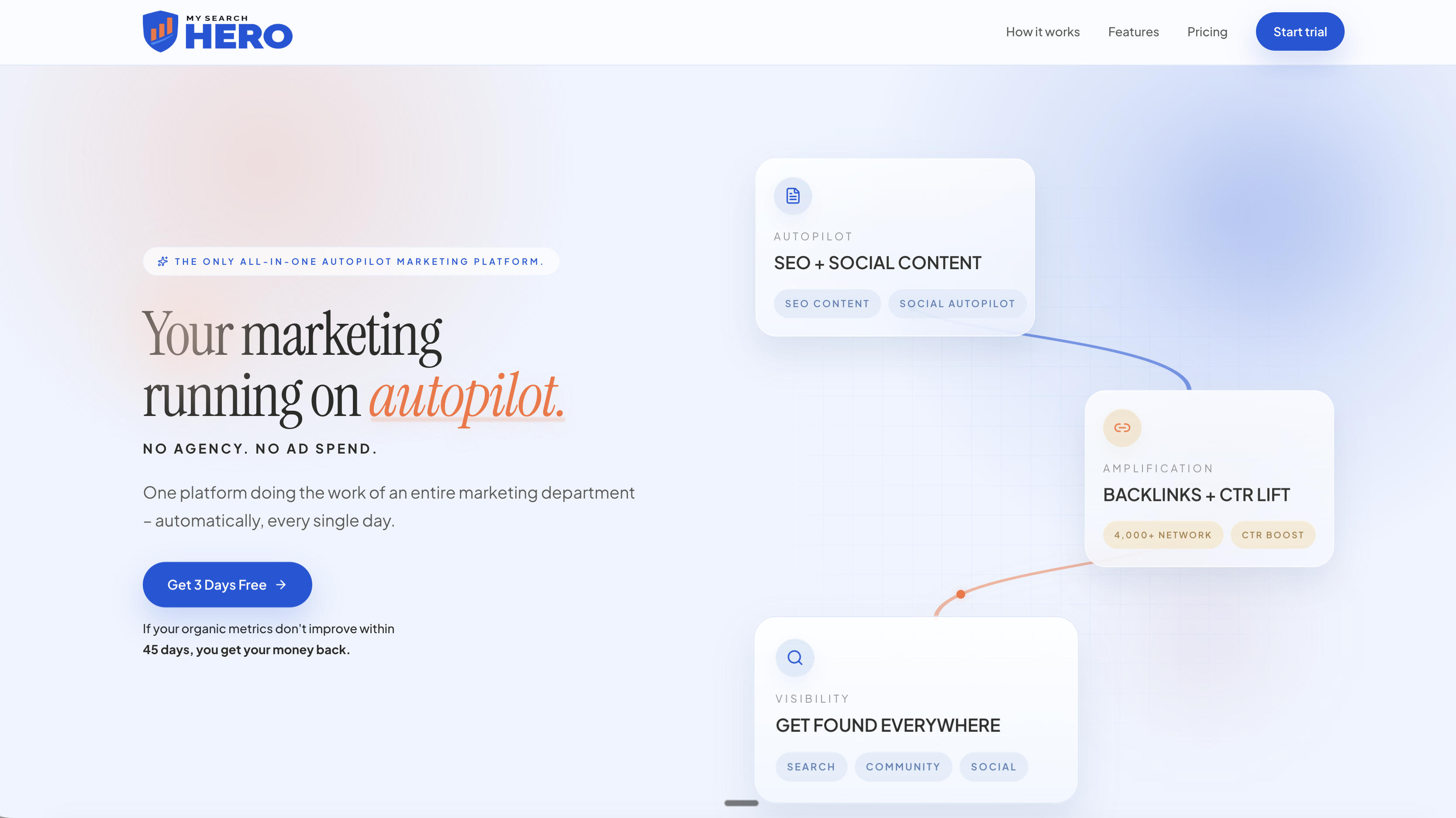
That’s exactly what My Search Hero is built for. As a done-for-you marketing automation solutions provider, My Search Hero builds and manages multi-channel marketing systems tailored to your business goals. From setting up trigger-based workflows to coordinating your content across channels, the team handles the technical work so you can focus on your customers. You get consistent output, measurable results, and a pipeline that runs whether you’re in the office or not. Explore all digital marketing services and find out how to get your marketing running on autopilot.
Frequently asked questions
What tasks can marketing automation handle for small businesses?
Marketing automation handles email campaigns, social media posting, lead nurturing, lead scoring, list segmentation, and reporting, freeing your team from repetitive work and reducing the chance of leads slipping through.
How does marketing automation improve lead qualification?
Lead scoring triggers automatic routing of qualified leads to the right sales reps based on behavior, so your team spends time on prospects most likely to convert rather than cold contacts.
Is marketing automation the same as personalization?
No. Automation controls when content is delivered based on triggers and behavior, while personalization shapes what that content actually says. Both are necessary for campaigns that feel relevant and timely.
What should I focus on when starting with marketing automation?
Start with two to three high-intent triggers, build simple workflows, and get your marketing and sales teams aligned on what a qualified lead looks like before you go live.
Can small businesses benefit from marketing automation without large budgets?
Yes. Benefits extend to small teams through time savings, reduced manual errors, and increased qualified leads, and many entry-level platforms offer meaningful automation features at low or no cost.