
TL;DR:
- SEO is essential for service businesses because it connects you with clients actively seeking your services online.
- Ranking on Google builds credibility and generates long-lasting inbound leads, reducing reliance on paid advertising.
Most service business owners assume SEO is something that e-commerce stores or big brands worry about. If you run a law firm, a cleaning company, or a landscaping business, you might think your clients come from referrals and word of mouth, so why bother with search rankings? That assumption is quietly costing you clients every single month. When someone needs a plumber at 11 PM or is searching for a family therapist on a Tuesday afternoon, they go straight to Google. If your business isn’t showing up, a competitor is getting that call instead of you.
Table of Contents
- How SEO connects your services to booking-ready customers
- Boosting credibility and trust through SEO
- SEO as a measurable growth engine for your business
- Organic SEO vs. paid ads and AI search trends
- Why service business SEO must focus on intent, not just traffic
- Ready to grow your service business with proven SEO strategies?
- Frequently asked questions
Key Takeaways
| Point | Details |
|---|---|
| Target high-intent keywords | SEO helps you connect with customers actively searching for your services, increasing conversions. |
| Leverage reviews for trust | Online reviews and testimonials directly boost your authority and search rankings. |
| Use SEO to track growth | With SEO reporting, you can measure leads, traffic, and ROI for continual improvement. |
| Balance SEO with paid ads | SEO is a long-term asset, but combining it with paid ads can yield faster results when needed. |
How SEO connects your services to booking-ready customers
There’s a critical difference between someone casually browsing the internet and someone who is actively ready to hire. SEO puts your business in front of the second group. These are people typing phrases like “emergency HVAC repair near me” or “divorce attorney in Phoenix” because they need help right now and are ready to book.
As high-intent searches for services demonstrate, SEO helps service businesses build an ongoing inbound channel rather than one-time exposure. That means every month, new clients who are already motivated to hire can find you without you having to actively chase them. It’s the difference between cold outreach and warm inbound leads showing up at your digital door.
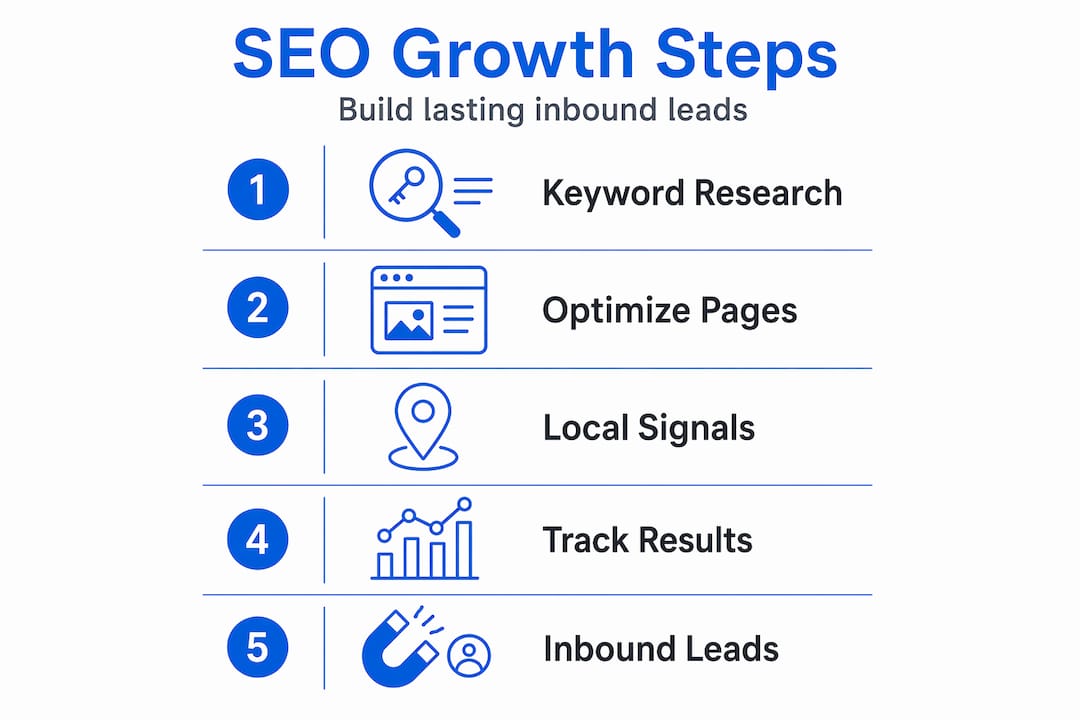
SEO increases inbound leads over time by layering ranking improvements, content, and local signals. Unlike a paid ad that stops working the moment you pause your budget, organic rankings keep pulling in traffic while you focus on delivering your service.
Here’s what separates SEO traffic from other channels for service businesses:
| Traffic channel | Intent level | Cost over time | Longevity |
|---|---|---|---|
| Organic SEO | High | Decreases over time | Long-lasting |
| Paid ads (PPC) | Medium to high | Ongoing spend required | Stops when budget ends |
| Social media | Low to medium | Time and content-intensive | Algorithm-dependent |
| Referrals | Very high | No direct cost | Inconsistent volume |
Types of service keywords you should be targeting:
- “Service type + city” (e.g., “accountant in Austin”)
- “Service type + near me” (e.g., “roof repair near me”)
- “Problem + solution” (e.g., “leaking pipe fix”)
- “Service type + qualifier” (e.g., “affordable family lawyer Dallas”)
- “Best + service type + location” (e.g., “best dog groomer in Seattle”)
Pro Tip: Add location modifiers to every core service page you have. A page titled “Plumbing Services” will almost never rank as well as “Plumbing Services in Chicago.” The more specific you get, the more you attract clients who are geographically ready to hire you.
Aligning SEO content with buyer intent is one of the fastest ways to turn website visitors into actual inquiries. When your content directly matches what someone types into Google, you win the click and often the booking.
Boosting credibility and trust through SEO
Ranking on the first page of Google does more than drive traffic. It signals to potential clients that your business is legitimate, established, and worth trusting. Think about your own behavior when you search for a service. You rarely scroll to page two. The businesses at the top feel more credible, even if you’ve never heard of them before.

SEO delivers brand visibility and credibility by improving your position in search results, which drives more clicks and conversions compared to relying solely on paid visibility. Paid ads have a small “Sponsored” label that many users consciously skip. Organic results carry an implied endorsement from Google itself.
But credibility doesn’t stop at rankings. Online reviews are now a core part of how service businesses win or lose clients. Most consumers read online reviews before choosing a local provider, and that pattern has a direct effect on your SEO too. Review signals feed directly into local search rankings, especially in Google’s local map pack.
“97% of consumers read reviews for local businesses, using an average of six different review platforms before making a decision.”
That statistic should stop you in your tracks. Nearly every potential client will look at your reviews before they ever pick up the phone. If your reviews are sparse, outdated, or negative, your conversion rate takes a hit regardless of how well your pages rank.
Here’s a look at how major review platforms compare in their SEO and conversion impact:
| Review platform | SEO impact | Consumer trust level | Best for |
|---|---|---|---|
| Google Business Profile | Very high (local rankings) | Very high | All local service businesses |
| Yelp | Medium | High | Restaurants, home services |
| Facebook Reviews | Medium | Medium to high | Service businesses with social presence |
| BBB (Better Business Bureau) | Medium | High | Professional services |
| Industry-specific directories | Varies | High in niche | Law, medical, trades |
Quick credibility boosters you can implement today:
- Ask satisfied clients for Google reviews immediately after a job is done
- Display testimonials prominently on your service pages
- List any industry certifications, awards, or accreditations
- Get your business listed on trusted directories like Yelp, Angi, and BBB
- Use LinkedIn optimization tips to build your personal brand as the face of your business
Exploring local SEO tactics and key local SEO tactics can help you combine review strategies with on-page optimizations that reinforce your authority in local search results.
SEO as a measurable growth engine for your business
One of the reasons service business owners hesitate to invest in SEO is that it can feel abstract. Unlike running a Facebook ad where you see impressions and clicks right away, SEO results seem to build slowly in the background. But here’s the thing: SEO is actually one of the most measurable marketing channels available to you.
SEO works as a measurable growth channel specifically because it tracks against real business goals, including traffic, leads, and conversions, rather than functioning as purely awareness-based marketing. You can see exactly which pages drive phone calls, which keywords bring in the most form submissions, and where your funnel breaks down.
The ability to boost your local business visibility through trackable SEO methods means you can course-correct in real time rather than guessing what’s working.
Here are the key steps to measure and interpret your SEO return on investment:
- Set up Google Search Console. This free tool shows you which keywords your site ranks for, how many people click through to your pages, and where you’re losing impressions to competitors.
- Connect Google Analytics. Track sessions, bounce rates, and goal completions (form fills, phone call clicks) to see which organic traffic actually converts.
- Define monthly goals. Don’t just track “more traffic.” Set goals like “increase calls from organic search by 15% this quarter.”
- Monitor keyword positions weekly. Use a rank tracking tool to watch whether your target service keywords are climbing or dropping.
- Calculate cost per lead. Divide your monthly SEO investment by the number of leads generated from organic traffic. Compare this with your cost per lead from paid ads and referral programs.
- Review and adjust quarterly. Look at what’s gaining traction and double down on it. If a page is ranking on page two, a few targeted improvements can push it to page one.
Pro Tip: Set up conversion tracking for phone calls on your website. Many service businesses get most of their leads via phone, not forms. If you’re not tracking calls tied to organic traffic, you’re severely underestimating the value of your SEO.
When you see exactly which service pages are generating calls and bookings, the path forward becomes obvious. You stop guessing and start optimizing with confidence.
Organic SEO vs. paid ads and AI search trends
The digital marketing landscape keeps changing, and in 2026, two major conversations keep coming up: paid advertising and AI-powered search. Understanding where organic SEO fits relative to these channels helps you make smarter decisions about where to put your resources.
Here’s how the three main channels stack up:
| Channel | Speed of results | Long-term value | Best use case |
|---|---|---|---|
| Organic SEO | Slow to medium | Very high | Sustained lead generation |
| Paid ads (PPC) | Fast | Low (stops when budget ends) | Launches, promotions |
| AI search referrals | Variable | Uncertain | Research and awareness |
Despite all the buzz around AI search tools, organic SEO still dominates conversions, while AI-driven traffic accounts for less than 1% of search volume. AI tools tend to assist users in the research phase rather than the booking phase. Your clients might use an AI assistant to learn about different types of HVAC systems, but when they’re ready to call someone, they go to Google.
Paid ads have an important role too. PPC may be more impactful when you need immediate visibility, such as when launching a new service or entering a new market. But paid ads are a cost that scales with your growth. SEO costs stabilize while your traffic compounds.
Pros and cons of each channel:
- Organic SEO pros: Long-term value, builds authority, compounds over time, low cost per lead at maturity
- Organic SEO cons: Slow to start, requires consistent effort and patience
- PPC pros: Immediate results, highly targetable, great for testing
- PPC cons: Expensive, zero value when budget ends, increasing competition drives costs up
- AI search pros: Growing presence, can position you as an authority if optimized well
- AI search cons: Minimal conversion traffic currently, uncertain future behavior
For deeper insight into AI trends in SEO and how to stay ahead, it’s worth studying how these shifts affect local search behavior specifically.
Pro Tip: Don’t treat SEO and paid ads as competitors. Run paid ads on your top converting keywords while your organic rankings build. Once your SEO matures and those pages rank organically, reduce paid spend on those terms and redirect that budget toward new growth areas. You can also explore marketing strategy tips for layering tactics effectively.
Why service business SEO must focus on intent, not just traffic
Here’s the contrarian view we’ve developed after working with service businesses across dozens of industries: most service businesses that “do SEO” are optimizing for the wrong thing.
They celebrate traffic increases. They chase blog topics with high search volume. They publish informational content about broad industry topics and wonder why their phone isn’t ringing more. Here’s the hard truth: traffic without booking intent is almost worthless for a service business.
When service pages target the wrong intent, such as informational topics when buyers are searching to book or compare, you may see more visitors without getting more calls. A law firm ranking for “how does child custody work in Texas” gets curious readers. A law firm ranking for “child custody attorney in Austin” gets prospective clients.
“Service SEO should prioritize revenue-intent service pages and local modifiers, not just broad informational traffic.”
The fix isn’t complicated, but it requires a mindset shift. You need to organize your SEO strategy around two categories: pages that get you found (service pages with local modifiers) and content that builds trust (case studies, testimonials, FAQs about your process). Most service businesses over-invest in the second category and neglect the first.
Every service you offer deserves its own dedicated page, optimized for the specific phrase a ready-to-book client would type. If you offer three services in two cities, that’s six pages you need at minimum. Each one should include the service name, the location, a clear call to action, and trust signals like reviews and credentials.
SEO increases inbound leads most effectively when your site structure mirrors how your clients search, not how you think about your business internally. Rename your services using the language your clients use, not industry jargon. Test your assumptions by typing your own service keywords into Google and seeing what the search results and “People also ask” sections reveal about real buyer language.
Pro Tip: Use Google Search Console to find which queries are already bringing people to your site. Look for keywords where you’re getting impressions but low clicks. Those are ranking opportunities one optimization away from generating real leads.
The businesses winning at SEO aren’t necessarily the ones with the best writers or the biggest content calendars. They’re the ones who understand exactly what their clients type when they’re ready to hire, and they’ve built their entire online presence around those moments.
Ready to grow your service business with proven SEO strategies?
If you’ve made it this far, you already understand something most of your competitors don’t: SEO isn’t just for big brands or online stores. It’s one of the most powerful tools a service business can use to consistently attract clients who are ready to book.
At MySearchHero, we handle the entire SEO and content marketing process for you on autopilot. Every month, your business gets published articles, quality backlinks, Reddit mentions, and AI-generated social media posts, all pushed out through a fully automated pipeline so you can focus on serving clients instead of chasing them. Explore our service SEO solutions and see exactly how we help service businesses like yours grow their online presence without adding work to your plate.
Frequently asked questions
What types of service businesses benefit most from SEO?
Any business where customers search for services locally or online can benefit significantly. Plumbers, law firms, cleaning services, tutors, therapists, and contractors all see strong returns because high-intent searches for services are exactly what local SEO is built to capture.
How quickly can I see results from SEO for my service business?
SEO results typically begin showing within three to six months of consistent effort, but PPC may be more impactful when you need immediate visibility for a new service or market entry.
Are online reviews really important for SEO success?
Yes, and significantly so. 97% of consumers read reviews for local businesses, and review signals directly influence both local search rankings and conversion rates.
Is organic SEO still relevant with the rise of AI search?
Absolutely. Organic search still dominates conversions while AI-driven traffic accounts for less than 1% of overall search volume, making organic SEO the most reliable long-term channel for service business growth.