
TL;DR:
- Blogging is a powerful long-term strategy that increases SEO visibility, generates leads, and builds customer trust. It offers sustainable growth, with content compounding in value and ranking over time, unlike paid advertising. Consistent, targeted blog posts aligned with the buyer journey are essential for small businesses seeking organic, scalable success.
If you’ve ever wondered why blog for business at all when you’re already juggling operations, payroll, and customer service, you’re not alone. Most small business owners treat a blog as a nice-to-have, not a growth driver. That’s a costly mistake. Blogging ranks among the top-performing channels for ROI, trust-building, and organic traffic. This article breaks down the real benefits of blogging for business, from how it compounds search visibility over time to how it generates leads while you sleep, so you can decide whether it belongs in your marketing plan.
Table of Contents
- Key takeaways
- Why blog for business: the SEO case
- How blogging builds leads and customer trust
- The long-term ROI reality
- Common blogging mistakes and how to avoid them
- My take: blogging is the most underrated tool in small business marketing
- Put your blog on autopilot with Mysearchhero
- FAQ
Key takeaways
| Point | Details |
|---|---|
| Blogging multiplies SEO reach | Each post targets different keywords, giving search engines more pages to index and rank. |
| Blogs generate more leads | Businesses that blog consistently generate 67% more leads per month than those that don’t. |
| ROI compounds over time | Blog content keeps working for months and years, unlike paid ads that stop the moment you stop spending. |
| Strategy beats volume | Aligning posts to the buyer journey and adding clear calls to action turns readers into customers. |
| Patience is required | Most blogs need 6 to 12 months before meaningful ROI appears. Starting now matters more than starting perfectly. |
Why blog for business: the SEO case
Search engines reward websites that publish fresh, relevant, well-structured content. A blog is the single most practical way to do that consistently. Every post you publish is a new indexed page targeting a specific search query. Over time, those pages accumulate, and your site begins to show up for dozens, then hundreds, of searches your homepage alone could never capture.
Here’s what that looks like in practice. A plumbing company’s homepage ranks for “plumber in Austin.” But a blog post titled “Why Your Water Heater Makes a Popping Sound” can rank for a completely different long-tail search. That post attracts a homeowner with a problem, and that homeowner becomes a lead. The importance of business blogging for SEO lies precisely in this ability to capture intent-specific searches at scale.
The data backs this up. Medium-sized websites with blogs see organic traffic grow at 24.3% compared to just 7.2% for sites without blogs. That’s more than triple the growth rate, and it compounds. A post that earns strong engagement signals in year one keeps pulling in traffic in year three.

Beyond traffic, blogs attract backlinks naturally. Other websites cite useful, well-written content. Those citations improve your domain authority and push every page on your site higher in search rankings. Blogs also create internal linking opportunities that distribute authority across your site and guide visitors deeper into your content.
Pro Tip: Pick one primary keyword per blog post and write the entire piece to answer that specific question completely. Partial answers rank poorly. Comprehensive ones rank and stay ranked.
The advantages of a business blog for SEO are not theoretical. They are measurable, and they grow proportionally with consistency. One post a month beats zero. Four posts a month beats one.
How blogging builds leads and customer trust
Traffic without conversion is just vanity. The real reason to blog is what happens after someone reads your post. A well-structured blog does not just attract visitors. It educates them, builds trust, and moves them toward a purchase decision.
Businesses that blog consistently generate 67% more leads per month than businesses that don’t. That number is not an anomaly. It reflects how the buyer journey actually works. Most people research before they buy. A blog puts your expertise directly in front of them during that research phase, before your competitors even enter the conversation.
Here’s how to make that work strategically:
- Write for the awareness stage. Posts like “How to Know If You Need a New Roof” attract people early in their decision process. These readers don’t know you yet. This is your introduction.
- Write for the consideration stage. Posts like “Metal Roof vs. Asphalt Shingles: What’s Better for Your Home?” pull in readers comparing options. They’re closer to buying.
- Write for the decision stage. Posts like “What to Expect During a Roof Replacement” reassure readers who are nearly ready to hire someone. A strong call to action here converts.
- Add gated content where appropriate. A free checklist or downloadable guide attached to a high-traffic post captures email addresses and starts a direct relationship.
Matching posts to buyer journey stages is the core principle that separates blogs that generate leads from blogs that just get read. Each post should have a clear next step: book a call, download a guide, visit a service page, or at minimum, subscribe to your email list.
Pro Tip: Add a contextual call to action inside the body of each post, not just at the end. Readers who leave before the conclusion will never see a footer CTA. Put one where the tension is highest, usually after you’ve described the problem your service solves.
Blogging also builds brand personality. The way you explain things, the examples you use, and the problems you prioritize all signal to readers what kind of business you are. That personality is trust, and trust is what converts browsers into buyers.
The long-term ROI reality
Paid advertising delivers fast results and stops the moment you stop paying. A blog is the opposite. It is a depreciating asset that grows in value over time, and understanding that difference changes how you think about marketing spend.

Content marketing ROI typically takes 6 to 12 months to materialize. That timeline frustrates most business owners, which is exactly why so many quit before they see results. The businesses that stay consistent are the ones that eventually dominate their niche organically. The patience required is real, but so is the payoff.
Consider what happens to a well-optimized post over time:
- It ranks higher as it accumulates backlinks and engagement signals.
- It attracts more traffic as its keyword becomes more competitive and your domain authority rises.
- It generates leads passively, without any additional spend or effort.
- Older posts continue working alongside newer ones, compounding total site traffic.
Earned media like blogging outperforms paid advertising by 4.7 times in ROI according to a 2026 industry report. That figure reflects the fundamental difference between renting attention through ads and owning it through content. You pay to produce the post once. It works for years.
A single well-researched blog post, updated annually and properly optimized, can generate more qualified leads over three years than a month of paid search ads. The math favors content every time.
The key is not to wait passively. Update your top-performing posts every 6 to 12 months. Add new data, expand thin sections, and improve internal links. Fresh, regularly updated content signals to Google that your site is authoritative and current, which keeps rankings strong as competitors try to push you down.
Common blogging mistakes and how to avoid them
Knowing why to blog is one thing. Knowing how to blog strategically is what separates the businesses that see results from the ones that give up after six posts and declare that “blogging doesn’t work.”
The most common mistake is treating a business blog like a personal journal. Many small businesses write about company news, product launches, and team updates. That content serves your ego, not your customer. Your readers are searching for answers to their problems, not updates about your office renovation.
Here’s a quick comparison of what works versus what doesn’t:
| Ineffective blogging approach | Strategic blogging approach |
|---|---|
| Writing about company news | Writing to answer customer questions |
| No calls to action | Clear next steps in every post |
| Random topics with no SEO targeting | Keyword-researched topics aligned to buyer intent |
| Publishing once and forgetting | Regularly updating high-performing posts |
| Ignoring post structure | Using headers, short paragraphs, and clear formatting |
Building topical authority requires depth, not breadth. Writing 10 thorough posts on one topic beats writing 50 shallow posts across 20 topics. Search engines, and readers, reward expertise that goes deep into a subject.
Understanding your audience is non-negotiable. Before writing a single word, ask yourself: what question is my customer typing into Google right now, and am I the best answer to that question? If the answer to both is yes, write the post. If not, find a topic where it is.
Pro Tip: Use your existing customer conversations as blog fodder. Every question a customer asks you by email or phone is a post waiting to be written. Those questions reflect exactly what your market is searching for, and answering them publicly builds authority fast.
For more on content types that attract local clients, it helps to map out a quarterly content calendar before you start publishing. That structure keeps you consistent and prevents the most common failure point: running out of ideas after the first month.
My take: blogging is the most underrated tool in small business marketing
I’ve worked with dozens of small and mid-sized businesses on their content strategies, and I can tell you the pattern is consistent. The owners who dismiss blogging are usually the ones who tried it without a strategy, wrote a handful of posts with no keyword targeting, saw no results in 90 days, and walked away. That’s not blogging failing. That’s strategy failing.
What I’ve learned is that a blog functions like compounding interest. The first six months look flat. Then something shifts. A post ranks. Traffic doubles. Leads start coming in from searches you didn’t even specifically target. The business owners who experience that moment never question blogging again.
In my experience, the businesses that win with blogging share three traits. They write with the customer’s problem at the center, not their own product. They publish consistently, even when they don’t feel ready. And they treat every post as an asset worth investing in, which means updating it, linking to it internally, and promoting it beyond their website.
The inbound marketing advantage is simple: you attract customers who are already searching for what you offer. That’s infinitely more efficient than interrupting people who aren’t. Blogging is the engine behind that. It’s not glamorous, and it doesn’t pay off overnight. But for small to mid-sized businesses that want sustainable, compounding growth without pouring money into ads indefinitely, it is the smartest investment you can make in your marketing.
— Mike
Put your blog on autopilot with Mysearchhero
If the case for blogging makes sense but finding the time to execute feels impossible, that’s exactly the problem Mysearchhero solves. Mysearchhero is a done-for-you SEO and content marketing service built specifically for small and mid-sized businesses. Each month, subscribers receive published articles, backlinks, Reddit mentions, and AI-generated social media posts, all pushed out through a fully automated pipeline.
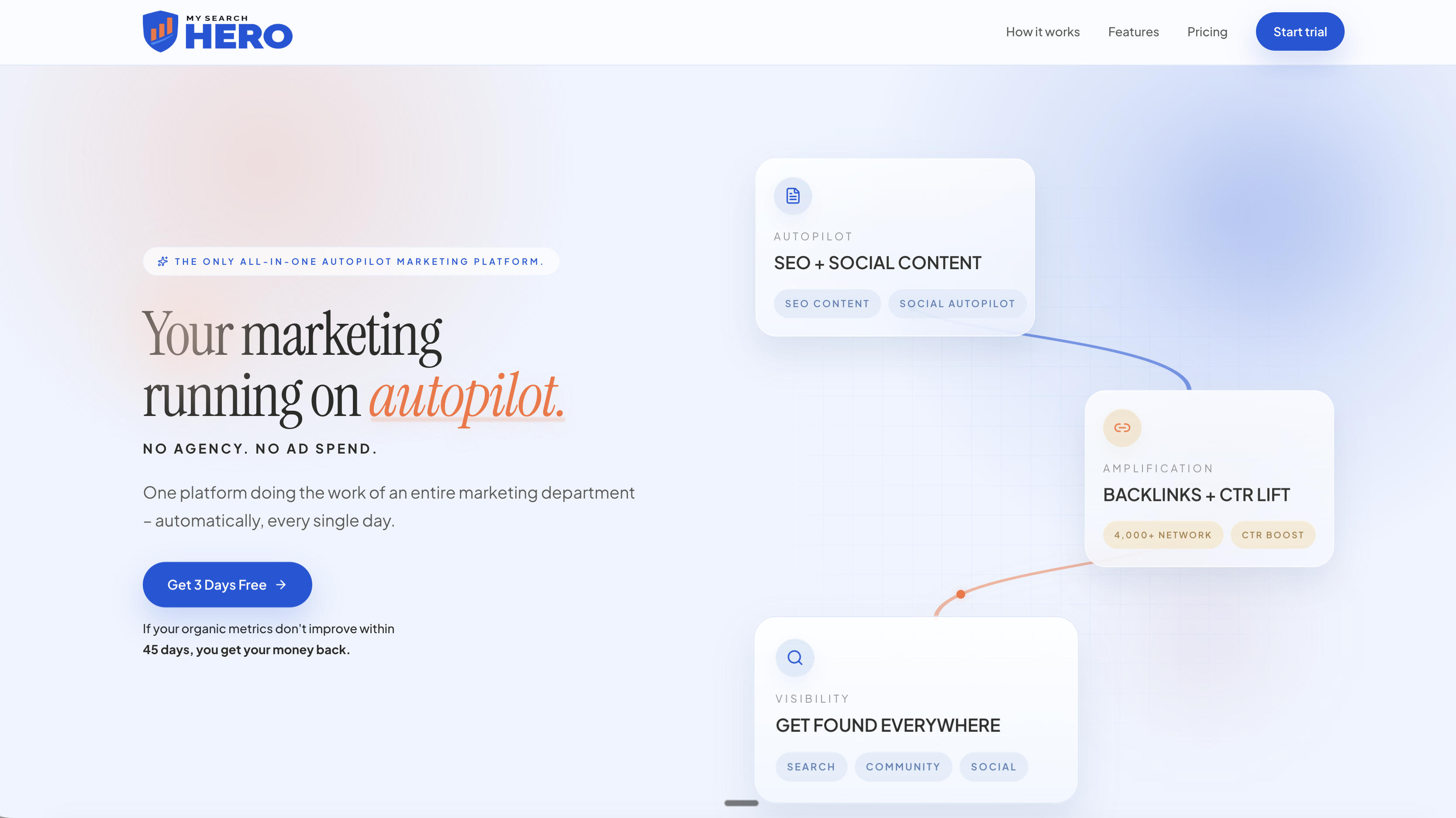
You don’t need to become a content strategist or learn SEO from scratch. You need a system that handles it while you run your business. From keyword-targeted blog posts to link building and social distribution, Mysearchhero delivers everything your content strategy needs without adding to your workload. Your marketing, on autopilot.
FAQ
Why blog for business if social media already exists?
Social media content disappears quickly and depends on algorithms. Blog posts are indexed by search engines and continue attracting traffic for years, making them a far more durable marketing asset.
How many blog posts does a business need to see results?
There is no fixed number, but consistency matters more than volume. Publishing two to four well-optimized posts per month and updating top performers regularly tends to produce measurable SEO growth within 6 to 12 months.
Should small businesses use blogs or paid ads?
Both have merit, but blogs build long-term equity while ads stop delivering the moment you stop paying. Earned media outperforms paid ads by 4.7x in ROI, which makes blogging the smarter long-term investment for most small businesses.
What topics should a business blog cover?
Focus on questions your customers already ask. Use keyword research tools to find the exact phrases your audience searches for, then write posts that answer those questions more completely than any competitor does.
How does blogging help with local SEO specifically?
Blog posts targeting local keywords and location-specific questions help your site rank in local search results. Combined with a Google Business Profile, a locally focused blog can significantly increase visibility among nearby customers actively searching for your services. Explore local business marketing strategies to see how blogging fits into a broader local SEO approach.