
TL;DR:
- Effective social media posts include clear captions, visuals, targeted hashtags, and a goal-aligned call to action.
- Consistency and strategic timing, tested over time, are key to building meaningful engagement for small businesses.
Most small business owners know they need to show up on social media. What they don’t know is why their posts keep getting ignored. This social media posting guide cuts through the noise and gives you a practical, data-backed framework for building a posting strategy that actually moves the needle. You’ll learn how to structure each post, when to publish on each platform, which tools save you hours every week, and how to measure what’s working so you can improve fast.
Table of Contents
- Key takeaways
- What makes a social media post actually work
- How to plan your posting schedule
- Tools and workflows for consistent posting
- Measuring performance and optimizing your strategy
- My honest take on social media for small businesses
- Let Mysearchhero handle your social media on autopilot
- FAQ
Key takeaways
| Point | Details |
|---|---|
| Post anatomy matters | Every effective post needs a caption, visuals, hashtags, and a call to action aligned with one clear goal. |
| Frequency vs. timing | Treat posting frequency and posting time as two separate levers you test and adjust independently. |
| Sustainable cadence wins | 64% of marketers post less than daily, and consistency over time outperforms bursts of volume. |
| Batch and schedule | Group content creation into sessions and automate publishing to protect your time and keep your feed active. |
| Measure engagement rate | Track comments, shares, and saves relative to your audience size, not just total likes. |
What makes a social media post actually work
Before you think about timing or tools, you need to understand what goes inside a post. Skipping this step is why most small business feeds look like a random collection of announcements that nobody cares about.
Hootsuite’s post anatomy framework breaks down the core elements of an effective post:
- Caption or headline: Aim for around 150 characters. Get to the point fast and give people a reason to keep reading.
- Emojis and special characters: Use them to add visual breaks and personality, not to pad thin copy.
- Mentions: Tag relevant accounts when it’s genuinely useful, not just for exposure grabs.
- Hashtags: Platform rules vary. On Instagram, three to five targeted hashtags outperform walls of thirty.
- Visuals: Images and short video consistently outperform text-only posts across every major platform.
- Call to action: Every post should prompt one specific behavior. Save, share, comment, click, or visit. Pick one.
The part most people miss is that each element should serve the specific goal of that individual post. A post designed to build awareness needs a different call to action than a post designed to drive website traffic. Mismatching post elements with goals is one of the most common posting mistakes, and it has nothing to do with creativity. It’s a structural problem.
Platform nuances matter here too. LinkedIn rewards longer, more professional captions with personal narratives. Instagram is visual first, so a weak image kills an otherwise solid caption. Facebook still favors posts that spark conversation in comments. Build a quick checklist for each platform you’re active on, and run every post through it before publishing.
Pro Tip: Never recycle the exact same post across all platforms on the same day. Adapt the caption tone and format for each channel. It takes ten extra minutes and makes a measurable difference in how each platform’s algorithm treats your content.
If you want a deeper look at structuring posts around a full content plan, this guide on how to build a social media content plan walks through the full planning process from goal-setting to execution.
How to plan your posting schedule
Posting frequency and posting time are two completely different variables. Treating them as one is how you end up with a muddled strategy that’s impossible to improve.

Frequency benchmarks by platform give you a starting point, not a mandate. Here’s a practical reference:
| Platform | Recommended frequency | Notes |
|---|---|---|
| 4 to 7 times per week | Reels get extra algorithmic push | |
| 1 to 2 times per day | Quality comments drive more reach than post volume | |
| 3 to 5 times per week | Thought leadership posts perform best | |
| TikTok | 1 to 4 times per day | Raw, authentic content tends to outperform polished |
| X (Twitter) | 1 to 5 times per day | Shorter cadence is fine if engagement is high |
The bigger truth here is that 64% of marketers post less than once per day, and the data supports this shift. Audiences and algorithms increasingly reward quality and originality over sheer volume. For a small business with limited time, a sustainable cadence you can actually maintain beats an aggressive schedule you abandon after three weeks.
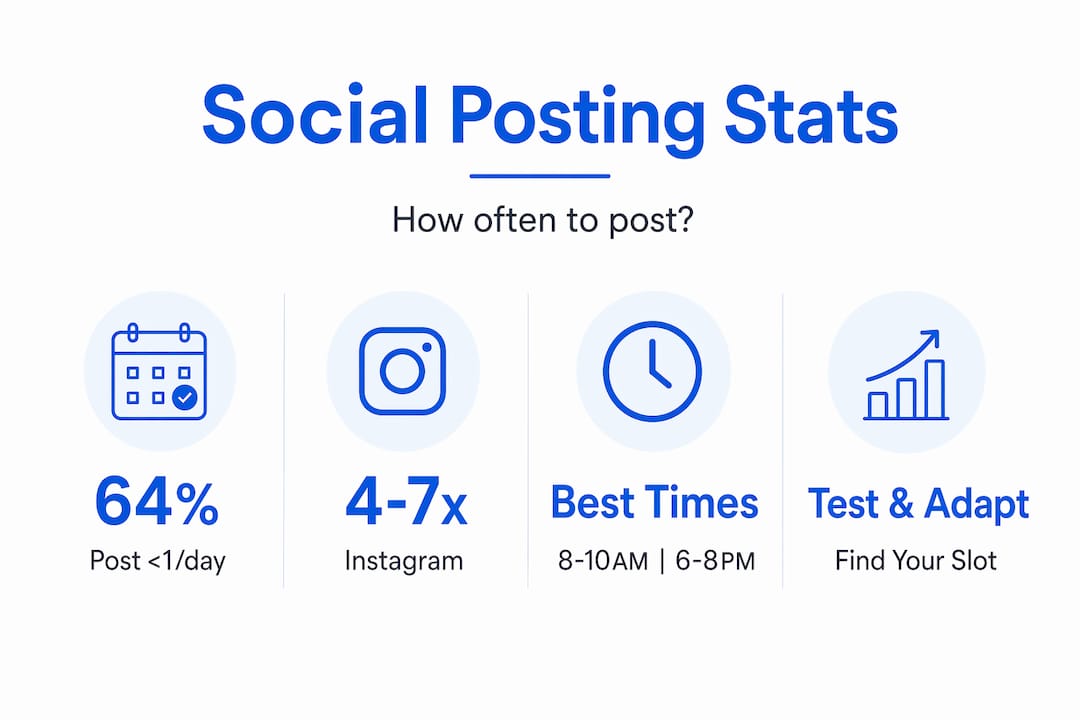
Timing is its own discipline. Platform-specific windows show Instagram performing best around 8 to 10 AM and 6 to 8 PM, Facebook responding well to mid-morning and evening posts, and TikTok seeing strong results on weekend mornings and mid-week afternoons. These are starting points based on aggregate data across millions of posts.
Your audience’s behavior may differ. The practical approach is to test two or three specific time slots consistently for at least two weeks, then compare engagement rates at each slot. Keep your frequency steady while you run this test. That’s how you isolate timing as the variable and get clean data.
Pro Tip: Use Meta’s “Active times” feature inside Meta Business Suite to see when your specific audience is online. This single data point is more useful than any industry benchmark because it reflects your actual followers, not an average.
Learning how to build a content calendar helps you turn these timing decisions into a repeatable weekly or monthly system instead of figuring it out fresh every day.
Tools and workflows for consistent posting
Even the best strategy falls apart without a system to execute it. The good news is you don’t need expensive software. You need a workflow that removes friction and keeps your feed running whether you’re slammed with client work or not.
Here’s a simple posting workflow that works for small teams:
- Plan: At the start of each week or month, decide your content themes and post goals.
- Create: Write all captions, source visuals, and finalize hashtags in one dedicated session.
- Schedule: Load everything into your scheduling tool of choice.
- Analyze: Review performance data every week or two.
- Adjust: Swap underperforming formats or timing slots based on what the data shows.
The scheduling step is where most small businesses stall. Here are the tools worth knowing:
- Meta Business Suite: Free for Facebook and Instagram. Includes scheduling, analytics, and the “Active times” insight.
- Buffer: Clean, affordable interface with multi-platform scheduling. Buffer’s workflow approach advocates for batching content in advance to avoid the daily scramble.
- Later: Strong visual planning features, great for Instagram-heavy strategies.
- Sprout Social: More advanced and better suited to teams managing multiple brands.
The core benefit of batching is focus. When you sit down to write five posts in one session, you maintain a consistent voice and catch gaps in your content mix before they go live. Batching and scheduling in advance is consistently cited as the top productivity practice for small marketing teams. It also means a hectic Tuesday doesn’t leave a blank spot on your feed.
Pro Tip: Block two hours every Monday to batch and schedule your posts for the week. Treat it like any other business meeting. After four weeks, you’ll wonder how you managed without it.
For a full picture of how batching fits into your broader content operations, this guide on content workflows for small businesses is worth bookmarking.
Measuring performance and optimizing your strategy
Posting consistently is the first step. Posting smarter over time is what separates businesses that grow their following from ones that plateau.
The most common measurement mistake is focusing on likes. Likes are passive. They require zero effort from the viewer and tell you almost nothing about genuine interest. The metrics that actually signal traction are:
- Comments: Someone took time to respond. That’s real engagement.
- Shares and reposts: Your content was valuable enough to redistribute. This is the highest signal.
- Saves: On Instagram, saves indicate someone wants to come back to your content. The algorithm notices this heavily.
- Engagement rate: Total meaningful interactions divided by reach or follower count. Tracking engagement rate rather than raw numbers gives you a fair comparison across posts with different audience sizes.
Native analytics inside Instagram, Facebook, and LinkedIn give you enough data to start. For cross-platform views, tools like Buffer or Sprout Social pull everything into one dashboard.
When you experiment, change one variable at a time. Test timing while keeping frequency steady. Then test format while keeping timing steady. Separating timing and frequency tests keeps your data clean and your conclusions reliable.
The three mistakes to avoid: posting every day with no strategy and burning out, ignoring your analytics for months at a time, and treating all platforms identically. Sprout Social’s content research shows that originality and meaningful brand interaction matter more to consumers than how frequently a brand posts.
Pro Tip: Set a recurring 20-minute analytics review on your calendar every two weeks. Look at your top three and bottom three posts. Ask why the difference exists. That habit alone will improve your content faster than any course.
My honest take on social media for small businesses
I’ve watched a lot of small business owners burn out chasing a posting cadence that was never sustainable in the first place. They see what big brands do and assume volume is the path. It isn’t.
In my experience, the businesses that build real engagement are the ones that show up with genuine perspective. They post less than the algorithm maximums suggest, but every post has a point of view. A local bakery sharing the story behind a new recipe will outperform a generic “happy Monday” post every single time, regardless of what the clock says.
The other thing I’ve learned is that your audience’s behavior rarely matches the industry averages exactly. I’ve seen B2B brands get their best LinkedIn engagement at 7 AM on Sundays, which no benchmark would predict. The only way to know what works for your audience is to test, look at the data, and stay curious.
My practical advice: commit to a posting cadence you can sustain for six months, not just six days. Then optimize from there. Social media rewards patience and consistency far more than it rewards exhausting sprints.
— Mike
Let Mysearchhero handle your social media on autopilot
Running a business leaves little time to batch content, analyze engagement rates, and fine-tune your posting schedule every week. That’s exactly the gap Mysearchhero was built to fill.
Mysearchhero is a done-for-you content and SEO service that publishes articles, builds backlinks, generates social media posts, and gets your brand mentioned across the web each month. You get a full pipeline of content and distribution without touching any of it yourself. If you’re ready to stop guessing at your social strategy and start growing on autopilot, explore what Mysearchhero offers and see which plan fits your business. Your marketing should be working even when you’re not.
FAQ
What should every social media post include?
Every post needs a clear caption, a relevant visual, hashtags suited to the platform, and a single call to action aligned with your goal. Hootsuite’s framework recommends an average caption length of around 150 characters for best clarity and engagement.
What are the best times to post on social media?
General best windows include 8 to 10 AM and 6 to 8 PM for Instagram, mid-morning and evening for Facebook, and weekend mornings for TikTok. These are starting points. Testing your specific audience’s activity patterns will give you more accurate results.
How often should a small business post on social media?
Consistency matters more than volume. Most marketers post less than once per day, and data supports focusing on quality over frequency. Pick a cadence you can maintain for months, then adjust based on engagement data.
How do I schedule posts without spending hours on it?
Batch your content creation into one weekly session, then use a scheduling tool like Buffer, Later, or Meta Business Suite to automate publishing. This keeps your feed active without requiring daily manual posting.
Which social media metrics actually matter?
Focus on engagement rate, comments, shares, and saves rather than total likes. These interactions signal genuine audience interest and are weighted more heavily by platform algorithms when determining how broadly to distribute your content.