
TL;DR:
- Branded mentions are references to a brand across the web that signal authority and presence to both humans and AI systems. They now have a stronger impact on AI visibility than backlinks, especially when distributed across diverse authoritative sources. Building a strategic, multi-channel mention and reputation monitoring program enhances search performance and brand recognition in AI-driven search results.
Branded mentions are defined as any reference to your brand name across the web, whether linked or unlinked, that signals your brand’s existence and authority to both human readers and AI systems. The role of branded mentions has shifted from a nice-to-have PR metric to a core driver of search visibility and AI citation. Brand mentions correlate at 0.664 with AI visibility, roughly three times stronger than the 0.218 correlation for traditional backlinks, according to 2025 Ahrefs research studying 75,000 brands. That gap tells you where the leverage is in 2026. Tools like Meltwater and platforms like Search Engine Land have both documented how mentions build entity recognition that AI models use to confidently recommend brands in responses.
How do branded mentions drive brand visibility?
The mechanism is entity recognition. AI search systems like ChatGPT and Perplexity do not rank pages the way Google’s PageRank algorithm does. They read semantic text and build a model of what a brand is, what it does, and how credible it appears based on how often and where it gets referenced. Unlinked brand mentions are as impactful as backlinks for AI visibility because AI models process semantic context, not just link graphs.

This is why source diversity matters more than raw volume. Distributing content across third-party news sites increases AI citation rates from 8% to 34%, a 4.4x lift in visibility. One hundred mentions on a single domain carry far less weight than twenty mentions spread across twenty independent, authoritative sources. The AI model reads breadth as confidence.
Brand mentions fall into four practical categories:
- Direct linked mentions: Your brand name appears with a hyperlink pointing to your site. These carry both semantic and link authority.
- Direct unlinked mentions: Your brand name appears in text without a link. These still build entity association in AI systems.
- Indirect linked mentions: A reference to your product, service, or founder links back to you without using your exact brand name.
- Indirect unlinked mentions: Contextual references that associate your brand with a topic or category without naming you directly.
Pro Tip: Track all four mention types using tools like Meltwater or Google Alerts. Unlinked mentions are often the most overlooked, and converting even a fraction of them to linked mentions compounds your authority over time.
| Mention Type | Linked | AI Visibility Impact |
|---|---|---|
| Direct linked | Yes | High: semantic + link authority |
| Direct unlinked | No | Medium: semantic association only |
| Indirect linked | Yes | Medium: link authority, weaker entity signal |
| Indirect unlinked | No | Low to medium: depends on context quality |
Branded mentions vs. backlinks: what is the real difference?
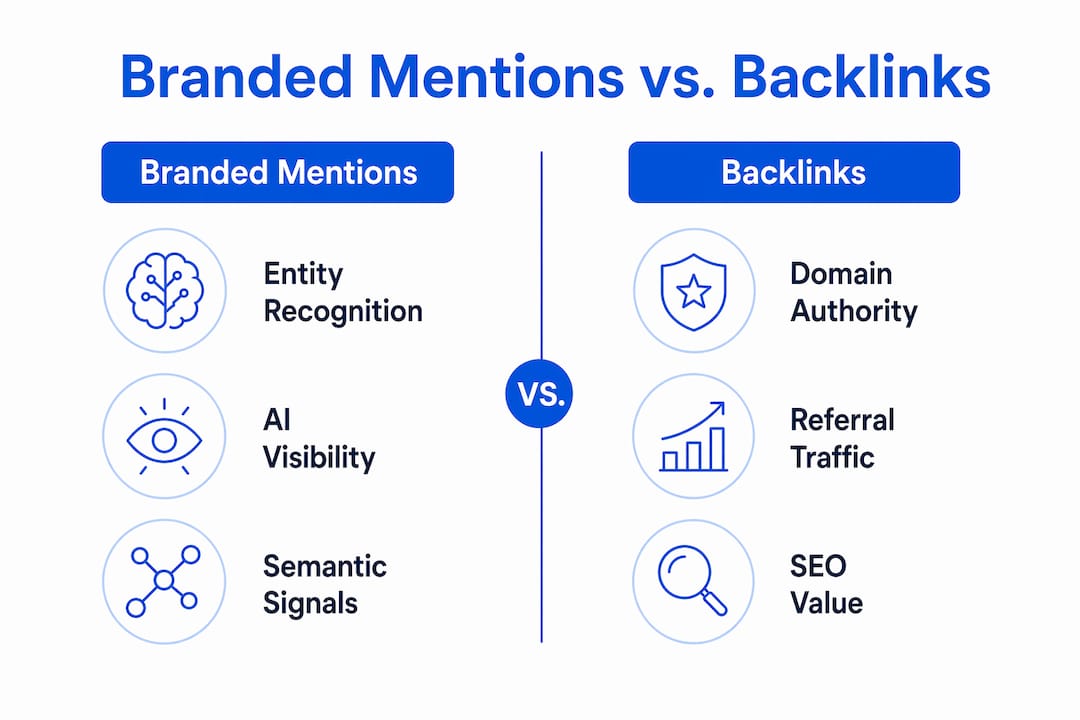
Backlinks pass domain authority and referral traffic. They are the currency of traditional SEO, and they remain valuable. But they tell search engines very little about what your brand actually means in a given category. A backlink from Forbes says you are credible. A mention in Forbes that describes you as “the leading project management tool for remote teams” tells an AI model exactly where to slot you in its understanding of the market.
Earned media functions as entity chain infrastructure that AI retrieval systems use to build brand confidence for citation. That is a fundamentally different job than what a backlink does. Backlinks are structural. Mentions are descriptive. You need both, but they serve different masters.
The strategic implication is clear. Brands that invest only in link building are building half a moat. Brand mentions compound over time and create a durable ranking advantage when combined with core technical SEO. The combination is what separates brands that appear in AI-generated answers from those that do not.
Pro Tip: Before you pursue mentions aggressively, audit your backlink profile using Ahrefs or Semrush. A strong backlink foundation makes each new mention more credible because AI systems cross-reference both signals.
| Signal Type | Primary Function | AI Visibility Impact | SEO Impact |
|---|---|---|---|
| Backlinks | Authority transfer, referral traffic | Moderate (0.218 correlation) | High |
| Brand mentions | Entity recognition, semantic association | Strong (0.664 correlation) | Moderate to high |
| Both combined | Full ranking moat | Maximum | Maximum |
For a deeper look at how backlink strategy fits alongside mentions, the distinction becomes even clearer when you map both signals against AI citation behavior.
How can marketing professionals earn more branded mentions?
Earning mentions at scale requires a deliberate distribution strategy, not just good content. Here is a practical framework for brand managers working in 2026.
-
Publish original data. Proprietary research gets cited by journalists, bloggers, and analysts. A single well-designed study can generate dozens of independent mentions across authoritative domains. This is the highest-leverage mention-earning activity available to most marketing teams.
-
Pursue press coverage on independent news sites. A mention in TechCrunch, Business Insider, or a niche trade publication carries more AI citation weight than ten mentions on your own blog. Source diversity is more critical than total mention volume for AI citation success.
-
Participate in forums and community platforms. Reddit, Quora, and industry-specific communities generate contextual mentions that AI models treat as organic social proof. These mentions often appear in AI-generated answers because the platforms themselves are heavily indexed.
-
Syndicate content through partnerships. Co-authored articles, guest posts, and content partnerships with complementary brands place your name in front of new audiences while building entity associations across diverse domains.
-
Optimize your homepage for entity clarity. The homepage is the strongest AI referral target, and brands should define their entity and value proposition clearly on the root domain rather than burying it in deep content pages. When AI systems link to you, they almost always link to your homepage.
-
Leverage third-party content creation. Platforms that specialize in AI-driven content distribution can accelerate the process of placing your brand name across independent sources, which directly feeds the entity chain AI systems rely on.
Pro Tip: When pitching journalists or partners for coverage, frame your brand in category-defining language. “The only tool that does X for Y audience” gives AI models a precise entity slot to fill. Vague brand descriptions produce vague entity associations.
The importance of brand mentions grows proportionally with how many independent sources confirm the same entity description. Consistency across sources is not just good PR. It is the signal that tells AI models they can cite you with confidence.
What 2026 trends are reshaping branded mentions?
The most significant development of 2026 is the ChatGPT update rolled out on May 7, 2026. OpenAI began embedding clickable homepage links directly into ChatGPT responses. The result was immediate and measurable. Branded referral traffic jumped 157.7% following that update. That number reframes the entire conversation about what a brand mention is worth.
Branded mentions are no longer just a citation signal. They are now a brand-discovery layer that drives direct traffic. When ChatGPT recommends your brand and links to your homepage, that is a referral visit from a high-intent user who was already asking a question your brand answers. The conversion potential is significant.
Several trends are accelerating this shift:
- AI-driven referral attribution is becoming measurable. Google Analytics 4 and tools like Semrush are beginning to surface ChatGPT and Perplexity as distinct referral sources. Brand managers can now track which mentions are generating actual visits.
- Consistent brand identity across sources increases AI citation confidence. If your brand is described differently on LinkedIn, in press releases, and on your homepage, AI models encounter conflicting entity signals and cite you less frequently.
- Social media mentions influence engagement metrics and platform algorithms more than surface-level analysis suggests. A spike in social mentions often precedes a broader shift in search visibility by several weeks.
- Sentiment analysis is becoming a mention quality filter. AI systems are increasingly sensitive to the tone of mentions. Positive, authoritative mentions in credible sources carry more weight than neutral or negative ones.
Understanding AI-driven search behavior is now a prerequisite for any brand manager who wants to appear in AI-generated answers rather than just traditional search results.
Brand mentions also act as an early-warning system for sentiment and reputation risks before broader crises develop. A sudden spike in negative unlinked mentions is often the first signal of a PR problem, appearing days before it surfaces in traditional media monitoring.
Key takeaways
Branded mentions are the single strongest signal for AI search visibility, outperforming backlinks by a factor of three and driving direct referral traffic at scale.
| Point | Details |
|---|---|
| Mentions outperform backlinks for AI | Brand mentions correlate at 0.664 with AI visibility versus 0.218 for backlinks. |
| Source diversity beats volume | Mentions across many independent domains increase AI citation rates from 8% to 34%. |
| Unlinked mentions still count | AI models read semantic text, so unlinked references build entity authority without a link. |
| Homepage clarity is non-negotiable | AI systems predominantly link to root domains, so your homepage must define your brand entity clearly. |
| Mentions are now a traffic channel | The May 2026 ChatGPT update caused a 157.7% surge in branded referral traffic from AI-linked mentions. |
Why most brands are still thinking about this wrong
Most brand managers I talk to treat mentions as a vanity metric. They track them in a spreadsheet, celebrate a Forbes placement, and move on. That is the wrong mental model entirely.
Mentions are infrastructure. Every time an independent, credible source describes your brand in consistent terms, you are laying another brick in the entity architecture that AI systems use to decide whether to recommend you. The brands that will dominate AI-generated answers in 2027 are the ones building that architecture right now, methodically and across diverse sources.
The mistake I see most often is chasing volume on weak sites. Twenty mentions on low-authority blogs do less for your AI visibility than two mentions in respected trade publications. Quality and diversity of source matter far more than the raw count.
I also see teams skip the technical SEO foundation and jump straight to mention campaigns. That is backwards. Brand mentions should come after crawlability, structured data, and homepage entity clarity are locked in. If AI systems cannot clearly read what your brand is from your own homepage, no amount of third-party mentions will produce confident citations.
The other underused application is reputation monitoring. Tracking brand mentions gives you a real-time feed of how the market perceives you. A sudden shift in mention sentiment is almost always an early signal of a larger problem. Most brands find out about reputation issues weeks after they could have intervened.
My honest advice: treat your mention strategy as a cross-functional program. PR earns the placements. SEO ensures the technical foundation supports them. Product and customer success generate the real-world outcomes worth mentioning. When those three functions align around a shared mention strategy, the compounding effect is real and measurable.
— Mike
Put your brand mention strategy on autopilot
Understanding the mechanics of branded mentions is one thing. Executing a consistent, multi-channel mention strategy every month is another challenge entirely.
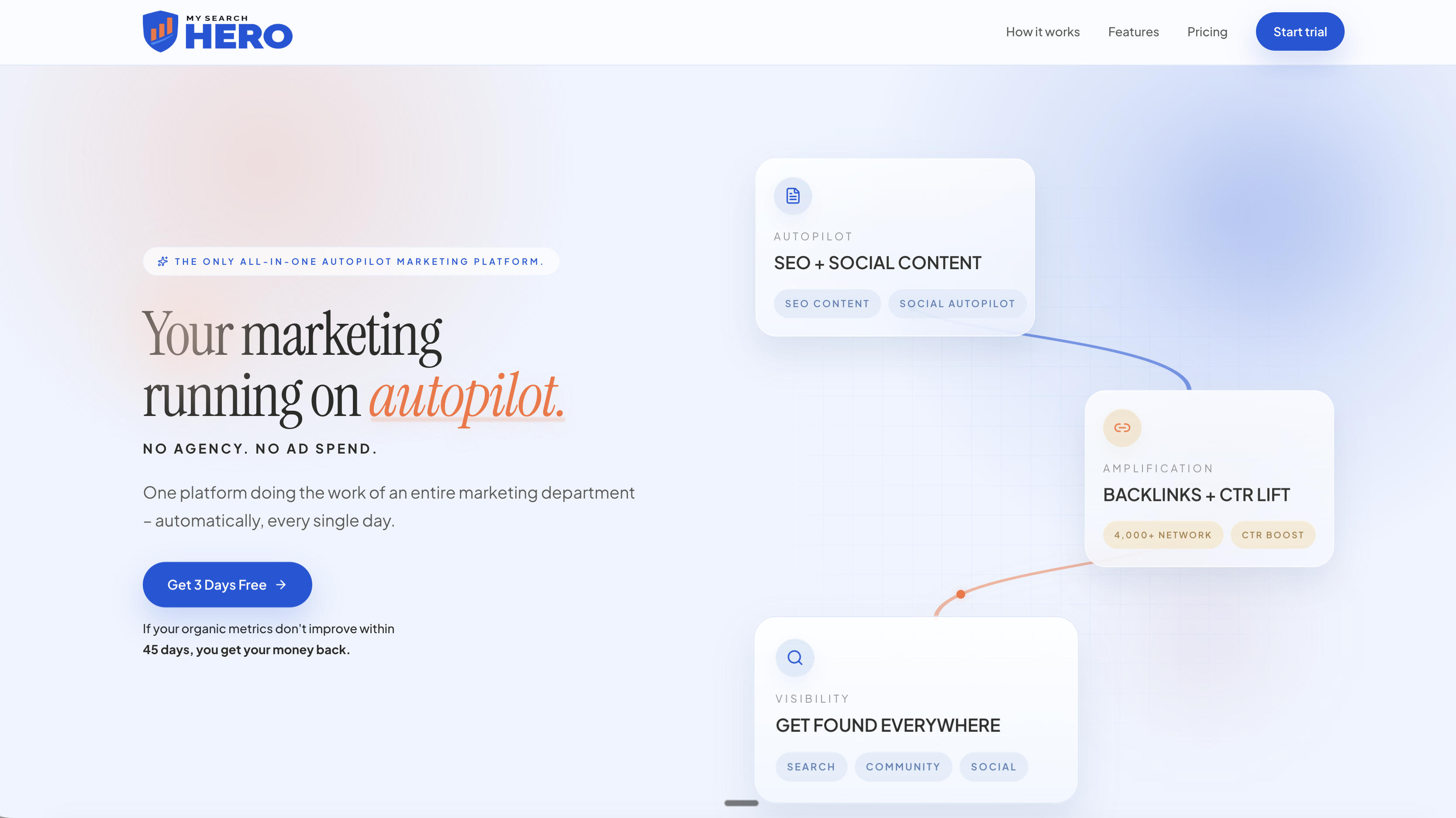
Mysearchhero is built for exactly this. Each month, subscribers receive published articles, backlinks, Reddit mentions, and AI-generated social media posts pushed through a fully automated pipeline. Every deliverable is designed to place your brand name across independent, authoritative sources, which is precisely what builds the entity chain AI systems need to cite you confidently. If you want your brand appearing in ChatGPT answers and driving referral traffic without managing the execution yourself, explore Mysearchhero and see how the platform handles it for you.
FAQ
What is a branded mention in marketing?
A branded mention is any reference to your brand name across the web, whether linked or unlinked, that signals your brand’s existence to search engines and AI systems. Both types contribute to entity recognition and AI citation likelihood.
Do unlinked mentions actually help SEO?
Yes. AI models read semantic text rather than link graphs, so unlinked mentions build authority and entity association even without a hyperlink. Their impact on AI visibility is well-documented as of 2026.
How many mentions do you need to rank in AI search?
Source diversity matters more than total count. Research shows that mentions across independent domains increase AI citation rates from 8% to 34%, so spreading mentions across many authoritative sites is more effective than concentrating them on a few.
How are branded mentions different from backlinks?
Backlinks transfer domain authority and referral traffic. Brand mentions build semantic entity recognition that AI systems use to categorize and recommend your brand. The two signals are complementary, not interchangeable.
How do i track branded mentions effectively?
Tools like Meltwater, Google Alerts, and Semrush monitor mentions across news, social, and web sources in real time. Meltwater specifically flags sentiment shifts, making it useful as an early reputation warning system for brand managers.